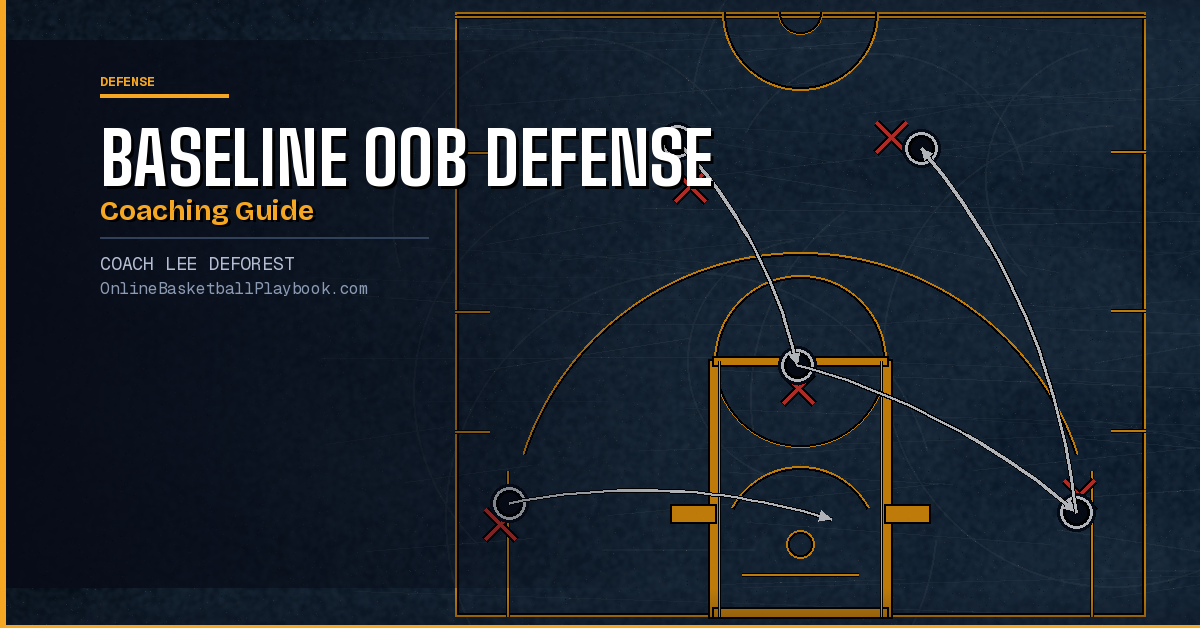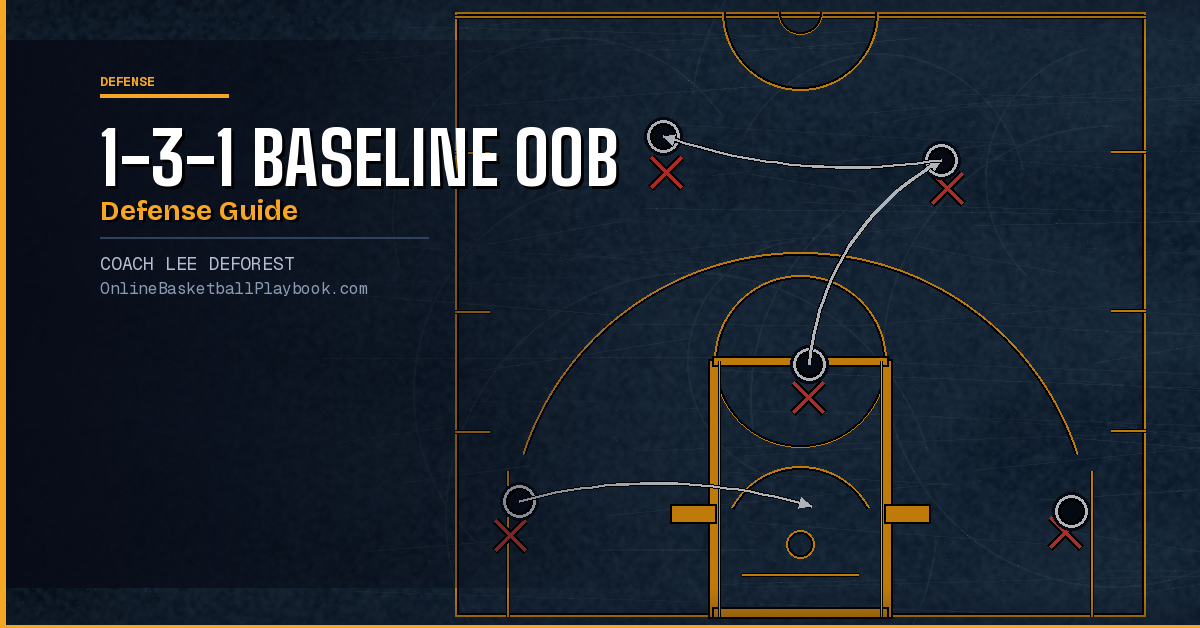

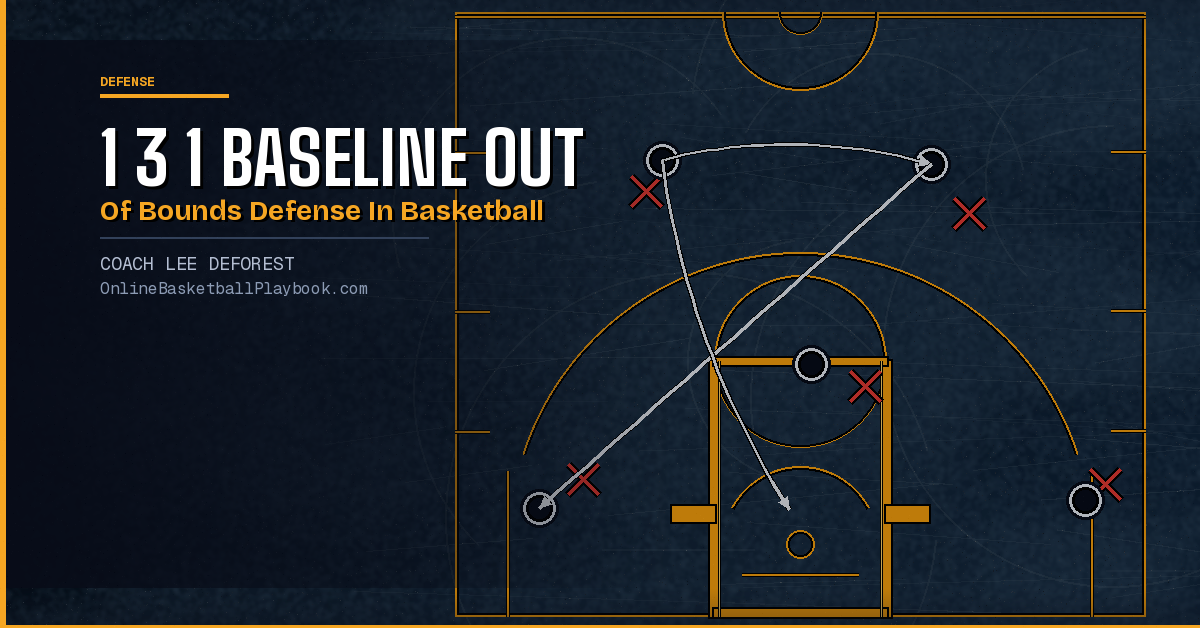
The 1-3-1 baseline out of bounds defense applies trapping zone principles to disrupt inbound plays under the basket. Used correctly, it forces rushed passes, generates deflections, and can produce easy transition buckets at the other end.
Why Use a 1-3-1 for Baseline Out of Bounds
Most teams spend practice time designing basketball inbounds plays but almost no time defending them. That imbalance creates an opening. When your opponent lines up for a baseline out of bounds (BLOB) situation, they are running scripted actions — screens, cuts, and release valves — that they have repped dozens of times. A passive, man-to-man or standard zone defense lets them execute the script.
The 1-3-1 BLOB defense breaks the script entirely. By pressing the inbounder and applying an immediate trap on the first receiver, you force the offense to improvise rather than run their play. The inbounder typically has just five seconds and a limited sightline. Putting a defender in his face while clogging the first pass option turns that time pressure into a genuine threat.
The 1-3-1 BLOB defense also fits naturally into a broader zone-first identity. Coaches who already run a 2-3 zone defense as their primary scheme will find many of the help rotations and communication habits carry over directly. The same principles — ball pressure, lane denial, and gap filling — apply here; the difference is the alignment and the triggering moment.
From a strategic standpoint, baseline out of bounds situations represent guaranteed offensive possessions. The offense knows exactly where the ball starts, which gives them a planning advantage. The 1-3-1 defense inverts that advantage: because your players have assigned jobs that don't change based on what the offense shows, your team can execute with confidence while the offense has to react to you instead of the other way around.
Even at the youth and high school level, this defense is teachable. The assignments are clear, the trap is triggered by a single event (the inbound pass), and the rotations follow a short set of rules. Teams that understand help defense principles can adapt to the 1-3-1 BLOB in a single practice session.
Personnel and Alignment
The 1-3-1 BLOB defense places five defenders in a formation that mirrors the standard 1-3-1 zone but is calibrated specifically for the compression and geometry of a baseline inbound situation. Starting alignment, before the ball is inbounded, looks like this from the inbounder's perspective:
- X1 (Point): Standing directly in front of the inbounder, arms up, no more than a foot from the out-of-bounds line. His job before the pass is to obscure the inbounder's view and cut off any quick hand-off or lob at the rim.
- X2 and X3 (Wings): Positioned at the elbows, straddling the lane line extended. They are within a step of their trap responsibilities and can jump to any receiver who catches near the block or short corner.
- X4 (Middle): Set at the mid-post area, reading the ball and prepared to front a high-post entry or rotate to the opposite short corner.
- X5 (Baseline): The most active communicator. Covers corner to corner. Must be vocal before the pass to alert teammates about receiver locations and cuts the inbounder cannot see.
The alignment looks unusual because it does not match anyone on offense. That is the point. Rather than guarding individual cutters, the 1-3-1 BLOB defense guards areas and forces the offense to throw into contested zones. Any pass the inbounder makes must travel through or around the defensive formation, which buys recovery time for your defenders.
Personnel choice matters. X1 should be tall enough to legitimately contest the inbounder's vision — a 6'3" guard with long arms is ideal. X5 must be your quickest, most vocal defender, not your biggest. The wings need athleticism over size. X4, the middle, should be physically strong enough to hold position in contact situations and mobile enough to shift across the lane quickly.
Roles and Responsibilities
Each position in the 1-3-1 BLOB defense has a distinct job that must be understood before any team attempts to run this scheme live.
X1 — The Inbounder Pressurer
X1's responsibility starts the moment the referee hands the ball to the inbounder. He gets as close to the baseline as the rules allow without fouling and puts his hands up to shrink the inbounder's passing window. He is not gambling for steals. He is creating difficulty and reducing pass options. After the ball is inbounded, X1 must sprint to the ball-side elbow to cut off any quick reversal or secondary cut through the middle.
X2 and X3 — The Wings
The wings key on the first catch near the block or short corner on their side. When the ball enters their zone, one wing becomes a trapper alongside X5; the other wing slides toward the paint to protect the high-post lane. Both wings must move on ball flight, not on the catch — they have to read the pass early and begin rotating before the receiver secures the ball.
X4 — The Middle
X4 is the defensive anchor and the most physically demanding position in this scheme. Before the pass, X4 straddles the paint and watches the inbounder's eyes. After the pass, X4 either fronts a high-post receiver or rotates to the weak-side short corner depending on which way the offense attacks. This requires excellent anticipation and real-time decision-making — X4 cannot freelance, but he must read quickly.
X5 — The Baseline Communicator
X5 sees the whole floor because he is behind the defense. He calls out receiver locations, alerts X1 to any lob threat, and moves laterally to take away the corner catch before the trap arrives. On a corner entry, X5 becomes the lead trapper with the ball-side wing closing behind. He must be loud throughout the entire possession.
"On a corner entry, X5 is the first trapper with the wing rotating down."
— Basketball Vault
Trap Triggers and Rotations
The most important concept in the 1-3-1 BLOB defense is that traps are triggered by the pass, not by a signal from the coach or a delayed read. Every defender must know, before the ball is inbounded, exactly what action triggers their trap and where they rotate next.
Primary Trap: Corner Entry
When the inbound pass reaches the short corner or corner area, X5 attacks the receiver immediately. The ball-side wing rotates down to join X5 in a two-man trap. Both defenders arrive with arms up, creating a no-pass zone. The remaining three defenders collapse on the nearest passing lanes — X4 takes the high-post lane, X1 takes the elbow extended, and the weak-side wing takes any skip-pass route to the opposite corner. This rotation must happen before the trapped player can pivot and survey the floor.
Secondary Trap: Block Entry
If the inbound pass goes directly to a player near the block, the ball-side wing is the primary defender and X5 closes as the second trapper. X4 fronts the high post immediately. X1 sprints to the weak-side elbow to take away the skip. This trap is tighter and quicker than the corner trap because the receiver has less space to operate and the trap distance is shorter for both defenders.
Rotations After the Trap
Any time two defenders commit to a trap, the remaining three must cover four potential pass outlets. That math requires discipline: defenders guard passing lanes, not players. They read the trapped player's eyes and move to intercept routes, not to cover specific cutters. This is where transition defense habits become valuable — the same gap-reading and help principles apply in the scramble after a trap is set.
Counters and Adjustments
Experienced offensive coaches will recognize the 1-3-1 BLOB defense and make adjustments, usually within a single game. Your defense needs built-in counters.
Counter 1: The Lob Over X1
Some inbounders will immediately attempt a lob over X1 toward the rim when they see him pressuring. X4 must be pre-loaded to defend this: he positions slightly toward the strong side before the pass and can step in front of the lob receiver. If X1 contests the inbounder's release well — arms up, slightly on the strong-side shoulder — the lob becomes a difficult, high-risk throw.
Counter 2: Quick Cross-Court Reversal
Offenses that are well-coached will try to hit a cross-court receiver before the defense can rotate. X3 (weak-side wing) is the key defender here. He cannot ball-watch. He has to cheat toward the weak-side corner the moment the ball is inbounded on the strong side, so a reversal finds him in position rather than sprinting to recover. This habit must be drilled in practice before it becomes automatic in games.
Counter 3: Staggered Screens Along the Baseline
Some teams run double or triple stagger screens across the baseline to free a shooter in the corner. The 1-3-1 is less vulnerable to this than man-to-man because you are defending areas, not chasing players through screens. X5 must communicate the screen action as it develops, and the wings must stay in their zones rather than following cutters. If a shooter gets an open catch in the corner, X5 closes out hard while the trap is initiated — the corner trap still fires, and the shooter must now make a decision under duress rather than getting a clean look.
Adjustment: Switching to a Soft Zone on a Time-Out
If an opponent has started solving the 1-3-1 BLOB with a specific action, use a time-out to show a soft zone or man-to-man on the next BLOB possession. The threat of the 1-3-1 is itself a weapon — an offense that spent a time-out prepping for the trap will be off-balance when it does not come. Rotate back to the 1-3-1 on a subsequent possession to keep them guessing.
The 1-3-1 BLOB is most effective when used selectively — two or three times per game in high-leverage moments rather than on every baseline possession. Overuse allows the offense to find counters during the game itself. Save it for situations where a turnover or a five-second call would shift momentum decisively.
Drilling the Defense
Any defense that relies on coordinated trapping requires dedicated practice time. The 1-3-1 BLOB defense is no different. A basketball practice plan that includes two or three BLOB defensive reps per week will build the necessary habits in four to six weeks.
Walk-Through Alignment Drill
Before live reps, walk the defense through their starting positions and first-step responsibilities against each pass option the offense might use. The inbounder tosses the ball to a corner, a block, or a high post, and all five defenders execute their rotations at half-speed. The goal is to eliminate confusion about assignments before adding competition speed.
Live 5-on-5 BLOB Defense Drill
Set up with an offense running their actual BLOB plays and a defense running the 1-3-1. Keep score: the defense earns a point for a five-second call, a steal, or a forced turnover; the offense earns a point for a made basket or an uncontested catch in the paint. This incentive structure forces the defense to compete for traps rather than going through the motions.
Rotation Communication Drill
Run a drill where only X5 is allowed to talk. Every other defender must listen and respond to X5's calls to find their position and identify the trap trigger. This builds the communication habit that makes the defense function under game pressure when things move quickly and players default to silence. Good basketball IQ development starts with learning to communicate under pressure in practice.
Film Review After Each Game
Pull every BLOB defensive possession from game film and review assignments as a unit. Focus on whether traps arrived on ball flight (correct) or on the catch (late). Identify any rotation where a defender followed a cutter instead of guarding a lane. Short, specific film sessions build the recognition skills that make the 1-3-1 BLOB defense sharp over a long season.
- X1 pressures the inbounder's vision before the pass — arms up, no fouls, ball-side shoulder.
- Trap triggers on ball flight, not the catch — wings and X5 must move before the receiver secures the ball.
- X5 communicates the entire play: receiver locations, screen actions, lob threats — he must never be silent.
- After a trap, the other three defenders guard lanes and intercept routes, not individual cutters.
- X4 in the middle is the safety valve against lobs and high-post entries — must be strong and mobile, not just big.
- Use the defense selectively — two or three times per game — to maintain the element of surprise and force time-outs.
- Walk-through reps at the start of every BLOB practice session build assignment clarity before live speed introduces chaos.
Get free play diagrams, drills, and coaching guides delivered weekly.
See it drawn up
Related diagrams
Keep Building
Related breakdowns
1-3-1 Baseline Out of Bounds Defense in Basketball
1-3-1 Baseline Out of Bounds Defense in Basketball
Baseline Out of Bounds Plays: Complete Playbook
Baseline Out of Bounds Plays: Complete Playbook