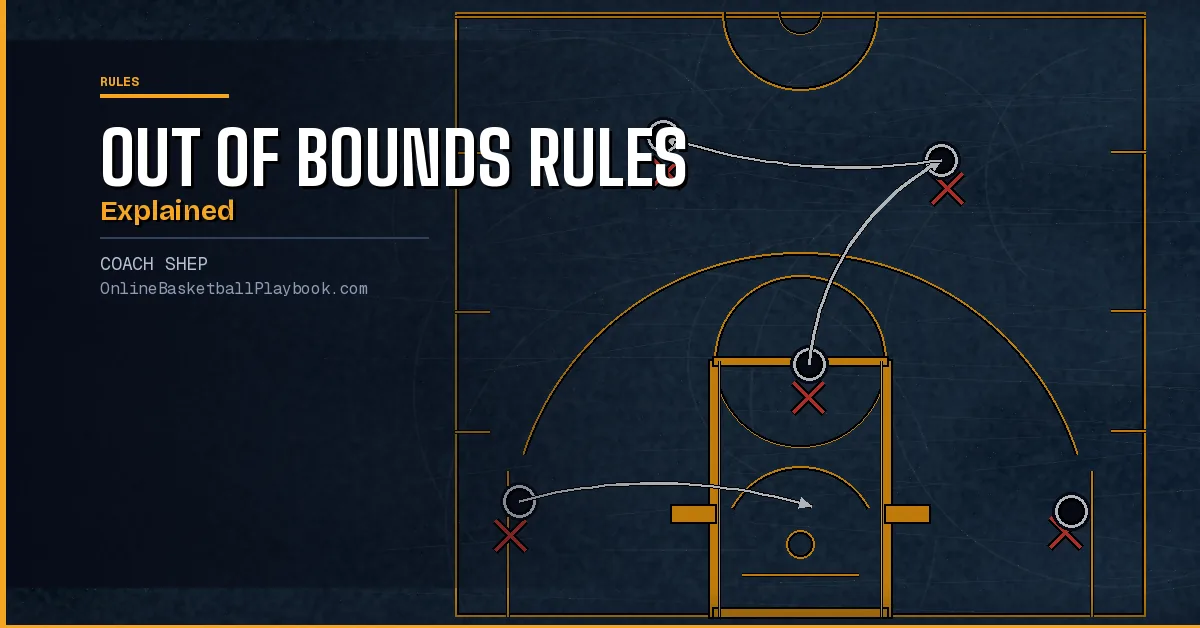
Out of bounds is one of the most misunderstood rules at every level of the game. This guide breaks down exactly when the ball is dead, who gets possession, and how smart teams turn boundary situations into scoring opportunities.
What Counts as Out of Bounds
A player is out of bounds when any part of their body touches the floor on or outside the boundary line. The lines themselves are out. Stepping on the line is the same as stepping over it. This is a detail that trips up young players constantly. You don't have to cross the line. Touching it is enough to be out.
The ball is out of bounds when it touches a player who is out of bounds, touches the floor out of bounds, or touches any object that is out of bounds. If a player who is in bounds tips or bats the ball and it goes out without touching an out-of-bounds player first, the call depends on the last person to touch the ball before it crossed the line.
Boundary lines run along all four sides of the court: two sidelines and two end lines (also called baselines). The key, three-point arc, and free throw lane are inside the court, so those markings don't trigger an out-of-bounds call. Only the perimeter lines do.
One concept that confuses coaches and players alike: a player can legally jump from in bounds, catch the ball while in the air, and throw it back in before landing out of bounds. The player is considered in bounds because they were in bounds when they left the floor. The landing doesn't matter, only their status at takeoff. This rule becomes important on baseline drives and corner plays where footwork near the boundary is critical. Teaching players to be aware of their feet is part of developing solid basketball footwork at every position.
Determining Who Gets the Ball
Possession after an out-of-bounds call is almost always awarded to the team that did not cause the ball to go out. The question officials ask is: which player last touched the ball before it went out? That player's team loses possession and the opposing team inbounds from the spot nearest to where the ball went out.
The trickiest possession calls happen when the ball deflects off multiple players in quick succession. Officials are trained to identify the last clear touch, but when it's genuinely impossible to determine, most rulebooks allow the referee to use a possession arrow or a jump ball to resolve it. At the youth and high school level, officials often use judgment calls that experienced players will try to influence by their positioning and reaction. Another reason basketball IQ matters.
One critical distinction: if a defender deflects a pass or shot attempt out of bounds, the offensive team retains possession. This matters enormously in late-game situations. A defense playing aggressive denial may tip balls out of bounds, keeping the offense alive. Teams that understand this rule use it deliberately, throwing passes at defenders near the baseline to force deflections and maintain possession.
In the NBA, the replay review system can overturn possession calls when video clearly shows which player last touched the ball. At the high school and college level, replay is limited or unavailable, so officials make live calls that stand.
Inbounds Pass Rules and Restrictions
Once possession is awarded, the inbounder has five seconds to release the ball. This five-second count begins when the referee hands the ball to the inbounder or places it at their disposal. Running the count down to zero (and doing so strategically) is a fundamental late-game skill.
The inbounder must keep one or both feet on or behind the boundary line until the ball is released. They cannot step onto the court before throwing the ball in. After releasing the ball, the inbounder may enter the court normally. The ball must be thrown directly onto the court. It cannot be handed to a player. It must be passed.
The inbounder is the only player with unlimited movement along the baseline after a made basket. Everywhere else on the court, the inbounder must inbound from a designated spot (within three feet of the spot the referee designates, depending on the ruleset). Under NFHS (high school) rules, the inbounder gets one step along the baseline after made baskets. Under NBA and FIBA rules, the inbounder can move freely the entire length of the baseline, a significant difference that coaches need to know when working with players who have watched a lot of professional basketball.
Running well-designed basketball inbounds plays requires players to understand these movement constraints. If the inbounder moves illegally, it's a violation and possession changes.
What the Inbounder Cannot Do
A handful of actions will immediately turn the ball over to the defense:
- Taking more than five seconds to release the ball
- Stepping onto the court before releasing the ball
- Handing the ball to a teammate rather than passing it
- Having the ball touch the back of the backboard or a support structure
- Throwing the ball so that it goes out of bounds without anyone touching it
Defenders can legally harass the inbounder by waving arms and attempting to deflect passes, but they cannot reach over the line to touch the ball or the inbounder. Any contact by a defender across the boundary line is a foul.
Baseline vs Sideline Situations
The practical application of out-of-bounds rules differs depending on where on the court the ball leaves play. Sideline out-of-bounds situations are typically straightforward: the ball is inbounded from the nearest spot, and the inbounder has limited movement. These situations arise frequently in live-ball action and require quick reads by both the inbounder and the receiving players.
Baseline situations are more complex and more strategically significant. After a made basket, the inbounder has full baseline movement (in NBA/FIBA) which creates opportunities to attack the defense before it can set. A smart inbounder will recognize when a teammate has a mismatch or when the defense is slow to get back, and will inbound quickly rather than calling a set play. This ability to read the defense and make fast decisions is a core part of developing fast break basketball.
After violations and fouls (not made baskets), the inbounder is stationary at the designated spot. This is where organized inbound plays are most valuable. The defense can set up, and the offense needs a designed action to create separation.
Corner and Extended Baseline Reads
Corner situations (where the ball goes out near the intersection of the baseline and sideline) require officials to determine whether the ball crossed the baseline or the sideline first. This affects exactly where the ball is inbounded. Experienced teams know that the corner is a gray zone and will claim whichever spot gives them a better angle into the offense.
On extended baseline situations, defenders need to be aware that the inbounder can move laterally. A common mistake in youth basketball is defenders standing flat-footed watching the inbounder, not realizing the ball can be inbounded from multiple angles along the baseline. Teaching your defense to account for this is part of building a complete transition defense.
Special Situations and Edge Cases
Several out-of-bounds scenarios come up in games that aren't covered in basic rule explanations. Understanding these edge cases separates coaches who know the rules from those who just know the basics.
Ball Lodged in the Support Structure
If the ball becomes lodged between the rim and the backboard, or in any support structure, the ball is dead immediately. Possession is typically determined by the alternating possession arrow or a jump ball, depending on the level of play.
Player Knocked Out of Bounds by a Defender
If a player is pushed or fouled out of bounds by a defender, it does not result in an out-of-bounds call against the offensive player. It results in a foul call against the defender. The offensive player does not lose possession simply because they were forced across the line illegally. Officials must recognize contact-driven boundary violations and apply the foul rather than the violation.
Ball Touches a Non-Player Person or Object
If the ball hits the scorer's table, a referee, a team bench area, or any object that is considered out of bounds, the ball is immediately dead and the team that last had possession before the ball left the court retains the ball at the nearest inbounds spot. This is one of those rulings that surprises players when it happens. A ball bouncing off a ref's leg is the same as it going out of bounds.
Simultaneous Out-of-Bounds
When two players from opposing teams both touch the ball simultaneously and it goes out of bounds, or when officials cannot determine the last clear touch, the rulebook specifies a jump ball or alternating possession depending on the level and situation. At the high school level in the United States, alternating possession is standard after the opening tip. The possession arrow determines who gets the ball in these ambiguous situations.
Coaching Out of Bounds Situations
Out of bounds situations are dead-ball moments. The clock stops, both teams reset, and the offense has a guaranteed possession. Coaches who treat every inbounds opportunity as a designed play gain a meaningful edge over the course of a game. Most teams waste sideline and baseline possessions by simply lobbing the ball in to the nearest player. Organized teams use that five-second window to run a play.
The most important thing a coach can teach about out-of-bounds rules is awareness of where the boundary is at all times. Players who lose track of the lines (especially during contested drives, hustle plays, or scramble situations) will give away possessions that should never be lost. Incorporating boundary awareness into your drills is part of building a well-structured basketball practice.
From a defensive standpoint, pressuring inbound passes is one of the highest-leverage places to create turnovers. A well-timed trap on the inbounder, or a denial rotation that eliminates the first passing option, can force a five-second violation or a desperation pass that leads to a steal. Teams that understand out-of-bounds rules on both ends of the floor are harder to beat in close games.
The inbounder's movement after a made basket varies significantly: NBA and FIBA allow full baseline movement, while NFHS high school rules allow only one step. Always confirm which ruleset governs your league before installing baseline inbound play concepts with your team.
- A player is out of bounds the moment any part of their body touches the boundary line or the floor beyond it
- The inbounder has exactly five seconds. Use that time deliberately, especially in late-game situations
- After a made basket, the inbounder can move along the baseline (varies by ruleset. Check your league rules)
- A defender cannot reach across the boundary line to touch the inbounder or the ball without drawing a foul
- If a defender deflects a live-ball pass out of bounds, the offense keeps possession. Teach your players to recognize this
- A player can jump from in bounds, catch the ball in the air, and return it before landing out. They remain in bounds based on takeoff position
- Alternating possession or jump ball resolves simultaneous out-of-bounds touches. Know the arrow status going into the fourth quarter
Get free play diagrams, drills, and coaching guides delivered weekly.
Draw this play free in the play drawer →
Membership: the full library, playbook packs, and Pro drawing tools →
Keep Building
Related breakdowns
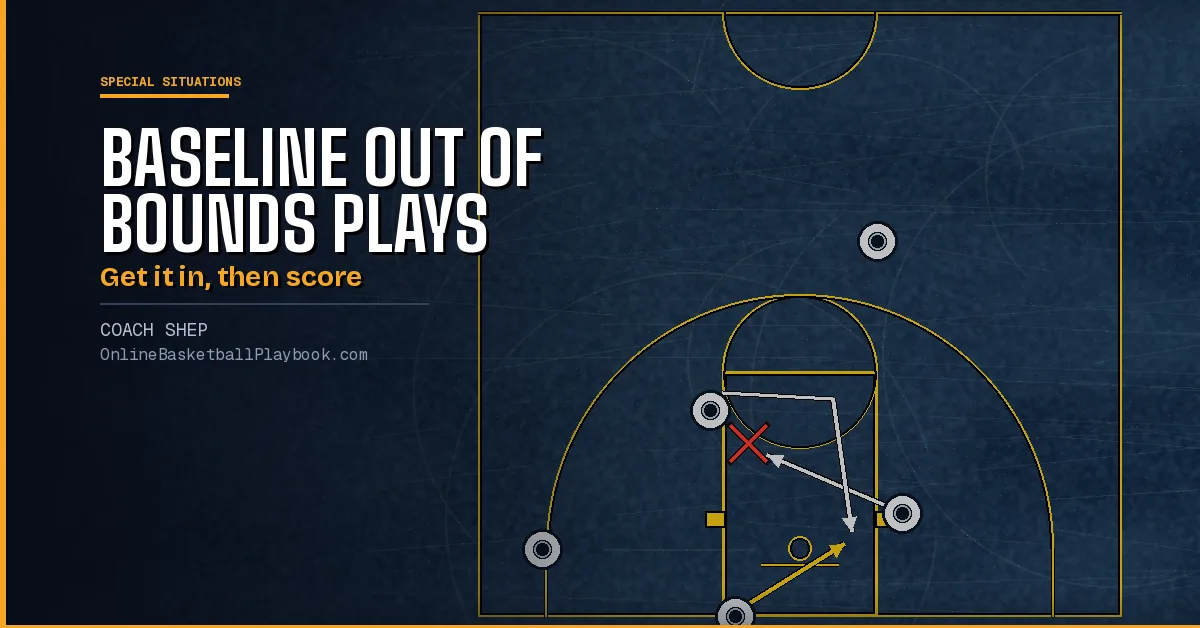
Baseline Out of Bounds Plays: Sets vs Man, Zone and for Youth
Baseline out of bounds plays drawn step by step: a box back screen and roll, Pick the Picker, the double stack, a 2-3 zone play, youth one-pass plays, the rules and the reads.
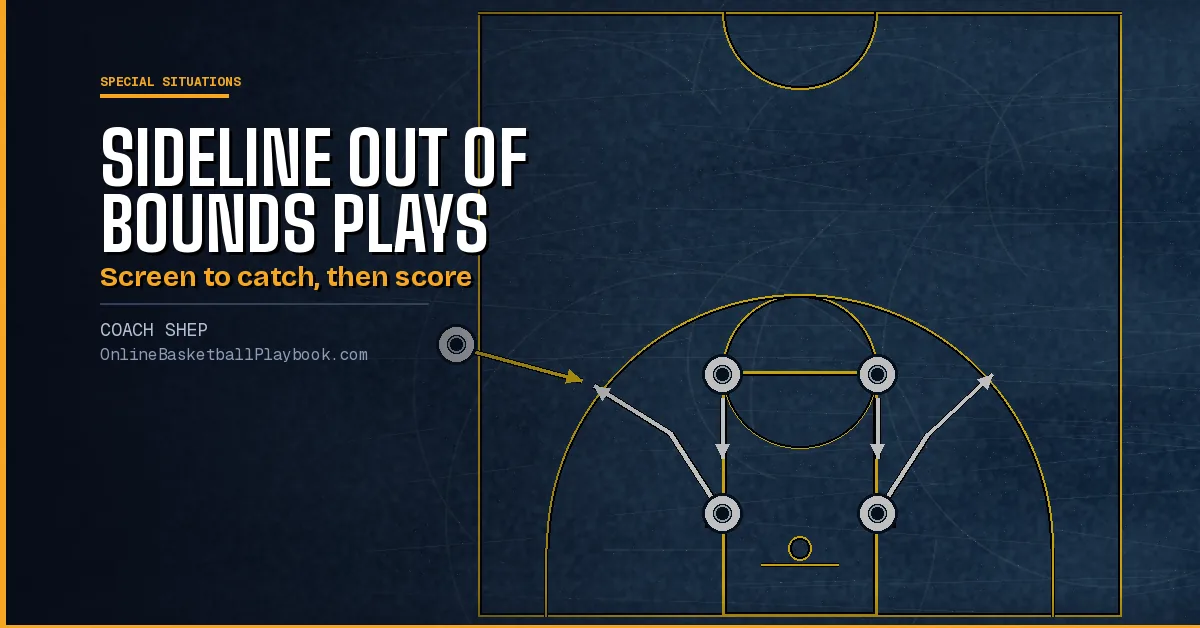
Sideline Out of Bounds Plays: SLOB Sets, Reads and Practice
Sideline out of bounds plays for coaches: SLOB sets from a box, stack and line, the inbounder's reads, plays against zone and denial, the clock and practice.