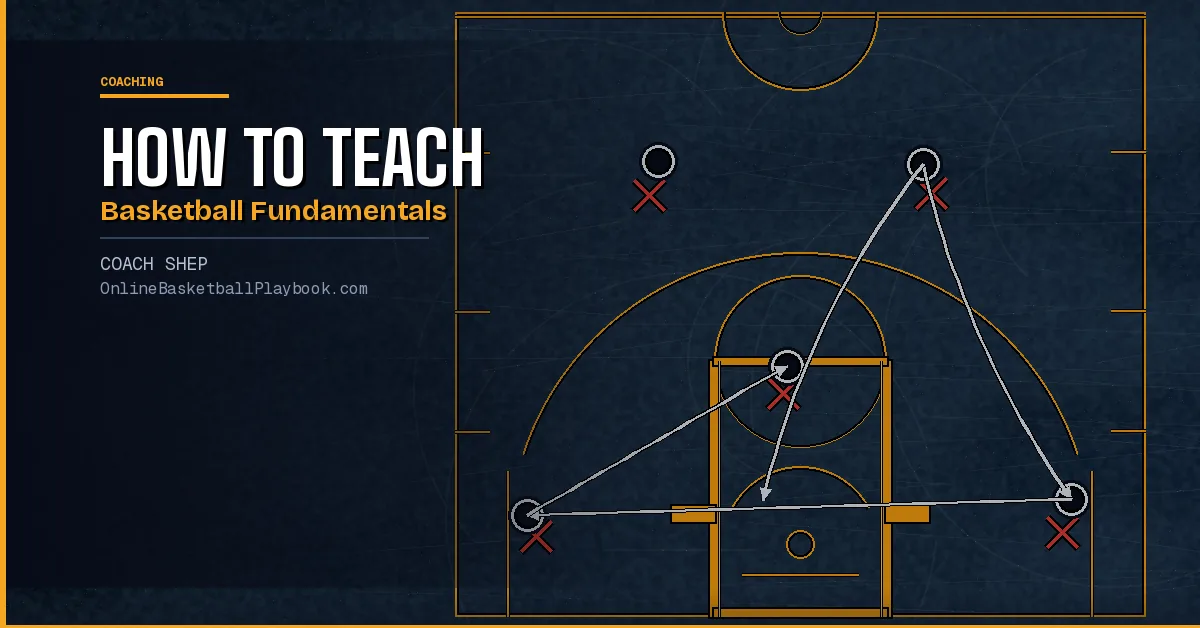
Teaching basketball fundamentals correctly from the start separates players who plateau from players who keep growing. This guide gives coaches a proven framework for building stance, footwork, shooting, passing, and defense in the right order.
Why Fundamentals Come First
Every coach wants their team to run motion offense, execute press breaks, and handle late-game situations, but none of that works if players lack the athletic and technical foundation underneath. Fundamentals are not a warm-up or a box to check. They are the product. When a player misses a layup under pressure, blows a rotation in help defense, or turns it over on a simple pass, the root cause is almost always a fundamental skill that was never locked in.
The research on skill acquisition is consistent: movement patterns learned early, with correct mechanics, are far more durable than those corrected later. A shooting form learned incorrectly at age ten takes years to rebuild. Coaches who cut corners on fundamentals in pursuit of early wins are borrowing against their players' long-term development. The investment in correct technique pays dividends every season afterward.
This is especially true for younger players. At the beginning stages of development, the job is not to win games. It is to guarantee that every player builds the athletic and technical base that everything else will be built on. Enjoyment drives motivation. A player who enjoys learning the game will seek more repetitions, more competition, and more growth on their own. Make the fundamentals fun, keep sessions moving, and celebrate progress at every stage of the process.
For coaches looking to build a complete system, understanding how fundamentals connect to team concepts is essential. A well-designed basketball practice plan Sequences individual skill work, small-group drills, and team concepts in a way that reinforces each other. Fundamentals are not separate from the team game, they enable it.
Stance and Footwork
Before a player can shoot, pass, or dribble effectively, they need a correct athletic stance. This is the most foundational skill in the sport, and it is also the most undercoached. An athletic stance means feet shoulder-width apart, knees bent and over the toes, weight slightly forward on the balls of the feet, back flat, and head up. This is the position from which every basketball action (cutting, defending, catching, shooting) begins.
Footwork determines everything that follows. A player who catches a pass with flat feet and poor balance will struggle to attack the basket, make a clean pass, or get a quality shot. Teaching the triple-threat position (balanced stance, ball in shooting pocket, eyes up) gives players a platform for making the right decision every time they catch.
Jump Stop and Pivot
The jump stop is one of the most important and least taught skills in basketball. A player who can land in balance on two feet, with either foot as a potential pivot foot, has a massive advantage in live-ball situations. Teach the jump stop early and drill it constantly. From the jump stop, players can pivot forward or backward to protect the ball, draw contact, or create a passing angle.
Pair footwork instruction with basketball footwork drills that isolate specific movements (V-cuts, L-cuts, back-cuts) so players develop habits they can use without thinking. Footwork should become automatic. When it is, players free up mental bandwidth to read the defense and make better decisions.
Spacing and Movement Without the Ball
Most players spend most of their time on the floor without the ball. Teaching them to move with purpose (setting screens, making cuts, filling open spots) is a fundamental skill just like shooting or passing. Players who understand spacing and off-ball movement make every teammate's job easier. This connects directly to motion offense principles, where reading the defense and moving correctly off the ball is as important as individual skill.
Shooting Form and Passing
Shooting is the skill players care most about, and the one with the most technical variables to get right. The fundamentals of basketball shooting form start from the ground up: feet aligned to the basket, shooting-side foot slightly forward, knees bent, ball loaded in the shooting pocket with the guide hand on the side (never behind), elbow under the ball, and a clean follow-through with the wrist snapping down toward the rim.
Young players almost always want to shoot from too far out, which forces them to use bad mechanics (pushing the ball, jumping sideways, or pulling the guide hand through the shot). The antidote is simple: move them closer. Shooting a perfect shot from six feet is far more valuable than a bad habit reinforced at fifteen. Build range only after mechanics are clean and consistent.
Teaching the Catch Before the Shot
Most missed shots start before the ball leaves the passer's hands. Players who catch the ball out of balance, off the body, or without establishing their shooting pocket first are already behind. Teach players to call for the ball with a target hand, catch in triple threat, and load immediately. The catch and the shot are one motion, not two separate events.
Passing Fundamentals
Passing is undervalued in player development because it does not show up on a personal stat line. But it is one of the most coachable skills in the sport, and teams that pass well are almost always more efficient offensively. Teach the chest pass first: step toward the target, thumbs rotate down on the release, ball arrives at the recipient's chest. Then add the bounce pass for getting through traffic, and the overhead pass for skip passes and outlet passes after a rebound.
The most common passing error at every level is telegraphing where the pass is going. Train players to look off the defense, use shot fakes and pass fakes, and deliver the ball decisively. Hesitation passes are the ones that get deflected. Quality passing drills should put players under mild defensive pressure so the habit of quick, decisive passes gets built in practice, not learned during games.
Dribbling and Ball Handling
The dribble is a tool, not a crutch. One of the most important things a coach can teach about ball handling is when not to dribble. Players who catch and immediately put the ball on the floor (before reading the defense) eliminate options. Teach players to catch, read, and then decide. The dribble is used to attack, to create a better passing angle, or to improve floor balance. That is it.
That said, players need to develop real dribbling skill so the dribble is available when needed. Basic ball-handling progression starts with stationary dribbling (right hand, left hand, alternating) before moving to walking, then jogging, then full speed. Add hesitation moves, crossovers, and between-the-legs once basic control is consistent. Every player should be able to dribble comfortably with both hands, even if one hand is dominant.
Ball Handling in Traffic
Stationary dribbling is just the beginning. The real test is maintaining ball control while moving, reading defenders, and making decisions. Incorporate ball-handling drills that require players to keep their heads up (calling out a number the coach holds up, identifying the open man in a small-sided drill, or reacting to a defender). Head-down dribbling is a habit that must be broken early, or it will follow a player for the rest of their career.
Defensive Fundamentals
Defense is the most coachable part of basketball. Effort, positioning, and communication (the three pillars of good defense) do not require elite athleticism. They require the right habits built through deliberate practice. A team that commits to defensive fundamentals will be harder to score on than their personnel suggests, every single season.
The defensive stance mirrors the offensive athletic stance: feet wide, knees bent, weight forward, hands active. Players who guard with straight legs or who stand upright between plays are always a step slow to react. The stance must be automatic so players maintain it when they are tired, when the game is on the line, and when the offensive player is dangerous.
On-Ball Defense
On-ball defense starts with positioning. The defender should be close enough to contest a shot but not so close that a single jab step beats them to the basket. Active hands (one hand up to contest the shot, one hand down to disrupt the dribble) make the offensive player uncomfortable. Teach defenders to move their feet first and their hands second. Reaching is the most common foul in basketball and almost always comes from being out of position.
The closeout is one of the most fundamental and most frequently botched skills in the sport. When rotating from help position to contest a shooter, a player who runs full speed and doesn't chop their feet gives up an easy drive every time. Teach the closeout with high hands, short choppy steps on arrival, and a controlled approach that takes away the shot without conceding the drive. Understanding help defense principles gives players the framework to know when to closeout, when to stay home, and how rotations work as a system.
Shell Drill as the Foundation
The shell drill is the single best tool for teaching defensive fundamentals as a team concept. It puts four defenders against four offensive players and walks through every defensive principle (on-ball pressure, one pass away denial, two passes away help position, rotations on drives, and closeouts on skip passes) in a controlled environment with immediate feedback. Run the shell drill at every level, from youth to varsity. The fundamentals don't change; the speed and execution do.
Structuring Practice for Skill Development
Knowing what to teach is only half the equation. The other half is how to structure practice so that skills are actually learned, not just exposed to. There is a significant difference between running a drill and building a skill. Drills only build skills when they are designed correctly, executed at the right intensity, and connected to feedback that players can act on immediately.
The most effective skill-development practice structures share a few consistent features. First, put the new or highest-priority skill at the very beginning of practice when attention and energy are highest. A skill buried at the end of a two-hour practice competes with fatigue and distraction. It will not stick as well. Second, keep individual drill segments short. Three to five minutes per drill is plenty at most levels. Short bursts with reset time allow players to stay focused and allow coaches to give quality feedback. Third, build competitive pressure into skill work as quickly as possible. Unopposed skill work has its place in early learning, but skills that have never been practiced under any pressure tend to break down the moment a defender appears.
Progression and Repetition
Skill development follows a predictable pattern: introduce the skill in isolation, practice it in a simple drill, then practice it in a game-like context. The mistake most coaches make is skipping straight from isolation to the full game, where the skill gets overwhelmed by too many variables. The middle step (a constrained drill or small-sided game that requires the skill) is where real learning happens. For example, teaching the jump stop in isolation, then using it in a 1-on-1 catch-and-score drill, before it appears in a full 5-on-5 context gives the skill time to develop roots.
Repetition is the final ingredient. Skills require many correct repetitions before they become automatic. Every player on the roster should be getting quality reps of the fundamental skills every single practice, not just watching the most skilled players while the rest stand in line. Maximize repetitions per player by running parallel stations, keeping lines short, and designing drills that keep everyone moving.
Give players one specific correction per rep, not a list of five things to fix. Overloading a player with feedback after every repetition slows learning. Identify the single highest-priority error, address it clearly, and let them try again with that one thing in mind. When that error is resolved, move to the next.
Connecting Fundamentals to Team Concepts
The best coaches teach fundamentals in a way that connects directly to how those skills are used in team play. A player who understands why a correct pivot foot matters (because it opens up driving lanes and passing angles) will maintain better mechanics under pressure than a player who was just told "pivot correctly." Connect the individual skill to the team concept every time you can. Teaching how to set a screen? Show them what a correctly set screen opens up in motion offense. Teaching closeouts? Put them in a team defensive shell drill right after the individual work so they can feel the connection.
For coaches building out a full development program, basketball player development resources can help structure the progression from individual fundamentals to team-level skill across a full season.
- Start every practice with the skill that matters most. Attention is highest at the beginning and fades as practice goes on.
- Correct one thing at a time per player; a list of fixes after every rep shuts down learning and creates hesitation.
- Use small-sided games and constrained drills to pressure fundamentals before exposing them in full 5-on-5.
- Every player needs quality repetitions every practice, not just the top of the rotation while others stand and watch.
- Teach the why behind every skill: players who understand purpose retain mechanics under pressure far better than those who were just told what to do.
- Keep drill segments short (3–5 minutes), maintain high energy, and transition quickly to prevent focus from drifting.
Get free play diagrams, drills, and coaching guides delivered weekly.
Draw this play free in the play drawer →
Membership: the full library, playbook packs, and Pro drawing tools →
Keep Building
Related breakdowns
Hook Shot Basketball: How to Do It and How to Teach It
Hook shot basketball for post players and coaches: the classic hook, sky hook and jump hook, the footwork steps, when to use it, the pivot foot rules and drills.
Basketball Shot Fake (Pump Fake): How to Do It and Teach It
The basketball shot fake, also called the pump fake, works when it looks like the real shot. The mechanics, the pivot foot footwork, the read and the drills.
Basketball IQ: What It Is and How to Teach It
Basketball IQ is knowing why and when, not just how: the reads players learn, thinking ahead, rebounding and shot reads, game state, and how coaches teach it.