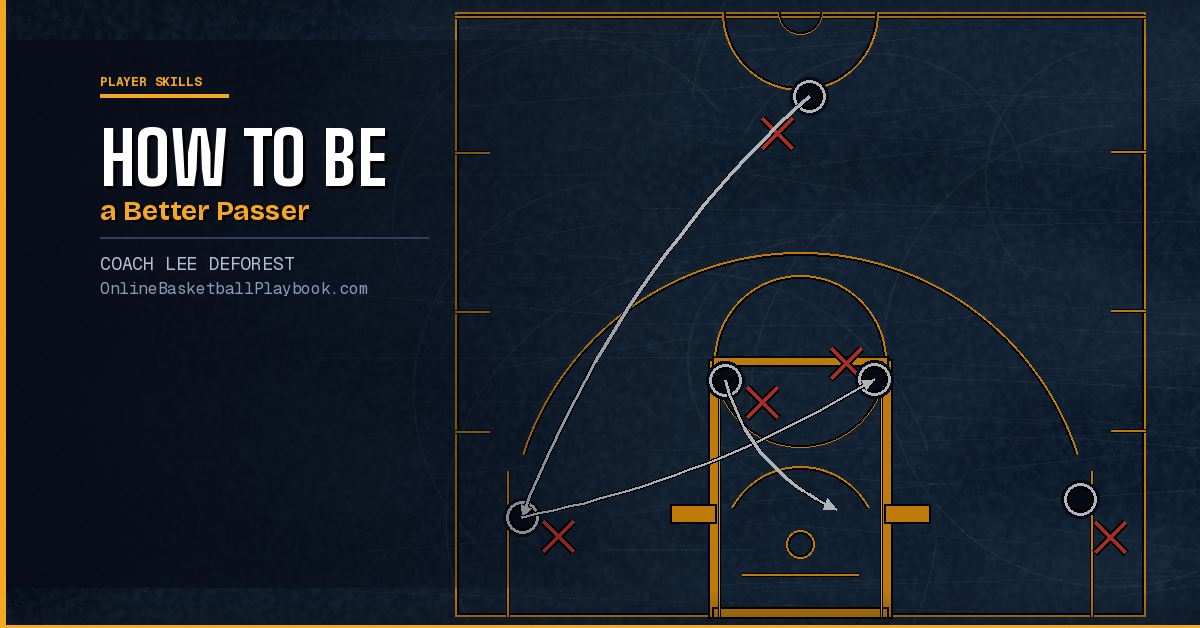

Passing wins games. Teams that move the ball efficiently create open shots, break pressure, and make defense work harder. This guide covers the mechanics, decisions, and drills that turn average ball-handlers into elite passers.
Why Passing Is the Foundation of Offense
Every great offensive system runs on passing. Whether you run a motion offense, a structured half-court set, or push the pace in transition, the ball only moves as fast as your players can pass it accurately and decisively. Dribbling moves one player; passing moves the whole team.
Research and film consistently show that the best offensive teams in basketball — at every level — lead their leagues in assist-to-turnover ratio. That is not a coincidence. When a player makes the right pass at the right time, it forces defenders to collapse, rotate, and scramble. That scramble is where open shots are born. A skip pass to the corner, a pocket pass to a cutting big, a simple drive-and-kick to the slot — each of these actions puts the defense in an impossible position. No individual scorer can replicate that effect by himself.
Coaches who run a 5-out motion offense understand this better than anyone. The entire system is predicated on ball movement: drive, kick, space, repeat. When players pass with confidence and timing, the offense flows. When they hesitate or force dribbles instead of delivering the ball, the spacing collapses and so does the efficiency. Passing is not a secondary skill you develop after shooting. It is the engine.
Beyond the offensive side, elite passing directly reduces turnovers, which is one of the fastest ways to improve a team's defensive opportunities per game. Every turnover is a transition bucket waiting to happen for the other team. Teaching players to value the ball — to see passing as precision work, not just a handoff — changes the culture of how a team plays.
At the youth level, the habits players form around passing stick with them for years. A player who learns to look off a defender, deliver a crisp bounce pass, and throw ahead in transition at age 14 will bring those skills to every level they reach. The window to build these habits is wide open early in development, and coaches who prioritize passing do their players a genuine long-term favor.
Core Passing Mechanics Every Player Must Know
Mechanics separate reliable passers from erratic ones. A player can have great basketball IQ and still throw passes that sail, bounce short, or tip off the receiver's hands because the fundamentals are off. Build the physical foundation first, then layer decision-making on top.
The Chest Pass
Start with the ball at chest height, elbows out, fingers spread across the back of the ball. Step toward the target, extend the arms fully, and snap the wrists so thumbs rotate down on the follow-through. The ball should arrive at the receiver's chest — not their knees, not their shoulders. Practice this on both sides, stepping with the right foot and the left. A pass you can only throw one way is a pass a defender can take away.
The Bounce Pass
Target a spot on the floor roughly two-thirds of the way to the receiver, angled so the ball bounces up into their hands between hip and chest height. Bounce passes are slower than chest passes, so they are most effective when threading through traffic — baseline drives into the post, skip-and-swing sequences, or any situation where a defender's hands are in the passing lane at chest height. Do not overuse them in open court; they are a tool for specific situations.
The Overhead Pass
Grip the ball above your head with both hands, arms bent slightly at the elbows, and snap through with extension and wrist-follow on release. The overhead pass is the weapon for skip passes across the floor, outlet passes on the defensive glass, and any situation where a defender is crowding the passing lanes low. Keep it two-handed unless you are a high-level player with significant upper-body strength.
The Wrap-Around and Pocket Pass
These are interior passes. The wrap-around feeds a post player when the defender is fronting or three-quartering; the pocket pass delivers the ball low and quickly to a cutter. Both require short, controlled arm movements. The longer your delivery motion, the more time a defender has to intercept.
Footwork on Every Pass
Footwork is where most youth players break down as passers. Establish a pivot foot before passing. Step toward your target on delivery. Do not hop or shuffle your feet before throwing — that is a travel. Square your hips to where you are throwing. If you do the footwork drills right in practice, this becomes automatic under pressure.
Decision-Making: Reading the Defense Before You Pass
Mechanics matter, but passing is ultimately a decision-making skill. A perfectly thrown pass to the wrong target at the wrong moment is still a turnover. The mental side of passing — reading the defense, understanding spacing, processing information before you receive the ball — is what separates good passers from elite ones.
See the Floor Before the Ball Arrives
The best passers are already reading the defense as the ball is coming to them. They are not catching and then looking. They catch with a pre-loaded decision: this defender is here, that cutter is open, the corner is available. This takes practice and film study, but the habit starts with one simple rule: keep your head up on every catch.
Pass to Where the Player Will Be, Not Where They Are
A pass thrown to a cutter's current position is always late. Lead the cutter. Throw the ball into the space they are running toward, timed so they receive it in stride. This is especially critical on the fast break, on back-cuts, and on skip passes where the receiver is already moving to catch and shoot. Developing this feel is one of the biggest jumps a player can make in their basketball IQ development.
Understand Defensive Rotations
When you drive and draw a helper, the kick-out pass is only as good as your read of where help came from and where the rotation left a gap. If the weak-side help came from the corner, skip to the corner. If the tag came from the slot, look for the slot defender's man. Reading defensive rotations on the fly is an advanced skill, but even youth players can learn the basics: help comes from somewhere, and that somewhere leaves someone open.
Value the Ball
The mental discipline of not making a low-percentage pass is as important as having the vision to find the open man. If nothing is there, reset. Reverse the ball, re-screen, and re-read. The easiest turnovers in basketball come from forcing passes into congested areas when patience would have created a better look in three more seconds of ball movement.
"Constrain to coach the diet. Rules force behavior."
— Basketball Vault
Passing Drills That Build Real Game Skill
Drills only work if they train what actually happens in games. Too many passing drills are stationary, predictable, and low-pressure — which means players get better at the drill but not at passing in competition. Build your drill progression to include movement, defense, and decision-making from the beginning.
Two-Ball Partner Passing
Two players, two balls, 12–15 feet apart. Both pass simultaneously — one throws a chest pass while the other throws a bounce pass. This forces players to catch and throw simultaneously, building soft hands and quick release. Progress to overhead passes and mixed types. Run it for 60–90 seconds per round.
Three-Man Weave
The 3-man weave drill is one of the best full-court passing drills ever designed. Three players spread across the court, pass and follow the ball, and finish with a layup. It trains passing on the move, communication, and spacing simultaneously. Run it every practice at game speed. Demand catches in stride and crisp deliveries — no lobs, no slop.
Drive-and-Kick Progression
Set up two offensive players at the wing and corner with a passer at the top. The top player drives, draws a help defender (played live or simulated by a coach), and kicks to the open man. Progress from 2-on-1 to 3-on-2 to live 4-on-4. This connects directly to game reads and is especially effective in teaching players to identify the second pass — kicking to the corner, who then swings to a shooter moving from the slot.
Restricted-Dribble Scrimmage
Play 4-on-4 or 5-on-5 with a dribble limit: two dribbles max before passing. This constraint forces players to catch with a plan, move without the ball, and trust their teammates. It is one of the fastest ways to improve passing culture on a team because it removes the individual dribble-escape that players default to when they are uncertain. Use it as a regular practice segment, not just a one-time experiment. You will see passing confidence increase across the board within two or three sessions.
Full-Court Pressure Passing
Run your passing drills at the end of practice when players are fatigued. Tired passers reveal their habits. If a player tends to rush, that tendency doubles when they are gassed. Building composure under fatigue is the closest you can get to simulating late-game pressure without playing a game.
Common Passing Mistakes and How to Fix Them
Most passing errors fall into a small number of categories. Knowing what they are makes correction faster for coaches and players alike.
Telegraphing the Pass
Players who look directly at their target before throwing give defenders a half-second of anticipation — and a half-second is all a good defender needs. Teach players to scan the floor, look off defenders with their eyes and head fakes, and deliver to the target without an extended stare. This is a discipline, not a talent. Drill it with constraints: if a coach sees you stare at the target before throwing, the pass doesn't count.
Throwing Off the Back Foot
When a player is off-balance or rushed, they throw off the back foot. The result is a floaty, off-line pass with no zip. The fix is footwork — specifically, the step-into-the-pass habit. Every time a player throws off their back foot in practice, stop play and reset. It takes repetition, but the habit builds.
Late Passes
A pass thrown one count too late is either deflected or received by a man who is now covered. Late passing usually traces back to hesitation — the player saw the open look but second-guessed it. Build decision-making speed by rewarding quick, accurate reads in drill settings. Score the drills. Create positive pressure for decisive passing.
Forcing Into Traffic
This is the turnover that stings the most because it is avoidable. A player sees a gap that isn't really a gap, threads the needle, and the defender picks it off. The correction is repetition and film. Show players the reset option. Show them the skip pass that was available. Over time, players learn to trust the ball-movement process instead of trying to thread every needle themselves.
No Weak-Hand Passing
If a player can only pass right-handed, defenders shade left and take the right away. The player is then stuck, and either turns the ball over or takes a bad shot. Passing with the weak hand starts with simple catch-and-pass drills using only that hand, then progresses to left-hand-only scrimmage, and eventually becomes natural. This is a long-term development project, not a one-week fix — which is exactly why you start it early.
When correcting passing mistakes, focus on one error category per practice block. Trying to fix everything at once overwhelms players and dilutes the learning. Pick the most common mistake in the session, name it clearly, and drill the correct behavior until it sticks before moving on.
Advanced Passing Concepts for Smarter Players
Once mechanics and basic decision-making are solid, there is a higher level of passing craft that separates truly elite playmakers from merely good ones. These concepts apply at the high school level and above, but introducing them earlier accelerates development significantly.
The Second-Pass Read
Great passers are not just finding the open man — they are finding the pass that creates the next open man. If you drive and kick to the corner, where is the defense rotating? The corner shooter catches the ball and immediately the slot is open as the help slides to contest. The second pass is the one that often gets the best shot. Train players to catch with their eyes up, already scanning for the continuation.
Passing Out of Pressure
In any press break or against a trapping defense, passing is the primary weapon. Teams that panic and dribble into traps turn it over. Teams that remain calm, pass quickly and accurately, and advance the ball in two or three passes break the press for easy baskets. Run press-break passing drills at least once a week. Simulate the pressure. Let players experience what it feels like to be trapped and escape cleanly — the confidence that builds from that experience is significant.
No-Look and Misdirection Passes
A no-look pass is not a showboat move — it is a deception tool. If you train your eyes to look away from your target briefly before delivering, you take away the defender's anticipation advantage. Start by practicing looking opposite from where you intend to pass in low-stakes partner drills. Progress to game situations. The goal is not to make fancy passes but to remove defensive telegraphing from your delivery.
Passing in Transition
The fast break rewards teams that pass ahead rather than dribbling into traffic. A player who catches a defensive rebound and immediately looks to outlet — rather than dribbling out — creates a scoring advantage in two or three seconds. Teach the outlet pass as a fundamental reflex: catch the board, pivot, look for the running guard, and throw a quick strike pass to the ball-side sideline. From there, the break builds naturally. Players who understand how to run the fast break know that the pass is almost always faster than the dribble.
Screening and Passing Together
Passing and off-ball movement are inseparable in any well-designed half-court offense. When a player sets a screen and the defender fights through it, a quick pocket pass to the screener rolling to the basket beats the defense before it can recover. The timing of that pass — not too early, not too late — takes repetition to develop, but it is one of the most efficient shots in basketball when executed correctly. Build this into your half-court drilling from day one.
- Step into every pass — plant the pivot foot, step toward the target, and extend through the delivery for accuracy and zip.
- Catch ready to pass — catch the ball with your head up, eyes already scanning, so the decision is made before you receive it.
- Lead the cutter — throw to the space the receiver is running into, not where they currently are.
- Look off defenders — use your eyes and head to freeze one defender before delivering to another target.
- Train the weak hand daily — five minutes of left-hand-only passing per practice eliminates one of the most exploitable defensive reads.
- Reset when nothing is there — reversing the ball and re-reading is not indecision; it is discipline that creates better shots.
- Pass after the drive — when you draw help, the kick-out pass creates a more efficient shot than finishing through traffic in most cases.
Get free play diagrams, drills, and coaching guides delivered weekly.
Keep Building
Related breakdowns
How to Shoot Better in Basketball: Perfecting Your Shot
How to Shoot Better in Basketball: Perfecting Your Shot
Creating Better Basketball Free Throw Shooters
Creating Better Basketball Free Throw Shooters