The best guards don't dribble more. They dribble with purpose. This workout builds the handles, footwork, and decision-making that separate good ball-handlers from ones who attack and score.
Why Ball Handling Is a Decision Skill
Most coaches run ball-handling drills as a warm-up. The best coaches run them as decision training. There is a difference between a guard who can do a crossover and a guard who knows when to use it and why, and that gap shows up in games, not in practice hallways.
The organizing principle behind every effective guard workout is this: the ball-handling work exists to free the mind. When dribbling is automatic, the guard's eyes come up. When the eyes come up, reads improve. When reads improve, the offense gets easier to play, for everyone on the floor, not just the ball-handler.
Coaches often measure ball-handling success by how flashy the dribbles look. A more useful measure is how rarely your best guard needs to dribble at all. Guards who have done the reps (two-ball drills, full-court pressure runs, change-of-angle work) arrive at games where one or two dribbles accomplish what a lesser guard would need five or six to do. They dribble less because they've dribbled more in practice.
That's the goal of this workout: build handles that disappear into the background so the guard's mind can focus on reading the defense and making the right play.
The Two-Ball Handling Battery
Two-ball work is the fastest way to build independent hand control. When both hands are occupied simultaneously, a guard can't favor the strong hand or hide behind their weak side. Every weakness shows up immediately, which is exactly what you want in practice.
Stationary Two-Ball Series
Start every session with five to eight minutes of stationary two-ball work. The sequence below moves from simple to complex:
Together bounces: Both balls hit the floor at the same time. Eyes up. This establishes the base rhythm. Most players can do this after thirty seconds. Move on quickly.
Alternate bounces: Right hand down as the left comes up, like a slow-motion marching band. This is harder than it looks because most players will want to synch. Insist on clean alternation before moving forward.
Shoulder height: Bounce one ball at waist height, the other higher at shoulder level, alternating. The different bounce heights force each hand to independently time its next catch and push. This is where handle independence begins to develop.
Crossover (two balls): Cross both balls simultaneously in front of the body. Start slow. Players who rush this drill are training sloppiness. One clean, controlled crossover rep is worth ten sloppy ones.
Push-pull: One ball pushed forward (low, out in front), one ball pulled back (behind the hip). Then switch. This trains the feel for protecting the dribble from a defender reaching across the body, a skill that transfers directly to driving lanes.
Non-Stationary Two-Ball Work
Once the stationary series is clean, take it full-court. The guard dribbles two balls from baseline to half-court, changing dribble moves on every jump-stop, without stopping the dribble itself. The jump-stop forces the feet to quiet while the hands keep working. That's the skill: separation of the lower body's stillness from the upper body's activity.
Common moves in the non-stationary series: crossover, behind the back, through the legs, push-pull, inside-out. The coach calls the change at each jump-stop or the player rotates through a pre-set sequence. Either approach works. The key is that the dribble never completely stops. If a player kills both dribbles, they reset and run it again.
Two-Ball vs. Defense
The defensive version uses only the pull-back dribble. The handler works side-to-side against a defender while holding two balls, using only the pull-back (pushing the ball back behind the body to create space) to change direction. This sounds simple. It isn't. The restriction forces the guard to use footwork and body positioning instead of crossovers, which is exactly how good guards beat defenders in games.
1-on-3 Full-Court Pressure Drill
This drill is a staple of elite guard workouts because it simulates the one scenario every guard will face in a real game: someone is trying to take the ball from you, and you have to keep attacking.
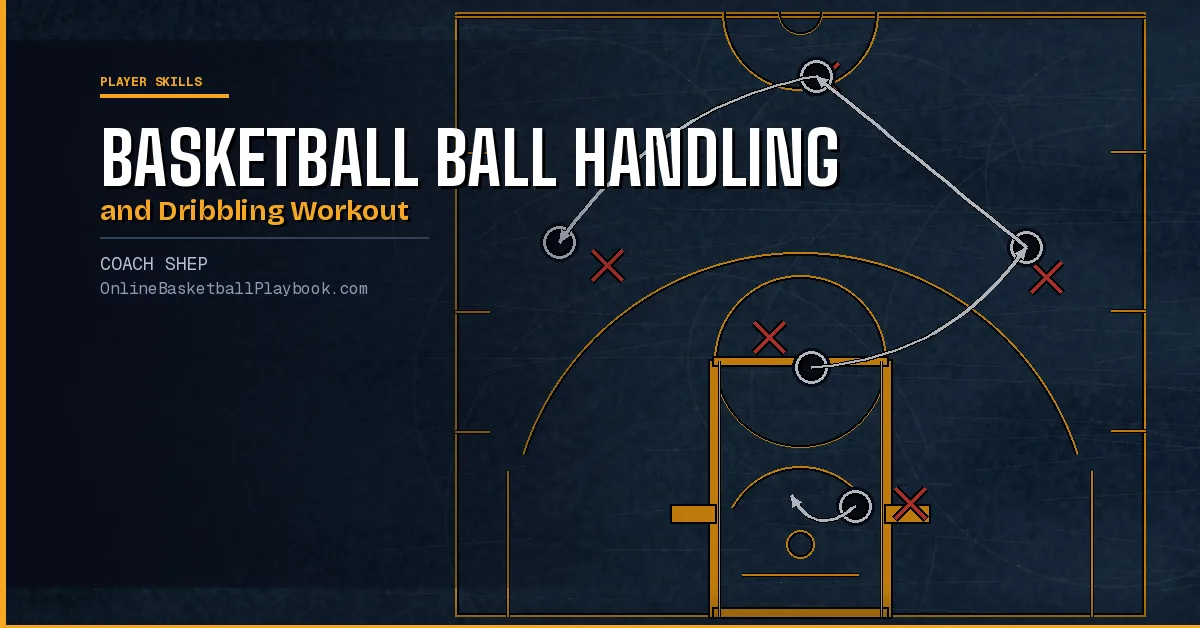
The setup is simple. Three defenders are stationed at equal intervals across the full court (one at the quarter-court line, one at half-court, one at the three-quarter line). The ball-handler starts at the baseline with one dribble and must beat all three defenders before reaching the far end.
Each defender is only responsible for their zone. They can't follow the guard past their zone's boundary. So the guard must beat each one in sequence using dribble moves, change of speed, and change of direction, not just raw speed. Racing past a passive defender with pure quickness doesn't train the skill. Beating a live hand in your face trains it.
What this drill develops that most other drills don't: sustained composure under consecutive pressure. Guards learn to reset their body language between zones, slow down to create space, and accelerate into the next zone only when they've earned it. That composure under sustained pressure is exactly what's needed at the end of close games.
Run this drill at the end of the two-ball battery, not the beginning. Fatigued hands and legs make it harder, which is the point. Teach players to maintain handle quality when they're tired.
Footwork: The Foundation Under Every Move
Ball-handling drills are only half the equation. A guard with excellent handles but poor footwork will still get called for travels, lose separation opportunities, and pull up off-balance. The footwork mechanics layer underneath every dribble move is what makes the move legal and effective.
The Inside-Heel Pivot Rule
One cue unifies pull-up shooters, guards coming off screens, and guards attacking off the dribble: drive the inside heel into the floor. The inside foot is always the foot closest to the basket at the moment of catch or the last dribble before a pull-up.
For a pull-up jumper: the last dribble should be the lowest and hardest dribble of the sequence, generating upward energy. At the exact moment that last dribble hits the floor, the inside heel drives down. This stops lateral drift, squares the hips, and launches the shot straight up. Guards who fade or drift on pull-ups are almost always initiating their heel-plant a half-beat too late.
The cue to repeat at every pull-up rep: "Last dribble down, inside heel down, same instant."
The Blast Move and Front Crossover Drive
These are the two primary first-step attacking moves from triple threat. The choice between them depends on the defender's foot position.
The blast move is used when the defender's lead foot matches the guard's free foot. Instead of stepping east or west (laterally), the guard steps almost directly at the defender's lead foot, stepping north into them. The guard then scrapes off the defender's shoulder to cut off the angle of pursuit. Stepping laterally gives the defender room to recover; stepping into them takes that recovery space away.
The front crossover drive is used when the defender's lead foot is on the guard's pivot side. The ball is ripped low and hard across the shoe tops (protected beside the free knee), the free leg front-pivots across, scrapes off the defender's shoulder, and the dribble begins as that foot lands. The rip and the first dribble are essentially simultaneous. Any gap between them is a travel waiting to happen.
The V-Cut: A Three-Step Sequence
Guards (and coaches) routinely underestimate the V-cut by treating it as a single jab step. It isn't. A V-cut requires a minimum of three steps to sell the defender on a false direction before the actual cut. One jab step gives a defender barely enough movement to react to. It doesn't commit them. Three deliberate steps in the wrong direction before cutting makes the defender move their feet, which is the only way to actually get open.
Drill the V-cut as a three-step sequence from the start and players won't need to re-learn it later when the game demands it.
Build a Named-Move Library
One of the most transferable ideas in elite guard development is naming every move after a player. Instead of calling it "the hesitation dribble," call it the Nash hesitation. Instead of "the body fake," call it the Bodiroga body fake. The name does three things: it gives the guard a film-study assignment, it gives the coach a one-word cue instead of a two-sentence description, and it builds a vocabulary the whole team shares.
The Nash Hesitation
Knee comes up, the guard reads the defender, and then chooses: pull-up jumper or pull-back dribble-pump-fake ("shake and bake"). The pull-back is what most programs never name or teach. It's the hesitation's escape valve when the defender doesn't bite on the knee-up fake. Without the pull-back, the hesitation has only one outcome. With it, the guard has two, which makes the defender's job twice as hard.
The Bodiroga Body Fake
Shoulders fake, ball stays in front, hands switch. Explicitly not a crossover. The ball never goes wide. This preserves the live dribble and the shot fake simultaneously. It's underused in most programs because it isn't flashy, but it's one of the most effective tools at the high school level precisely because defenders don't see it enough to be ready for it.
The Tony Parker "Never Expose Yourself" Read
When the defender goes under a screen, the guard stops right behind it and shoots. They don't keep moving through. The screen is the shot. Guards who continue past a free pull-up are training the wrong read. Parker's rule is a coverage read, not a dribble move: when the defense gives you a clean look, take it immediately.
The Al-Cut
Body-positioning seal-cut: contact with the defender, seal, catch, rip-through. Worth naming in your program because it gives players a vocabulary for an action that often gets described in three sentences. Named moves make self-correction possible without the coach present.
A practical install: introduce one named move per week during pre-season workouts. Post a player clip to the team film account for that week's move. By the time the season starts, guards have a library of six to eight named moves, each with a film reference they've already watched.
Introduce named moves one per week during pre-season and post a short player-film clip for each. By week six, your guards can self-correct in live drills without you stopping play. They have the vocabulary to identify their own mistake and fix it on the next rep.
The Florida Guard Development Progression
The Donovan/Florida approach adds one structural principle that most individual skill workouts lack: every drill has a progression built in, moving from simple form-work to live defensive pressure within the same session. Most programs drill skills in isolation, then add defenders in a separate practice phase. Florida threads the competence-to-pressure arc inside each workout day.
Full-Court Guard Shooting (Three Angles)
The guard starts below half-court, pushes the dribble, executes a move at a coach stationed above the three-point line, and finishes with a layup or pull-up. Rotate sides. Different moves each sequence (hesitation, inside-out, cross-reverse layup). The coach's position simulates a live decision point, not just a cone the guard runs around.
Sprint/Catches
Start behind half-court, push the ball, execute a dribble move on the wing, then one-push layup. The next player in line goes as soon as the previous player shoots. Continuous flow. This simulates transition catch-and-attack at game speed, which is one of the highest-leverage scenarios in any up-tempo offense.
Rip-Thrus
The guard catches on the wing with a passive or active defender. They rip the ball through (typically from the catch-high position to the other side) to create a clear driving angle. This drill teaches ball security under catch pressure and a clean driving path. It's the one guard technique most underrepresented in typical individual skill libraries.
Pullup-Change
Hesitation or inside-out dribble move, then shoot the pull-up three. All players have a basketball and work simultaneously for maximum reps. The inside-heel pull-up mechanic from the footwork section applies here: last dribble down and heel down at the same instant.
Half-Court with a Second Defender
The same sequences run above are repeated but with a live closeout defender on the catch. The two-stage progression (no defender, then live defender) installs the skill and pressure-tests it in the same session. Guards who only work against cones don't know whether their move actually works until a game. This progression answers that question in practice, where the stakes are lower and the reps are available.
All-Game-Shots Conditioning Circuit
The principle behind this circuit is that skill work should double as conditioning. If you separate skill reps from conditioning, guards learn that skill reps happen when they're fresh. Real scoring happens on tired legs, so the reps need to happen on tired legs too.
The circuit runs nine to ten shot stations, each built off a real game action: elbow catch-and-shoot off the dribble, handoff, side pick-and-roll into the lane, and others. The final station is five-spot shooting on tired legs, real percentage, not fresh-legs performance. Each station runs to a team "make 11" target. Stations are timed, and the circuit doesn't stop between them.
What makes this circuit different from a standard shooting workout is the specificity of the actions. Guards aren't just catching and shooting from random spots. They're reading off actions that look like what they'll see in games. The hesitation move, the read off the show, the pull-back when the lane closes, all of these are built into the stations, not bolted on as separate drills.
The conditioning effect is a byproduct, not the goal. But it's a significant byproduct: a guard who has run this circuit thirty times over a preseason has taken hundreds of reps at game-real actions under fatigue. That's what makes skill transfer from practice to competition.
Putting the Workout Together
A complete ball-handling and dribbling workout doesn't need to be long to be effective. Forty-five to sixty minutes, structured correctly, covers more ground than a ninety-minute session with no arc.
A recommended sequence: open with five to eight minutes of two-ball stationary work, move to non-stationary two-ball work full-court, run the 1-on-3 full-court pressure drill, shift to footwork (inside-heel pull-ups, blast move, front crossover drive), introduce or review one named move from the library, run two to three Florida guard development sequences with and without a live defender, and close with the all-game-shots circuit.
The order matters. Stationary work first, because it trains the hands without demanding athletic output. Full-court pressure next, when the hands are warm but the body is still fresh enough to move well. Footwork work in the middle, when guards are alert enough to focus on mechanics. Named move review is quick, five minutes at most. The Florida sequences and circuit close the session when legs are tired, which is when the conditioning effect and the pressure-under-fatigue reps are most valuable.
Track "make 11" counts at each station across sessions. Guards who see their own numbers improve stay invested in the work. The scoreboard doesn't have to be official. A whiteboard on the gym wall is enough. What gets measured gets repeated.
- Two-ball battery first, every session: stationary series (together, alternate, shoulder, crossover, push-pull) before any live work. This builds hand independence faster than any other method.
- Inside-heel cue on every pull-up rep: "Last dribble down, inside heel down, same instant." Fix this before moving on to other pull-up details. It solves drift, fade, and off-balance shots in one cue.
- 1-on-3 full-court at end of ball-handling block: fatigued hands make this harder and more valuable. Guards who can handle under consecutive pressure don't panic in late-game situations.
- One named move per week: introduce it Monday, post a player-film clip the same day, drill it all week, review it Friday. By pre-season game six the team has a shared move vocabulary that travels into games.
- Florida two-stage progression for any new skill: clean reps with no defender first, then same reps with a live closeout. Never go straight to live defense on a new move or guards build bad habits under pressure.
- V-cut as three steps, not one jab: require three deliberate steps in the wrong direction before the cut in every off-ball drill. One jab step doesn't commit the defender, three steps do.
- Make 11 circuit closes every session: nine to ten stations off real game actions, final station is five-spot shooting on tired legs. This is where skill reps and conditioning happen simultaneously instead of separately.
Want more basketball coaching strategies, drills, and tools?
Join the Online Basketball Playbook newsletter →
Draw this play free in the play drawer →
Membership: the full library, playbook packs, and Pro drawing tools →
Keep Building
Related breakdowns
Youth Basketball Dribbling Drills: Cone Drills and Games by Age
Youth basketball dribbling drills for kids: finger-pad work, eyes-up games, cone dribbling drills, line drills and harder drills by age.
Guard Workout: Handles, Reads and Finishing You Can Print
A guard workout you can print: a full session with its standards, plus handle work, jab, closeout and ball-screen reads, finishing and shooting off the dribble.
Basketball Dribbling Drills: Beginner to Advanced
Basketball dribbling drills from beginner to advanced. Stationary series, moving drills, two-ball work and pressure drills, with how to run each block.