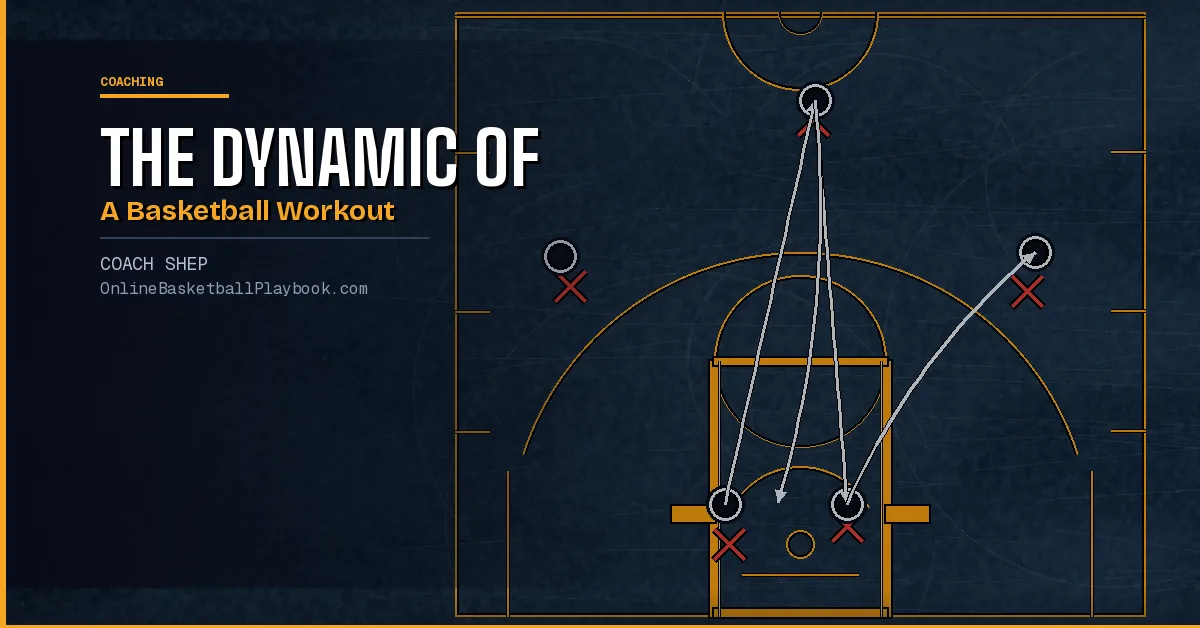
Most players leave the gym having worked hard but having gotten better at very little. The difference between a productive workout and wasted repetitions comes down to three things: a plan, game speed, and a number to beat.
The Three Non-Negotiables of Every Workout
Coach Mac distilled individual skill work to a standard that holds up across every level and every skill set: every workout must have a plan, must run at game speed, and must track the shots and reps. That's the entire framework. Everything else is a variation on those three demands.
A plan means the player walks into the gym knowing exactly what they are working on and in what order. Not a rough idea but a written sequence with a time or make-count attached to each block. Players who show up without a plan end up making decisions mid-workout about what to do next, and those decisions are almost always driven by comfort, not development. They shoot from spots they already make. They skip the moves that feel hard. A plan removes that option.
Game speed is where most individual workouts quietly fail. A player who spends forty-five minutes executing moves at half speed is not developing a basketball skill. They are developing a slow version of one. The nervous system adapts to the speed at which it trains. If the catch, the footwork, the shot, and the decision don't happen at the pace they will face in a game, the drill is giving the player a false sense of progress.
Tracking the shots and reps is not optional either. The number you record is the accountability mechanism and the motivational structure simultaneously. "I made 47 from the wing today, I want 55 next session" gives a player something real to chase. Without a number, the session is aimless and there is no way to measure improvement from one week to the next.
The Part-to-Whole Progression
Every skill, no matter how advanced, should be introduced through the same four-stage sequence. Start with the move in isolation (no defense, no decision) so the player can focus entirely on the mechanical execution. This is the 1-on-0 stage. Then progress to a coach-guided read-and-react situation where the player is making a decision but the outcome is managed. Follow that with a controlled advantage situation, such as 1-on-2 with a delayed second defender, so the player encounters resistance without being overwhelmed. Finally, place the skill into a live game situation with full defense.
This progression applies to every skill the coach is trying to install. A guard learning to come off a ball screen goes through the same four stages as a post player learning a drop step or a wing learning to use a pin-down. The temptation is to skip to the game situation because it feels more real. But players who skip the earlier stages never actually learn to read the skill. They memorize reactions to situations they've been in before, and they break down when they face anything different.
The numbers inside that progression should scale too. Start at 1-on-0, move to 2-on-0, then 3-on-0, layering in teammates and reads as the player demonstrates competence at the previous level. What you are training is decision-making, not memorization.
Score Everything. Make-Count Discipline
Make-counts, not rep-counts, drive real development. The difference matters. A player who shoots 200 shots and makes 83 of them has told you something meaningful. A player who shoots 200 shots without tracking makes has told you nothing except that they were present for forty minutes.
Every drill block in a quality individual workout has a specific make target attached to it. "Make 14 of this in 1:30." "Make 300 before you leave." "Make 20 from each of the five spots before moving to the next." The number serves multiple functions at once. It creates urgency because the player cannot mentally coast through a block when they know they need to hit a threshold. It creates honesty because the player cannot round up or approximate. And it creates a record, which is the only way to track progress over time.
Free throws belong inside this discipline, not after it. The common error is shooting free throws fresh at the end of a workout as a cool-down. That is not how free throws happen in games. Shoot them tired, in the middle of the workout, and count them. Make 8 of 10 while breathing hard and your legs are heavy. That is the actual skill you are trying to build.
How to Structure the Sequence of a Session
The sequence inside a workout is not arbitrary. It follows a logic: form and footwork first, then the move, then the game shot off a real action. This mirrors how a skill actually lives in a game. You never see a player in a game begin with a catch-and-shoot isolation. The shot comes at the end of a series of actions, and those actions rest on footwork and body control.
Open every session with form work. Quarters shots, Mikan drills, footwork repetitions from the elbow, or whatever the player needs to re-establish their mechanical baseline before the pace and complexity escalate. This serves two purposes: it grooves the foundation, and it gives the coach an immediate read on what the player is bringing into the session that day.
After the form block, build the move. Pair it with its counters. A player who has a go-to pull-up off the dribble but no counter when the defender takes it away does not actually have a move. They have a preference. The workout must build the primary action and the two or three reads that follow when the defense takes it. Mark Few's Gonzaga program uses an 80% completion standard: you do not advance to the next move until you hit 8 of 10 attempts against token pressure. That threshold forces genuine competence before progression.
Then pair ball-handling with shooting throughout the session, not in separate isolated blocks. Shooting comes off the dribble in games. Train it that way. The handling work and the shooting work should feed each other throughout the session rather than being treated as separate skill categories that happen to share a gym.
Error Detection: The Coach's Primary Tool
The coach's job during an individual skill block is not to explain correct execution repeatedly. It is to watch for the specific error that is occurring, identify it by name, and apply the matched correction. This is the diagnostic-first model, and it changes how a coach should spend their attention during a workout.
Every technical skill has a predictable set of common breakdowns. Dribbling: watching the ball, pumping the arm instead of using wrist and finger flexion, dribbling too high. Shooting: shoulders not squared before the shot, elbow drifting out, no follow-through, rushing before getting balanced. Footwork: bending at the waist instead of the knees, a jump stop where one foot lands before the other, lifting the pivot foot before releasing. These are not random errors. They are the same four or five mistakes that appear in that skill regardless of the player's level or experience.
A coach who has those error patterns memorized for the five or six skills their team practices most is operating at a fundamentally different level than one who is just watching and offering general encouragement. The first coach sees the elbow drift on rep three and applies the correction before rep four. The second coach watches twenty reps of the same error and tells the player to "focus on your mechanics."
The same diagnostic logic applies to self-directed workouts. A player reviewing their own video should run through the known error checklist for whatever skill they are training. Make-count is not a sufficient self-evaluation. A player making 7 of 10 pull-ups with a drifting elbow has a mechanical problem that will surface the moment a defender contests. The make percentage is hiding the flaw. The error checklist exposes it.
Before your next individual workout, write down the three most common errors for the skill you are training. Post it on the wall or put it in your pocket. Your job during each block is to run through that checklist on every rep, not to count makes and nothing else. The gap between what you see and what is actually happening on each rep is where development lives.
Designing a Weekly Development Rhythm
One of the most persistent traps in individual player development programming is the theme-week structure. A coach or player decides to spend an entire week on shooting, then an entire week on ball-handling, then an entire week on finishing. The idea is to go deep. The result is that the player loses touch with everything else during each focus week, and development stagnates in the areas that aren't being touched.
The more durable structure assigns a theme to each day of the week rather than each week of the month. Monday might be ball-screen fundamentals. Tuesday goes deeper into ball-screen reads. Wednesday shifts to ball-handling. Thursday covers finishing. Friday addresses conditioning and toughness. Saturday handles mid-range shooting and open-court actions. That template repeats for eight to twelve weeks. The player touches every pillar of their game every week, making-count accountability runs inside each daily theme, and the routine itself becomes the habit.
Within each themed day, the part-to-whole progression still applies. The earlier days in the week handle foundational skill work, and the later days in the week layer in advanced reads and competitive situations. Progression exists. It just lives within the week rather than across weeks. This structure keeps the player sharp everywhere while still allowing enough repetition within each theme to drive real improvement.
A mental skills block belongs in this weekly structure as well. Three or four days per week, add a short co-block that addresses visualization, competitive mindset, or self-evaluation. The mental game compounds alongside the physical work when it is trained with the same regularity. The player who develops both simultaneously is more durable under pressure than one whose entire development has been physical.
Small Groups, High Intensity
Individual player development does not require a solo session. Forty-five to sixty minutes with three or four motivated players at high intensity produces the same quality of development as a solo session, and often better, because the competitive element creates pressure that mirrors game conditions.
The model is simple: cover the core pillars (footwork, ball-handling, finishing, shooting, passing, and spacing) in the session, and immediately place each offensive skill into defensive pressure. Not a token defense. Real body-to-body contact. The player who can execute the move while being pushed and read is developing a game-usable skill. The player who can only execute it in space is developing a drill skill.
Small groups also create accountability that solo sessions lack. When three players are watching your make-count block, the social pressure sharpens focus. The written evaluation trail matters here too. After the session, each player should have a record of what they worked on, how many makes they hit, and what they need to address next time. A session without a record is a session that cannot be built on.
The coach who refuses to end the session until the move is mastered (not attempted, mastered) creates a standard that solo sessions rarely enforce. That insistence is a coaching principle, but it applies equally to the player who is self-directing. Set the threshold before you start. Do not leave until you hit it.
- Have a written plan before you enter the gym: List each block, the skill, the make-count target, and the time allotted. No plan means you'll default to comfortable work that doesn't develop you.
- Every block gets a make-count, a completion percentage, and a clock: All three together: "Make 14 in 1:30, hit 80% of attempts." A single number leaves gaps in accountability.
- Pair your primary move with its two or three counters: A move without a counter is a preference, not a skill. If the defender takes your pull-up, you need the drive. If they take the drive, you need the step-back. Build the whole series.
- Shoot free throws tired and in the middle of the workout: Not fresh at the end. The FT you need to make in a game comes at the end of a possession after you've been sprinting. Train it that way.
- Run the error checklist on every skill block, not just the make count: Know the three most common mechanical breakdowns for each skill you train and check them on every rep. Makes hide mechanical flaws that defenders will expose.
Want more basketball coaching strategies and drills?
Join the Online Basketball Playbook newsletter →
Draw this play free in the play drawer →
Membership: the full library, playbook packs, and Pro drawing tools →
Keep Building
Related breakdowns
Guard Workout: Handles, Reads and Finishing You Can Print
A guard workout you can print: a full session with its standards, plus handle work, jab, closeout and ball-screen reads, finishing and shooting off the dribble.
Basketball Workout Plan: How to Build One by Position
How to build a basketball workout plan: the blocks to include, the order, how long, make counts and game speed, position work, tracking, and where coaches disagree.
Big Man Workout Basketball: Drills, Make Counts and Order
Big man workout basketball: the order of a post session, Mikan and McHale finishing, catching drills, block-to-block moves, face-up work and make counts.