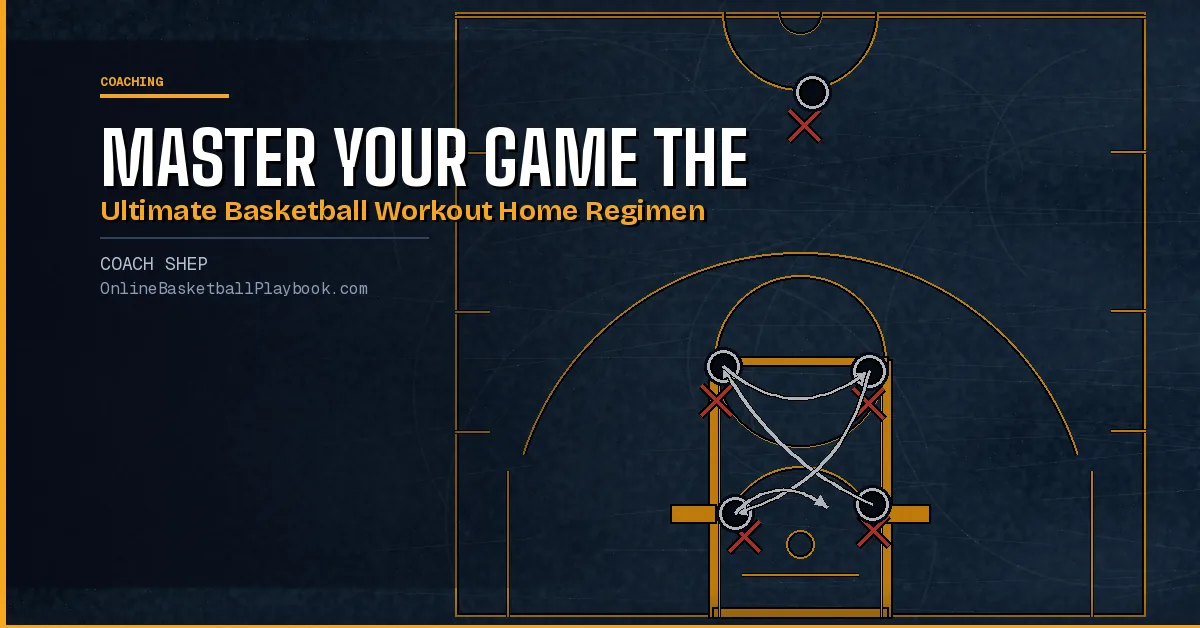
Most players go to the gym and wing it. The ones who actually improve follow a structure: a plan, a target number of makes, and a drill sequence that mirrors how the game is played.
The Three Non-Negotiables of Every Home Workout
Before you touch a basketball, you need to understand what separates a development session from just shooting around. Coach Mac's framework (drawn from two decades of individual workout programming) identifies three elements that must be present in every workout, no exceptions.
First, have a plan. Walk in knowing exactly what you're training, in what order, and for how long. A player who shows up without a written plan is practicing randomness. They might feel productive, but they're not building anything that carries over to games.
Second, run at game speed. This is where most home workouts fall apart. Players go through motions at half-pace, grooving habits that vanish under defensive pressure. Every drill, every move, every rep should be executed at the pace you'd use in an actual game. If you can't do it fast yet, slow down just enough to execute correctly, then push the speed up as you improve.
Third, track your makes. Chart attempts and makes on every shooting block. Aimless gym time doesn't develop anyone. When you put a number on your session ("make 14 in 1:30," "300 makes total") you create real accountability and a benchmark to beat next time.
These three elements are the foundation everything else is built on. No plan, no speed, no tracking means no real development, regardless of how many hours you log.
How to Structure a Solo Basketball Session
The best individual workout programs follow a consistent progression that coaches call part-to-whole. You install a skill in isolation, add a read or reaction, then bring it into a game situation. This isn't just pedagogical preference. It reflects how the brain actually learns motor skills under competitive pressure.
The Four-Stage Skill Progression
Every skill block in your home workout should move through these four stages in order:
Stage 1: Introduce it (1v0). Perform the move or shot with no defense, focusing entirely on footwork, hand position, and body mechanics. This is where you build the correct movement pattern. Don't rush past this stage because what you correct first is what you care about most.
Stage 2: Coach-guided read (1vC). Add a read or a reaction cue. If you're working alone at home, you simulate this by responding to a visual trigger (a cone placement, the spot on the floor, or a predetermined rule like "if I catch left of center, I go left."). You're no longer just executing a move. You're making a decision.
Stage 3: Controlled advantage (1v2 or constraint). Add a challenge that mirrors game pressure without overwhelming the skill. A chair as a defender, a tighter scoring target, a time constraint, or a rule that forces you to use a specific finish.
Stage 4: Game situation. Finish on a game shot off a real action (a catch off a cut, a shot off a dribble pull-up, a post move from a live feed position). The final rep of every skill block should look like something that would happen in a real game.
Form Before Move, Move Before Game Shot
Within each stage, follow the same internal order: footwork and form first, then layer the move, then finish on a game shot. Opening with form shots (even a few reps of "Quarters" shooting from close range) gets your mechanics right before you start adding speed and complexity. Players who skip straight to pull-up threes are reinforcing whatever habits they already have, good or bad.
How Long Should a Home Session Run?
Research from player-development coaches including the Raca, Manouselis, and Chrysalas framework supports 45 to 60 minutes as the sweet spot for individual skill work when the intensity is genuinely high. Beyond that, quality drops and you're logging volume without real development. A focused 50-minute home workout with a plan beats two hours of unfocused gym time every time.
The Daily Theme System That Builds Complete Players
One of the most common traps in solo training is spending too much time on one skill in a single stretch. A player spends a whole week on shooting, then neglects their handle and footwork. The following week they go back to handles, and the shooting cools off. It's an inefficient cycle that produces narrow specialists instead of complete players.
The Point Guard Academy model solves this with a day-theme system: assign a named theme to each day of the week, hold that template for eight to twelve weeks, and hit every pillar of your game every single week.
A Sample Weekly Theme Template
Monday: Ball-Handling Fundamentals. Stationary ball-handling, dribble series, weak-hand isolation. Every rep with purpose: eyes up, hard dribble, no ball-watching.
Tuesday: Finishing and Footwork. Mikan drill, layup angles, euro steps, contact finishes. Form work first, then live-speed finishes off a cone or chair at the elbow.
Wednesday: Shooting (Catch and Shoot). Spot shooting from five positions, then catch-and-shoot off movement (a self-pass or toss-back). Make-count tracked on every set.
Thursday: Mid-Range and Pull-Up Game. Pull-up off the dribble from the elbow, floaters, step-backs. Always finish with your game shot from your go-to spot.
Friday: Conditioning and Toughness. Game-conditioning drills (wind sprints, defensive slides, Brittenham-style competitive conditioning). Shoot free throws at the end while tired and counted. Not fresh, not after a rest, tired, just like the fourth quarter.
Saturday: Open-Court and Transition. Full-court layup series, fast-break finishing, outlet-and-go reads. The open-court game is a separate skill from the half-court game; it needs its own time.
The critical discipline here: you touch every pillar of your game every single week. Make-count accountability runs inside each daily theme. The routine itself becomes the habit, and habits compound over an eight-week block in ways that a scattershot approach never does.
Make-Count Scoring: Why Reps Aren't Enough
Here is the single biggest upgrade most players can make to their home workouts: stop counting attempts and start counting makes.
The difference sounds small but changes everything. When you count attempts, finishing a set of 20 shots feels like completion whether you made 8 or 18. When you count makes and set a target ("make 14 before moving on") you have to perform. You can't coast through a drill on volume.
Setting Your Make-Count Standards
The standard varies by drill type and distance, but here are reliable frameworks:
Short-range and finishing drills: "Make 20 in a row" or "make 5 consecutive." The Mikan drill is a classic example. Coach K's individual workout program specifies making 5 in a row before moving on, not completing 5 attempts.
Mid-range shooting: "Make 8 of 10" or "make 14 in 90 seconds." Gonzaga's program uses an 80% completion gate. You don't advance to the next move until you finish 8 of 10 against token pressure. That standard forces real execution.
Three-point and volume sets: "300 total makes in the session" or "100 makes from each zone." The Oak Hill standard pairs a make-count with a pace target ("80 makes in 4 minutes") so you're accountable to both accuracy and tempo simultaneously.
Record Every Session
Write down your makes. Keep a notebook, a notes app, whatever you'll actually use. A number you can beat next session is one of the most powerful motivators in individual player development. Over eight weeks, watching your make totals climb is concrete evidence of real improvement, much more meaningful than a vague sense that you're "getting better."
Free throws belong inside this system too. Shoot them tired, inside the workout, not fresh at the end. Set a make target ("make 7 of 10 after the conditioning block") and track it like everything else. Free throws in a game come when you're gassed. Train them that way.
Pair your ball-handling and shooting work inside the same block. Don't train them as completely separate categories. Dribble series should flow directly into pull-ups and jumpers, because that is exactly how shooting comes off the dribble in a real game. Separation in training creates separation in your game.
Error Detection: The Skill That Separates Developing Players
The ASEP coaching model identifies error detection as the primary tool in individual skill development, and it applies just as much to players training alone as it does to coaches watching from the sideline. Every technical skill has a predictable set of common breakdowns. Knowing what those breakdowns are, and watching for them in your own game, is what separates players who develop from players who just put in time.
Common Errors by Skill Area
Shooting: Not squaring shoulders to the basket before releasing, elbow drifting out to the side, no follow-through (wrist not snapping down), rushing the shot before getting balance. If you're missing consistently in one direction, your elbow is almost always the cause.
Ball-handling: Ball-watching instead of keeping eyes up, pumping the arm instead of using wrist and finger flexion, dribbling too high or too far from the body. A hard dribble, low and tight to the body, is the baseline. If you don't have this, every advanced move is built on sand.
Footwork and stops: Bending at the waist instead of the knees (throws balance forward), jump stop with one foot landing before the other (limits your pivot-foot options), lifting the pivot foot before releasing the ball (a travel waiting to happen in a game).
Triple-threat position: Not squaring to the basket (limits your court vision to one side), holding the ball away from the body (theft risk), jab step with too much weight forward (slows your drive follow-through).
Use Video for Self-Coaching
Set your phone up to film a portion of every home workout. Watch back specifically for the common errors listed above, not for whether the shot went in, but for whether your mechanics are sound. A player who makes 6 of 10 jumpers but has a consistently drifting elbow has a mechanical problem that will surface under defensive pressure. The make percentage hides the flaw. Video exposes it.
Gonzaga's individual workout structure uses what coaches call "Game Shots, Game Spots, Game Speeds" as the organizing standard for every rep. That phrase is worth memorizing: are you shooting shots you actually get in games, from spots you actually occupy on the floor, at the speed you'd actually shoot them under pressure? If the answer to any of those three is no, you're building habits that don't transfer.
- Have a written plan before you touch the ball: Know your drill order, your make targets, and your time blocks before you arrive at the gym or driveway.
- Track makes, not attempts: Write your make total for every shooting block. The number you can beat next session is your real development metric.
- Run every rep at game speed: If you can't execute at game pace yet, slow down just enough to do it correctly, then push speed up incrementally over sessions.
- Use a daily theme to touch every skill every week: Assign handles, finishing, shooting, conditioning, and transition to specific days and hold that template for 8 weeks minimum.
- Shoot free throws tired and tracked: Put them inside your conditioning block, not at the end of a rested session. Game free throws come when you're exhausted, so train them that way.
- Film yourself and check for the three or four common errors in your key skills: The make percentage hides mechanical problems. Video catches what the score sheet misses.
Putting It All Together: A Sample Home Workout Week
Here is how a complete home workout week looks when you apply every principle above. This template runs 45 to 55 minutes per session and works on a driveway, a local court, or a gym with a single basket.
Monday: Ball-Handling (45 min)
Open with 5 minutes of stationary ball-handling: ball slaps, circles, figure-8, spider dribble. Move to a 10-minute dribble series covering weak hand, crossover, between-the-legs, and behind-the-back, all at game speed, eyes up. Finish with 15 minutes of dribble-into-shot combinations: crossover into pull-up, between-the-legs into mid-range, behind-the-back into a step-back. Make target: 40 total makes in the finishing segment. Close with 5 minutes of weak-hand-only stationary work. The 24-hour weak-hand discipline Eastman describes is the fastest way to close the gap between your strong and weak sides.
Tuesday: Finishing and Footwork (50 min)
Open with 8 minutes of Mikan drill. Make 5 in a row before moving on. Then 10 minutes of layup angles: straight-line, reverse, euro step, and scoop from both sides. Add a chair or cone at the elbow as a simulated defender and finish layups off a drive read for 12 minutes. Make target: 60 total makes in the layup segment. Close with 5 minutes of free throws, tired, tracked, with a make target of 7 of 10.
Wednesday: Catch and Shoot (50 min)
Open with 5 minutes of form shots from 8 feet, feet set, wrist snap, clean follow-through. Move to 5 shooting positions around the arc: wing, corner, top, and two elbows, spending 5 minutes at each spot with a make target of 10 per spot. Finish with 10 minutes of catch-and-shoot off a self-pass or toss-back, simulating real catch-and-shoot actions. Make target: 80 total makes in the full session. Record total makes. Beat it next Wednesday.
Thursday: Mid-Range and Pull-Up (45 min)
Open with elbow jumpers, both elbows, 5 makes from each before moving. Then 12 minutes of pull-up off two dribbles from the wing and top of the key. Add a step-back series for 10 minutes, one dribble, two-foot gather, straight back. Finish on your go-to game shot from your actual spots: if your go-to is a mid-range pull-up from the right elbow, close every session on that shot. Make target: 50 total makes in the mid-range and pull-up segments combined.
Friday: Conditioning and Toughness (45 min)
This session is physical. Open with 10 minutes of defensive slides, lane slides, closeout footwork, drop steps. Move to a 15-minute conditioning block: full-court sprint and back, defensive slide series, explosive jump series. Finish with 10 minutes of shooting while fatigued, come off a sprint and shoot. Free throws: make 7 of 10 before you leave. Write the number down.
Saturday: Signature Move Series (50 min)
Every player has a bread-and-butter move. Today you drill that move and its two or three counters. If your go-to is the crossover drive, you also drill the between-the-legs step-back when the lane closes, and the pullup when the defender over-helps. Open each move with the 1v0 form stage, add a constraint, then finish on a game shot. Make target: 15 makes from each of the three moves in your series. Building counters alongside your primary move is what makes the primary move actually work under pressure. A one-move player is a guarded player.
Want more basketball coaching strategies and drills?
Join the Online Basketball Playbook newsletter →
Draw this play free in the play drawer →
Membership: the full library, playbook packs, and Pro drawing tools →
Keep Building
Related breakdowns
Guard Workout: Handles, Reads and Finishing You Can Print
A guard workout you can print: a full session with its standards, plus handle work, jab, closeout and ball-screen reads, finishing and shooting off the dribble.
Basketball Workout Plan: How to Build One by Position
How to build a basketball workout plan: the blocks to include, the order, how long, make counts and game speed, position work, tracking, and where coaches disagree.
Big Man Workout Basketball: Drills, Make Counts and Order
Big man workout basketball: the order of a post session, Mikan and McHale finishing, catching drills, block-to-block moves, face-up work and make counts.