
The best ball handlers make dribbling look effortless because they practiced it relentlessly. This guide gives you the drills, progressions, and coaching cues that turn raw talent into reliable court control.
Why Ball Handling Is the Foundation of Guard Play
Ball handling is not a standalone skill — it is the platform that every other guard action runs on. A guard who cannot keep the dribble alive under pressure cannot run your offense. A guard who has to watch the ball cannot read the defense. A guard who fumbles on speed changes cannot execute the timing moves that create open shots.
The most direct coaching principle on this comes from the Kokoškov guard development system, derived from working with Steve Nash at the peak of his career: "The more you dribble in practice, the less you dribble in the game." That sounds like a paradox, but it is not. Repetition in practice ingrains the handle so deeply that the brain stops consciously managing the ball during games. The dribble becomes automatic, which frees the player's mind to read the defense, find cutters, and make decisions. That mental freedom is the actual goal of ball handling training — the dribble is just the vehicle.
For coaches, this reframes how you structure workouts. You are not just training the hands. You are training the player to think without the ball occupying their mental bandwidth. Every drill in this guide is designed with that objective in mind.
Stationary Ball Handling Drills
Stationary drills often get dismissed as beginner work. That is a mistake. Stationary reps allow players to drill specific hand and wrist mechanics at high volume without worrying about court coverage. They are also easy to self-administer — no partner or coach required — which means players can get reps before and after practice on their own.
Pound Dribbles — Eyes Up
The most basic drill, and still one of the most useful. The player pounds the ball hard to the floor at knee height or below, keeping eyes level with the rim. The cue "eyes on the rim" is the coaching point that separates a useful drill from wasted time. Players who look at the ball during stationary dribbles will look at the ball in games. Insist on eyes up from the first rep.
Vary the height: low (below knee), mid (knee), and high (hip) dribbles teach the player to control the ball at different levels. Low dribbles simulate protected handles in traffic; high dribbles prepare players for pushing the ball in transition.
Figure Eights and Around-the-Body
Figure eights through the legs and around-the-body circuits (head, waist, knees, ankles) build hand speed, touch, and the ability to control the ball in tight spaces. The drill prescription is simple: go fast in one direction for 30 seconds, switch directions. Do not let players slow down just to avoid drops — drops are part of learning. The speed is the point.
Spider Dribbles
The player pounds the ball four times in succession — left front, right front, left back, right back — while in a low athletic stance. This builds the side-to-side hand switch and the ability to keep the ball low and active without dribbling it in a predictable pattern. Spider dribbles are particularly useful for developing the pull-back crossover, one of the most underused and most effective ball handling tools at the high school level.
Two-Ball Training: The Fastest Way to Improve
Two-ball dribbling is one of the highest-return investments in a guard workout. When a player handles two balls simultaneously, both hands are forced to operate independently. The brain cannot compensate by leaning on the dominant hand. It must coordinate both simultaneously, which accelerates skill acquisition significantly compared to one-ball work.
The Billeter/Augustana guard workout — a staple of elite college skill development — structures the two-ball battery in three phases:
Phase 1: Stationary Two-Ball Combinations
Start with both balls pounding together (same time), then alternate (one up, one down), then shoulder height, then crossovers, then push-pull (one ball going forward, one backward). The progressions get increasingly difficult in coordination demand. A player who cannot do the push-pull cleanly needs more time at the alternating stage. Do not advance until the current stage is solid.
Phase 2: Non-Stationary Two-Ball to Half Court
The player dribbles both balls to half court, changing moves on jump stops without stopping the dribble. The jump stop is critical — it teaches the player to collect themselves in traffic, not just run free. This phase transfers stationary skill to movement, which is where the real game happens.
Phase 3: Two-Ball vs. Defense
A defender pressures the ball handler, who can only use the pull-back dribble to create space. The constraint forces the player to use one specific tool under live pressure. This is a high-level drill — save it for players who have mastered Phases 1 and 2.
The more you dribble in practice, the less you dribble in the game — handle trained to automaticity frees the guard's mind to read the defense and make decisions without conscious attention on the ball.
— Kokoškov Guard Development System, Basketball Vault
Full-Court Pressure Drills
Stationary and two-ball work builds the tool. Full-court drills test whether the player can use the tool under the game's actual conditions: speed, fatigue, and defensive pressure.
1-on-3 Full-Court Ball Handling
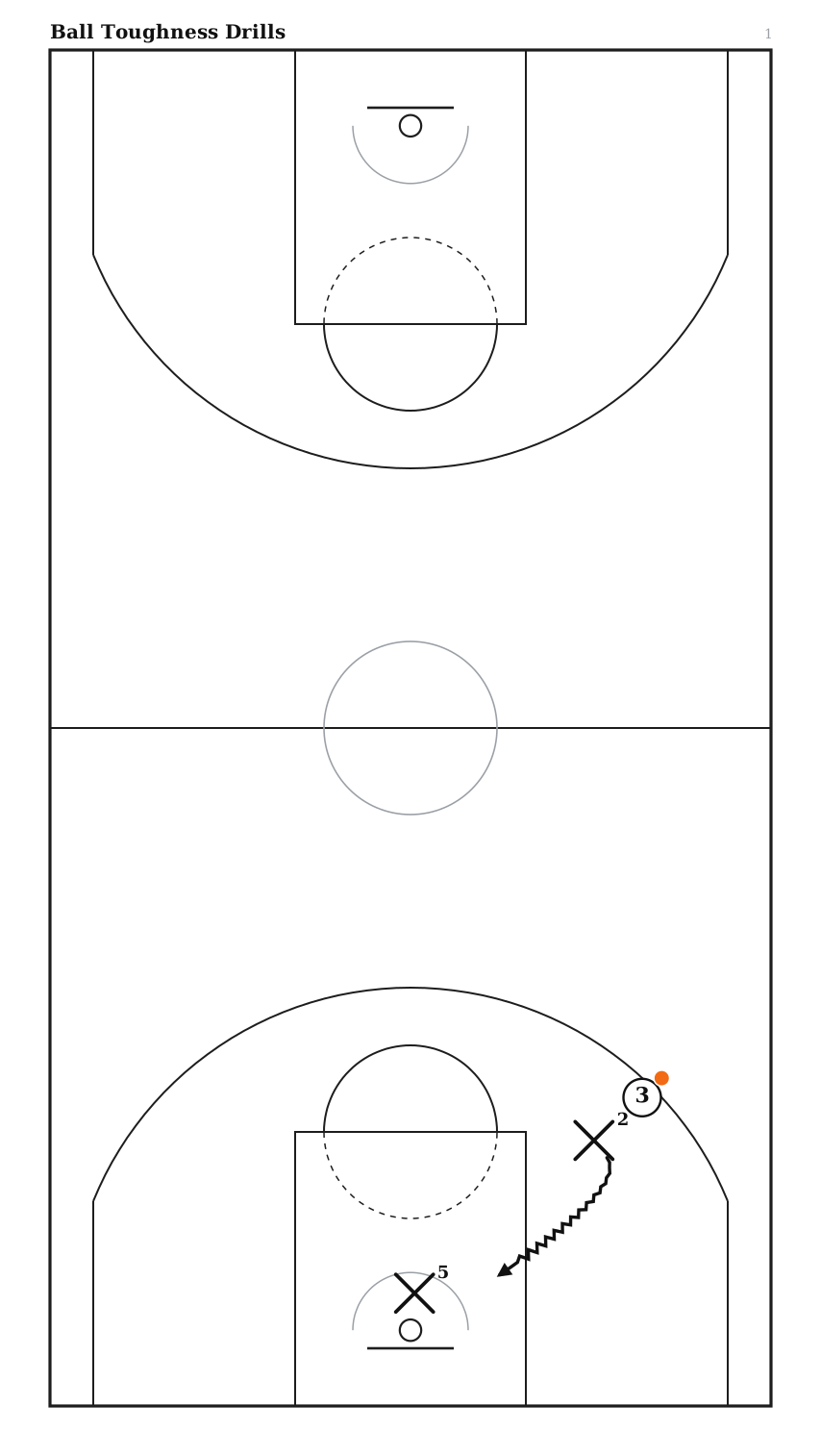
This is a pressure-handling staple from the Billeter/Augustana system. One ball handler faces three defenders spread across the court, each covering a third of the floor. The ball handler must beat each defender in succession to reach the other end. There is nowhere to hide. The player either protects the dribble or loses it.
The drill does several things at once: it builds handle under pressure, it forces the ball handler to make quick decisions on which move to use against each defender, and it builds the conditioning to maintain dribble quality on tired legs. Running this at the end of a workout rather than the beginning amplifies the conditioning benefit.
Sprint-and-Catch Attack Sequences
Drawn from the Donovan/Florida guard development system, this drill simulates transition catch-and-attack scenarios. Players start behind half court, push the ball with a speed dribble, execute a designated move at a coach positioned at the free-throw line extended, then finish at the basket. The drill runs continuously — the next player goes as the previous player shoots. Different moves are called each sequence: hesitation, inside-out, crossover, reverse layup.
The key design principle in the Florida system is that every drill has a built-in progression. The Sprint-and-Catch starts with no defender, then adds a live closeout defender on the catch once the skill is established. This two-stage arc — competence, then pressure — should be the model for how you introduce any handling drill to your players.
Pull-Back Crossover for Separation
The pull-back crossover is underrepresented in most high school programs. The move works as follows: the ball handler attacks one direction to get the defender leaning, then snaps the ball back with a hard crossover dribble, creating a separation step. The UNCW system ("all drills at game speed") recommends this as the primary separation tool for guards who cannot yet reliably beat defenders off the initial attack dribble.
Footwork: The Hidden Layer Under Every Dribble Move
Ball handling drills without footwork instruction are incomplete. The hands deliver the ball, but the feet determine whether the move actually creates separation. Sloppy footwork cancels out clean hands. This is the most commonly missed element in guard development at the youth and high school levels.
The Inside-Heel Pivot — Your Most Important Footwork Cue
Whether a guard is coming off a ball screen, catching a pass on the wing, or pulling up off a dribble, the mechanical cue is the same: drive the inside heel (the foot closest to the basket) into the floor at the moment of reception or last dribble. This heel-brake stops lateral drift, squares the hips, and creates a stable base for the shot or next dribble.
Kimble's footwork system makes this explicit with a specific cue for pull-up jumpers: "Your last dribble down, your inside heel down — same instant." When this timing is right, the guard rises straight up and lands in the same spot. Drift and fadeaways disappear naturally because the footwork has stabilized the base.
The Blast Move vs. the Front Crossover Drive
Guards need two named first-step options out of triple threat, depending on where the defender's lead foot is positioned:
Blast move: When the defender's lead foot matches your free foot, step almost directly at that foot — step north, not east. Scraping off the defender's shoulder cuts off their angle of pursuit. This is the counterintuitive move: stepping into the defender instead of around them is what creates the advantage.
Front crossover drive: When the defender's lead foot is on your pivot side, rip the ball hard and low across your shoe tops, front-pivot your free leg across, scrape the defender's shoulder, and start the dribble as your foot lands. The rip mechanics keep the ball protected through the crossover without exposing it wide.
Teaching these two options as a read — left or right foot leads, which move responds — gives guards a decision framework rather than a single default move. Players who only know one first step are predictable. Players who read the defender's foot position and respond accordingly are not.
Run the Offensive Pivoting and Passing Breakdown Drill during pre-practice warm-up — six minutes with all players working simultaneously on jump stop, step-out, rip-through, and pull-up footwork. It requires no setup, needs no defenders, and gets every player on the court getting meaningful reps before the main practice block starts. This is how you build footwork volume without sacrificing practice time.
Build a Named-Move Library
One of the most transferable ideas from the Kokoškov system is the habit of naming every move after a player who executes it at the highest level. This approach has three practical benefits for your program: it gives players a film-study assignment tied to each move, it gives coaches a one-word cue instead of a two-sentence description, and it builds a cultural connection between your players and the professional game.
The Core Named Moves
Nash hesitation: Knee up, eyes on the defender, then read — pull-up jumper or pull-back dribble pump fake ("shake and bake"). The pull-back is what most programs never name. It is the hesitation's escape valve when the defender does not bite on the knee-up.
Bodiroga body fake: Shoulders fake, ball stays in front, hands switch — not a wide crossover. The ball never goes wide, which preserves the live dribble and the shot-fake threat simultaneously. An underused move at the high school level because it is not flashy, but it is highly effective against disciplined defenders.
Tony Parker "never expose yourself": If the defender goes under a screen, the ball handler stops right behind the screen and shoots. Do not keep moving. The screen is the shot. Guards who keep running past a free pull-up opportunity are training the wrong read. This one named principle corrects a decision-making error that shows up constantly in game film.
The Al-cut: A body-positioning seal-cut where the offensive player makes contact, seals the defender, receives the pass, and rip-throughs into the lane. Worth naming in your own program so players have vocabulary for a catch action that many teams run without ever explicitly teaching.
How to Install a Named Library
Introduce one named move per week during pre-season skill workouts. Post a short film clip of the player executing the move to your team film account. By the start of the season, your guards have a library of six to eight named tools, each with a professional reference point, a one-word coaching cue, and repetitions tied to the name. The coaching efficiency during games improves immediately — one word triggers the full execution package the player already knows.
Putting It Together: Structuring a Handling Workout
A complete ball handling session for a high school or college guard program should move from isolated skill to applied pressure within the same workout. Florida's design principle is the model: every drill builds toward live defensive pressure, and the session ends with game-speed reps on tired legs.
A 45-minute guard handling session might look like this: open with eight minutes of stationary two-ball work (Phases 1 and 2 from the Augustana battery), move into 12 minutes of full-court one-ball speed dribbling with designated moves at designated spots, shift to 10 minutes of Sprint-and-Catch sequences against a passive coach, then finish with 10 minutes of 1-on-3 full-court pressure handling and five minutes of pull-up shooting off the last dribble on tired legs.
The conditioning is built into the structure, not added at the end as extra sprints. This is important: players who complete a structured handling circuit are also completing conditioning work tied directly to basketball movement patterns. The reps feel purposeful because they are purposeful.
The final five-spot pull-up shooting round forces the player to maintain shooting mechanics when the legs are tired. This is the "real percentage, not fresh" principle from the Kokoškov system. If a guard can make pull-ups on tired legs with correct footwork, they can make them in the fourth quarter. That is the standard you are training toward.
- Eyes up from rep one. Any stationary or moving dribble drill where the player watches the ball is building a bad habit. Establish "eyes on the rim" as a non-negotiable from the first session and hold it every session after.
- Two-ball work three times per week minimum. Two-ball training accelerates hand independence faster than any one-ball drill. Even 10 minutes of stationary two-ball at the start of a guard workout will produce visible improvement within three weeks.
- Name your moves and use the names during games. One-word cues during live action — "Nash," "Parker," "body fake" — trigger the full learned sequence without stopping play or shouting a paragraph of instruction.
- Build pressure into the drill, not onto the drill. Add a defender within the drill structure rather than running the same drill live as a bolt-on. The Florida two-stage progression (no defender first, live defender second) is the right model for skill retention under pressure.
- Finish every skill workout with game-speed, tired-leg reps. Pull-up shooting, one-on-one drives, or full-court attacks on the final round should happen after the hard conditioning work, not before. Real game skill holds up under fatigue — train it that way.
- Teach the inside-heel pull-up pivot explicitly. Do not assume guards pick up correct pull-up footwork by osmosis. Isolate the mechanic, give them the cue ("last dribble down, inside heel down — same instant"), and drill it in a Circle Footwork setup with no basket needed before adding a shot.
Want more basketball coaching strategies, drills, and tools?
See it drawn up
Related diagrams
Keep Building
Related breakdowns
Where to Practice Basketball: Complete Guide to Finding Courts and Training Spaces
Where to Practice Basketball: Complete Guide to Finding Courts and Training Spaces
Sample Practice Plan Basketball: Complete Guide for Effective Team Training
Sample Practice Plan Basketball: Complete Guide for Effective Team Training