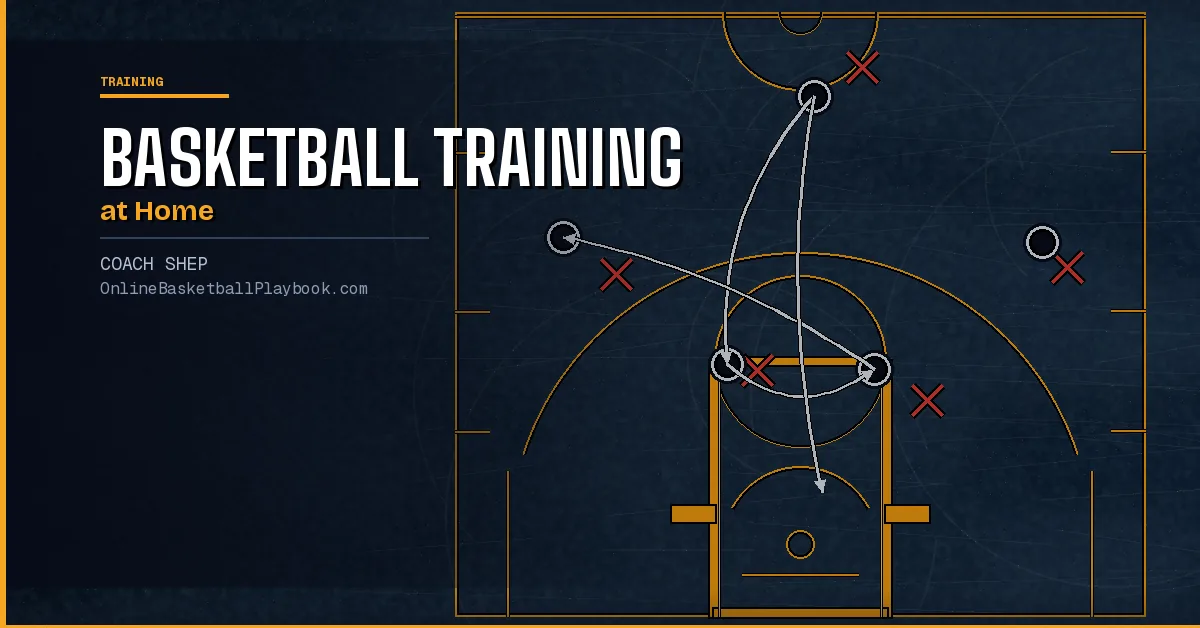
You don't need a gym to get better. With a hoop, a ball, and a structured plan, home workouts can build real skills. This guide covers shooting, ball handling, footwork, and conditioning, which is everything to train alone and improve fast.
Why Home Training Works
Most players wait for practice to get better. The ones who actually develop are the ones putting in reps between scheduled sessions. Home training fills that gap, and when it's structured correctly, it accelerates basketball player development faster than gym time alone.
The key word is structured. Aimless dribbling for 30 minutes does almost nothing. But a focused 45-minute session with a clear sequence of skills, a make-count target, and real game-speed effort? That moves the needle. The difference between players who plateau and players who break out is almost always what happens outside of team practice.
Home training also builds the mental habits that transfer to games. Working alone forces you to self-correct, to push through fatigue without a coach watching, and to hold yourself accountable to the numbers. Those habits compound over a season. A player who does 200 focused makes per day across a summer doesn't just shoot better. They think differently about the work.
The setup doesn't need to be elaborate. A driveway hoop handles shooting and finishing. An open garage or backyard handles all ball handling and footwork work. The limiting factor is never the equipment. It's always the plan.
Building Your Workout Plan
Every productive home workout follows the same basic architecture: warm-up, skill block, game-speed application, conditioning, and free throws. The exact drills change, but the structure stays consistent. That structure is what separates development from random reps.
Start with 5–8 minutes of dynamic warm-up: lateral shuffles, hip openers, ankle circles, and a few minutes of light dribbling to get the hands ready. This isn't optional padding. Cold muscles and stiff joints produce sloppy reps, and sloppy reps build bad habits. The warm-up matters.
The main skill block should run 25–35 minutes. Sequence it from form work to movement to game shots. If you're working on shooting, start with close-range form shots (Quarters method or elbow shots), then add footwork and catch-and-shoot scenarios, and finish with pull-up jumpers off two or three dribbles (the shot you'd actually take in a game). Always finish on a game shot. Check out the fundamentals on basketball shooting form to anchor your technique before adding movement.
Build every block around makes, not attempts. "Make 14 mid-range shots in 90 seconds" creates real pressure. "Take 20 shots" does not. Scored reps teach you to focus, and the number gives you something to beat next session.
End every workout with free throws shot tired. Most players shoot free throws fresh in warm-ups. That's not how games work. Shoot them after your conditioning block, legs heavy, lungs working. That's the environment they get called in.
Ball Handling and Footwork
Ball handling is the easiest skill to train at home because you don't need a hoop. You need a ball, a flat surface, and discipline. The biggest mistake players make in solo ball-handling work is going slow. Comfortable is the enemy. Every stationary drill should be done at a pace that makes mistakes likely. That's how the hands get better.
Start with stationary series: two-ball dribbling, one-ball pound dribbles at knee, hip, and waist height, figure-eights, and spider dribbles. Keep the head up throughout. If you have to look at the ball to complete the drill, the speed is too slow, not too fast. Push until you're making mistakes, then push a little more.
From stationary, move to change-of-direction dribbling in a 10–15 foot space. Crossover, between the legs, behind the back, hesitation. Work each move in isolation first, then combine them in 2–3 move sequences. The goal is to replicate the dribble moves you'd use attacking a defender, not to complete a routine, but to make each move sharp and decisive.
Footwork gets overlooked in home training because it feels less exciting than dribbling or shooting. That's exactly why it separates players. Spend 10 minutes every session on pivoting, jump stops, and drop steps. Basketball footwork drills translate directly into better finishing, cleaner catches, and more confident post play, even for guards.
Cone and Marker Work
Six cones or chalk marks on a driveway unlock a full movement circuit. Use them for lane agitation patterns (defensive shuffle to cone, sprint to next), ball-handling attack lines (dribble hard at the cone, make your move), or spot-shooting triggers (sprint to cone, catch your own pass off the backboard, shoot). Movement before shooting is underrated in home training. Almost every shot in a game comes off of some action: a cut, a sprint, a jab step. Train it that way at home too.
Shooting at Home
Home shooting work fails for one reason: players camp in their favorite spots and shoot comfortable shots. Improvement requires discomfort. That means working the weak hand side, practicing shots off one and two dribbles, and shooting from spots you'd rarely choose voluntarily.
Structure your shooting session in zones. Spend time at the elbow, mid-range, and three-point line from five spots: both corners, both wings, and the top of the key. Don't move on until you've hit your make target at each spot. Keep a tally. This turns casual shooting into measurable practice and gives you honest data on your real percentages.
Add movement into every shooting block. Use a chair or a cone as a screener. Catch and shoot off a simulated curl. Take a jab step and rise. Pull up off the dribble from each spot. The mechanics of how to shoot a basketball don't change with movement, but your ability to execute them under pressure does. And that only improves if you train it.
Mikan Drill and Finishing
The Mikan drill is the best finishing drill you can run alone. Alternate glass-bank layups from each side of the basket, right-left-right-left, continuous, for 60 seconds. Make as many as possible. Then do it in reverse footwork. Then do it with a power stop and two-foot finish. Three minutes on Mikan teaches more about footwork and touch around the rim than most players get in a week of team practice.
Add off-hand finishing once the rhythm is established. A player whose left hand is unreliable at the rim is predictable. Defenders know it, help knows it. Two weeks of focused off-hand Mikan work closes that gap significantly. Count your makes. Beat your number the next session.
The most important 10 minutes of any home shooting workout are the last 10. That's when fatigue sets in and technique breaks down. Finishing strong, making your count when you're tired, is what builds shooting consistency in the fourth quarter.
Conditioning Without a Gym
Basketball conditioning is sprint-based, not endurance-based. A player who can run a 10-minute mile but can't sprint back-to-back possessions for four minutes is not conditioned for basketball. Home conditioning work needs to reflect that reality. Short, intense efforts with incomplete recovery.
The baseline home conditioning circuit: 17s (sideline to sideline 17 times in under 60 seconds), suicide variations on a driveway or yard, and 10-second max-effort sprints with 20-second recovery. These formats replicate the energy system demands of a real game. Volume builds from there, start at 4–6 rounds, build toward 10–12 over a training block.
Bodyweight strength work belongs in home training too. Lateral lunges, single-leg squats, plank variations, and hip flexor work address the injury risks and movement demands specific to basketball. Players who neglect this pay for it mid-season when fatigue accumulates. Twenty minutes of strength work three days per week makes a measurable difference in how a player moves in the fourth quarter.
For players building toward a full conditioning block, the basketball conditioning drills library gives you organized circuits that map to game-intensity demands. Use those frameworks as the structure and adapt them to whatever space you have at home.
Tracking Your Progress
The difference between working hard and getting better is measurement. Players who track their workouts improve faster, not because tracking is magic, but because it forces honest self-assessment and creates accountability to something besides feelings.
Keep a simple workout log. Date, skill focus, drill names, make-counts and targets, total time. That's it. After four weeks you have a real picture of which skills improved, which plateaued, and where the next training block should focus. Without the log, you're guessing.
Set weekly make targets that stretch your current level by 10–15%. If you're making 12 mid-range shots per minute now, the target next week is 13 or 14. That margin is uncomfortable but achievable. Stretch too far and you get frustrated. Don't stretch at all and you stagnate. The log tells you exactly where the line is.
Video review is underused in home training. Set your phone on a chair or a cone, record your shooting form, and watch it back. You will see things you cannot feel. Elbow drift, early release, stance width. These are invisible to you in the moment. A 60-second review at the end of each session catches technique drift before it becomes habit. That self-correction habit is what good solo training looks like at the highest level.
Combine tracking with a longer view on basketball IQ development. Technical reps build skill. Understanding the game builds the judgment to use those skills at the right moment. The two compound together, and both can be developed at home.
- Plan before you touch the ball. Know the skill focus, drill sequence, and make targets before the session starts, not after you get bored.
- Every session ends with free throws shot tired. Shoot them after your conditioning block, not before. That's the real game condition.
- Use a make-count, not a rep-count. "Make 15 from the elbow" creates pressure and honest data. "Take 20 shots" creates nothing.
- Add movement to every shooting block. At least half your shots should come off a dribble, a cut, or a catch from self-pass. Game shots come off actions.
- Weak hand work is non-negotiable. Build it into every ball-handling and finishing session, at minimum one-third of your dribble reps and one-third of your Mikan reps.
- Log every session. Date, drill, make-count vs. target. Four weeks of data tells you more than four weeks of feelings about where you actually stand.
- Sprint conditioning, not jogging. Run the 17s, the suicides, the 10-second all-out efforts. Jog days don't prepare you for basketball games.
Get free play diagrams, drills, and coaching guides delivered weekly.
Draw this play free in the play drawer →
Membership: the full library, playbook packs, and Pro drawing tools →
Keep Building
Related breakdowns
Master Your Game: The Ultimate Basketball Workout Home Regimen
Master Your Game: The Ultimate Basketball Workout Home Regimen
A Free Sample Basketball Training Workout
A Free Sample Basketball Training Workout
Basketball Training: Shooting at Game Speed
Basketball Training: Shooting at Game Speed