Basketball clock management is the set of decisions a staff makes about time, score and fouls at the end of quarters, halves and games: how many possessions are left, whether to foul up 3, when to foul from behind, when to take a two for one, when to start the last shot, and when to spend a timeout. The coaches who write about it agree on one thing: settle the answers before the season and rehearse them, so nothing is decided cold.
They split on almost every answer. This page owns the clock decisions, laid out side by side. The plays and the full late-game picture are on basketball late game situations. It sits in the special situations section.
Basketball Clock Management Starts With Your Rulebook
The same score and time mean different things at different levels, because the clock, the bonus and the timeouts are different. The official rules by level:
| Level | Shot clock | Clock after a made basket late | Bonus | Advance after a late timeout |
|---|---|---|---|---|
| NFHS (high school) | 35 seconds where the state adopts one | No rule in the NCAA comparison chart | Two shots from the fifth team foul in a quarter, no one-and-one | No rule |
| NCAA men | 30, reset to 20 on an offensive rebound off the rim | Stops in the last 59.9 seconds of the second half and overtime | One-and-one from the seventh foul in a half, two shots from the tenth | No rule |
| NCAA women | 30, reset to 20 | Stops in the last 59.9 seconds of the fourth quarter and overtime | Two shots from the fifth foul in a quarter | Frontcourt throw-in 28 feet from the end line in the last 59.9 seconds |
| NBA | 24, reset to 14 | Stops in the last minute of the first three periods and the last two minutes of the fourth and overtime | After four team fouls in a period, three in overtime | Frontcourt throw-in at the 28-foot hash mark in the last two minutes |
| FIBA | 24, reset to 14 | Stops in the last two minutes of the fourth quarter and overtime | Two shots after four team fouls in a quarter | Frontcourt throw-in line in the last two minutes |
Timeouts differ as much:
- NFHS. Three 60-second and two 30-second timeouts.
- NCAA men. Games without the media format give four 75-second and two 30-second timeouts.
- NCAA women. Three 30-second and two full ones.
- NBA. Seven, no more than four in the fourth period. One team foul in the last two minutes of a period is allowed without a penalty if the team had not reached its limit.
- FIBA. Two in the first half and three in the second, with no more than two of them in the last two minutes of the fourth quarter, and unused ones do not carry over.
For anything your state association sets differently, such as the shot clock, check your state association rulebook. The full shot clock rules are on basketball shot clock rules, and when the game clock runs and stops is on basketball game clock rules. Know your level's rulebook before you plan a late call.
Count Possessions and Seconds
Frame every late call by possessions behind or ahead, not the raw margin. Most games are decided by 8 or fewer points, so three or four possessions decide them. Jay Wright teaches that each dribble, pass, shot fake or shot costs about one second.
A point guard test: down ten with two minutes left means push, up four with two minutes left means burn clock. Dean Smith did not want his players watching the score until about five minutes were left. Count possessions first and the right call gets clearer.
Ahead and Behind Are Different Games
Behind: the clock is the enemy
The comeback list: take charges, force five-second counts, steal inbound passes, foul, push the ball and attack the rim. Add sprinting, taking the first good shot and driving to get fouled.
Ahead: the clock is an ally
The protect-the-lead list: pressure without fouling, deny penetration, contest threes with both hands, box out and keep spacing. Add not stopping the clock, giving up no threes or second shots, and making them throw one more pass.
Stan Van Gundy puts it in three lines: ahead, play the clock. Tied, get the last shot to your best player. Behind, play to score and ideally go earlier. Know which game you are in before the last two minutes.
Up 3: Foul or Defend
Make the call in advance and tell the players. Coaches split on the call itself.
| Approach | Rule |
|---|---|
| Foul inside a set window | Jeff Van Gundy's Knicks fouled to take away a three at 6 seconds and under with a timeout left, 9 and under with none. Lon Kruger's UNLV always fouled up 3 with 8 seconds left and practiced it. Foul under 6 seconds by going for the ball, never above 6. Or foul a non-shooter under 5 seconds. |
| Foul, with a named fouler | Erik Spoelstra fouled up 3 and allowed only Dwyane Wade to do it. Hubie Brown fouls so they cannot shoot the three and has a play ready to score two. |
| Defend the arc, no foul | Every defender goes on the arc with no help inside, the defense concedes the two, switches perimeter screens and never fouls the shooter. Fouling with more than 3 seconds left risks a make, a miss, a rebound and a tying three. |
| Decide by the matchup | Stan Van Gundy asks how much time is left, whether they make free throws, and whether you can rebound the free throw. The statistics show little difference, so the priority is telling the team the choice in advance. |

If you foul, do it on the floor, not in the shooting motion, at a clock time set in advance. Then box out the intentional miss, and drill it. The inbound that often follows is on how to defend inbounds plays.

Whatever you pick, rep it until it is automatic.
Down 3: Chase Two or Three
- Take the three. Go for the three under 10 seconds. Down 3 with 14 seconds left, a screen-the-screener set got a three that forced overtime.
- A quick two, then pressure. Take a quick two and immediate pressure over a contested three when only seconds remain, because a missed three usually ends the game. Drive for two and press with more than 10 seconds left.
- Plan for their foul. Keep a situation card for down 3 with 4 seconds when the leader fouls on the inbound. Hubie Brown's missed free-throw play down three with two seconds has the shooter miss to the left and a back screen free a shooter for the three off the diagonal pass.
Choose the three or the two before the game, not in the huddle.
Get the next coaching guide in your inbox
One email when a new guide or diagram set goes up. Free.
Fouling When You Are Behind
The full plan, from when to start to who to foul, is on fouling when trailing.
When to start. Dean Smith's rule is that trailing by more than two possessions late, the clock is the bigger enemy, so foul at once. Trailing by two or three possessions inside a minute, try one quick steal and then foul, because letting 20 seconds run off wastes time you cannot get back.
The counterweight is a study of over 2,000 NBA and college games, which found that trailing teams who foul to extend the game succeed 1.5 percent of the time.
How to foul. A player told only to "go foul" will grab or hammer. Go for the steal first, because a steal is much better than a foul, then foul by trying to knock the ball loose rather than grabbing or pushing. Use a one-word signal so the referee does not hear a shouted order.
Who to foul splits too.
- Not the best scorer. Never foul the opponent's best scorer and never foul a player who is struggling from the field.
- The weakest shooter. A gutsy option: foul the weakest free-throw shooter at once while the opponent is not in the bonus, but not in the double bonus or under 10 seconds.
- The big on a miss. Stan Van Gundy fouls the big on a miss.
Decide who fouls, whom and when before the game.
Fouls to Give
A team not yet in the bonus can defend harder late, because a foul there forces another inbound pass instead of free throws, and that inbound can bring a steal, a five-second call or simply burn clock. Bo Ryan's low-foul Wisconsin team makes the case, and with fouls left before the bonus, pressure on the inbound pass is worth the foul risk.
Track fouls to give and set in advance the clock time to use them. Foul-trouble rules are on basketball substitution patterns. The bonus counts by level are in the rules table above.
The Two for One
Few coaches put numbers on it. Mike Krzyzewski practices an end-of-half two for one with one minute left. Jeff Van Gundy's Knicks listed a two for one goal as "36," with the unit not stated, and the idea of one good shot over two bad ones.
Brad Stevens' Celtics have a set for it in which the guard attacks one on one with a double screen as the decoy. Put the two for one on the preseason list of calls to settle when there is a shot clock.
Holding for the Last Shot
Hold for the last shot. The reason is to leave time for a putback but not enough for the other team to answer. The clock numbers differ.
| Approach | Situation | Start | Shoot |
|---|---|---|---|
| Set at 10, start at 8 | Under 30 seconds, within 8 points | Set at 10, start at 8 | 3 to 5 seconds left, then crash |
| Shoot at 4 to 5 | Tied with the ball | Not stated | 4 to 5 seconds, or 3 to 4 |
| Start at 12 | Last shot of a quarter | 12 seconds | 5 or less, a late shot over a rushed one |
| Dean Smith | Tied, no shot clock | About 8 seconds | Leaves room for one offensive rebound |

Two more clock rules:
- A dribble ceiling. About one dribble per 3 seconds: 3 dribbles for 5 seconds, 5 for 7.
- No late high ball screen. Never start a high ball screen play with less than 7 to 8 seconds left.
Who takes it splits three ways:
- The best player. Stan Van Gundy gets it to him, and he never takes the ball out of bounds.
- Inside first. Feed the post for a good shot or a foul.
- The unexpected target. Run a set that looks built for the shooters and pass inside to the big.
The play menu by time left is on late game situations and after timeout plays. Pick your last-shot window and rep the clock until it is automatic.
Timeouts: Save, Spend or Play On
The timeout budget splits coaches.
- Save them. Save at least two for close games, or bank two or three for the final minutes. Stan Van Gundy saves timeouts.
- Spend them. Do not bank timeouts. Use all of them and call timeouts before fouls to stop the clock.
- A clock line. No timeout to save a possession before the last 2 minutes unless the coach says so.
Whether to stop the clock on the last possession splits the same way:
- Play on. Dean Smith usually did not call one, because his team had practiced it and a stoppage lets the other coach set his defense. Hubie Brown says never call time out in the backcourt and let the defense dictate the tempo.
- Stop and advance. Inbound to half court and call timeout with under 4 seconds left, rather than trying to advance the ball live.
- A clock line. Go above 8 seconds and call timeout below 8.
The rule that lets some levels advance the ball after a late timeout is in the table at the top, and the timeout itself is on timeout strategy. Decide the timeout plan before the game.
Protecting a Lead
Hold
- Wide-open layups only. A delay takes only wide-open layups and free throws in the last minute when tied or ahead.
- Uncontested layups only. With a small lead under a minute, take only uncontested layups and free throws.
- No dribble on the inbound. Mike Krzyzewski allows no dribble on the inbound with a five-point lead and 12 seconds left.
- Four corners. Invented by John McLendon and made famous by Dean Smith, it hunts layups and free throws with the best foul shooters on the floor.
Keep attacking
Keep the aggression that built the lead, do not sub freely or tinker, and guard the defensive glass. Keep the clock running but keep cutting to the rim. The four corners is not for youth teams.

It is called the main reason the shot clock arrived in 1985. Its full breakdown is on four corners offense. Choose to hold or attack before the lead exists.
Practicing the Clock
The dose differs by coach:
- Daily. 10 to 15 minutes a day.
- Every two weeks. A special situations practice of about an hour and a half.
- A short game. Will Wade's VCU played a six-minute game three times a week.
The formats:
| Format | How it runs |
|---|---|
| Index cards | Phil Martelli pulls one situation card a day at the end of practice, such as down 4 with 7 seconds. |
| Point series | A one-point series with 5 seconds, two points with 10, three with 20 and four with 30. |
| Down 8 and up 8 | Three minutes on the clock, one timeout, both teams in the double bonus. |
| Same situation, both teams | Give one team down 1 with 20 seconds, then give the other team the same situation. |
| Situation tournament | Teams play sets of situations with one timeout each, both teams in the bonus. |
More drills are on drills to teach late game situations. Make the late game something your players have already lived.
Questions Coaches Ask
What is clock management in basketball?
The late-game decisions about time, score and fouls: counting possessions, fouling or not, using timeouts, taking a two for one and timing the last shot.
Should you foul when up 3?
Coaches split: foul inside a set window, such as 6 seconds and under, defend the arc and never foul, or decide by the matchup. The shared rule is to decide before the game and tell the players.
When should you start fouling when behind?
Foul at once when trailing by more than two possessions late, or try one quick steal inside the last minute, then foul. Fouling to extend the game rarely wins it.
What is a two for one in basketball?
Shooting early enough at the end of a period that your team gets the ball back for a second shot before time runs out. It is a call for games with a shot clock.
Does the clock stop after a made basket in high school?
The NCAA's comparison of NFHS and college rules lists no NFHS rule stopping the clock after a made basket. Check your state association rulebook for any local change.
Want the printable playbook packs?
OBP Pro members get the premium playbook packs: the zone attack, out of bounds and practice plan PDFs, plus each new pack as it is finished. The membership page lists what is in each one. Or draw your own version free in PlayDraw.
See what OBP Pro includesMore Core Coaching Guides
- Trap Defense Basketball: When, Where and Who to Trap
- Three Quarter Court Press: Pickup, Traps and Rotations
- Transition Defense Basketball: Get Back, Stop the Ball, Match Up
- How to Defend Inbounds Plays: Baseline and Sideline Options
Back to Special Situations and every Special Situations page.
Keep Building
Related breakdowns
Basketball Late Game Situations: Decisions, Fouls and Clock
Basketball late game situations settled before tip-off: the score math, timeouts, fouling up three and behind, the last shot, protecting a lead and daily practice.
Full Court Last Second Plays: Long Passes, Screens and Splits
Full court last second plays for a baseline throw-in with seconds left: the long pass and pitch, screen releases, the slip against a switch and the clock rules.
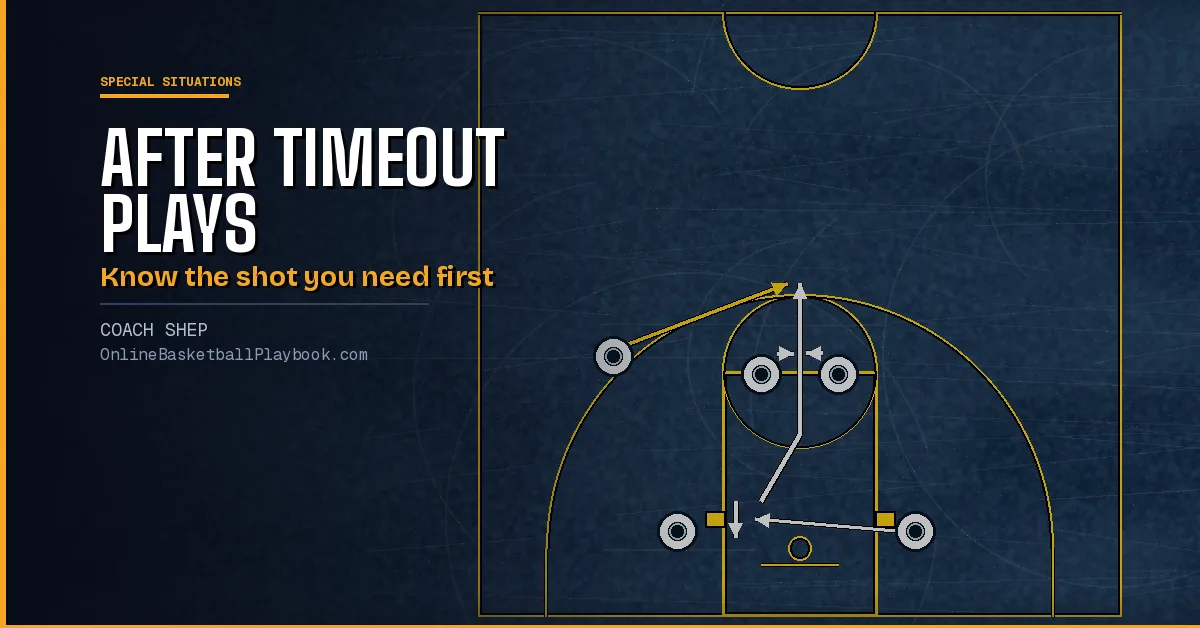
After Timeout Plays: ATO Sets by Score, Clock and Spot
After timeout plays sorted by situation: need a three, need a two, stop a run, sideline or baseline, man or zone, with the fake, the counter and the huddle rules.