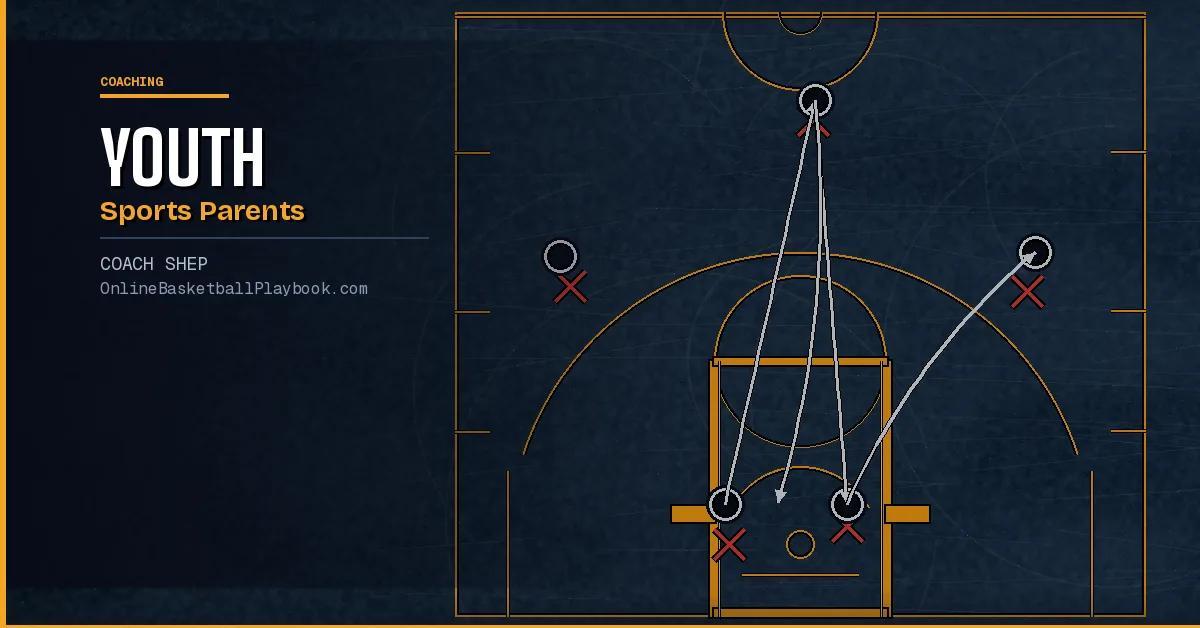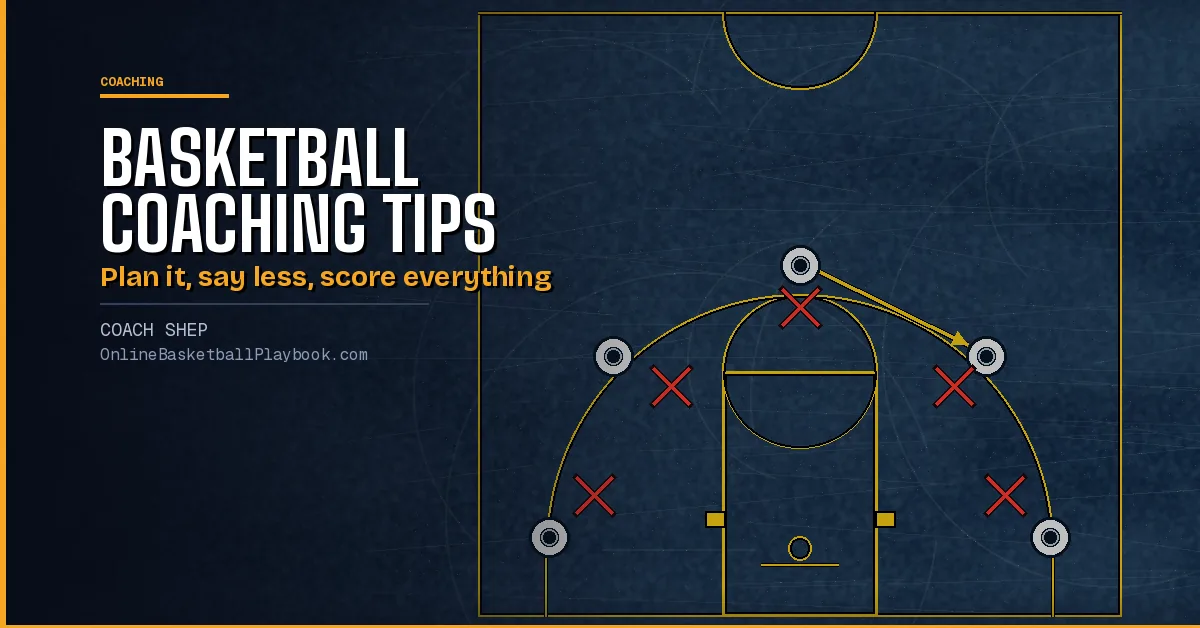
The best basketball coaching tips are the habits real coaches write into their practice plans and team rules. This guide collects them in five groups: running practice, teaching and talking, game day, coaching young players, and working with parents. Every tip comes from working coaches.
Where coaches disagree, such as how loud to be, what opens practice or how long a drill should run, the options are shown side by side so you can choose what fits your team. More guides for running a program are in the coaching section.
Basketball Coaching Tips for Practice
1. Write the plan, then cut it. John Wooden spent two hours each morning planning with his staff and wrote each session on cards down to the minute. Mike Krzyzewski plans the week two weeks ahead and finishes each day's plan the night before. Stan Van Gundy lists every drill he wants with its minutes, at double or more the time he has, then cuts by priority. Templates are on basketball practice plan.
2. Give each practice one emphasis. Bob Knight picks the key thing for each practice and, in season, a point of emphasis for the next game. Sean Miller prints one emphasis and a quote at the top of his plan. Allow two emphases at most.
3. Start on time and never stop. Jeff Van Gundy's rule is that once practice starts it never stops. Knight wants energy from the first drill and players moving to the next drill before the coach finishes explaining it. Phil Martelli calls the immediacy, being ready from minute one, the most important part of practice.
4. Put new and hard work early, and end on something they enjoy. Wooden's planning rules alternate offense and defense, follow hard drills with easier ones, put new material early and close on a happy note. Never end on anything that feels like punishment.
5. Score everything. Nate Oats scores every rep at Alabama, plus three for a made three, plus two for a made two, plus one for a putback and minus two for a turnover, and the losers run. Make the winning team validate a drill win with a made free throw. Scored games for any team are on fun basketball games.
6. Nobody stands. Krzyzewski counts coaches, baskets, managers and rebounders before he plans, so one player is never taught while eleven stand. Knight's assistants cannot stop practice: they pull one player aside, fix him on the sideline and send him back in.
7. Practice the defense against an advantage. Run drills with an extra ball or a 5 on 4 and take away the dribble almost every day. Knight's restriction games keep the defense at a disadvantage on purpose.

8. Build in no-dribble work. Željko Obradović runs no-dribble 5 on 5 for 5 to 10 minutes every practice, because nobody moves without the ball. Go longer with no-dribble drills for 15 to 20 minutes a day.

9. Teach a new idea across days, not in one drill. Obradović installs only two or three new concepts per side of the ball at the start of preseason. A two-two-two timeline gives two minutes to show a skill, two weeks to be comfortable with it and two months before it is automatic in a game. A split-day install never introduces and refines a skill on the same day.
10. Shorten practice as the season goes. Kelvin Sampson practices about two and a half hours in October and an hour and a half in January and February. Krzyzewski never goes past two hours and runs about 45 minutes in February.
Plan it, keep it moving and give every player something to do.
Where Coaches Split on Practice
Coaches split on four questions, so pick an answer for each.
What opens practice?
- Teach first. Jeff Van Gundy opens with teaching, film and situations before the stretch.
- Warm up. Jay Wright opens with a warm-up.
- Individual attention and free throws. Wooden at UCLA opened with them, with stretching inside the fundamentals block.
How long is a drill?
- Five and ten minutes. Knight runs 5 minutes for individual drills and 10 for team drills.
- Six minutes at most. Vance Walberg caps a drill at six minutes.
- Ten to twelve minutes. John Beilein runs drills of 10 to 12 minutes.
How fast is practice?
- Teaching pace. Too slow is better than too fast.
- Game pace. Full accountability on fewer reps.
- Build the pace. Go slow, get a rhythm, then go fast enough to make mistakes.
Do you stop a drill early?
- Stop when the team owns the point.
- Follow the posted schedule. Fix a weak section another day.
Hold your answers all season so players know the rhythm.
Get the next coaching guide in your inbox
One email when a new guide or diagram set goes up. Free.
Teaching and Talking
11. Use fewer words. Observers who counted John Wooden's UCLA practices found he rarely spoke longer than 20 seconds and demonstrated for about three seconds at a time. A shorter rule: one word beats two. Give every coach the same one-syllable cue words. More is on coaching communication.
12. Say what you want, not what you do not want. Drop the word "don't" and say what you want instead. "Don't foul" plants the wrong idea, so teach what to do.
13. Praise in public, correct in private, and show the right way. The rule shout praise and whisper criticism often comes with a praise, correction, praise shape. Wooden showed the right way, imitate the wrong way the player just did, then show the right way again.
14. Choose your volume on purpose. Coaches split here:
- Quiet. Keep the volume down: whisper criticism, never coach angry, or, with youth, yell only positives.
- Loud in practice only. Yell in practice to make players compete harder, never in games or in front of parents, and frame it to players as care.
- A five-level scale. Name five levels, conversational, instructional, correctional, encouragement and "go nuts", each used less often as it escalates.
15. Decide who has a say. Roy Williams is directive: do what he tells you and you will be successful. The alternative is to share the floor:
- Let players voice opinions. Players voice opinions and name the sets.
- Let players write rules. Players help write the team rules.
- Match the style to age. Share the floor with older players and stay directive with younger players.
More on styles is on basketball coaching styles.
16. Write the vocabulary down. Name every drill, action and move and use the names the same way every day. Hand players a written glossary with one word per action. The site's own glossary is on basketball terminology.
Say less, say it clearly and say it the same way every day.
Game Day
17. Timeouts: one voice, one to three points, nothing new. Split a timeout into 30 seconds for water and towels and 30 seconds for the coach, with a single coach speaking, eye contact first and one to three adjustments the team has already drilled. Players remember very little of a timeout. More on basketball timeout strategy.
18. Halftime: one to three keys. Give halftime one to three keys in a positive, confident tone, criticize the team rather than one player, and give a direct reason for any starter who is benched. More on basketball halftime adjustments.
19. Keep the postgame talk short. Keep road postgame talks to a minute or two, name specific positives such as the number of charges taken, and save the real discussion for school.
20. After a costly mistake, console first. The model is John Thompson consoling Fred Brown after the errant pass at the end of the 1982 title game. After a late loss on a player's rules violation, the coach owns it and restores the player's confidence at once.
Decide what you will say before the game so you only have to say it once.
Coaching Young Players
21. Make it fun, and measure it by who comes back. If children do not enjoy it, they will not play it, and players wanting to come back is the best sign of a successful season. Success is defined as each child improving, such as a player who could not dribble in October and now can.
22. Teach the skill inside a game. Use games as the teaching tool, not the reward at the end. Sharks and Minnows teaches heads-up dribbling, and Monkey in the Middle teaches the fake before the pass. You can also reverse the usual order: play a modified game, let players find what they need, teach the skill, then play again.

23. Load a drill instead of switching drills. Add complexity to the drill already running, such as a defender, a second ball or a rule, instead of losing time setting up a new one.
24. Play small-sided. The case for 3 on 3 is more touches and simpler reads for each player. Teach skills first, because young players need one-on-one skills before ball screens.

25. Keep young children's activities short. Cap one skill or drill at five minutes with young children, and run 45 to 60 minutes of several short activities with a ball for every child. A full youth guide is on coaching youth basketball.
Keep it fun and keep every child moving.
Parents
26. Set the terms before the first complaint. Hold a preseason parent meeting or send a letter. Cover the coaching philosophy, season goals, how playing time and roles are decided, and an invitation to ask questions up front. Add the playing-time, schedule-conflict and medical or emergency policies. A full agenda is on basketball parent meeting.
27. Put the policies on paper. Hand out a sheet at the first practice that lists contacts, the schedule, goals, the roster, costs and an explicit playing-time policy, including how absences affect minutes.
28. Use a cooling-off rule. Handle the post-game parent in one of three ways:
- Next-day talk. A parent may ask for a conversation, never right before or after a game, only the next day.
- 24-hour rule. A 24-hour wait after games, with every concern routed through the coach.
- Six-point plan. For an unhappy parent: a preseason meeting, a 24-hour cooling-off period, a witness present, listening fully, talking only about that player and offering specific points to improve.
29. Never compare one player to another. Give a parent the facts behind a starter or position decision, but never compare their child to a teammate. More on basketball parent communication.
Say it early and say it the same way to every parent.
Roles, Standards and Hard News
30. Declare roles early. Role declaration is huge, so declare roles before players play. Dean Smith's Blue Team gave substitutes 8 through 12 a fixed role: they entered as a unit, always in the first half, for one to two minutes.
31. Pick your rule for mistakes. Dean Smith never substituted on a mistake, because a player who is trying needs encouragement. You can instead pull a player for named breaches, such as subbing a player out for a pull-up midrange jumper.
32. Deliver cuts in person. Warn the whole group at the first tryout, tell each player in person with specifics and a written list of skills to improve, offer an alternate role such as manager, never compare players and never post a list. More on basketball tryouts.
33. Set the standards before the first problem. Obradović sets a code of conduct in preseason and enforces it from the first session. Kelvin Sampson's non-negotiables are attitude and effort, held the same after a great practice and after a home loss. How to write team rules is on basketball team rules, and the bigger picture is on basketball coaching philosophy.
Settle the rules before anyone breaks one.
Want the printable playbook packs?
OBP Pro members get the premium playbook packs: the zone attack, out of bounds and practice plan PDFs, plus each new pack as it is finished. The membership page lists what is in each one. Or draw your own version free in PlayDraw.
See what OBP Pro includesQuestions Coaches Ask
What are the most important basketball coaching tips?
Write the practice plan, keep drills short and on a clock, score the drills, say less and say what you want, and set your standards and parent policies before the first problem.
How long should a basketball practice be?
It varies by level and time of year. Kelvin Sampson goes about two and a half hours in October and an hour and a half late in the season. Mike Krzyzewski never goes past two hours. A session for young children runs 45 to 60 minutes.
How long should a basketball drill last?
Bob Knight caps individual drills at 5 minutes and team drills at 10. Vance Walberg caps any drill at six minutes. John Beilein runs drills of 10 to 12 minutes.
How do you coach a youth basketball team?
Keep it fun, teach skills inside games, give every child a ball, keep activities short, play small-sided games and measure success by each player's improvement.
How should a coach handle parents?
Hold a preseason meeting, put playing-time and team policies in writing, use a cooling-off rule after games and never compare one player to another.
More Guides From This Batch
- Spread Offense Basketball: Alignments, Rules and Versions
- Basketball Coaching Philosophy: Examples and a Template
- List of Basketball Violations: Every Violation by Level
- 131 Offense Basketball: The 1-3-1 Set vs Man and Zones
Back to Coaching and Program and every Coaching page.
Keep Building
Related breakdowns
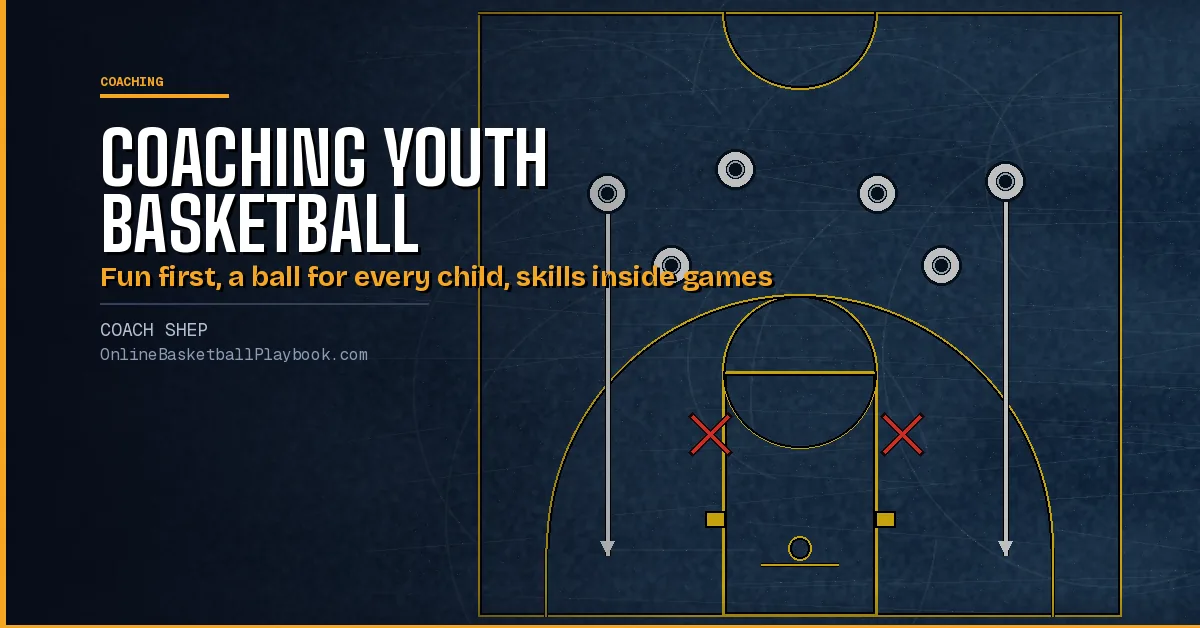
Coaching Youth Basketball: Practices, Games and Parents
Coaching youth basketball for ages 6 to 14, with practice shapes by age, skills taught inside games, man-to-man defense, playing time, feedback and parent meetings.
Tips for Basketball Tryouts: How to Prepare and Stand Out
Tips for basketball tryouts from the player's side: how to prepare, what coaches watch, what to show by position, what to wear and what to do if you do not make it.