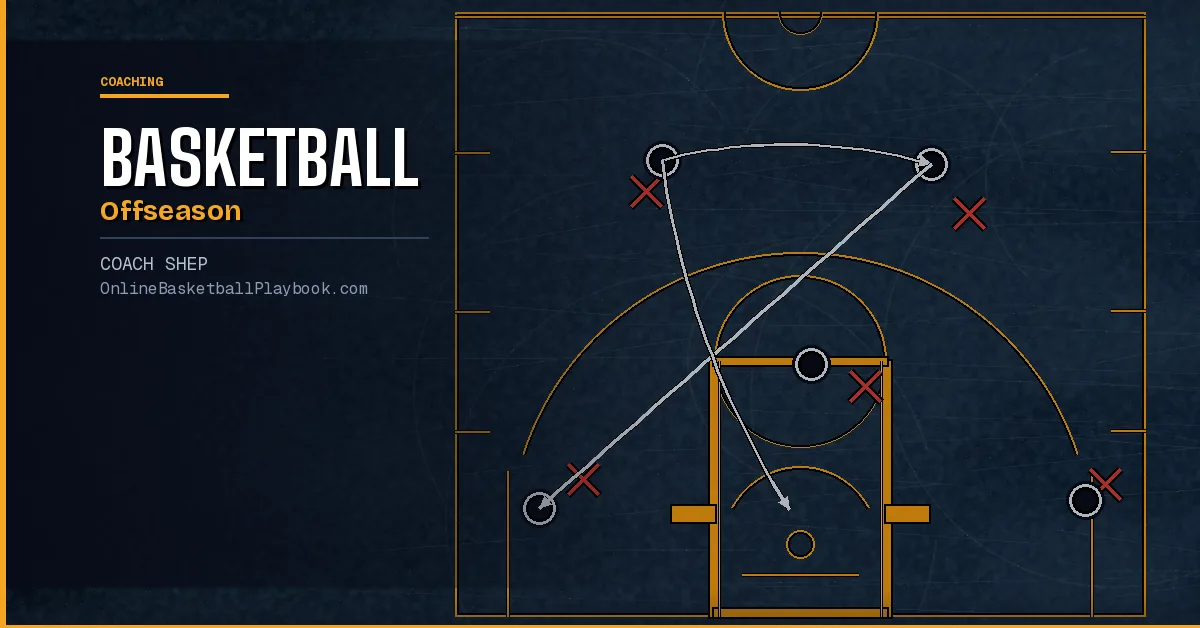
The offseason is where real development happens. Games reveal who you are; the offseason decides who you become. Here is exactly how to spend those months so you return a better player.
Why the Offseason Is Your Biggest Opportunity
Most players treat the offseason like a break. The players who make real jumps treat it like a second season, a longer, quieter one where nobody is watching the scoreboard, which means you can work on what actually needs work.
During the season, coaches are managing rotations, preparing game plans, and trying to win. There is little time for a player to radically change their shot mechanics or learn a new skill from scratch. The pressure of the next opponent forces everyone to play it safe with what they already know. That constraint disappears in the offseason.
This is the window to build something genuinely new. Maybe you are a decent ball-handler who cannot shoot off the dribble. Maybe you are a shooter who folds when you are tired. Maybe your left hand is a liability. The offseason is when you close the gap between who you are as a player and who you want to be, and it only works if you treat the time with real intention.
The players who show up to fall workouts looking noticeably different did not get lucky. They committed to a plan and executed it through the summer. That plan starts with the most valuable skill in the modern game: shooting.
Build Your Shot the Right Way
Shooting development is not complicated, but it does have a sequence. Skip steps and you build bad habits that compound over time. Follow the sequence and you build a shot that holds up under pressure.
Form Before Volume
The first step is form work without a ball. Work on a balanced stance, feet slightly wider than shoulder-width, knees flexed, dominant foot just forward of the other. Then add the ball: get underneath it with your shooting hand (the classic "pizza waiter" cue), elbow under the ball, elbow tracking over the shooting-side knee.
From there, practice the follow-through before you take a single live shot. Hold your finish with your arm fully extended, fingers pointing down at the rim as if you are reaching into a cookie jar on a high shelf. Do this against a wall first. The wall gives you feedback immediately: if the ball hits it crooked, your release is off-center. This is how youth coaches teach it, and it is how professional trainers open their workouts. The form sequence does not change based on level.
The Most Common Errors and How to Fix Them
Most shooting problems trace back to a small number of mechanical issues. Short shots usually mean a release point that is too low. The fix is holding your follow-through with your arm fully extended until the ball lands. A flat arc means your wrist is not finishing through the ball. Pick a point on the gym ceiling above the front of the rim and aim your arc there. Players who do this immediately gain four to six inches of arc. If your shot pulls left or right, check your guide hand: an off-hand thumb pushing across the ball at release is usually the culprit.
The disciplined approach, attributed to shooting expert Dr. Hal Wissel, is to work backward through the mechanics before prescribing any drill. Check arc angle first, then hand position, then elbow alignment, then foot balance. The root cause is rarely what the player thinks it is, and treating symptoms without finding causes means you will be back with the same problem in two months.
Make Every Rep Competitive
Form work is the foundation. But form work alone will not make you a shooter. The second layer (the one most players skip) is making every shooting rep competitive.
A shooting workout should have a winner. That winner might be you versus a clock, you versus a partner, or you versus your own previous record. What it cannot be is a directionless gun-up where you fire shots from the same spots for thirty minutes and leave without knowing whether you got better or worse.
The competitive structure forces concentration on every shot. When there is no consequence for a miss, players rush their preparation, drop their follow-through early, and develop sloppy habits that transfer directly into games. Jay Wright of Villanova put it plainly: sloppy drills create bad habits. Bad reps are not neutral. They actively harm your shot.
Named Drills with Records to Chase
One of the best structures a player can use is a named drill with a record attached to it. Pick three or four drills, something like the Streak (make a set number in a row from one spot), the Star (hit shots from five spots around the arc in sequence), or the Purdue Drill (make four threes in a minute from different spots with a sprint between each), and keep a personal record for each one. Your job every workout is to beat the number on the board.
Shaka Smart ran this system at Texas with explicit team records posted publicly: the 3-Minute drill had a team record of 157 made shots, and the Evans drill had a record of 219. Players competed against each other and against those numbers every day. That scoreboard turned shooting from a chore into a team culture.
You can build the same thing for yourself with a phone notes app and a consistent drill selection. After thirty days, you will have data on your shooting that most players never bother to collect.
Skill Work Beyond Shooting
Shooting gets the most attention, but it does not exist in isolation. Every shot in a real game comes off an action (a catch off a cut, a pull-up off the dribble, a catch-and-shoot off a drive-and-kick). If you only train spot-up shooting, you are preparing for a game that does not exist.
The Pull-Up and the Hesitation
Two of the most undervalued skills in player development are the pull-up jumper and the hesitation dribble. A player who can take one or two dribbles and pull up around the free throw line gives their team a weapon that forces defenders out of the paint and opens driving lanes for teammates. These "in-between" skills are sometimes called lost arts because so many players skip them in training. They either practice threes or they practice finishing at the rim, with nothing in between.
In your offseason work, dedicate at least one session per week to pull-ups from the mid-range. Work off one dribble, two dribbles, and a hesitation-then-pull. Get comfortable shooting tired from that range. It will show up in fourth quarters.
Ball Handling That Creates Shots
Shots come off the dribble, so build the handling that creates them. Game-speed stationary ball-handling (two-ball dribbling, crossovers, through-the-legs, behind-the-back) conditions your hands to move automatically in traffic. Full-court ball-handling sequences build the ability to push pace in transition and attack closeouts. The pull-back crossover for separation, specifically, is one of the highest-value moves you can add in an offseason: it creates space from a defender who is crowding you on the perimeter and gives you the pull-up or the drive depending on what the defense gives you.
Pair your ball-handling with finishing work on straight-line drives. Four dribbles, four trips. Push the ball north-south, attack the rim, finish with either hand. If your weak-hand finishing is a liability in games, the offseason is the only time you can do the volume of reps needed to change that.
Conditioning and Physical Development
Skill work on its own means little if your body cannot sustain it for forty minutes. Offseason conditioning has a different character than in-season conditioning. You have more time, more flexibility, and the ability to push your physical limits without worrying about being ready for tomorrow's game.
Train Under Fatigue
One of the highest-leverage conditioning habits a player can build is training skill under fatigue. Shoot free throws at the end of your workout (after sprints, after your shooting series, after your ball-handling circuits), not at the start when you are fresh. Rick Pitino tracked free throw percentages specifically in the context of live 1-on-1 games when players were exhausted, because those conditions mirror the situations where free throws actually matter in games. If you only shoot free throws fresh, you are not training the shot that counts.
Michigan under John Beilein required players to run 17 sidelines in under one minute before they earned practice reps. That is a conditioning standard attached to a privilege. You can use the same logic in your offseason: earn your skill work by completing your conditioning block first. The sequence matters. Tired hands, tired legs, and a tired mind are what game reps demand.
Strength and Body Composition
The offseason is also the right window for weight room work that you cannot fully pursue during the season. Adding functional strength (particularly in the lower body and core) translates directly to rebounding, post play, driving through contact, and holding your shooting form late in games. Injury prevention work, hip mobility, and shoulder stability all have compounding returns over a career. If you have access to a strength coach or a well-designed program, prioritize it during these months. Your body will not get a longer runway to develop than the summer.
The Mental Edge: Mindset and Film Study
Physical and skill development are not enough on their own. The players who sustain growth over multiple offseasons develop a specific set of mental habits alongside their physical work (habits around how they watch film, how they set and track goals, and how they respond when a workout session goes poorly).
Watch Film with a Question in Mind
Watching film without a specific question is passive. Watching film to answer a specific question ("How does this player get open off ball screens?" or "What does this team's help defense do when the ball is driven baseline?") is active work that transfers to your game. Pick one or two questions per film session and answer them before you close the laptop.
For offensive players, study how the shooters and scorers you want to model get into their shots. Watch their footwork before the catch. Watch what they do when the first option closes. Watch how they set up their pull-up by driving the defender back a step first. These are the reads and habits that separate players who score at a high level from players who wait for perfect situations.
Track Your Progress in practice
Keep a simple log of your workouts. Record which drills you ran, what your makes were, and one observation about what went well or needs work. After thirty days, you have a picture of your development that is based on data, not feeling. If your three-point percentage in the Star drill has gone from 58% to 71% over eight weeks, that is real evidence of growth. If it has been flat for three weeks, that is a signal to change something about your approach: your spots, your form, your practice structure.
The record board that the best shooting cultures use at the team level works the same way for individual development. Numbers tell you things that feelings cannot. Trust the log.
Building Your Offseason Plan
All of the above is useful only if you actually build a plan and stick to it. Here is how to structure an offseason development block from start to finish.
Start with an honest self-assessment. List the two or three weaknesses that cost you the most in games last season. If you fouled out twice because you could not guard the ball without reaching, that is on the list. If your shot broke down in the fourth quarter, that is on the list. Your offseason should address the things that hurt you most, not the things that are fun to work on.
Then build a weekly structure. A sample week for a perimeter player might look like this: two days of shooting-only work (form into competitive drills), two days of full-skill sessions combining ball-handling with shooting off actions, one day of conditioning-heavy training with skill work under fatigue, and two days of rest or light lifting. The exact structure will depend on your goals, your access to a gym, and whether you have a trainer or a partner. The non-negotiable element is that the structure exists before Monday morning. You are not deciding what to work on when you show up.
Finally, build in a checkpoint every three weeks. Review your logs, reassess whether the weaknesses you targeted are actually improving, and adjust the plan accordingly. The offseason is long enough that a plan that is not working should be revised, not just repeated out of habit.
One of the most overlooked offseason habits is training with a partner who holds you to a standard. A partner who counts your makes, calls out soft reps, and competes with you in drills will push you harder than any amount of solo motivation. Find one and commit to a regular schedule for the summer.
- Open every shooting session with form work: Balanced stance, pizza-waiter hand under the ball, follow-through to the cookie jar. No shortcuts, even five minutes, even in July.
- Attach a number to every drill: set a personal record on the Star or Purdue drill the first week, then chase it every session. No target, no accountability.
- Train the pull-up deliberately: At least one session per week focused on one- and two-dribble pull-ups from the mid-range and the wing. The in-between game that separates good perimeter players from great ones.
- Shoot free throws at the end, not the beginning: tired free throw reps build the habit that matters in fourth quarters; fresh free throws only tell you how good your shot is when nothing is on the line.
- Review your log every three weeks: If a weakness you targeted in week one has not moved by week six, change the approach. Same drill, same spots, same result is not a development plan.
Want more basketball coaching strategies and drills?
Join the Online Basketball Playbook newsletter →
Draw this play free in the play drawer →
Membership: the full library, playbook packs, and Pro drawing tools →
Keep Building
Related breakdowns
Basketball IQ: What It Is and How to Teach It
Basketball IQ is knowing why and when, not just how: the reads players learn, thinking ahead, rebounding and shot reads, game state, and how coaches teach it.
The Gather Step in Basketball: What It Is and How to Use It
The gather step is what makes the Euro step and spin move possible. Here's how a strong, controlled gather creates a scoring advantage, plus footwork drills to build it.
How to Protect the Ball: Ball Security and Fewer Turnovers
How to protect the ball in basketball: where turnovers come from, ripping and catching, the sure pass, beating a trap, ball security drills and pricing turnovers.