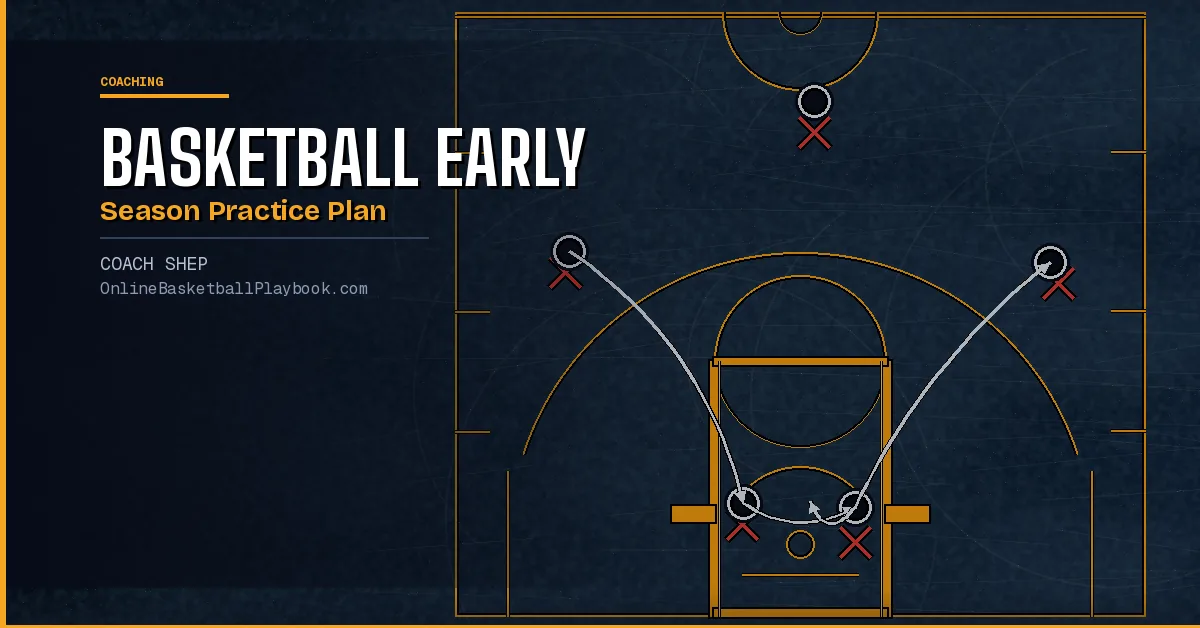
The first weeks of practice set the tone for everything that follows. Get the structure right (conditioning, skills, offense, defense) and your team builds habits that compound all season long.
How to Structure Every Practice Session
Before you map out week-by-week content, you need a consistent session template. Without one, practice time bleeds into setup, water breaks turn into ten-minute conversations, and your players never know what comes next. A predictable structure removes that friction.
A reliable 90-minute early season template looks like this:
- 0–10 min: Dynamic warm-up: Movement patterns, hip openers, change-of-direction work. Not static stretching. Get their bodies ready to move at pace.
- 10–25 min: Individual skills block: Ball-handling, footwork, or shooting repetitions in small groups. Coaches are on the floor coaching technique, not standing back watching.
- 25–50 min: Team offense installation: Walk it through at half-speed first, then build to live pace. Correct posture and spacing before you ever add defenders.
- 50–70 min: Defensive segment: Breakdown drills first (1-on-1, 2-on-2), then build to team concepts.
- 70–82 min: Competitive drill or 5-on-5 segment: Players need to compete every day. Keep score. Make it matter.
- 82–90 min: Conditioning close and team talk: End with wind sprints or shell-drill runs, then bring them together for a brief film or whiteboard review of the day's priority.
Stick to this template for the first two weeks. Players adapt faster when they know what phase is coming. By week three, the structure itself becomes invisible and the focus shifts entirely to execution.
Week 1: Conditioning and Foundational Skills
Week one has a single job: build the physical and technical floor your season will sit on. Most coaches are tempted to install plays immediately. Resist that. Players who aren't conditioned to execute your system will learn the wrong habits at slow speed, then carry those habits into games.
Conditioning Priority
Early season conditioning should be basketball-specific. Long distance running builds aerobic base but does little for the anaerobic bursts that actually drive game performance. Instead, use:
- Suicide sprints: Full court, half court, baseline to half. Time them. Post the times. Competition on the board creates urgency.
- Shell drill at pace: The shell drill (four offensive players, four defenders in proper positioning) doubles as a conditioning exercise when you run it for reps without stopping. Players are moving their feet, communicating, and getting their heart rates up inside a defensive concept.
- Transition runs: Numbered fast break (3-on-2, 2-on-1) run continuously for five to seven minutes. Players get wind and see the floor at the same time.
Foundational Skills for Week One
Pick two or three skill categories and own them before you add more. The typical early-season mistake is touching too many things and mastering none. Here is where most programs should start:
- Ball-handling: Two-ball dribbling, stationary and moving. Weak hand emphasis every day. This pays dividends on ball security in pressure situations later in the season.
- Footwork in the post: Jump stop, pivot, shot fake. These fundamentals disappear when players are tired in game four. Build them when everyone is fresh.
- Catch-and-shoot mechanics: Triple threat, one dribble pull-up, catch and go. Run these from different spots on the floor with game-like footwork, not just standing still.
Week 2: Building Half-Court Offense
By week two your players should be moving well enough to absorb offensive concepts. Start with your most-used half-court action (the one play or set you expect to run thirty times per game) and install it with precision before adding anything else.
Teaching the Primary Action
Walk through your primary action without defense in three stages:
- Whiteboard or diagram first. Players should see the floor before they step onto it. Use a portable whiteboard or tablet at half court. Five minutes here saves fifteen minutes of confusion on the floor.
- Walk-through at 50% speed with no defense. Coach every player through their cut, screen, or spacing assignment individually. Stop and correct spacing constantly. "You're two steps too close to the ball. Move to the three-point line" said on day one means you never have to say it in January.
- Full speed against a dummy defense. Defenders are passive. They don't contest, they just occupy space. This lets the offense feel the timing without the stress of live competition.
Spacing Principles to Reinforce Daily
Whatever your offensive system, spacing principles carry across all of them. Drill these verbally every practice until players can say them back without prompting:
- The ball is the center of gravity. Every player adjusts their position based on where the ball is, not where they started.
- Five feet outside the three-point line is the minimum floor spacing. Closer than that and you clog driving lanes for your own teammates.
- When in doubt, move. A stationary player with no defender on them is dead spacing. Cut, screen, relocate.
Week 3: Installing Your Pick-and-Roll Defense
Pick-and-roll defense is the highest-leverage teaching priority on the defensive end. It is not one coverage. It is a decision menu tied to personnel, game situation, and where the ball is caught. The earlier you install the menu, the more reps your players get at executing the right coverage at the right time.
Start With the Coverage Decision Rule
Before players can execute any coverage, they need a simple decision rule that tells them which one to use. Teach your bigs this first: if the ball is caught high or there is initial separation between the handler and the screener, drop back and contain. If both players arrive attached at the arc level, show hard and "dance" with the handler: arrive with the screen, stay in sync, do not get hit, and bully through the recovery. Everything else grows from that two-choice decision tree.
The Three-Phase Framework
Every ball-screen coverage has three phases and players need to know the vocabulary of all three before you install any specific scheme:
- Coverage: What the two on-ball defenders do (the on-ball guard and the screener's defender).
- Protection: What the three off-ball defenders do to ensure the initial coverage holds up. This is where most high school teams fall apart. They get the on-ball coverage right and then give up the corner three because nobody moved on the pass.
- Recovery: Closeouts and rotations after the ball moves. A short closeout is played as a 1-on-1 contest. A long closeout off a skip pass runs the shooter off the line into a rotation.
When a coverage breaks down, name the phase that broke first. That discipline ("we gave up that shot because Protection failed, not because our on-ball coverage was wrong") teaches players to self-diagnose rather than blame the scheme.
The 2-on-2 Reps That Install the Coverage
Run your pick-and-roll breakdown drill at the start of every defensive segment in week three. Set it up at the top of the key: one handler, one screener, their two defenders. The defense executes the coverage decision (drop or show) and reads the roll vs. pop. Run it for reps (both sides of the floor) before any 5-on-5 look. Players who own the 2-on-2 read execute it correctly in team defense without needing to be coached in the moment.
Week 4: Putting It Together in Live Situations
Week four is where early season practice starts to look like basketball. You have conditioned players, a primary offensive action, and a ball-screen coverage decision installed. Now you compete at full pace and let mistakes teach.
Running Competitive 5-on-5 Segments
Structured 5-on-5 play in week four should not be open scrimmage. Assign specific situations:
- Half-court only, shot clock at 14 seconds: Forces your offense to run their primary action quickly rather than settling into slow play. Defense knows the set is coming and must execute the coverage.
- Live ball-screen situations: The defense must call out the coverage before the screen is set. If they don't communicate, stop play and reset. The habit of calling the coverage early is the behavior that survives to games.
- End-of-shot-clock pressure: Put the offense in with eight seconds on the shot clock. They must create a quality shot. Defense must deny the easy escape. This is where your week three PnR work gets tested at game speed.
Using Film and the Whiteboard Mid-Week
At least once in week four, cut practice short by ten minutes and use the time for a whiteboard session or brief film clip review. Show your team their own footage from week two or three, good and bad reps. Players fix mistakes faster when they see them. A coach saying "you're too close to the ball" has less impact than a player watching themselves crowd a driving lane on screen.
When you install any new coverage or offensive set in live play, let the first few reps go without stopping, even if the execution is poor. Players need to feel the chaos of real defense before corrections land. Stop the drill after a sequence completes, then coach the error you just saw. Stopping mid-rep before players finish the action teaches hesitation, not execution.
Common Early Season Mistakes and How to Avoid Them
Most early season practice plans fail not because the content is wrong but because of a handful of predictable execution errors. Recognizing them before they happen is half the fix.
Installing Too Much Too Soon
A practice plan with eight offensive sets, three defensive schemes, and a full transition package in the first two weeks produces players who execute nothing cleanly. Pick one thing per practice segment and own it. Add the next concept when the first one holds up under live defensive pressure, not before.
Conditioning Debt Catching Up in November
Teams that skip rigorous conditioning in the first two weeks pay for it in the fifth and sixth games of the season. That is when opponents who worked harder in October pull away in the fourth quarter. Run your players hard in week one and week two. They will thank you when they have legs at the end of close games.
Neglecting the Off-Ball Defenders
Most defensive coaching time in the early season goes to the on-ball defender. The other four are largely forgotten. But over-helping is as costly as under-helping. A wing who cheats toward the ball-screen roll gives up a corner three every time. Build your protection rules into every defensive rep from week three forward, not as an afterthought.
Skipping the Language
Your players can only execute what they can name. If they do not have a word for the coverage, they cannot call it before the screen is set. Install the defensive vocabulary (drop, show, blitz, early, last, low-man) before you install the technique. The word is the behavior. Once a player can say "drop" the moment he sees a ball-handler with separation, the feet follow.
Not Competing Every Day
Early season practices that are entirely drill-based without a competitive segment produce soft players. Keep score in at least one drill per day. Post the winners. Let players celebrate. Competition in practice is the training environment that most directly transfers to game performance. Build it into your template and protect it from being squeezed out by other segments running long.
- Day 1 priority: establish the session template: Open with dynamic warm-up, move through individual skills, offense installation, defense segment, competitive drill, and conditioning close. Run this same order every day until it becomes muscle memory for your staff and players alike.
- Ball-screen coverage call is mandatory before every screen: Defenders must verbally call "drop" or "show" as soon as they see the screen being set. If the call is absent, stop the drill and reset. The habit of early communication is built in practice or it never arrives at all.
- Protection rules for the off-ball three. Teach them as one unit: The low man owns the roll or pop, the next man X-outs to the hardest passing lane, and every defender moves on the flight of the pass in the direction of the pass. If even one of the three fails, the coverage leaks regardless of how clean the on-ball work was.
- Whiteboard before floor: always: Five minutes diagramming the new action before anyone steps on the floor saves fifteen minutes of confusion mid-drill and reduces the number of times you stop play to re-explain spacing that players should have already seen.
- Run the 2-on-2 PnR breakdown drill at the start of every defensive segment in week three: Handler, screener, two defenders: run it both sides of the floor, call the coverage decision out loud before each rep, and correct the roll-vs.-pop read before layering in 5-on-5 looks.
Want more basketball coaching strategies and drills?
Join the Online Basketball Playbook newsletter →
Draw this play free in the play drawer →
Membership: the full library, playbook packs, and Pro drawing tools →
Keep Building
Related breakdowns
Basketball Practice Plan: Template, Youth Plans and Examples
A basketball practice plan template you can copy, youth plans by age, high school orders from named coaches, rules for timing and scoring and where coaches disagree.
How to Run an Effective Basketball Practice: Plan, Pace, Score
How to run an effective basketball practice: write the plan, start on time, cap drills on a clock, score every rep, pick your pace and use film.
Basketball In-Season Practice Structure Guide
Basketball In-Season Practice Structure Guide