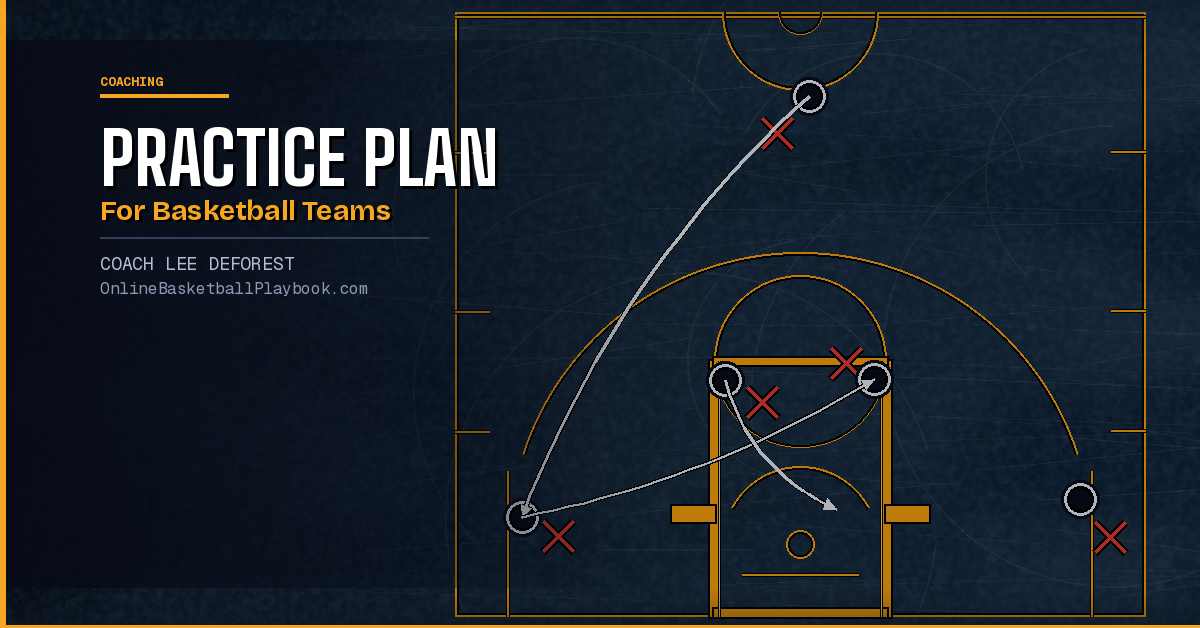

A great practice doesn't happen by accident. The coaches who develop players fastest build every session around a repeatable structure — clear priorities, purposeful reps, and built-in accountability. Here is how to do it.
Why Practice Structure Determines Team Development
Most coaches know what they want to teach. The problem is time. A typical high school basketball practice runs 90 to 120 minutes. Factor in transition time between drills, water breaks, and addressing mistakes in the moment, and the window for actual skill development is smaller than it looks on paper. The coaches who consistently develop players fastest share one trait: they treat practice time as a scarce resource and structure every minute deliberately.
Structure removes the most common coaching mistake — spending too long on what feels comfortable. Coaches naturally gravitate toward drills they like running, skills they feel confident teaching, or situations the team struggled with in the last game. All of that is reactive. A structured practice plan is proactive: it sequences development in the right order, builds on the previous session, and ensures nothing critical gets skipped because the coach ran out of time.
The other benefit of structure is player confidence. When players know what to expect at practice — how it opens, how it flows, how it closes — they arrive mentally prepared. That mental readiness compresses the warm-up period because players are already locked in before they step on the floor. Over the course of a season, that adds up to dozens of extra high-quality reps.
Think of your practice plan the way a good teacher thinks about a lesson plan. You have a learning objective, a sequence that builds toward it, and an assessment moment at the end to verify it was absorbed. The medium is basketball. The discipline is the same.
The Core Components of an Effective Practice Plan
Every practice, regardless of where you are in the season, should move through the same five phases. The time allocated to each phase shifts depending on the week, the opponent, and what the team needs most — but the phases themselves stay constant. That consistency is what makes them useful.
Phase 1: Dynamic Warm-Up (8–12 minutes)
Skip static stretching at the opening of practice. Research and coaching experience both support the same conclusion: dynamic movement prepares the body better and doubles as early skill work. Run your warm-up through a combination of movement patterns — defensive slides, carioca, backpedals, and then ballhandling chains that progress from simple to complex. By the time warm-up is done, every player has already handled the ball at least 50 times and their feet are ready to move.
Use this time to set the tone. The energy you establish in the first 10 minutes carries through the rest of practice. If warm-up is sloppy and casual, the next 90 minutes will follow. Hold the standard from the first whistle.
Phase 2: Skill Development (20–30 minutes)
This is the core teaching block. Pick one or two skills that align with your weekly teaching priority. Do not try to teach five things. Depth beats breadth in skill acquisition — your players will absorb one skill drilled 200 times far better than five skills drilled 40 times each.
Structure skill work as a progression: isolated technique first, then conditioned decision-making, then live application. A shooting drill that starts with form work, moves to off-the-catch decisions (baseline or middle), and finishes with a defender closing out gives players the full context they need to use the skill in a game.
Phase 3: Team Concepts (25–35 minutes)
This is where you install and reinforce your system. Walk through situations at a teaching pace first, then increase speed and resistance incrementally. Call freeze reps when you see a mistake so the entire team can learn from it — not to embarrass the player who made the error, but because the same situation will come up for every player on the court at some point. Shared reps create shared understanding.
Phase 4: Competitive Drills (15–20 minutes)
Give the team a chance to compete. This is where learning gets tested. The competitive block should have stakes — winners and consequences for losers, kept small and meaningful. Sprint, extra reps, or a drill reset are fine; nothing that degrades trust or morale. The goal is to simulate game pressure inside a controlled environment so players have a reference point when that pressure appears on game night.
Phase 5: Conditioning and Closeout (10–15 minutes)
Close with conditioning only if it has not been embedded throughout practice. Most well-designed practices are already physically demanding — the conditioning is built into the competitive drills and transition work. If you close with additional conditioning, make it skill-integrated wherever possible. Sprint and catch. Closeout and contest. Defensive slide and recover. Pure running is a last resort, not a default.
How to Teach Defense Through Your Practice Plan
Defense is where most teams lose practice efficiency. It requires the most verbal coaching, the most correction, and the most coordination among players — which means it takes longer to install than offense. Coaches who don't account for that reality end up rushing their defensive teaching and then wondering why the team breaks down in games.
The most effective defensive practice structure isolates the two-player problem first, then adds the three off-ball defenders, then plays five-on-five. This mirrors how elite coaches — including those who have built some of the best defensive systems at the pro level — think about the problem. The ball-screen is a prime example.
Pick-and-roll defense accounts for roughly 30 to 40 percent of all possessions at every level of the game. That number climbs above 50 percent when you add transition and late-clock sets. That makes it the highest-leverage defensive concept to install in practice. Yet many teams spend more practice time on offensive sets than on the two-on-two and three-on-two situations that determine whether their defensive system holds up under pressure.
Teach your bigs one clear rule first: drop if the ball is high or there is separation, show if both defenders are attached at the arc. That single rule upgrades any young team's ball-screen defense immediately because it removes the hesitation that kills coverage — the moment when a defender is unsure what to do and does nothing while the handler turns the corner.
Add off-ball protection in the second week. Players need to know their job when the ball is being screened and they are not involved in the action. The two most important assignments are the low man — who owns the deep roll — and the next man out, who moves to cut off the first pass. Drill those two roles explicitly before you move to five-on-five, or your five-on-five will be five players each guessing independently and blaming each other when it breaks down.
Coverage is a decision, not a default. Ball caught high or with initial separation means drop — heels to the arc, keep the handler in the middle third, trace the roller's pass. Both men attached at the arc means show — arrive with the screen, stay in sync, never get hit, bully through.
— PnR Defense Coverages, Basketball Vault
Competitive Drills That Transfer to Games
The best competitive drills share three qualities: they replicate a situation that happens in games, they force players to make the same decisions they will face under game pressure, and they can be scored or tracked so players know exactly where they stand.
A few reliable structures that work across age groups and skill levels:
3-on-3 Halfcourt — First to 5
Three-on-three is the purest test of individual skill within a team framework. Every player is involved on both ends. There is no hiding. Run it in halfcourt to a score of five, make-it-take-it. The team that wins stays on; the team that loses goes to the back of the line. This drill surfaces every offensive and defensive concept you are teaching — ball movement, spacing, pick-and-roll reads, closeout defense, help rotations — without the complexity of five-on-five.
Shell Drill — No Mistakes Allowed
Shell drill is the foundational defensive teaching tool. Four offensive players stationed around the perimeter, four defenders in help positions. The objective: ball moves, defense moves. No late rotations. No reaching. No missed coverages. Run it until the defense executes four consecutive stops without a breakdown, then add a ball-screen and run it again. The "no mistakes allowed" framing — restarting the count when a breakdown occurs — applies natural pressure without manufactured stakes. Players police themselves because the restart belongs to the whole group.
Transition Drill — Sprint to Score
Start with a live rebound or turnover situation and push the pace immediately. The goal is to create a numbers advantage within the first two passes. This drill teaches players to read the break — who leads the push, who fills the lanes, who trails for the reset — while also conditioning the defensive mindset of a team that sprints back rather than watching the shot. Keep it short. Six or eight possessions is enough. The intensity drops sharply after that.
How to Adjust Your Practice Plan for Gameweek
Practice plans should not look the same in October as they do in February. Early in the season, practice is about installation — teaching your system, establishing standards, and building physical conditioning. As the season progresses and the schedule intensifies, practice shifts toward reinforcement and game preparation.
A general gameweek structure that works for most programs:
Day 1 after a game: Review film. Walk through breakdowns without the ball. Keep it short — 45 to 60 minutes maximum. Players need physical recovery and the film session is more valuable than another hard practice 24 hours after competition.
Two days before the next game: Full practice, maximum intensity. This is where you install what you need to install and get as many quality reps as possible. Run your full practice structure. Compete hard. End with confidence.
One day before the game: Shoot-around and mental preparation. Thirty to forty minutes. Reinforce three or four key points for the next game. Walk through defensive assignments against the opponent's primary sets. Finish with free throws and something the team does well — you want them leaving the building feeling ready, not scrambling to fix problems they cannot solve in one session.
The coaching temptation before a big game is to add more — more sets, more coverage calls, more scouting detail. Resist it. Players execute what they know, not what they learned the day before the game. The best preparation is sharp execution of your own system, not a cramming session on the opponent.
Write your practice plan on paper the night before, not in the gym parking lot. When you plan ahead, you make intentional decisions about priorities. When you plan on the fly, you default to comfort — which means the things your team needs most get skipped in favor of what is easy to run. Give your plan 15 minutes the night before and it will save you 30 minutes of wasted practice time the next day.
Evaluating and Improving Your Practice Plan Over Time
The coaches who improve fastest are the ones who treat their own practices like film sessions. After every practice, spend five minutes reviewing what worked, what didn't, and what you would change if you ran it again tomorrow. Write it down. Most coaches do this mentally but never commit the observations to paper, which means the same inefficiencies repeat week after week.
Track the following metrics over the course of a season:
Time on task. How many minutes were players actually engaged in purposeful activity versus standing and waiting? This is the most important efficiency metric in practice design. A drill that requires six players but only has two active at a time is costing you four repetitions for every one earned. Redesign it.
Drill-to-game transfer. When you watch game film, which skills are showing up? Which ones are absent? If your team runs a closeout drill every day but is not closing out in games, the drill is not replicating game conditions closely enough. Add a live ball and a decision. Add a second defender. Make it more realistic and the transfer will improve.
Player engagement.** Are players locked in from the first whistle to the last? Disengagement during practice is not a discipline problem — it is a design problem. Players disengage when drills are too easy, too slow, or too disconnected from what they care about. Fix the drill before you address the attitude.
Bring your assistants into the evaluation process. Ask them one specific question after practice: what would you have done differently? That conversation, done consistently, surfaces blind spots that are invisible to a head coach who is also managing a hundred other things during practice.
Over time, you will build a library of drills and sequences that you trust completely — because you have data on them. You know which drill produces the best ball-screen reads. You know which competitive structure generates the most defensive intensity. You know how long your team can sustain maximum effort before quality drops. That knowledge is what separates a practice plan from a guess.
- Lock in your teaching priority before Monday: every drill in the week should connect back to one or two core concepts you are installing — scattered themes produce scattered players.
- Max 3 new things per practice: players absorb one new concept deeply far better than three at surface level; drill the priority until you see it click, then move on.
- Name every coverage and assignment explicitly: "the word is the behavior" — use the same language every day so players respond automatically under pressure without needing to think about terminology.
- Put your best drill in the first 40 minutes: player attention and energy peak early; save the conditioning and individual work for later when the teaching window is smaller.
- End every practice with something the team does well: the last five minutes shape how players feel walking out — confidence and positive momentum carry over to the next session.
Want more basketball coaching strategies and drills?
Keep Building
Related breakdowns
Sample Practice Plan Basketball: Complete Guide for Effective Team Training
Sample Practice Plan Basketball: Complete Guide for Effective Team Training
Basketball Practice Structure: How to Plan Your Time
Basketball Practice Structure: How to Plan Your Time