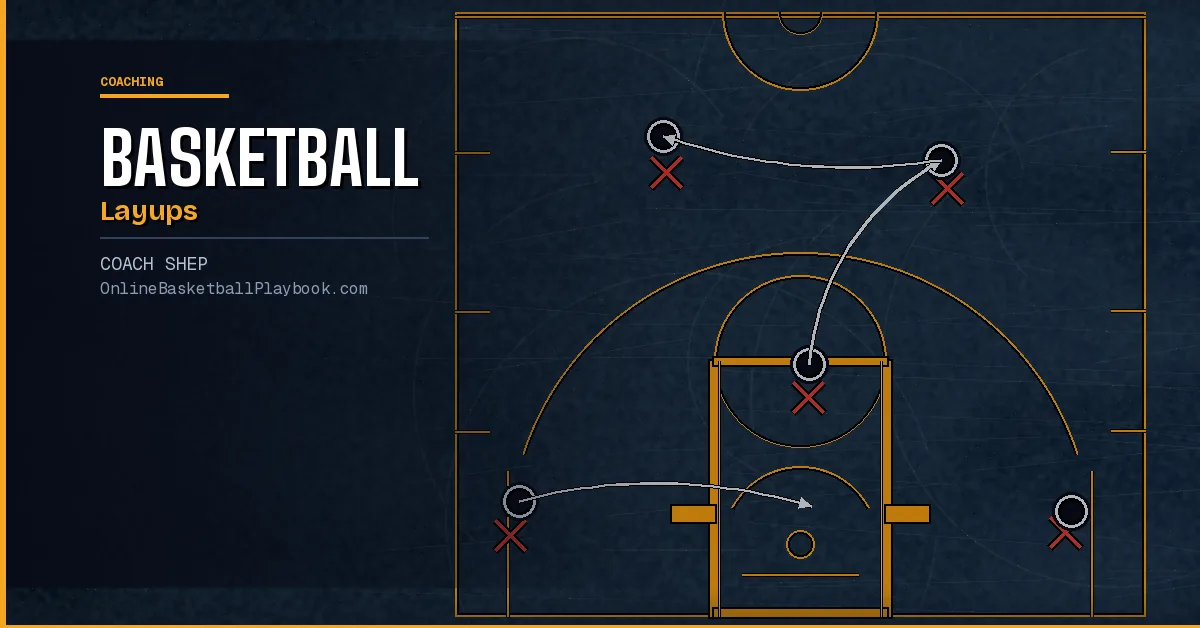
Most players know one layup. Great finishers know six and pick the right one by reading the defense. This guide teaches the footwork, the finish menu, and the drills to own the paint.
Why the Layup Is the Hardest Skill to Master
Players shoot layups from age five. By high school, most coaches stop teaching them. That is a mistake. The layup looks simple in isolation, but it is the most decision-dependent shot in basketball. You are moving at full speed, a defender is closing, help is rotating, and you have roughly half a second to choose your footwork, your hand, your angle, and your target on the backboard. Get one piece wrong and the shot is gone.
The reason most players struggle to finish at the rim is not lack of athleticism. It is a thin finish menu. They have practiced one layup their entire career: the right-hand regular layup from the right side. The moment a defender takes that away (shading their body, forcing left, or simply sending a help-side big to the rim), the player has no answer. A missed layup in a close game almost always traces back to this single-option problem.
Great finishers are built, not born. Players like Stephen Curry and Ja Morant are studied in part because of how many different ways they can score at the rim. Curry finishes with both hands, uses the backboard from angles most players ignore, and draws fouls with well-timed power moves. Morant extends through contact with his body control and uses the floater to eliminate rim protectors entirely. These are trained skills, not natural gifts. The difference is that they were taught a full finish menu early and drilled it until each option was automatic.
This guide covers the footwork base, the full menu of finishes, how to read the defense to select the right one, and the practice structure that makes all of it stick.
The Footwork Foundation Every Finisher Needs
Before you can master a layup menu, you need body control. The footwork that supports layup finishing is the same footwork that supports every individual offensive skill: a balanced stance, reliable stops, and the ability to gather under pressure.
The Jump Stop
The jump stop (landing on both feet simultaneously after a dribble or catch) is the most underused teaching tool in finishing development. Most players are taught a one-two step layup early and never deviate from it. The jump stop gives the player a reset: land balanced, designate your pivot foot, and make a decision before committing. Coaches who enforce a jump-stop-only layup rule in the first weeks of the season consistently report that their players improve at dealing with help defense, because they are forced to gather and read rather than float through contact.
The Stride Stop and Gather
The stride stop (a two-count stop using alternating feet) is what powers the traditional layup. The key teaching point is the gather: the last dribble should be low and hard, the gather step long and low, and the knee should drive upward on the finish to protect the ball and generate lift. Players who struggle with off-hand layups almost always skip the gather. They try to finish before their body has actually collected itself, which is why the ball goes flat against the glass or deflects off the rim.
Driving North, Not East
One of the clearest footwork concepts in finishing is the difference between a driver's first step and a passer's first step. Passers step laterally, east or west, to create a passing lane around a defender. Drivers step north (directly at the defender's lead foot) and then scrape off the defender's shoulder to cut off the angle of pursuit. Players who step laterally when they intend to drive give the defender recovery space. When you attack the lead foot directly, the defender cannot recover without fouling or giving ground. This distinction alone fixes many layup problems that look like finishing issues but are actually footwork problems that happen three dribbles before the shot.
Using the Rim as a Shield
Every finish in the layup menu should be taught with the principle of using the rim as a shield. When you finish from the right side with your right hand, the rim sits between your shooting hand and the shot blocker on that side. When you switch to a reverse layup, you are putting the rim between you and the help that has rotated from the opposite side. The rim itself is the blocker. The player just needs to get to the right angle to use it. Players who understand this principle automatically make better decisions about which finish to use, because they are solving a geometry problem: where is the help, and which angle puts the rim in the way?
The Complete Layup Finish Menu
A complete finisher needs six finishes. Not all six are needed at age ten, but by high school the full menu should be accessible. Here is each finish, what it is for, and what the common error looks like.
1. The Regular Layup
The starting point. Right side of the basket, right hand, right knee driving up, ball placed off the backboard above the box. The common errors are releasing too early (ball comes off the board below the box), using the wrist incorrectly (the ball should roll off the fingertips, not be pushed), and failing to gather before jumping. Drill this until both hands are equally automatic. Many players have a reliable right-hand regular layup and a broken left-hand version, which tells defenders everything they need to know.
2. The Power Layup
The power layup uses a two-foot jump stop instead of a one-two stride to gather before finishing. It is the finisher's tool against rim protectors and physical defenders. By landing on two feet, the player can absorb contact without losing balance, and the two-foot launch generates enough force to finish through the foul. Power layups are underused at the youth level because coaches prioritize the more aesthetic stride-stop version. Teach the power layup early. It is the highest-percentage finish in traffic.
3. The Opposite-Hand Layup
The left-hand layup from the left side (and right-hand from the right side when the defender shades the primary hand). The same mechanics as the regular layup, but the off-hand version is rarely drilled enough. A player who cannot finish with both hands is predictable. Run the Mikan drill (alternating regular layups from each side) until both hands are equal. Most players need double the reps on their weak hand to close the gap.
4. The Reverse Layup
The reverse layup goes under the basket and finishes on the opposite side of the rim. It is the answer to baseline help defense. When you attack the baseline and a shot blocker is rotating from the weak side, going reverse puts the rim between your shot and the block attempt. The finish requires a player to stay low under the basket, keep the ball protected, and place the shot softly off the near side of the backboard. The most common error is taking the ball too wide and losing the angle. The reverse should be tight to the basket.
5. The Floater (Runner)
The floater is the weapon against rim protectors in the mid-range. Rather than driving all the way to the backboard and contesting with a taller defender at the rim, the finisher releases the ball early (off the proper foot, with a high arc) before the shot blocker can get set. The floater is a delicate finish that requires significant repetition to develop touch. Key teaching point: the release foot matters. A floater off the wrong foot produces an awkward, flat shot. Drill the floater explicitly off both feet so the player can use it going left or right.
6. The Euro Step
The Euro step is a two-step gather that changes direction: the first step goes one way, drawing the defender, and the second step goes the other way to avoid the block. It is the most advanced finish in the menu and requires the most body control. The Euro step is legal as long as the player gathers before the two steps begin. The common traveling mistake comes from taking an extra step before the gather. At the youth level, the Euro step should be introduced after the player can reliably perform the first five finishes. Master the simple before the complex.
Reading the Defense: Choosing the Right Finish
The menu is only half the equation. Players need a decision framework for choosing the right finish in real time. This is what separates a practice finisher from a game finisher. In practice, you know which finish you are going to use before the rep starts. In a game, you read the defense and react.
Scan Before You Catch
The best finishers read the defense before they even begin their drive. Where is the help defender? Is the weak-side big staying home or rotating? Where is the primary defender positioned? This pre-drive read narrows the finish decision before the drive begins. If you see the rim protector is already cheating toward your driving lane, the floater is the first option before you even take a dribble. If the lane is open, a power layup is the highest-percentage choice.
Help from Straight Ahead: Floater or Reverse
When the rim protector takes away a direct path to the backboard, the two primary answers are the floater (release before contact) and the reverse (change angles to use the rim as protection). The floater works best when the help arrives early and the player has time to set their feet for the release. The reverse works best when the player has already committed to the drive lane and needs to go under rather than through the defender.
Help from the Weak Side: Reverse or Power
Weak-side help that rotates to the rim is best answered with a reverse layup (it goes opposite the help) or a power move that absorbs the contact and finishes through it. The reverse keeps the ball on the non-help side of the rim. The power layup dares the defender to foul.
Primary Defender Shading the Ball Hand: Switch Hands
When the primary defender forces the player away from their dominant hand, the opposite-hand layup is the answer. This sounds obvious but requires that the off-hand layup has actually been drilled. Most players arrive at this moment having never seriously practiced the finish with their weak hand, and the result is a miss. The off-hand layup is only a real option when it has been trained to match the dominant hand's reliability.
Teach the read before you teach the move. Show players what each defensive position looks like, name the threat, and then explain which finish answers it. Players who understand why they are using a specific finish make better in-game decisions than players who have only been shown the mechanics of each move without the defensive context that triggers it.
Drills That Build Real Finishing Ability
Finishing skill is built through specific, well-designed repetition. The following drills are organized by purpose: footwork first, then individual finishes, then reads.
Mikan Drill
The classic finishing drill: alternate layups from each side of the basket without letting the ball touch the ground. Left hand from the left side, right hand from the right side, continuous. The Mikan drill builds touch, timing, and coordination around the basket. Set a rep target (20 makes in a row, alternating sides) before moving to the next drill. Add a reverse Mikan (same motion but reverse layups) once the basic version is automatic.
Jump-Stop Layup Series
Dribble to the basket, jump-stop gather, then finish. The jump-stop forces players to gather before committing to the finish, which builds the habit of reading the defense before launching. Run this from both sides with both hands before introducing any live defense. Once the gather is reliable, add a manager or coach at the rim to force a decision: they show a hand on the regular-layup side, which triggers a switch to power or reverse.
Two-Ball Finishing
A player attacks the basket with two balls (one in each hand) and must finish with the hand opposite the side they attack from. This forces off-hand reps while also training body control and ambidexterity. Advanced version: a coach holds up a colored card at the basket (red = regular, yellow = power, blue = reverse) and the player reads and executes during their approach.
Three-Man Weave with Finish Menu
The standard three-man weave ends with a layup. Modify the drill by assigning a specific finish to each iteration: first run regular, second run power, third run reverse, fourth run floater. Players get high-volume reps of every finish within a single drill. This is also an excellent conditioning drill, which means players practice finishing when tired, a closer approximation of game conditions than isolated walkthrough reps.
Help Defense Read Drill
Set up a live-ish situation: one offensive player drives the lane, one stationary defender positioned at the rim. The defender chooses a position randomly (straight-up, shade left, shade right, or rotating from weak side), and the offensive player reads and selects the appropriate finish. No live defense. This is a slow-motion decision drill, not a game-speed battle. Once the reads are clean at slow speed, add speed incrementally. The goal is to make the decision process automatic before the movement becomes full-game-speed.
Teaching Progression: When to Add Each Finish
Not every finish belongs in every practice or at every age. A useful teaching progression keeps young players from being overwhelmed while ensuring older players develop the full menu before they need it in games.
Beginner (Ages 8–11): Two Finishes
Regular layup with the dominant hand. Left-hand layup with the off hand. Nothing else. Use the Mikan drill exclusively. The goal at this level is to make both hands reliable on the standard regular layup. Any finish beyond this adds complexity before the foundation exists. Coaches who introduce the Euro step to nine-year-olds find that their players have a flashy travel that they use in games, not a real finishing weapon.
Intermediate (Ages 12–14): Add Power and Reverse
Once both hands are reliable on the regular layup, introduce the power layup and the reverse layup. The power layup is especially important at this level because players are beginning to encounter legitimate rim protection and physical defenders who contest at the glass. The reverse adds the geometry concept (using the rim as a shield), which opens up the player's understanding of the entire finishing problem. Use the jump-stop layup series to anchor the power finish.
Advanced (Ages 15+): Full Menu
The floater and the Euro step require the most body control and touch, so they are best introduced when a player already has the first four finishes reliable. The floater takes extensive individual repetition to develop consistent touch. It is a feel shot, not a mechanical one. So players who want to add it need dedicated individual workout time beyond team practice. The Euro step requires explicit teaching of the gather to avoid the travel, and should be drilled against a stationary defender before using it live.
Throughout the progression, the key principle is never to let a newer finish crowd out a more fundamental one. If a player starts relying on the Euro step because they find it exciting, but their power layup in traffic has regressed, the coach needs to redirect. Every finish in the menu has a specific defensive situation it answers. The goal is a player who chooses correctly, not one who defaults to their favorite.
- Jump stop before the finish: Enforce jump-stop-only layup rules for the first two to three weeks of the season so players build the gather habit before adding speed and contact.
- Both hands every session: Every finishing drill should include equal reps from the left side with the left hand and the right side with the right hand. Track makes separately and hold both hands to the same standard before moving on.
- Name the defense, then execute the finish: In every finishing drill, call out which defensive position is being simulated (help from weak side, shade left, rim protector straight up) so players build the read-to-finish connection, not just the mechanics of each move in isolation.
- Rim as shield. Teach the geometry. Draw it on a whiteboard once. Show where the help is, where the rim sits, and which finish puts the rim between the ball and the block. Players who understand the geometry self-correct on the floor without coaching cues.
- Finish through contact, not around it: Players who flinch from contact before shooting turn live finishes into misses. Use the power layup as the tool for building contact comfort. It dares the defense to make contact and rewards the player for accepting it.
Want more basketball coaching strategies and drills?
Join the Online Basketball Playbook newsletter →
Draw this play free in the play drawer →
Membership: the full library, playbook packs, and Pro drawing tools →
Keep Building
Related breakdowns
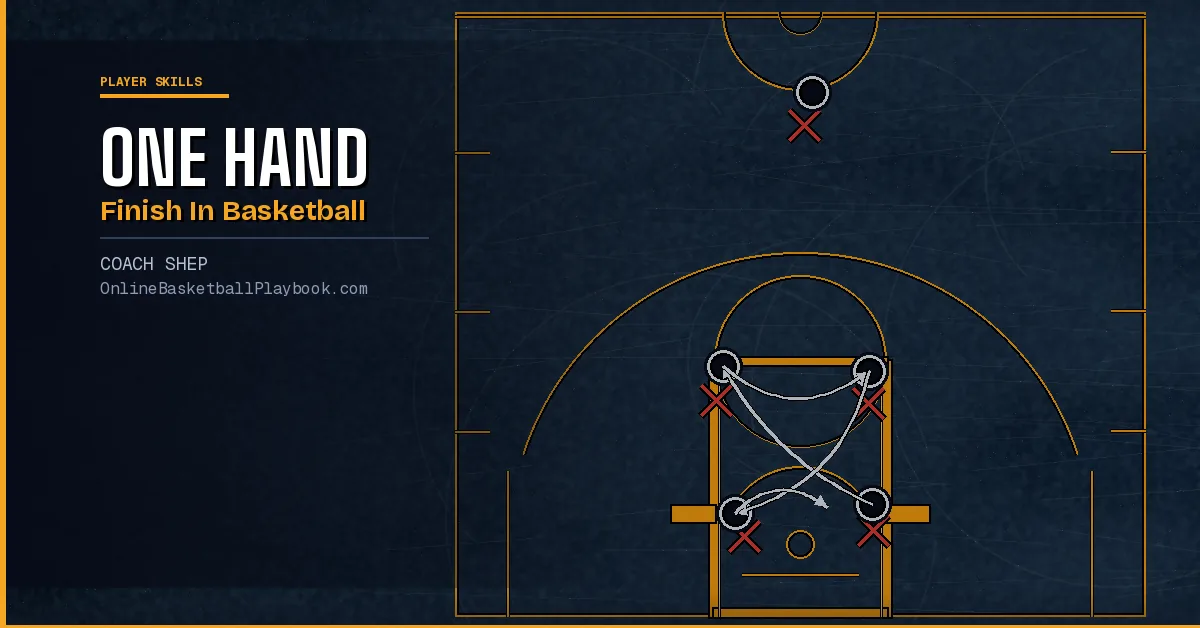
Learning the One Hand Finish in Basketball
Learning the One Hand Finish in Basketball
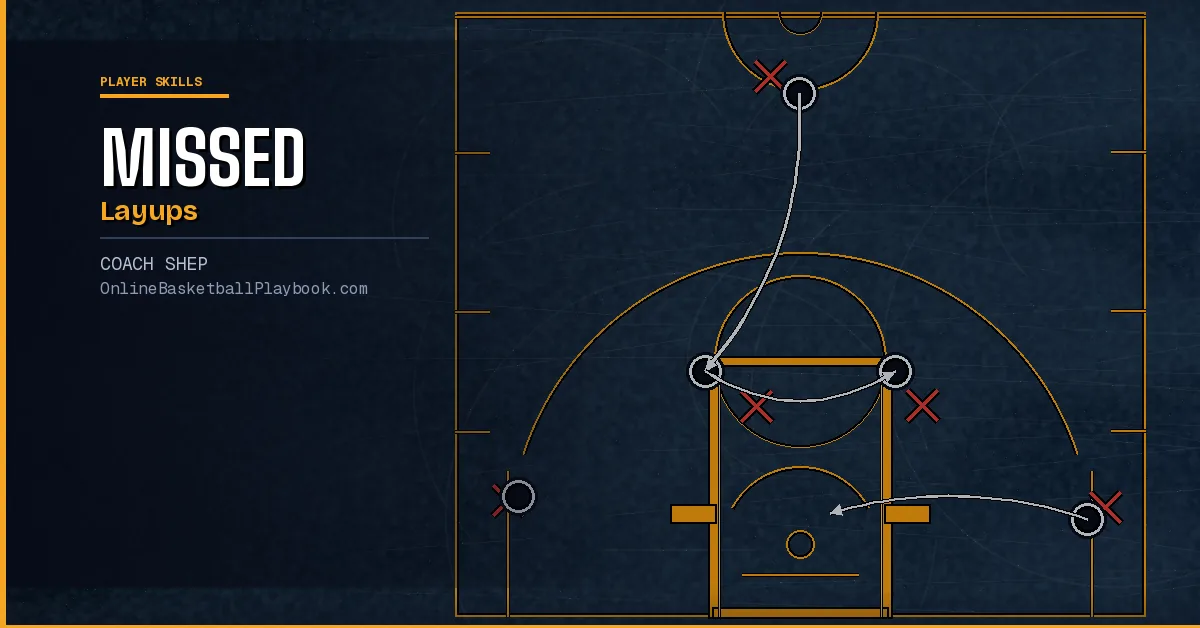
Why Players Miss Layups and How to Fix It
Why Players Miss Layups and How to Fix It
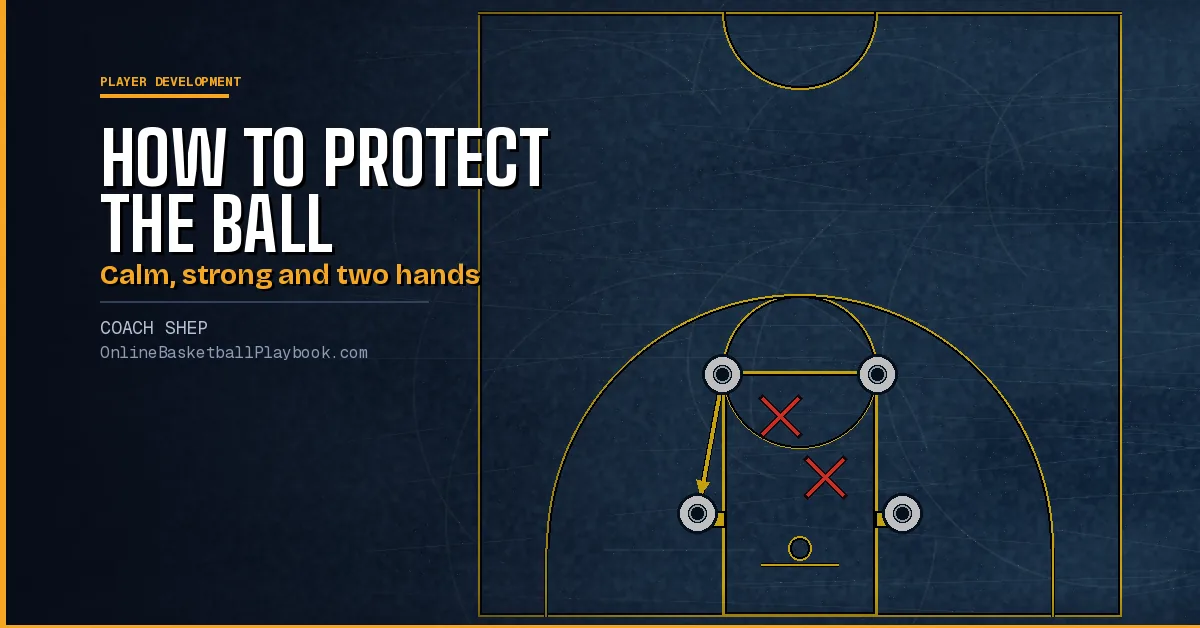
How to Protect the Ball: Ball Security and Fewer Turnovers
How to protect the ball in basketball: where turnovers come from, ripping and catching, the sure pass, beating a trap, ball security drills and pricing turnovers.