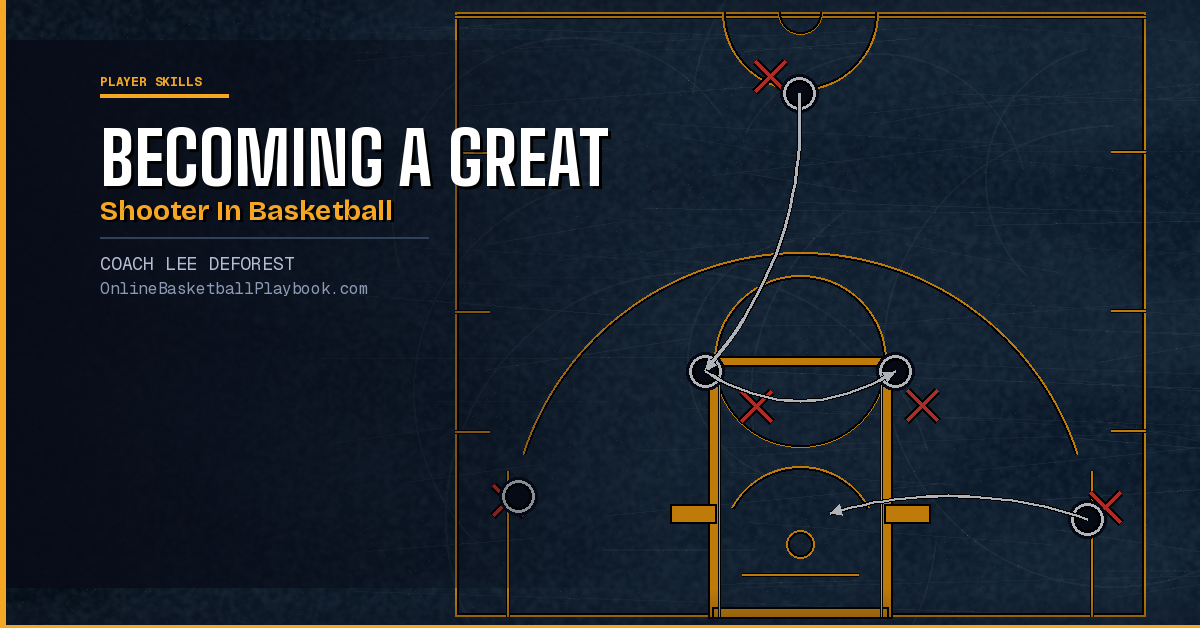

Great shooters are made, not born. Whether you are a youth coach building form or a varsity player grinding your stroke, these eight principles separate the players who shoot well in practice from the ones who deliver in games.
Key 1: Form Before Volume
The single biggest mistake coaches make with young shooters is adding volume before the form is sound. Bad reps do not groove a good shot — they groove a bad one, and bad habits compounded over thousands of makes are harder to break than a raw player who has never shot at all. Jay Wright opened every Villanova practice with form work: the Set Lift drill (elbow under, lift and follow through, no rim contact) and the Bradley drill (ball as high as possible, five shots each side). These were not warm-ups — they were the foundation the entire practice was built on.
The progression for every player, from a six-year-old to a high school starter, should follow the same ladder: balanced stance, "pizza waiter" grip with the hand under the ball like a waiter carrying a tray, elbow under the hand and over the knee, then a high follow-through with fingers pointed down toward the rim — the "cookie jar" finish. Start without the ball. Repeat against a wall. Then progress to the basket. Only add volume once the shape is clean.
Wright's doctrine is blunt: "Sloppy drills create bad habits." Running a hundred reps with a broken elbow or a collapsing guide hand is not just wasted time — it is actively harmful. You are programming the wrong motor pattern. Fewer disciplined reps with 100% attention to form beat more careless ones every time. A coach's job is to protect the quality of each repetition, not just fill up the clock.
Key 2: Make Every Rep Competitive
Shooting in silence is not training — it is just touch-up paint. The moment you add a clock, an opponent, or a personal record to chase, the nature of the drill changes entirely. The player who is silently gunning at an empty gym is practicing making shots when there is no pressure. The player shooting against a timer while a partner watches the count is practicing making shots when something is on the line.
This is not a philosophical point. It is a structural one. Jay Hernandez, one of the most respected shooting coaches in the country, builds his entire workout system around it: every drill has a winner. Shaka Smart's Texas program maintained explicit team records — the 3-Minute drill record was 157 makes; Evans held 219 — posted where players could see them and challenged. That number is not decoration. It is the target. "The most dangerous person is the one who is continually improving," which means you need a number to improve against.
The simplest version: run your next shooting drill with a clock. Count makes only. Require a minimum make count to exit — or run a consequence (sprint, pushups, five more reps) when you miss it. Your players will shoot differently when the score matters. That is the whole point.
Make every rep competitive — against the clock, an opponent, or yourself. A shooting workout should have a winner. Compete against a timer, a partner, or your own record.
— Shooting Development Concept, Basketball Vault
Key 3: Score It, Record It, Build a Culture
Competitiveness in isolation fades. The institutional version of competitive shooting is the record board — a physical or digital log where players set, break, and sign their own marks by drill. Shaka Smart's Texas program is the cleanest model in the vault: roughly 18 named drills with posted records. Players were not just trying to make shots. They were trying to beat a named record that a teammate set, with everyone watching.
The named drills matter too. Streak. Star. Around the Horn. M Drill. Personal Best (the "30-30"). Burner. Over-and-Back. These are not arbitrary labels — they give players something to own. "I hold the Burner record" means something. It creates identity around shooting, which is how you build a shooting culture rather than a shooting assignment.
For youth programs, scaling the record board is straightforward: three or four named drills per team, with each player's initials next to their best score. Let players sign the board when they set a mark. The cost is a whiteboard. The return is a group of players who think of themselves as shooters, track their own progress, and push each other voluntarily. That is the cheapest investment in player development available to any program.
Key 4: Train Game Shots at Game Speed
Standing in one spot catching flat passes from a manager is not shooting practice — it is shooting simulation with the hardest variable removed. Games do not give you a stationary catch from the same angle at the same speed. They give you a skip pass you were not expecting, a catch off a pin-down after you ran through a screen, a pull-up off a drive that broke down. If your practice never replicates those conditions, your players will shoot well in warmups and seize up in games.
Kevin Eastman's framework says it plainly: game shots, game spots, game speed. Every drill should answer the question: does this shot happen in games? If the answer is no, cut it or modify it until the answer is yes. Mix block shooting — volume at one spot to groove the form — with movement shooting: catches off screens, cuts, dribble handoffs, and relocations. Shaka Smart's rule for movement drills is explicit: you cannot shoot the same spot twice. You must move. That single rule converts a static drill into a game-realistic one.
Larry Brown's SMU system takes this further. Every shooting drill in that system is built around a realistic offensive action before the shot: a zipper cut, a baseline drive and throwback, a ball screen. Players are always responding to a read before they shoot. They are never standing still and catching. The logic is simple — the shot is the last thing that happens on a possession, not the first. Train everything that comes before it.
Key 5: Earn the Shot with an Action
This is the Larry Brown principle stated as a rule: players should never spot up cold. Every shot in practice should be earned through an offensive action — a cut, a screen, a drive, a dribble handoff. This is not just about realism. It is about building the mental habit of reading before shooting. A player who always shoots off a read will carry that discipline into games. A player who practices spot-up shooting and then gets a drive-and-kick in a game has to access a skill they never practiced under realistic conditions.
The practical application is straightforward. Add a cut before every catch-and-shoot drill. Add a screen before every wing three. Add a dribble handoff before every elbow jumper. The complexity of the action does not have to be high — a simple V-cut before the catch is enough to activate the sequence. Jay Wright's inside foot principle applies here: on every V-cut and screen catch, plant the inside foot first. "Step with your inside foot." Wright and John Beilein taught this identically and independently — it is a shared first principle, not a system-specific quirk. It keeps players balanced, in rhythm, and ready to shoot on the catch rather than stumbling into position.
Key 6: Develop the Pull-Up — the Lost Art
Programs that train only catch-and-shoot threes and rim finishes create a predictable gap: the mid-range pull-up. The player who can take one or two dribbles off a pin-down and pull up around the free throw line is as difficult to guard as a pure three-point shooter — arguably more so, because defenses are not built to respect that shot in the same way. Coaches Rumjahn and Kelbick identified the pull-up and the hesitation as "lost arts" in player development, and the vault consistently supports that read.
Building the pull-up is not complicated. The hesitation dribble creates separation; the pull-back crossover resets the angle; a two-dribble attack to the elbow produces the shot. Pair these footwork patterns with game-speed handling work — stationary at high velocity, then full-court, then in combination with finishing drills — and you are building a complete offensive skill, not just a single shot type. The UNCW ball-handling battery from the Florida clinic captures this: pull-back crossover for separation, machine-gun passing, four dribbles and four trips to the rim on finishing. Shooting off the dribble requires ball-handling skill. Build both together.
The tactical payoff is real. A player who only catch-and-shoots can be taken away by a ball-pressure defense. A player who can also pull up off the dribble forces the defense to choose. That choice creates spacing advantages for teammates even when the shot is not taken. Developing the pull-up is not optional for complete scorers.
Key 7: Know Your Shot Errors and Fix the Root Cause
When a player misses consistently, most coaches tell them to "bend your knees" or "follow through." Those cues are sometimes correct and often not. Dr. Hal Wissel's diagnostic framework — developed across decades as one of the most respected shooting educators in the world — works backward from the miss pattern to the mechanical cause before prescribing a correction. The root cause is rarely what the player thinks it is.
A short shot usually means the release point is too low, not that the player lacks strength. The fix is a high-extension finish: arm fully extended, fingers pointing down at the rim until the ball lands. A ball that floats wide right means the guide hand thumb pushed across the ball at release — the fix is a thumb-lock drill with one-handed form shots. A flat arc (line drive) means the wrist did not finish above eye level — aim at a point on the ceiling above the front of the rim and the arc fixes itself in a single session. Side spin means the elbow is flared at the set-point rather than directly under the ball and over the shooting knee.
The discipline for coaches is to work through the diagnostic before reaching for a generic cue. Arc angle first, then hand position, then elbow alignment, then balance and foot. The correct diagnosis produces a specific correction drill — not a vague reminder to "stay focused." Players can feel the difference between a drill that addresses their actual problem and a platitude. The right correction drill changes a miss pattern in one workout. The wrong cue just adds noise.
Rick Pitino tracked an exact number at Louisville: players shot 22% on challenged shots, versus a baseline of roughly 42% in the NBA. His practice rule was equally precise — if a shot would have been challenged, pass it back and restart the action with no exceptions. He taught shot selection as a measurable stat, not a feeling. That is the level of specificity that builds shooting discipline into a team's culture, not just a player's individual habit.
Key 8: Shoot Free Throws Tired and Counted
Free throws in games happen after a fast break, after a charge, after a physical possession where a player just absorbed contact. They do not happen after a leisurely walk to the line with fresh legs and a clear head. Most programs shoot free throws at the beginning of practice, at the end of a light drill, or between segments — all circumstances that bear no resemblance to when free throws actually matter. The result is teams that shoot 80% in warm-up lines and 62% in the fourth quarter.
The fix is structural: bake free throws into the workout after the hardest physical segment, count every attempt, and hold players to a standard. Jay Hernandez builds free throws into his workout twice — after the second turn and after the final segment — so they are always shot on tired legs. Pitino goes further: shoot free throws at the end of live one-on-one games when players are fully fatigued, then track the percentages. The data from those sessions tells you more about your team's fourth-quarter free throw execution than any other metric you can collect in practice.
John Beilein's Michigan program required 17 sideline sprints in one minute before players earned practice reps. Conditioning was not separate from skill work — it was the entry requirement. The players who took free throws at the end of that standard were not fresh. They were exactly as tired as they would be in a game. That is the discipline that transfers. Build free throws into your workout under fatigue, count them, and hold the standard. Everything else is just practice.
- Form first, always: Build the shot without the ball — balanced stance, pizza-waiter grip, elbow in, cookie-jar follow-through — before adding volume or competition.
- Put a clock on every drill: No shooting drill should end without a make count or a time limit. A drill without a score is not competitive practice.
- Post a record board: Name three to four drills, post the records by drill, and let players sign their marks. Culture is built through records, not just reps.
- Add an action before every shot: V-cut, screen catch, dribble handoff — players must earn the shot with a realistic offensive move before they pull the trigger.
- Diagnose misses precisely: Wide right means guide hand; short means low release; flat means elbow angle. Work backward from the pattern to the cause before prescribing the drill.
- Shoot free throws after your hardest segment: Count every attempt, require a make standard, and log the percentages so you have real data on fourth-quarter execution.
Want more basketball coaching strategies and drills?
Keep Building
Related breakdowns
4 Keys to Becoming a Great Basketball Free Throw Shooter
4 Keys to Becoming a Great Basketball Free Throw Shooter
10 Keys to Setting and Defending Screens in Basketball
10 Keys to Setting and Defending Screens in Basketball