The best coaches don't just run drills. They engineer competitive reps that translate directly to games. These basketball practice drills build the defensive and offensive habits that hold up when the game is on the line.
Ball-Screen Defense: The Drop and Dance Reps
Pick-and-roll possessions account for roughly 30 to 40 percent of all half-court possessions in organized basketball. When you add transition drag screens, that number climbs above 50 percent. That math alone explains why ball-screen defense is the single highest-leverage skill set you can drill and why it earns coaches their jobs as often as it costs them.
The foundational decision your players must own is this: drop coverage when the handler catches the ball high or enters the action with initial separation; show when both the handler and screener are attached at the arc. Two situations, two answers. Once your players can read that trigger without thinking, the rest of the coverage menu gets much easier to install.
The Drop Rep
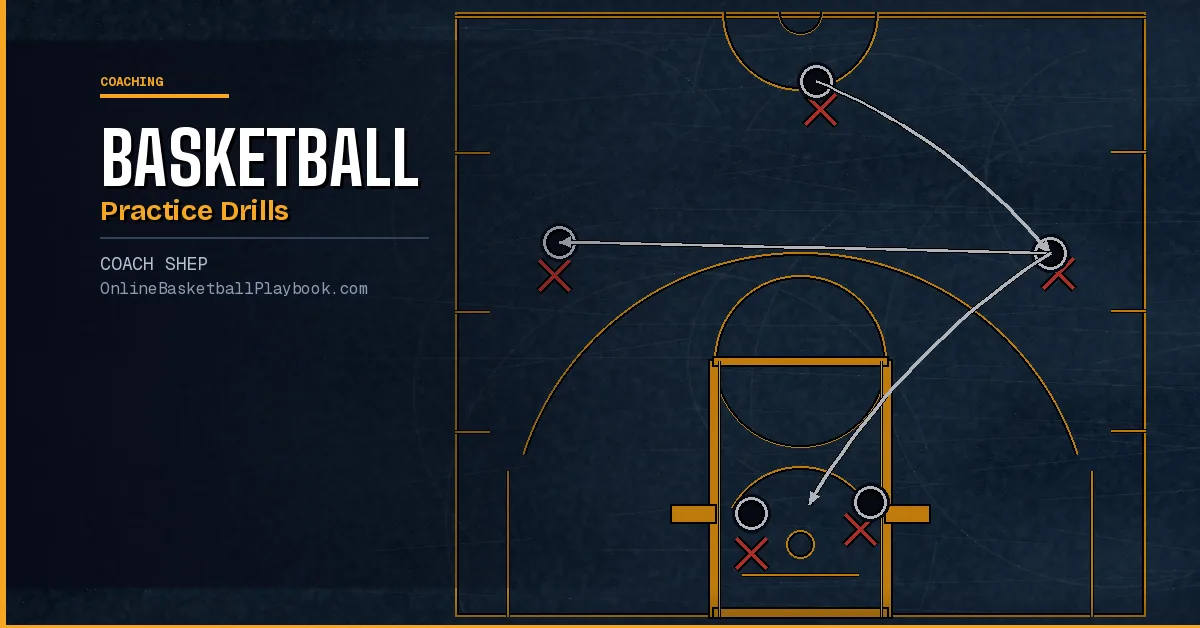
Set up 2-on-2 at the top of the key. The offensive guard dribbles off a high ball screen. The defensive big slides his heels to the arc, not past it, and keeps the handler in the middle third of the floor. His job is to take away the screener's roll-pass lane, not to stop the dribble penetration himself. Run this rep ten times from each side of the floor. The cue to teach: "heels to the arc, trace the roller." If your big is past the arc, he has overextended and the roller flashes to an easy catch.
The Dance Rep
Now set the screen lower, with both the handler and screener attached at the arc. This time the big shows. He arrives with the screen, stays in sync, and never gets hit by the screener. The guard and big move together like one unit. The language that makes this stick is "the dance": two defenders choreographed, neither getting out of position. Drill this until the arrival timing is automatic. A show that comes early is a bluff; a show that comes late gets beaten on the catch.
Slip Recognition
Add a third read to your ball-screen defense reps: the slip. When a screener slips early, the action is no longer a ball screen. It is a 2-on-2 play where the second offensive player is cutting. The defensive error here is to over-rotate, which collapses the interior and opens the short roll or the corner. Teach your players the phrase "stunt and stay": recognize the slip, show a deterrent gesture, and hold their 2-on-2 assignment. This one rep eliminates a huge source of lay-ups at every level of the game.
Closeout Footwork and Contest Drills
Closeouts are where defensive breakdowns happen in plain sight. A defender who sprints to a shooter with no footwork plan either barrels into a foul or slides past and gives up an open look. Teaching the right closeout mechanics is not optional. It is the difference between a defense that holds up in late-game situations and one that collapses under pressure.
The Short Closeout
A short closeout (meaning the pass travels only one pass away) is a 1-on-1 contest. The defender reads the shot threat first. If the offensive player is in a shooting stance, the defender chops his feet short of the shooter, contests high with the near hand, and does not leave his feet until the shot is released. The coaching cue is "short feet, high hand." Drill this with a passer and shooter, no defense on the ball. The closeout defender starts in a help stance in the paint and closes on the pass.
The Long Closeout (Skip Pass)
A skip pass sends the ball across the court. The closeout distance is double or more. Here the defender must run the shooter off the three-point line rather than arriving in time to contest a catch-and-shoot. The technique is to sprint at the shooter's outside hip and turn him baseline, forcing a dribble penetration rather than a pull-up three. Once the shooter puts the ball on the floor, rotations kick in. Drill this with a coach triggering a skip pass from the top of the key, defenders closing out from opposite help.
The Bluff Closeout
The bluff, sometimes called a "cold closeout", teaches defenders to arrive at a shooter with a fake-and-absorb posture rather than a contested-or-fouling posture. The defender sprints to short range, fakes a full contest, and absorbs into a stance that invites the shot while staying out of foul trouble. This sounds passive, but it is the right tool when you're protecting a late-game lead and cannot afford a foul on a three-point attempt. Drill it explicitly; otherwise players never learn the posture exists.
Ballhandling and Pressure Drills
Offense runs on the handler's ability to read coverage and keep the ball alive. Drills that simulate defensive pressure (without scripting the outcome) are the ones that actually develop this skill. The goal is to make training harder than the game, so that game situations feel manageable by comparison.
Zig-Zag Dribble with Live Contact
The zig-zag dribble is a foundational drill in most programs, but it is often run passively. Make it live: the defender applies hand pressure and attempts to cut off the handler at each cone. The offensive player must change speed, not just direction. Teach the low-speed pocket dribble when the defender closes the passing lane, and the burst dribble when space opens. Run four lengths of the floor per pair before rotating.
Two-Ball Dribbling Series
Two-ball dribbling forces the non-dominant hand to work at the same intensity as the dominant hand. Run alternating dribbles, simultaneous high-low dribbles, and stagger-rhythm patterns. The goal is ambidextrous control under fatigue. Five minutes of two-ball work at the start of practice reduces late-game turnover rates in tight games. Players who have trained both hands stop defaulting to the right when tired.
Attack the Blitz
Against elite ball-handlers, many defenses blitz the pick-and-roll: two defenders trap the handler hard, get flat, and try to force a bad pass. Drill the offensive answer in isolation. The handler catches on a ball screen, the blitz arrives, and he must drive away from it, split the gap between defenders, or dribble around and keep possession. The rep trains two things simultaneously: the handler learns to see the blitz early, and the defense learns where the coverage breaks down. Run it 5-on-5 after establishing the 2-on-2 mechanics.
Help-Side Rotation and Recovery Drills
Most defensive breakdowns do not happen on the ball. They happen off it. The three defenders not directly guarding the ball screen are responsible for protecting the paint, reading the roller, and closing back to shooters when the ball moves. This three-man protection layer (call it Last, X-Out, and Low-Man) is what keeps any coverage from springing a leak.
The Last Man and X-Out Drill
Set up a ball screen at the top of the key with four offensive players: the handler, the screener, and two shooters in the corners. The defensive low man (the "goalie") owns the deep roll. If the roll is not a threat, he reads the first pass out. The next defender X-cuts to the hardest passing lane on the flight of the pass. Drill this rep slowly at first: pause it after the screen, confirm the low-man is in the right spot, then run it live. The teaching moment is "move on the pass, in the direction of the pass." Defenders who wait to see where the ball lands are always a step slow.
Over-Help Recognition
Over-helping is as damaging as under-helping and harder to coach because it looks like effort. If the low-man collapses too far toward the roll, the corner three opens. Run a 4-on-4 drill where the constraint is: the low-man must read roll versus flare before committing. Place an offensive player in the corner and instruct the screener to randomly roll or flare after the screen. The defense must stay disciplined. Track corner-three concessions over a set of reps and make them the measurement, not the defensive effort on the ball.
Sprint-Off Recovery
After any ball-screen coverage, whether drop, show, or blitz, the defenders must sprint off to their original assignments as the ball moves. This recovery habit is the hardest to build and the first to break under fatigue. Drill it with a simple constraint: after the coverage rep, the coach makes a skip pass. Every defender sprints to their shooter. No walking. No drifting. The tempo of the recovery drill sets the tempo of the game.
Competitive 2-on-2 and 3-on-3 Breakdowns
Breakdown drills are where you isolate specific situations and drill them to mastery before connecting them to full 5-on-5. The principle is: identify the situation, attack it in practice, and hold players accountable to executing it correctly. Competitive scoring keeps intensity high and forces players to perform skills under pressure rather than in cooperative reps.
2-on-2 Ball-Screen Gauntlet
Run a gauntlet: the same offensive pair runs ball-screen actions back-to-back against rotating defensive pairs. Score it. Offense gets a point for a basket or a foul drawn, defense gets a point for a stop or a forced turnover. First defensive pair to three stops moves on. The gauntlet format removes the passivity that creeps into cooperative breakdown drills and forces live decision-making from both sides. Rotate quickly (two minutes per pair maximum) to keep reps high.
3-on-3 Shell with Live Closeouts
Shell drill is the gold standard for teaching help-and-recover. Make it competitive by running it with live cutters: the offense is allowed to cut off the ball anytime, and the defense must communicate and cover without leaving a shooter open. Add a rule that any open catch-and-shoot attempt within the arc results in a defensive possession reset (they stay on defense). This one rule alone raises communication levels dramatically. Count defensive stops in a row as the performance metric.
The Late-Game Coverage Drill
Reserve five minutes at the end of every week's practice for a late-game scenario. Set the clock at two minutes, put a specific score on the board, and run live 5-on-5 with the coverage menu active. This is where you install your blitz or switch-into-fire for un-guardable opponents. When the situation is real, the execution tightens. Players who only practice coverages in neutral-stakes settings often forget the late-game escalations when they need them most.
Before installing multiple coverages in the same week, make sure your players own the language first: drop, dance, blitz, low-man, bluff. When players share the same vocabulary for each coverage, communication on the court becomes automatic, and decision-making under pressure gets dramatically faster. The word becomes the behavior.
- Drop coverage trigger: Ball is caught high or handler has initial separation. Heels to the arc, trace the roller's pass lane, stay out of the paint.
- Dance / Show trigger: Both handler and screener are attached at the arc. Arrive with the screen, stay in sync, never get hit, bully through together.
- Slip recognition: Screener peels early. Do not over-rotate. Stunt and hold your 2-on-2 assignment or you give up the short roll for free.
- Low-man assignment: Read roll, pop, or flare before committing. Collapsing to the roll while the screener flares leaves the corner three wide open.
- Closeout rule: short closeout = 1-on-1 contest with chopped feet and high hand; skip pass = run the shooter off the line, don't chase a catch-and-shoot you'll lose.
- Recovery cue: Move on the pass, in the direction of the pass. Sprint off every time, no exceptions, or the protection layer collapses on the second pass.
Want more basketball coaching strategies and drills?
Join the Online Basketball Playbook newsletter →
Draw this play free in the play drawer →
Membership: the full library, playbook packs, and Pro drawing tools →
Keep Building
Related breakdowns
Fun Basketball Games for Practice: Scored Games for Any Team
Fun basketball games for practice at any level: shooting games, defense-only scoring, rebounding contests and passing games, with scoring rules and records.
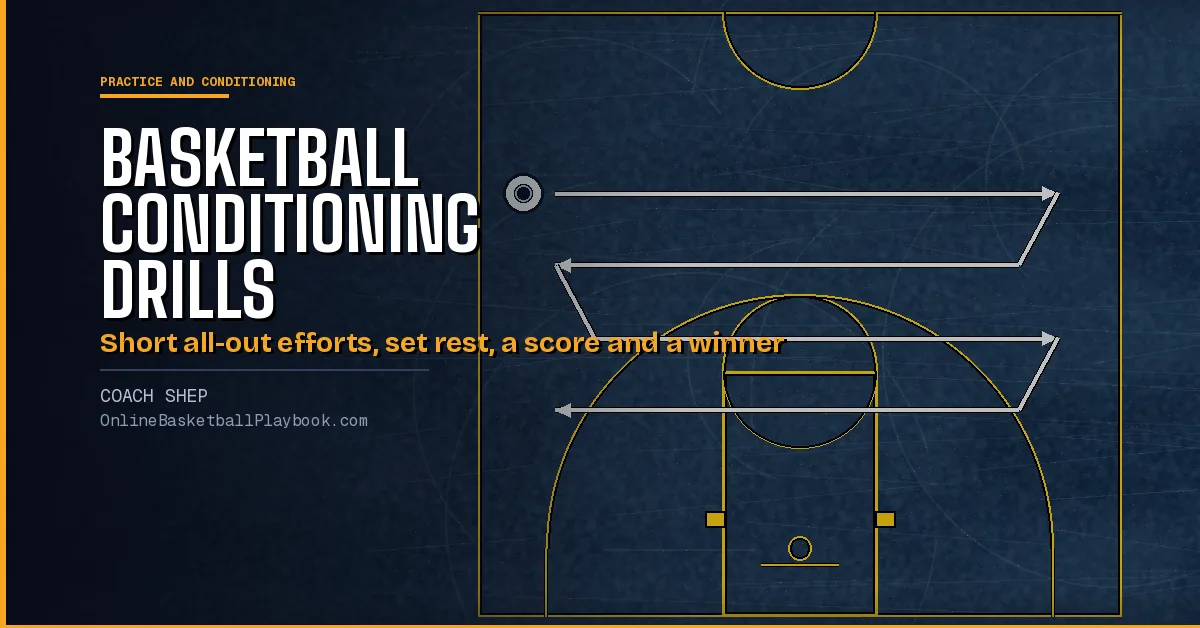
Basketball Conditioning Drills for Teams: Runs, Games and Tests
Basketball conditioning drills in three styles, timed runs, conditioning inside skill drills and scored games, with the tests and yearly plans coaches use.
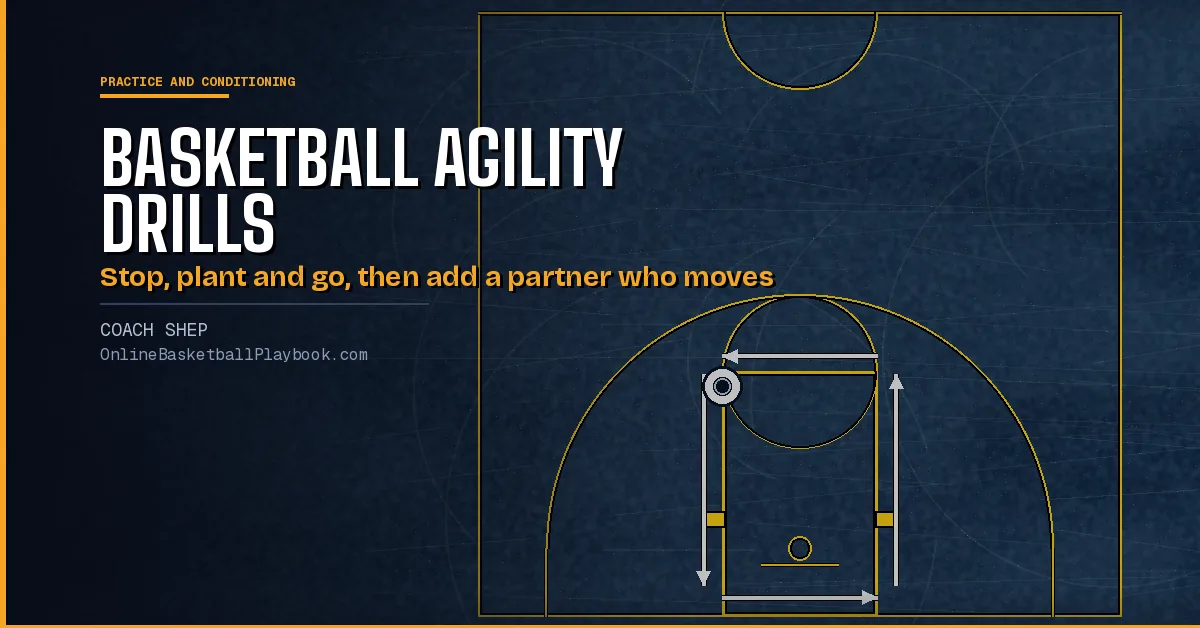
Basketball Agility Drills: Cone, Reaction and Ladder Drills
Basketball agility drills from timed cone tests to reaction, mirror and ladder drills and defensive circuits, with schedules and where coaches differ.