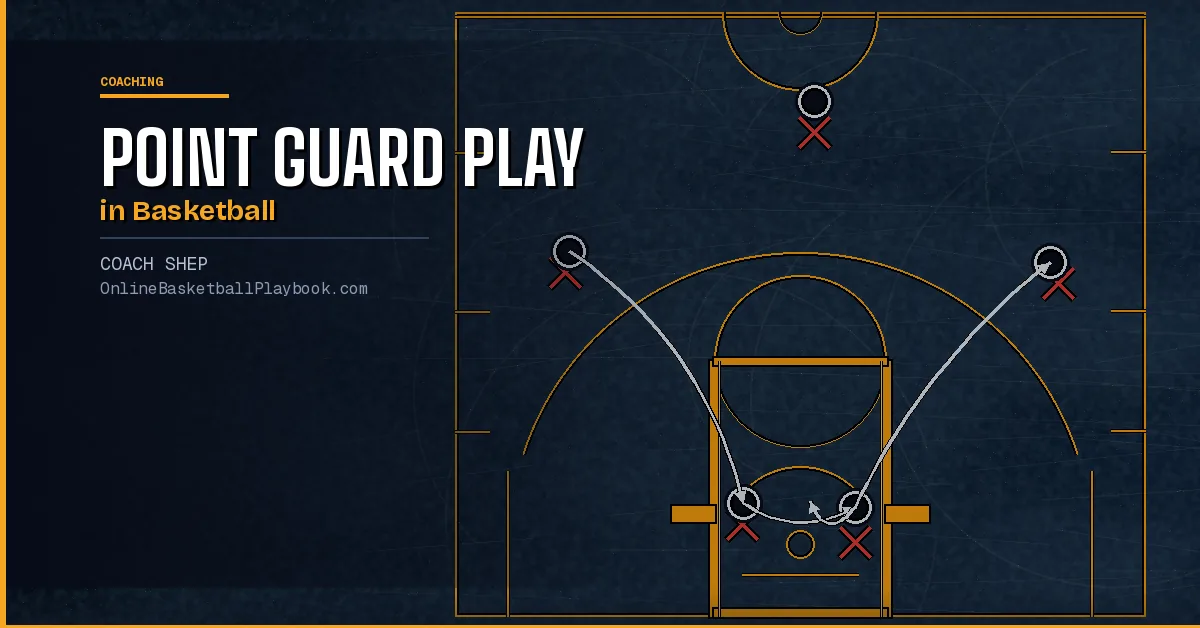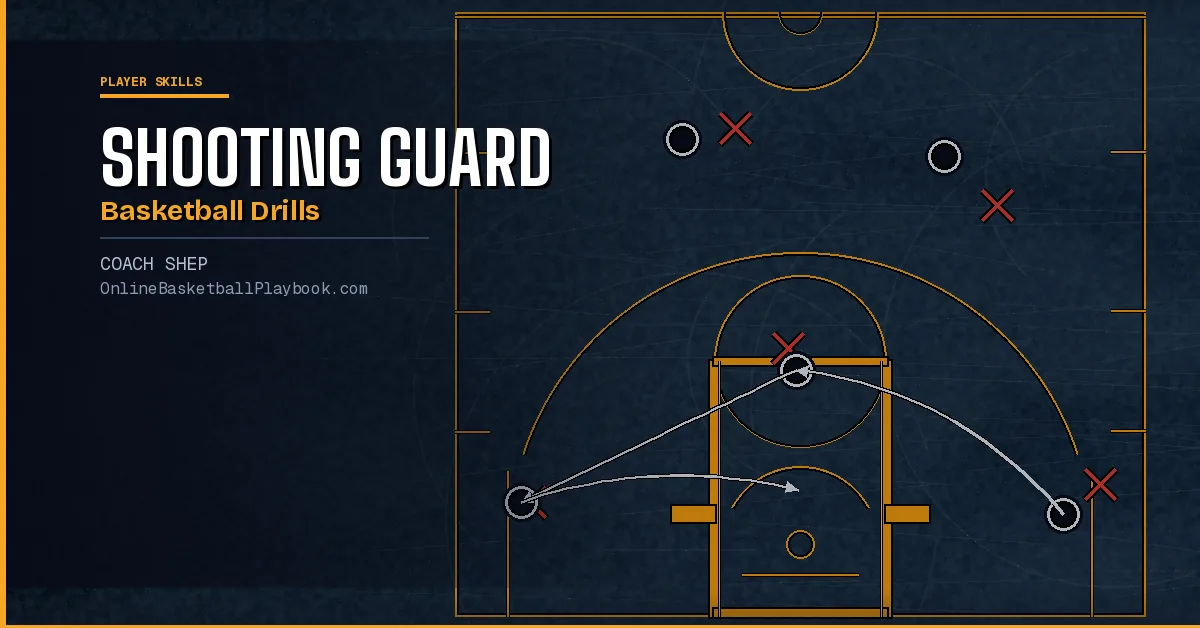
Shooting guards win or lose games at the perimeter. These drills build the form, footwork, and competitive edge your 2-guard needs: catch-and-shoot, off screens, pull-ups, and free throws under pressure.
Form Shooting: The Non-Negotiable Foundation
Every elite shooting guard, regardless of level, starts practice the same way. Form shooting. Before you put a two-guard through three-point volume reps, the mechanics need to be right. Bad reps are not neutral. As Jay Wright's doctrine states: sloppy drills create bad habits, and those habits carry into games when the pressure is highest.
The form-shooting sequence every shooting guard should run at the start of every session:
Set Lifts (Villanova Method)
Start with no ball if necessary. Teach the player to get the elbow under the ball, lift through the follow-through with the arm fully extended, and hold the finish (fingers pointing down at the rim) until the ball lands. No shortcuts. Wright runs Set Lifts as the first drill in every Villanova practice because the elbow position at the set-point determines everything that follows: arc, direction, and consistency.
One-Handed Wall Shots
Stand two to three feet from the wall. Shooting hand only. The guide hand drops away before release. The goal is to see clean backspin on every shot and feel the index finger as the last point of contact. If the ball wobbles or side-spins, the elbow is flaring or the wrist is not snapping through cleanly. Ten reps, five on each side. No moving forward until the ball tracks straight.
The Bradley Drill
Hold the ball as high as possible. Release point matters. The closer to the rim the player releases, the higher the effective arc. Five shots on each side of the lane, focusing on the release point staying above the forehead. Players who drop their release point under pressure will always struggle in late-game situations because defenders can contest a low release far more easily.
Form shooting is not a warm-up ritual to rush through. It is the work. Spend at least eight minutes here before any volume shooting begins.
Off-Screen Shooting Drills
The most common way a shooting guard gets a quality look in organized basketball is coming off a screen. Down screens, flare screens, stagger screens. The shooting guard has to master all of them. What separates shooters who get open from shooters who get open and convert is footwork at the catch point.
The shared first principle from both Jay Wright and John Beilein: plant the inside foot first. That single cue (step with the inside foot) puts the body in balance for a catch-and-shoot in one motion. If a player catches on the outside foot, they are half a beat slow and one step out of rhythm. Practice the footwork cue so many times that it becomes automatic under game speed.
Pin-Down Catch-and-Shoot
Set a chair or cone at the elbow as the screener. The shooting guard starts at the block, cuts hard off the screen, plants the inside foot at the wing, catches from the passer at the top of the key, and shoots. Make eight of ten before moving to the next spot. If the player is using a two-foot hop at the catch, confirm the hop is balanced (both feet landing simultaneously), not a staggered step that kills rhythm.
Flare Screen Drill
The flare is a read. When the defender cheats under the down screen, the cutter flares away instead of curling. This drill trains the read and the shot. Player starts at the block, reads a hand signal from the passer (curl or flare), executes accordingly, and catches on the move. The inside foot principle still applies on the flare. The footwork rule does not change based on which cut was chosen. Ten reps, alternate cuts randomly so the player reads rather than anticipates.
Beilein Timed Standard: 7-of-10 in 30 Seconds
Run a down screen into a flare screen sequence. The shooting guard catches at the wing after running through both screens and shoots. Set a 30-second clock. Make seven of ten to pass the standard. If the group fails, three players run. The screener is exempt. Accountability lands on the shooters. This is the highest timed standard in elite college basketball coaching. Running it in practice makes games feel slow.
Pull-Up and Mid-Range Drills
The pull-up jumper and the hesitation mid-range are undervalued skills in today's analytics-heavy environment. A shooting guard who can pull up off two dribbles from 15 feet keeps defenses honest. It opens the drive, it opens the three, and it gives the offense an answer against a defense that is scrambling in transition.
These are not shots to abandon because the expected value is slightly below a corner three. They are shots to train because the player who can take one or two dribbles and pull up around the free throw line is as valuable as a pure three-point shooter. The defense cannot simply sag and concede them.
Catch-Ready-to-Attack Pull-Up
The catch should happen in triple threat every time. The shooting guard receives the pass on the wing, catches ready to attack (not upright, not casual), takes one dribble right at the defender's hip, and pulls up at the elbow. The key teaching point: the power comes from the legs unwinding upward, not from the arm throwing. The arm is a guide. Players who lean back on their pull-up are trying to generate power from the wrong source. Drill this ten times per side, right elbow pull-up and left elbow pull-up.
Jab-Step into Pull-Up
From the wing in triple threat, jab to freeze the defender, then use a crossover or a straight drive to gain one step of separation. Pull up on the wing. This is Series 5 from Tom Billeter's scored shooting series: jab-step into a curl, wing shot, wing three, flare, or ball-fake drive. The common thread across all five actions is that the shot comes off a realistic offensive move, never a standing catch with no setup. Add a passer at the top of the key who feeds on time, forcing the shooting guard to react to the ball rather than anticipate it.
Hesitation Pull-Up
Drive to the middle off the wing, hesitate at the lane line with a hard stop, and pull up as the imaginary defender recovers. The hesitation creates separation without a second dribble. Work this one without a defender first, then add a live closeout. When live defense is added, the shooting guard must read whether to pull up or attack all the way to the rim. That read (pull up or finish) is the play the two-guard needs to make in games dozens of times per season.
Competitive Scoring Drills
Volume shooting is how you groove form. Competitive shooting is how you build a scorer. The difference between a player who shoots well in warmups and a player who shoots well in games is almost always whether they practiced under pressure. Scored, recorded, and competitive. Those three words should describe every shooting rep a two-guard takes after the form block is done.
Purdue Drill
The shooting guard needs a rebounder and a passer. The goal: make four threes in one minute. After each make, sprint baseline to half-court and back before resetting for the next shot. Every point below four in the make count equals one sprint at the end. The consequence is attached to the result, not to effort. That distinction matters. It trains the player to finish, not just to try. Run this drill once at the end of every session so the last reps of practice are competitive and counted.
Around the Horn
Five spots: left corner, left wing, top of the key, right wing, right corner. The shooting guard shoots from each spot in sequence, one shot per spot, and tracks makes in each full rotation. Set a goal (12 of 15 in two complete rotations) and post the results. When results are posted, players compete against themselves and against each other. A blank wall with masking-tape names and scores is the cheapest shooting culture investment a coach can make.
Star Shooting with Variation
Run the traditional Star drill (five spots, shoot from each), but add a screen, a DHO (dribble hand-off), or a closeout at each station to make it game-real. The rule: the shooting guard cannot shoot the same spot twice in a row. They must move to a new spot each time. This is the Shaka Smart Texas rule: movement is mandatory. Standing and resetting at the same spot produces range-only shooters. Moving to new spots after each rep produces shooters who can function off a chaotic, live action.
Beat the Pro
The shooting guard goes head-to-head against an imaginary opponent (or a real one). Each make by the player is worth one point. Each miss is worth two points for the opponent. First to 11 wins. The asymmetry (a miss costs double) forces the player to value shot selection even during a drill. A contested bad shot is not neutral; it shifts the score. Run this drill three times per session and track the win-loss record over a week. Players who track their own win-loss record against a drill start showing up differently in games.
Free Throw Discipline Under Fatigue
Free throws in games happen when players are tired. The fourth quarter, end-of-shot-clock scrambles, after a defensive sequence that burned a rotation. These are the moments when free throws get missed. The fix is to train free throws when tired, not when fresh.
Never let a shooting guard shoot free throws only at the start of practice. Bake them into the workout after a competitive drill has already drained the player. Ten free throws after the Purdue Drill. Ten after the Beat the Pro sequence. Count every one. Track the percentage over a week. When a player sees their tired free-throw percentage going up, they stop treating it as automatic and start treating it as trained.
Free Throw Mechanics to Reinforce
Ball and head over the free throw line. The body is leaning slightly forward toward the rim, not upright or leaning back. The power still comes from the legs. The wrist snap is the last action before release, and the index finger should be pointing toward the rim at the finish. If the player is short on free throws, the release point is too low or the legs are not engaged. If they are pushing left or right, the guide hand is interfering at release. Use the Wissel diagnostic: identify the error, trace it to the mechanical cause, then prescribe the specific correction drill. Do not repeat the same generic cue when a precise correction exists.
Track your shooting guard's free throw percentage separately when they shoot fresh versus when they shoot tired. Most coaches never separate these numbers. And that gap is where game-day misses live. If the tired percentage is more than ten points below the fresh percentage, free throws need to move earlier in your fatigue blocks, not later.
Building a Shooting Culture
Individual drills develop individual skills. Culture develops shooters who compete every day without being told to. The single cheapest investment a coach can make in their shooting guard's development is a record board, a physical board in the gym where players set records, break records, and sign their names next to their marks.
Shaka Smart's Texas program ran explicit team records beside every named drill. Three-Minute shooting had a need-100, record-157 standard. Evans drill had a record-219 mark. Players walked into practice knowing exactly what they were chasing. When a player breaks a record, they sign it. When someone else breaks it, they know whose name they erased. That is culture, not a drill.
Setting Up the Board for Your Shooting Guard
Start with three drills: Around the Horn, Purdue Drill, and Beat the Pro. Post the current record for each. Let the shooting guard set the first mark, then chase it. Add a fourth drill once those three are established. The record board works at every level. Youth programs can run it with three spots and a one-minute clock just as effectively as a college program running five spots with a 30-second window. Scale the standard, keep the scoreboard.
Game Shots, Game Spots, Game Speed
Every drill in this guide was designed to honor the framework Kevin Eastman and Rick Pitino both reinforce independently: game shots, game spots, game speed. The form work builds the foundation. The off-screen drills build the catch. The pull-up drills build the answer against the sag. The competitive scoring drills build the performer under pressure. And the record board makes it all stick across a season.
A shooting guard who logs 200 competitive, scored reps per week (not 200 aimless makes, but 200 reps where something is on the line) will look like a different player by midseason. The reps are available. The question is whether they are trained correctly or whether they are just volume for volume's sake.
Run the drills with a scoreboard. Post the records. Compete every block. That is how shooting guards are built.
- Form before volume, always: Eight minutes of Set Lifts and one-handed wall shots before any volume shooting begins. Form errors grooved at volume become game-day misses.
- Inside foot on every screen catch: Plant the inside foot first on all V-cuts and off-screen catches. Drill the footwork cue verbally ("inside foot, 1-2, lift") until players say it without prompting.
- Score every shooting block: Set a make target for every drill and post the result. Unscored reps train mechanics. Scored reps train competitors. You need both, but only scored reps transfer to games under pressure.
- Shoot free throws tired: Move at least one free-throw block to after a competitive drill. Track tired percentage separately from fresh percentage. The gap tells you where game-day misses will come from.
- Post the record board before the season: Three named drills, first marks set in week one. Players sign their records. Shooting culture costs a whiteboard and a marker. There is no cheaper investment with a higher return for a shooting guard's development.
Want more basketball coaching strategies and drills?
Join the Online Basketball Playbook newsletter →
Draw this play free in the play drawer →
Membership: the full library, playbook packs, and Pro drawing tools →
Keep Building
Related breakdowns
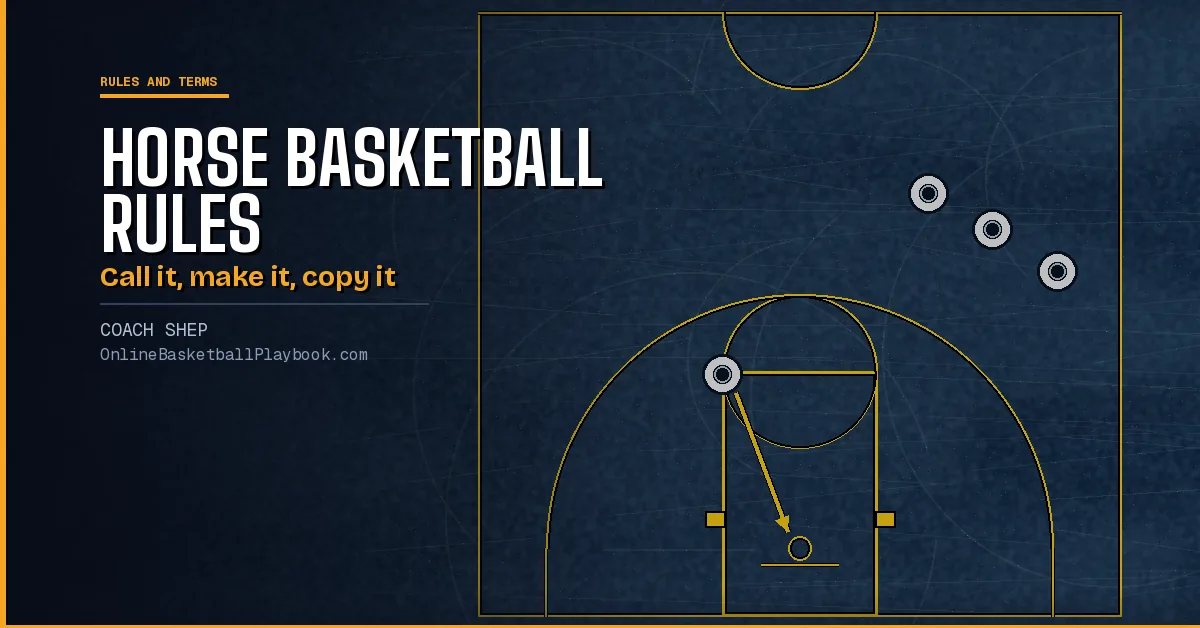
HORSE Basketball Rules: How to Play the Shooting Game
HORSE basketball rules: how many play, setting the order, calling a shot, copying it, taking letters, who calls next, the shorter PIG game and HORSE in practice.