The shooting guard is your offense's primary scoring weapon away from the ball. This guide covers everything: footwork, shot creation, off-ball movement, defensive responsibilities, and the drills that build a 2-guard worth defending.
What the Shooting Guard Does
The shooting guard (the 2) has one primary job: make the defense pay for sagging, helping, or losing focus. Every other skill in this position profile flows from that mandate. When a 2-guard catches on the wing and the defense doesn't close out hard, the ball goes in. When they run off a down screen and the coverage slips, they're already set and shooting. The position is built around the threat of scoring, and that threat is only credible if the player has actually built their shot.
That said, the modern 2-guard carries a broader responsibility than the nickname suggests. At the high school and college level, your shooting guard is often your second ball-handler, your best defender on the wing matchup, and a critical link in secondary break. They need to be able to attack closeouts, finish off the catch-and-go, and make the correct pass when the defense collapses. The shooting is the foundation. The rest of the position is built on top of it.
The biggest mistake coaches make with their 2-guard is treating shooting as a given rather than something that must be deliberately developed and maintained. Shooting is a skill with a scoreboard. It needs to be trained with the same structure and competitive accountability as any other skill in your program.
The Shooting Foundation Every 2-Guard Needs
Before you build any system around your shooting guard, they need a sound, repeatable shot. Form before volume. That is the consistent first principle across every elite shooting coach. Build the shot without the ball, then to a wall, then to the rim. The checklist: balanced stance, "pizza waiter" hand under the ball, elbow under the hand and over the knee, follow-through high with fingers pointing down ("cookie jar"). Coaches Jay Wright at Villanova and John Beilein at Michigan both opened every practice with form-first sequences before any volume shooting began. That convergence is not a coincidence.
Once form is stable, the work shifts to making every repetition competitive. A shooting workout should have a winner. Compete against a timer, a partner, or your own record. The most dangerous player in a program is the one who is continually improving against a number they set themselves. Jay Hernandez's system operationalizes this with a record board: named drills like Streak, Star, Around the Horn, M Drill, and Burner, each with a posted personal best that players sign when they break it. Shaka Smart ran the same logic at Texas: explicit team records on the board (3-Minute drill "record 157," Evans "record 219"), plus a "Beat the Pro" format where your miss is worth two points for the opponent. The scoreboard turns shooting practice from a chore into a culture.
Jay Wright's competitive standard for shooting guards: six makes out of ten shots in 30 seconds coming off a screen. Beilein's Michigan standard was even tighter, seven makes in 30 seconds off a down screen and flare sequence, with the whole group running if unsuccessful. Use those as targets when setting your own program benchmarks. Numbers make the standard real. A vague instruction to "be a good shooter" does not.
Footwork Is the Prerequisite
Both Wright and Beilein stated the same principle independently: footwork is more important than any offense you run, because the player still has to make a play regardless of what the defense does. For the shooting guard, this means the inside-foot principle on all V-cuts and screen catches: plant the inside foot first, every time, no exceptions. Wright had players say the sequence aloud during technique work: "1-2, lift, follow through." The footwork is not a component of the shot. It is the beginning of the shot. Without it, a great shooting guard becomes a mediocre one the moment the defense adds a wrinkle.
Off-Ball Movement and Screen Usage
A shooting guard who stands and watches the ball is a defensive liability, easy to guard and easy to ignore. Your 2-guard needs to be in motion between passes, reading the defense and setting up the next cut, screen, or relocation. This is where most young shooting guards struggle: they think their job starts when they catch the ball. It actually starts three passes before they touch it.
The two most important off-ball skills for the 2-guard are reading the down screen and executing the V-cut. On a down screen, the shooting guard must read the defender's position before they get to the screen. Defender on the high side? Curl tight and attack the rim. Defender sagging? Fade and catch behind the three-point line ready to shoot. Defender trying to fight over the top? Reject the screen entirely and cut baseline. Nelson's offensive skill development framework calls this "feet in position on the catch." The read happens before the screen, so the feet are already set when the ball arrives.
The curl and the flare require different footwork but the same discipline: "think shot before you get the shot," in Wright's words. A shooting guard who has to decide whether to shoot after catching the ball is a half-second too slow. The decision is made coming off the screen. The catch is just confirmation.
Stagger screens add a second layer. The 2-guard must navigate two defenders instead of one, and the read changes at the second screen based on how the first defender was defended. Teach the shooting guard to make that decision at the first pin rather than arriving at the second screen confused. Early reading is everything.
Shot Creation off the Dribble
The pull-up and the hesitation are what our coaching research library calls "lost arts", undervalued and undertrained at nearly every level. A shooting guard who can take one or two dribbles and pull up around the free throw line is as valuable offensively as a pure catch-and-shoot three-point threat. It opens a second scoring layer that defenses cannot take away by sagging.
The key to the pull-up is attacking from a realistic offensive movement, not spotting up cold. Larry Brown's SMU shooting system built every drill around an action before the shot: a zipper cut, a baseline drive, a ball screen, or a drive-and-kick read. Players are always responding to a defensive look before pulling the trigger. The practice context matches the game context, so the rep has transfer value.
For the shooting guard specifically, the two most game-relevant pull-up situations are the mid-range off the ball screen and the hesitation off the wing. On the ball screen, the 2-guard must decide: turn the corner and attack the rim, or pull up off the screen's shoulder when the big's defender drops. On the wing, the hesitation is a one-two rhythm: attack the closeout, hesitate to freeze the defender's momentum, then pull up or continue to the rim based on their reaction. Both of these are trainable reads, not instincts that players either have or don't.
Pitino's contested-shot standard reinforces the discipline here: Louisville shot 22% on challenged shots, compared to an NBA baseline of roughly 42%. His practice rule was that if a shot would be challenged, you pass it back and restart the action. No exceptions. This is teachable as a number ("22%) restart." It gives players a decision rule, not a feeling. For your shooting guard, this means training the pull-up only in situations where there is genuine space, and building the ball-handling and drive-and-kick reads for when the defense takes it away.
Defensive Responsibilities
The shooting guard is usually matched against the opponent's second-best perimeter scorer. At the high school level that means defending the other team's best athlete on the wing, someone who can shoot, attack off the bounce, and use screens. This is not a spot where you can hide a defensive liability.
Defending the shooting guard position requires three competencies: fighting through screens without fouling, staying in front off the bounce, and closing out under control on catch-and-shoot situations. The closeout is where most players fail. They either sprint and fly by, or they jog and give up an open look. The correct closeout is a short-choppy-step approach that keeps the defender balanced and able to mirror the first dribble. Sprint the first three-quarters of the distance, then chop. Every rep in practice should reinforce that rhythm.
Guarding the ball screen is the other critical defensive assignment. The 2-guard needs to know whether they are fighting over, going under, or switching, and that decision should be preset by the coaching staff based on the opponent's tendencies. A shooting guard who makes the wrong call on a screen forces a scramble that breaks down the entire defensive scheme. Pre-scout it, communicate it, and hold the position accountable to the call.
Defensive effort on the weakside is the least practiced and most important element. Rotating to the corner on a drive, tagging the lob, and sprinting back on a missed shot transition. These are the plays that win games at the margin. They require a level of attention and hustle that many scorers resist investing. The shooting guard who checks all three of these boxes is worth far more than their point total suggests.
Position-Specific Drills and Training Standards
The following drills build shooting guard skills in the areas that matter most. Run them with a standard (a make target, a time limit, or a competitive consequence), or the reps won't have the same transfer value as game situations.
The Star Shooting drill covers five spots around the arc. The player catches and shoots at each, then relocates immediately after the release, "can't shoot the same spot twice." This builds the combination of movement, footwork, and catch-and-shoot mechanics that define the position. Add a screen at the top of the key or a DHO at the wing to make it game-realistic. Set a make target and require all misses inside the target to be replayed.
The Purdue Drill is four three-pointers in one minute with a rebounder and passer, sprinting baseline to half-court between each shot. Every point below four requires a sprint run at the end. This is the scored consequence layer that turns a shooting block into a competition. Run it at the end of practice when the shooting guard is already tired. Game free throws and late-clock shots happen when exhausted, so that is when they must be trained.
The down screen and flare sequence (the core of Beilein's Michigan shooting standard) is three players, two balls, with the shooting guard catching off a down screen followed immediately by a flare. Target: seven makes in ten shots in 30 seconds. If the group misses, they run. The screener is exempt from the run to preserve the incentive structure. Run this drill first in practice, when the standard is hardest to hit, not at the end when everyone is loose and the make rates inflate.
Shooting free throws tired is not optional for the shooting guard. Bake ten free throws into the workout after the second major block, not at the start when the player is fresh. Count them, post them, and hold the player to a standard, 75% minimum, 80% expected at the varsity level. Free throw percentage is one of the few individual stats that a coach can directly influence through practice design. Build the rep count when it matters.
Post a record board for your shooting guards with three or four named drills and their personal bests. Players who sign their own records take ownership of the standard in a way that coach instruction alone cannot create. The board does the motivating for you.
- Form before volume: Open every shooting block with one-handed form shots or Set Lifts. No full shooting reps until the mechanics are warm and correct.
- Inside foot first on all screen catches: Plant the inside foot, set the feet on the catch, then decide. Never catch the ball flat-footed or in motion with no base.
- Make every drill competitive: set a make target or time limit on every rep sequence; a shooting workout without a winner produces slower development than one where something is at stake.
- Train the pull-up deliberately: Dedicate at least one block per practice to pull-up jumpers off one or two dribbles. This skill separates good shooting guards from great ones.
- Shoot free throws tired: always place free throw reps at the end of a hard block, never only at the start, so the shooting guard builds the habit of making them when it counts.
- Contested shots restart: If the shooting guard catches and the defender is in their face, the ball goes back. No bad shots in practice, and track the percentage on challenged looks to make the standard concrete.
Want more basketball coaching strategies and drills?
Join the Online Basketball Playbook newsletter →
Draw this play free in the play drawer →
Membership: the full library, playbook packs, and Pro drawing tools →
Keep Building
Related breakdowns
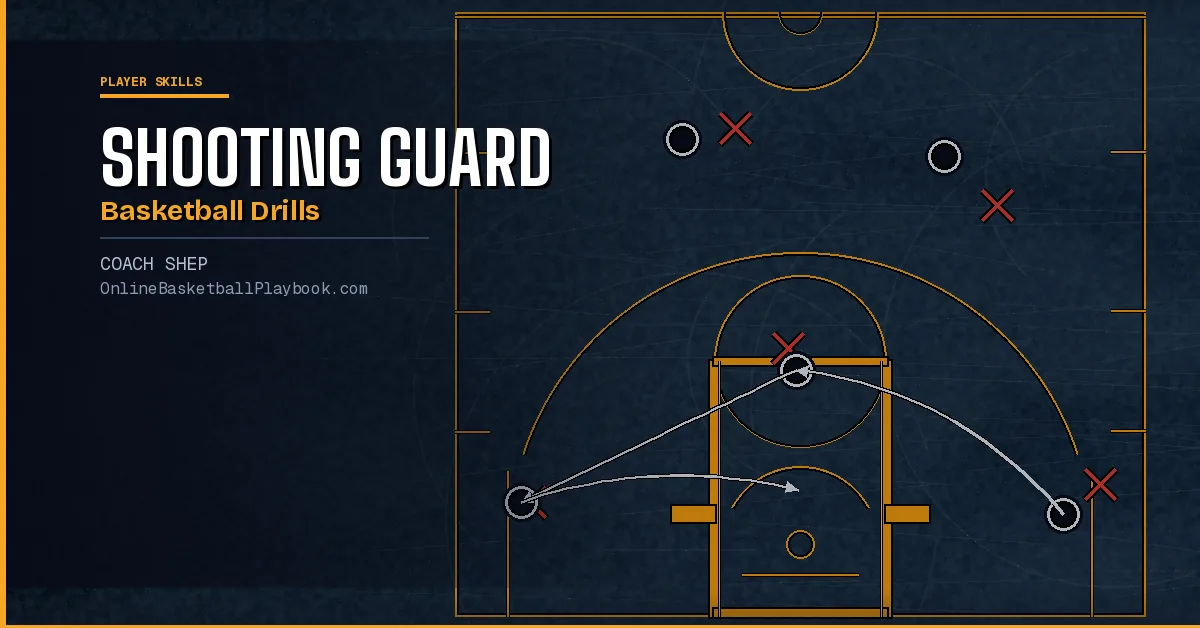
Shooting Guard Drills for Basketball Practice
Shooting Guard Drills for Basketball Practice
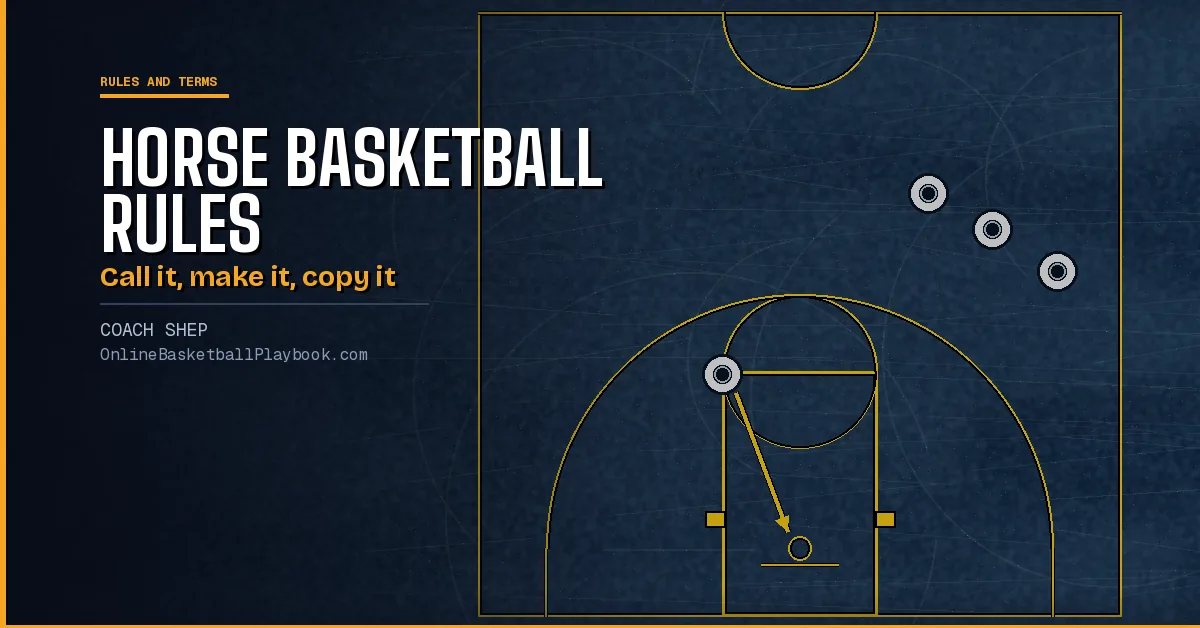
HORSE Basketball Rules: How to Play the Shooting Game
HORSE basketball rules: how many play, setting the order, calling a shot, copying it, taking letters, who calls next, the shorter PIG game and HORSE in practice.