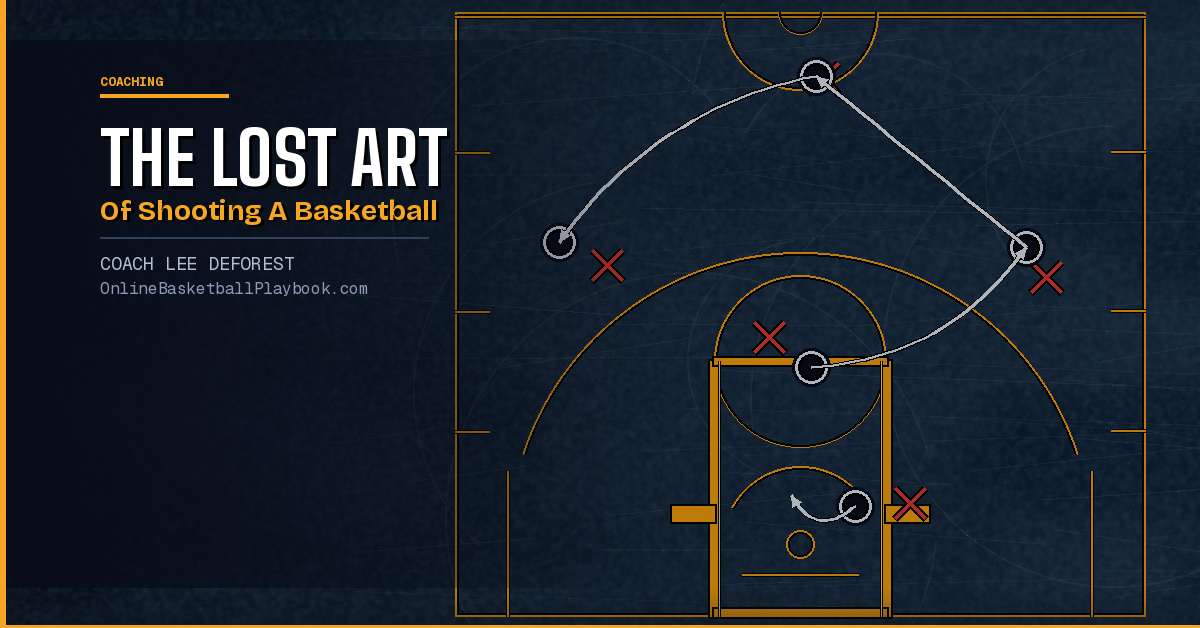

Most players shoot thousands of reps and never improve. The problem isn't effort — it's that aimless volume without form, competition, or feedback is the slowest path to becoming a real shooter.
Form Before Volume: The Foundation Every Coach Gets Wrong
Walk into most youth gyms and you'll see players hoisting shots from wherever they happen to catch the ball, in whatever body position they landed in, with whatever grip they already have. The gym is full of reps. Almost none of them are building a shooter.
The principle that elite coaches converge on — Jay Wright at Villanova, John Beilein at Michigan, Jay Hernandez in his competitive shooting clinics — is the same: form first, volume second. Not because volume is unimportant, but because volume with bad form compounds bad habits rather than removing them. Jay Wright's first two drills at every Villanova practice are form drills. Not to warm up — to reinforce the foundation before adding pace and competition.
The youth on-ramp version of this is the "pizza waiter" and "cookie jar" cue sequence. The ball sits flat on the shooting hand like a pizza on a tray — palm up, balanced, elbow tucked under. The follow-through finishes high, hand reaching up into an imaginary cookie jar, fingers relaxed and pointing down toward the rim. It sounds cartoonish, but these two images solve the two most common form errors in young players: a collapsing elbow that pushes the ball off-line, and a short follow-through that kills arc and consistency.
From there the progression is simple. Form shots without the ball. Form shots to a wall. Form shots to the rim from two feet, then five, then ten. The distance only expands once the mechanics hold up at the shorter range. Adding range before mechanics are sound just teaches a player to muscle the ball, which buries the problem deeper under more reps.
Wright's "sloppy drills create bad habits" doctrine makes the same point from a practice-design angle: bad reps are not neutral. They are actively harmful. Running fewer drills with full discipline produces better shooters than running more drills carelessly. The quantity of reps matters far less than coaches often assume. The quality of each rep — balanced stance, elbow under the ball, elbow over the knee at the set point, full follow-through — is what compounds over a season into a real shooter.
Make Every Rep Competitive — Against a Clock, a Partner, or Yourself
Once mechanics are stable, the second principle is the one most development programs ignore completely: every shooting workout should have a winner.
That sounds like a small thing. It is not. The difference between standing in a spot and putting up two hundred shots versus standing in a spot and competing to make fourteen shots in ninety seconds is not a small difference in engagement. It is a different physiological state. Competitive pressure, even mild artificial pressure against a timer or a partner, changes how a player processes a miss. A miss in a aimless block session is forgettable. A miss in a timed window when you need fourteen makes costs something — and that cost is what drives correction.
Shaka Smart built this into his Texas shooting system explicitly. Named drills — the 3-Minute drill, the Evans drill, the Burgess drill — all carry posted team records. Players know that the 3-Minute record is 157 makes. They know who set it and when. The record board turns a shooting drill into a team benchmark, and chasing a record is a fundamentally different psychological experience than doing reps for their own sake.
Jay Hernandez's competitive shooting system layers this further with the "Beat the Pro" format: your miss is worth two points for your opponent. That single rule shifts the cognitive weight of every shot. You are no longer shooting until you make; you are protecting a lead or fighting a deficit on every release.
The underlying principle is one that applies across all skill development: "the most dangerous person is the one who is continually improving." A player with a scoreboard always knows where they stand relative to their own best. That self-referential pressure — the personal record — is the most durable motivational driver in skill development because it doesn't depend on opponent quality. You can always chase your own mark.
The Diagnostic: What Your Misses Are Actually Telling You
Most coaches watch a player miss and say "bend your knees" or "follow through." Dr. Hal Wissel's diagnostic framework — developed over decades of international coaching — replaces that generic prescription with a systematic error-to-cause-to-correction pathway. The question is never just "what went wrong with that shot?" The question is "what mechanical breakdown caused that outcome, and what specific drill addresses the root cause?"
Short shots, for example, are usually a release-point problem: the ball leaves the hand before the arm reaches full extension. The correction is a high-extension finish drill — hold the follow-through with the arm fully extended, fingers pointing down at the rim, until the ball lands. The body gets proprioceptive feedback from holding the position, which grooves a higher release point faster than any verbal cue.
A ball that goes consistently wide right or wide left in a right-handed shooter is almost always the guide hand — the off-hand thumb pushes across the ball at release. The correction is a thumb-lock drill: consciously hold the guide-hand thumb up and away, shoot one-handed form shots until the ball tracks straight. Many players who describe themselves as "not a natural shooter" have been fighting this problem for years without knowing it had a name and a fix.
Line-drive shots — flat arc, too much like a football pass — come from a wrist that doesn't fully flex and an elbow that doesn't finish above eye level. The ceiling-target drill addresses it: identify a point on the gym ceiling above the front of the rim and aim the arc at that point. Players who have been shooting line drives for years typically add four to six inches of arc immediately when given a specific ceiling target. The rim is suddenly makeable from further out because the ball is now dropping in rather than hitting the back of the rim.
The diagnostic discipline that Wissel emphasizes — work backward through arc angle, hand position, elbow alignment, and balance before prescribing a drill — is what separates a shooting coach from a coach who happens to run shooting drills. The root cause of a miss is rarely what the player thinks it is. A player who says "I'm rushing" is usually describing a symptom. The actual cause might be footwork, or elbow alignment, or a grip that's too wide with the ball resting on the palm instead of the finger pads.
The Pull-Up and Hesitation: Basketball's True Lost Art
If you ask coaches what the lost art of shooting is, many will talk about catch-and-shoot mechanics or free throw discipline. Those are real concerns. But the deeper loss — the shot type that has quietly disappeared from most development programs — is the pull-up jumper off one or two dribbles.
The motion offense systems that Rumjahn and Kelbick document describe the catch-ready-to-attack mentality: a player who catches the ball at the wing or elbow is reading the defense from the first instant of possession, already deciding whether the shot, the drive, or the pass is available. The pull-up off a hesitation dribble — one dribble hard at the defender, plant, rise — is one of the three reads off that initial catch. But it requires a player to have practiced the footwork and the release specifically from a moving position, not just from a standing catch.
A player who can take one or two dribbles and pull up around the free-throw line is as valuable to an offense as a pure three-point catch-and-shoot specialist. The pull-up attacks the defense at a different angle. It rewards sagging defenders. It opens driving lanes when defenders begin to cheat up. And it is nearly impossible to develop without deliberately programming it into shooting workouts.
Most shooting workouts are designed around stationary or near-stationary catches. Players get thousands of reps shooting off a clean catch from a passer who delivers the ball exactly where they want it. They get almost no reps putting the ball on the floor and stopping themselves into a two-foot pull-up on balance. The result is a generation of players who can shoot off the catch but cannot create their own shot off the dribble when the catch isn't perfect — which is most possessions in a real game.
Larry Brown's SMU shooting system addresses this directly. Every drill is built around a realistic offensive movement before the shot: a zipper cut, a baseline drive, a ball screen, or a drive-and-kick. Players are always responding to a read before pulling the trigger. The drill teaches shooting and decision-making simultaneously rather than isolating them. The shot arrives at the end of an action, the way it does in games, not at the beginning of a sterile block session.
The pull-up and the hesitation are lost arts — a player who takes one or two dribbles and pulls up around the free-throw line is as valuable as a pure three-point shooter.
— Shooting Development, Basketball Vault
Build a Shooting Culture, Not Just a Shooting Drill
A shooting culture is the difference between a program where players shoot on their own and a program where players compete to shoot. The infrastructure is simple and nearly free: a record board, a set of named drills, and the discipline to post marks and protect them.
Shaka Smart's Texas system gives the clearest example of what this looks like at the college level. Named drills — 3-Minute, Evans, Burgess, Around-the-World, Spurs 100 — each carry an explicit team record. The record is posted. Players who break it sign the board. The act of signing creates ownership. Chasing the record creates a reason to shoot beyond staying sharp. "Can't shoot the same spot twice" is a rule in several of Smart's movement drills — it forces players to relocate, which is how shooting happens in games, and it prevents the muscle-memory false confidence of making ten in a row from the same exact spot with no defensive pressure and a perfect pass every time.
At the youth and high school level, the same system scales down. Three or four named drills per team. A posted record for each. Let players sign their marks when they break them. The record board does not need to be sophisticated — a whiteboard in the gym and a marker work fine. What matters is that every shooting session has a number attached to it that players carry forward. "I'm at 38 on the Star drill" is a different kind of motivation than "I shot around for twenty minutes."
Beilein's Michigan system adds the accountability layer: players had to run 17 sidelines in 60 seconds before earning practice reps. Practice was a reward for fitness, not a given. The standard for in-practice shooting was 7 makes out of 10 shots in 30 seconds, coming off a down screen and flare screen sequence. Three players ran if unsuccessful. The screener was exempt. The consequence was fast and the standard was clear — which is the operational definition of a real culture rather than a stated aspiration.
The Contested-Shot Problem: A Number, Not a Feeling
Rick Pitino, while at Louisville, identified a specific and measurable problem in his program: Louisville players shot 22% on challenged shots. The NBA average on contested shots at the time was approximately 42%. The gap between those two numbers — 22% versus 42% — represented a coachable problem, not a talent problem.
Pitino's practice rule was simple: if a shot would be challenged, pass the ball back and restart the action. No exceptions. The rule made the contested-shot rate a coaching discipline rather than a player tendency. Players weren't told to feel when a shot was too contested. They were given a threshold that forced a pass, which trained the recognition over time and drove up the team's overall efficiency by eliminating the lowest-percentage shots from the possession sequence.
George Karl's "no tough twos" mandate operates on the same logic. Mid-range pull-ups against a closing defender are the least efficient shots in basketball. Training players to recognize and decline that shot in practice — by rule, not by instruction — changes what they reach for in games. The goal is not to make the contested pull-up a better shot. The goal is to train players to choose a better option before the contested pull-up becomes the only one available.
Free throw discipline fits here too. Pitino's protocol for free throw training was specific: shoot free throws at the end of live 1-on-1 games when players are exhausted, and track the percentages. Game free throws happen when players are tired. Practice free throws should replicate that condition. A player who shoots 85% fresh and 62% after a hard possession is a player with a conditioning and rhythm problem on free throws, not just a mechanics problem — and the only way to identify it is to measure it under the right conditions.
Post your contested-shot rate in the locker room the same way you'd post shooting percentage. When players see 22% next to the NBA's 42%, the rule to pass it back stops being a constraint and becomes an obvious strategic choice they want to make.
- Open every shooting session with form-only reps — no ball to the wall, then to the rim from five feet. Don't skip this because players are old enough to "already know" the mechanics. Grooved form breaks down under pressure and must be rebuilt regularly.
- Attach a number to every competitive drill — post the record, name the drill, let players sign their personal bests. A scoreboard changes the physiological state of every rep. Aimless volume does not build shooters; scored volume does.
- Program pull-ups and hesitations deliberately — add one or two dribbles before the catch-and-shoot in at least two drills per session. The pull-up off a hesitation at the free-throw line is one of the most undervalued shots in the game, and it will not develop through catch-and-shoot reps alone.
- Shoot free throws last, not first — put them at the end of a live competitive segment when players are tired. Track the percentage. Game free throws happen under fatigue; practice must replicate that or the training transfers poorly to real situations.
- Use Wissel's diagnostic before prescribing a drill — identify the error pattern (short, wide, flat, long), trace it to the mechanical cause (release point, guide hand, wrist flex, leg drive), then prescribe the specific correction drill. "Bend your knees" fixes nothing if the real problem is a collapsing elbow at the set point.
Want more basketball coaching strategies and drills?
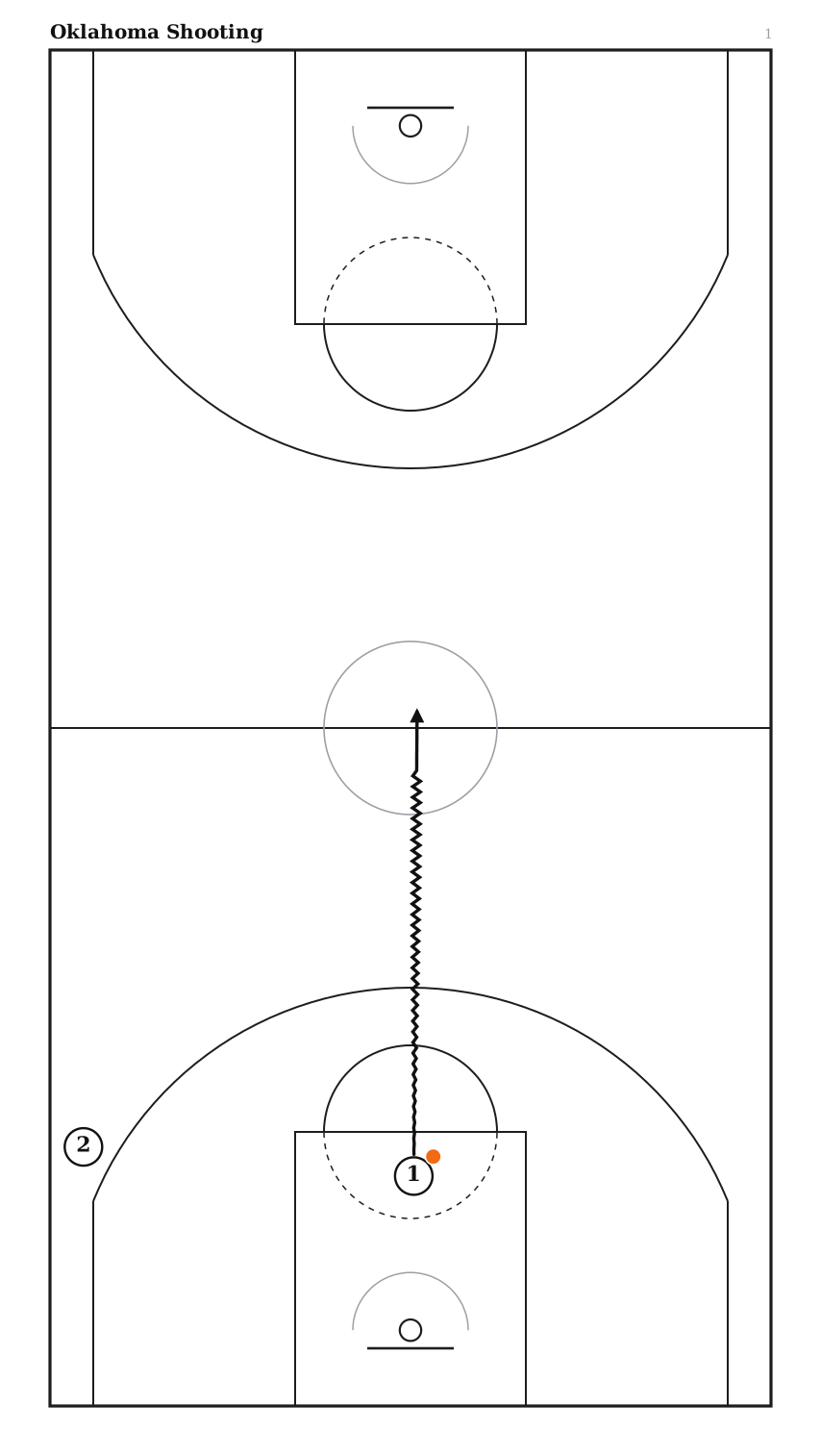
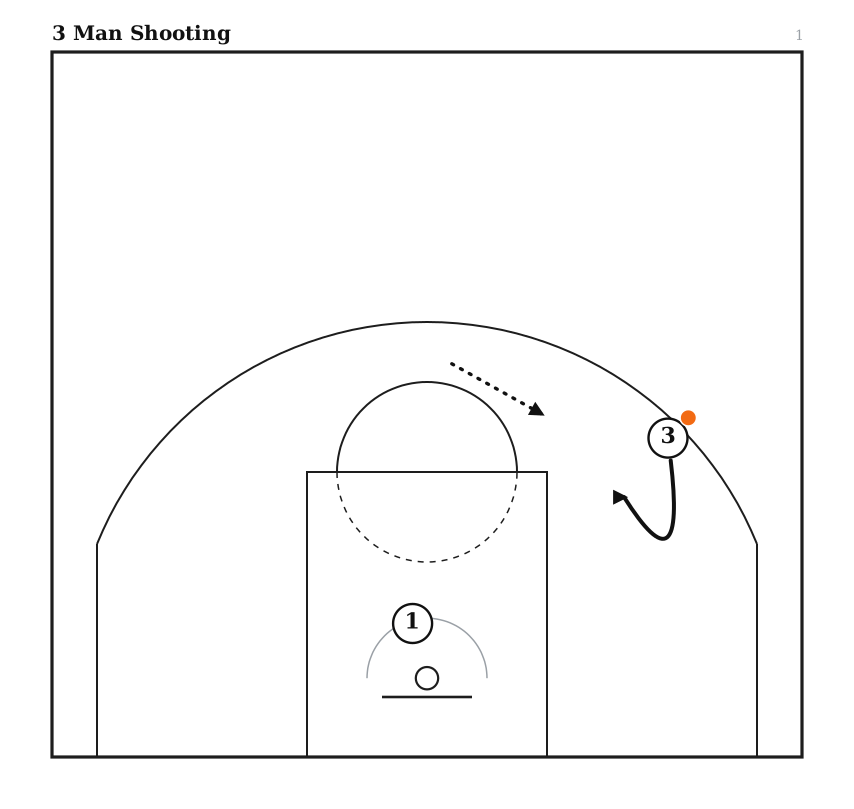
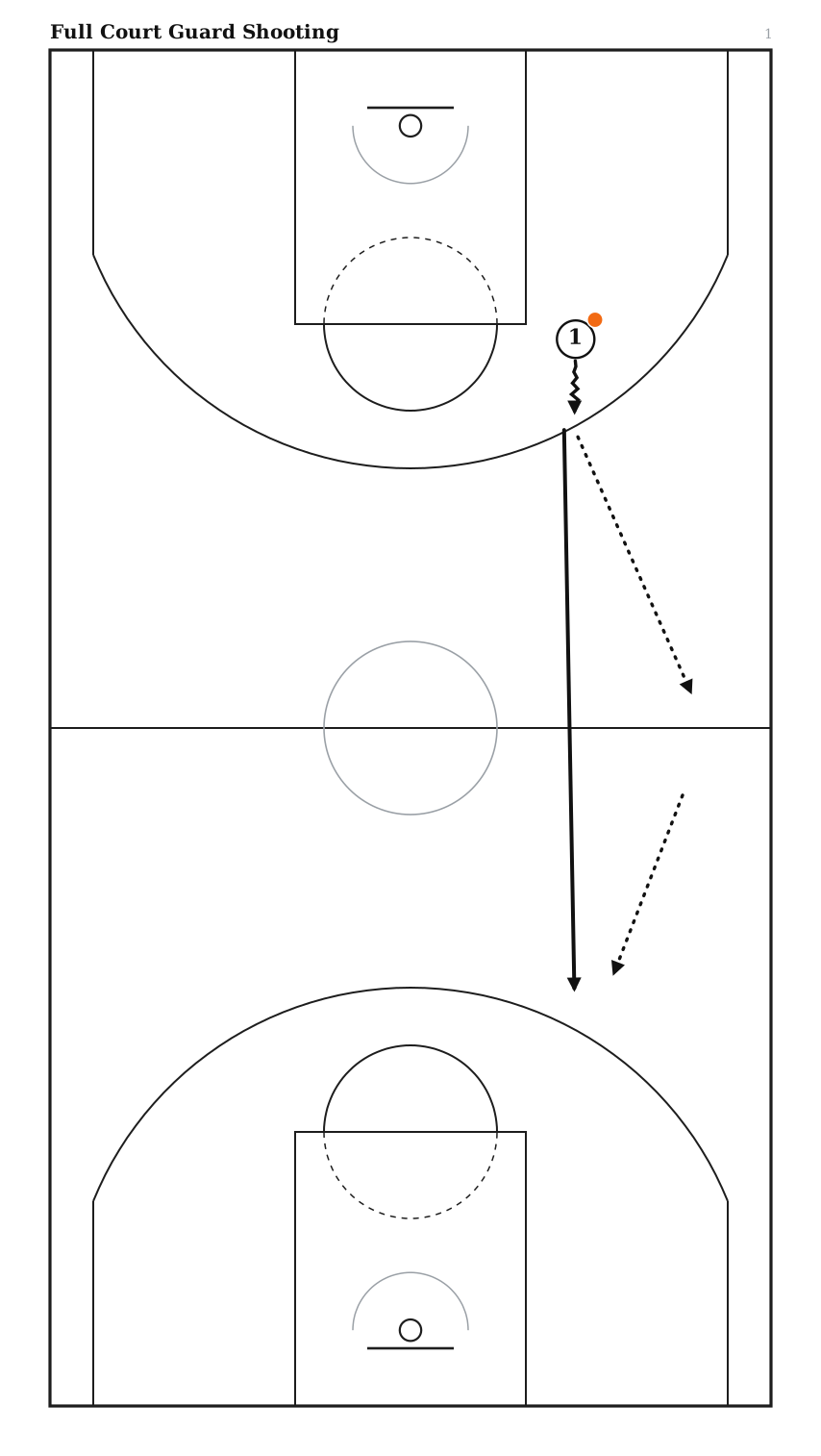
See it drawn up
Related diagrams
Keep Building
Related breakdowns
Taking Your Basketball Shooting to the Next Level
Taking Your Basketball Shooting to the Next Level
Strategies for Improving Team Shooting Efficiency
Strategies for Improving Team Shooting Efficiency