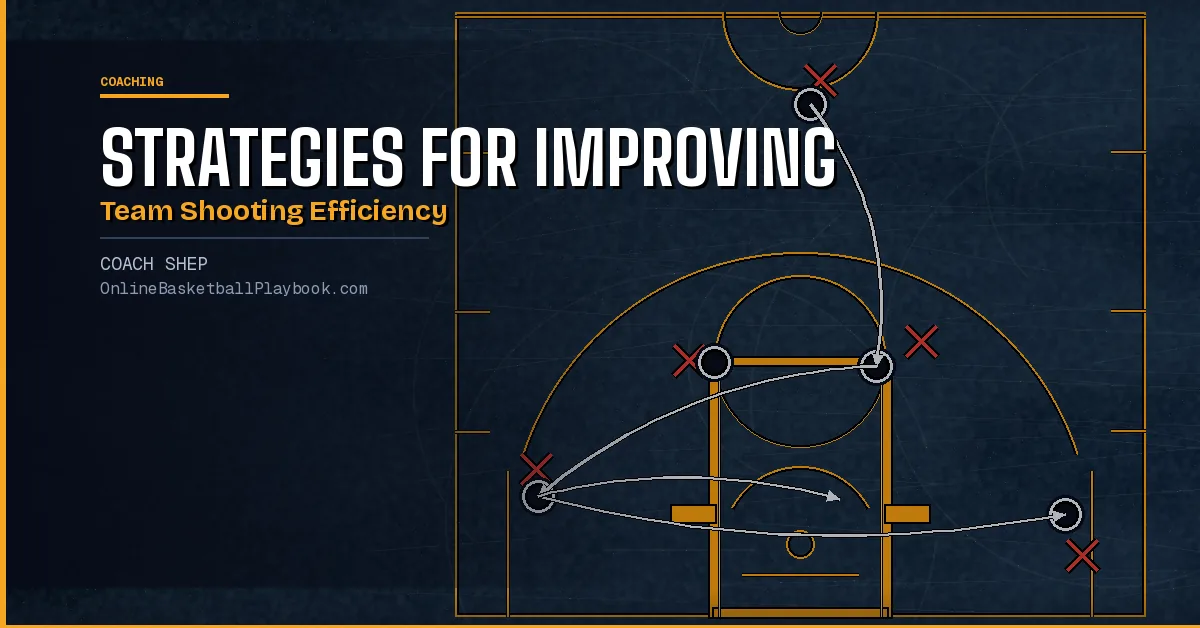
Low shooting percentages are rarely a talent problem. They are a practice design problem. The right drills, standards, and culture shifts can measurably raise your team's efficiency within a single season.
Form Before Volume: The Foundation
Every effective shooting program starts in the same place: mechanics. Volume reps on a broken shot do not produce a better shooter. They cement bad habits. The most efficient path to higher team shooting percentages is to fix the form first, then add volume.
Jay Wright's Villanova program opens every practice with Set Lifts and the Bradley Drill (form-first sequences before a player attempts a real jump shot). The logic is straightforward: "elbow under the ball, lift and follow-through, no rim contact." Players must be able to execute the movement in isolation before layering in competition and volume.
For youth players, this means the "pizza waiter" (ball resting on the shooting hand as if balancing a pizza tray) paired with the "cookie jar" finish, where the wrist snaps through and the fingers hang down toward the floor. These cues are not dumbed-down versions of real shooting mechanics; they are real shooting mechanics translated into language that sticks.
The build sequence matters: start without the ball (stance and arm action), progress to a wall target, then to the rim from close range, and only then add the full shot. Coaches who skip steps one and two and go straight to shooting drills are building on a shaky base. When the pressure of a game arrives, the foundation cracks.
John Beilein at Michigan held a simple belief: "Footwork is more important than any offense you run because the player still has to be able to make a play no matter what the defense does." Good shooting footwork (specifically the inside foot principle, where a cutter or screen-catcher plants the inside foot first to square the body) is the bridge between a ball-handler's action and a clean shooting position. Jay Wright reached the same conclusion independently. When two elite coaches converge on the same detail, it is worth treating as a first principle, not a stylistic preference.
Make Every Rep Competitive
Aimless shooting is the most common waste of practice time. Players who gun up shots without a target, a clock, or an opponent are conditioning themselves to shoot without pressure, which bears little resemblance to what basketball actually demands.
The solution is simple: every shooting block needs a winner. That winner might be determined by a timer (make 6 out of 10 in 30 seconds or your team runs), a partner (head-to-head, first to 10 makes), or a personal record (beat your own mark from last week). The specific format matters less than the presence of stakes.
Shaka Smart's Texas drill bank illustrates this well. Named drills like "3-Minute" (goal: 100 makes, record: 157), "Evans" (record: 219), and "Beat the Pro" (your miss counts as 2 for the opponent) all carry explicit team records. Players know exactly what the standard is and exactly how they measure against it. That specificity creates the internal drive that vague encouragement never can.
Tom Billeter's Purdue Drill from the POWER Clinic captures the consequence layer directly: make four threes in a minute with a rebounder and passer, sprinting baseline to half-court between shots. Fail to reach four makes and the shooter runs for each point below the target. The drill is scored, timed, and consequential (three properties that transform a shooting drill from maintenance work into genuine development).
The underlying principle, articulated plainly in our coaching research library: "the most dangerous person is the one who is continually improving." Competitive reps create that person. Aimless reps do not.
Build a Record-Board Shooting Culture
The record board is the cheapest high-leverage tool in a basketball program. Put one up in the gym. List three or four named drills. Let players sign their marks when they set them. Watch what happens to practice energy.
Shaka Smart's Texas program carries explicit team records on their drill board (actual numbers, actual names). When a player steps up to shoot the 3-Minute drill, they know they are chasing 157 makes. That number is real. The person who set it is real. The competition is ongoing even when that person is not in the gym.
A record board does something that individual instruction alone cannot: it turns shooting from a personal obligation into a team culture. Players start tracking each other's marks. They push each other to shoot before practice, to stay after, to compete in the open gym. The coach does not have to manufacture motivation. The board does it.
For programs with multiple teams or age groups, a board per team works best. Younger players competing against a 16-year-old's record will feel the gap as discouraging rather than motivating. Same-cohort records keep the standard reachable and the competition real.
The named drills on the board should be movement-based, not stationary. Shaka Smart's key rule, "can't shoot the same spot twice and must move," turns the record board into a test of real shooting skill rather than a test of who can stand in one corner and get hot. Drills like Star, Around the Horn, and Over-and-Back work well because they reward the shooter who can make shots off movement, not just off rest.
Train Game Shots at Game Speed
Kevin Eastman's framework is three words: "game shots, game spots, game speed." Every word carries weight.
Game shots means training the shots your offense actually produces: threes from the corners and wings, pull-ups on the wing, short mid-range from the elbows. If your team's offense lives in the paint and on the perimeter and your shooting drills are from spots you never see in games, you are wasting reps.
Game spots means practicing from the exact locations on the floor where those shots arise. A wing shooter who trains exclusively from the top of the key will be less comfortable when the ball finds them in the corner after a drive-and-kick, even if the shot mechanics are identical. Spatial comfort comes from spatial repetition.
Game speed means the approach, the catch, and the release all happen at the pace of real defense. Slow-speed shooting drills produce slow-speed shooters. The Larry Brown / SMU system builds this in by structuring every drill around a realistic offensive movement before the shot (a zipper cut, a baseline drive, a ball screen) so players are always responding to a read before they pull the trigger. The shot arrives at the end of an action, not at the beginning of a stationary catch.
The pull-up and hesitation deserve special emphasis here. These mid-range, off-the-dribble shots are what the Rumjahn motion system calls "lost arts." A player who can take one or two dribbles off a ball screen and pull up around the free throw line is as valuable as a perimeter shooter, sometimes more so, because defenses are often poorly positioned to contest a stop-pull-up. Train it deliberately, with the same competitive structure you apply to catch-and-shoot work.
The Contested-Shot Rule
Rick Pitino tracked a number that most coaches never calculate: Louisville shot 22% on challenged shots in a given period. The NBA baseline for contested shots is approximately 42%. That gap (20 percentage points) tells you everything about the cost of taking bad shots.
Pitino's practice rule followed directly from the number: if a shot would be challenged, pass it back and restart the action. No exceptions. He made the rule teachable as a statistic, not a feeling. Players knew the 22% figure. They understood why "restart" was the right play. The number removed the argument.
George Karl's "no tough twos" mandate operates on the same logic. Long two-point shots under pressure sit at the worst spot on the efficiency curve: too far from the rim to draw fouls reliably, too close to the arc to count for three points, and contested often enough to suppress the make rate below sustainable levels. If that shot is available, the right play is almost always to reset and find something better.
Implementing this rule in practice requires courage from the coach. Players who pass up shots they feel ready to take will initially resist. The coaching response is simple: show them the number. What is your team shooting on contested shots? Track it for two weeks. Let the data make the argument. Once players see that their contested shot percentage is materially lower than their open shot percentage, the logic of the restart rule becomes self-evident rather than a matter of trust.
Free Throws Under Fatigue
Free throws are practiced fresh and shot tired. That gap explains a significant portion of the difference between a team's free throw percentage in warmups and their free throw percentage in the fourth quarter of a close game.
The fix is structural: bake free throws into the shooting workout at the points when players are already tired. After a running drill, shoot two. After the last competitive shooting block, shoot ten. Track the percentages. Pitino's approach at Louisville was to have players shoot free throws at the end of live 1-on-1 games (the most fatiguing drill format) and record the results. Over time, the fatigued percentage improves, and more importantly, players build the mental pattern of focusing on routine rather than on legs that are burning.
The mechanics matter too: ball and head over the free throw line, projecting the ball toward the rim rather than lobbing it from behind the stripe. Players who shoot from behind the line compensate with arm strength, which is inconsistent under fatigue. Players who get the ball forward over the line let the legs provide the base and the arm provide the guide, a much more repeatable motion when the body is compromised.
Diagnosing and Fixing Common Shot Errors
Dr. Hal Wissel's diagnostic framework gives coaches a systematic way to fix shooting problems rather than repeating generic cues. The method: observe the miss pattern, identify the mechanical cause, prescribe the specific correction drill. Work backward from what you see to what is causing it.
A flat arc (line drive) is almost always a flat wrist at release, with the elbow not finishing above eye level. The correction is the ceiling target. Pick a point on the gym ceiling above the front of the rim and aim the arc there. Players who "shoot line drives" gain four to six inches of arc immediately.
A short shot is typically a low release point, the ball leaves the hand before full arm extension. The correction is the high-extension finish: hold the follow-through with the arm fully extended, fingers pointing down at the rim, until the ball lands. Do not let the elbow drop early.
Wide right or wide left shots are almost always caused by the off-hand thumb pushing across the ball at release. The correction is the thumb-lock drill: consciously hold the guide-hand thumb up and away from the ball, and shoot one-handed form shots until the ball tracks straight. Once the guide hand is genuinely a guide rather than a participant, the directional error disappears.
Inconsistent release timing (the miss that seems to come from nowhere) is usually a rushed release, shooting before the natural rise of the jump peaks. The "Sight–Set–Shoot" rhythm protocol addresses it directly: establish the target (sight), pause momentarily at the set-point with the ball above the shooting shoulder (set), then release on the way up (shoot). Three distinct beats, not one continuous motion.
The key coaching discipline Wissel emphasizes: when a player misses consistently, work backward through the diagnostic (arc angle, hand position, elbow alignment, balance and foot) before prescribing a drill. The root cause is rarely what the player thinks it is, and the wrong drill wastes time while reinforcing the original problem.
Post a record board in your gym this week with three named drills: Star, Around the Horn, and a timed free throw block. Let players sign their marks. You will spend no extra money and no extra practice time, and your shooting culture will shift within two weeks of consistent use.
- Open with form, not volume: Start every shooting block with one-handed form shots or Set Lifts. No full shots until the mechanics are confirmed clean for the day.
- Add a clock or a score to every drill: A drill without a winner or a tracked number is a warmup, not a development session. Set make targets and run consequences when teams miss them.
- Inside foot first on every catch: Whether coming off a pin-down, a zipper cut, or a DHO, the inside foot lands first to square the body. Drill this footwork separately before adding the ball.
- Shoot free throws tired: Schedule two free throw blocks per practice. Both after high-effort stretches, never fresh. Track the percentage over time and post it alongside the shooting records.
- Restart contested shots: no exceptions in practice: If a player takes a challenged shot in a drill, stop the action, repeat the possession. Build the habit before the game asks for it.
Want more basketball coaching strategies and drills?
Join the Online Basketball Playbook newsletter →
Draw this play free in the play drawer →
Membership: the full library, playbook packs, and Pro drawing tools →
Keep Building
Related breakdowns
Basketball Shooting Form: Step-by-Step Mechanics
Basketball shooting form step by step, from the ready stance and grip to release and follow-through, with drill progressions and where coaches disagree.
Free Throw Shooting: Routine, Form and Drills
Free throw shooting starts with a routine the player never changes. Form cues, the mental side and drills that copy the fatigue and pressure of a game.
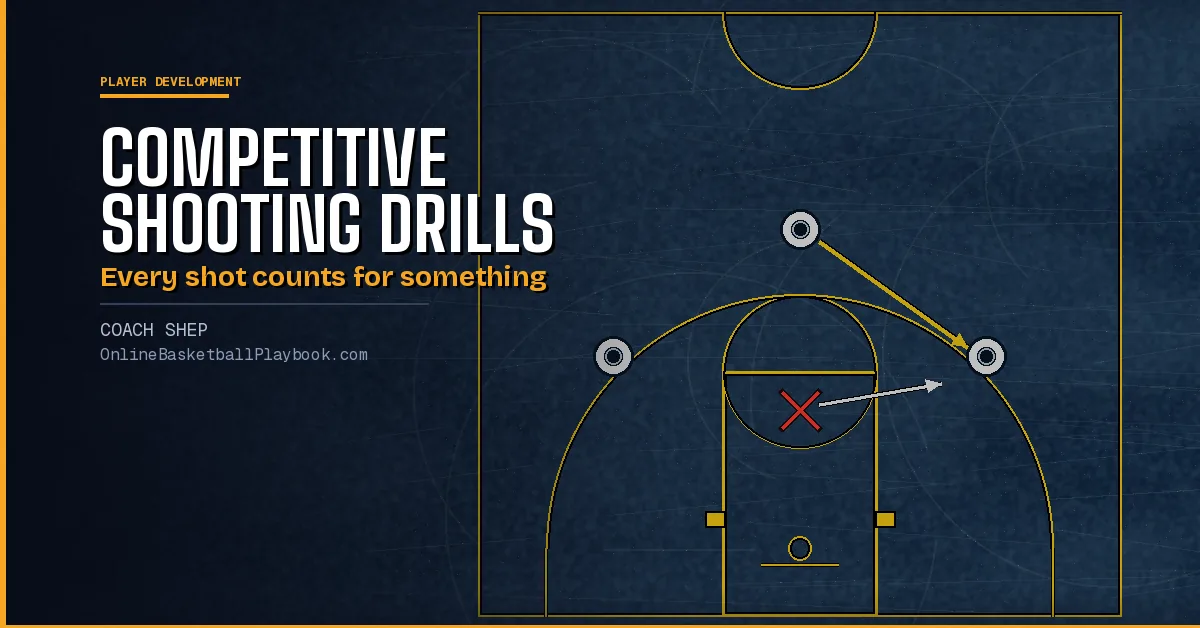
Competitive Shooting Drills: Scored Games and Records
Competitive shooting drills with a score on every shot: streak games, timed targets, Beat the Pro, plus and minus, 2-on-1 shooting and record boards.