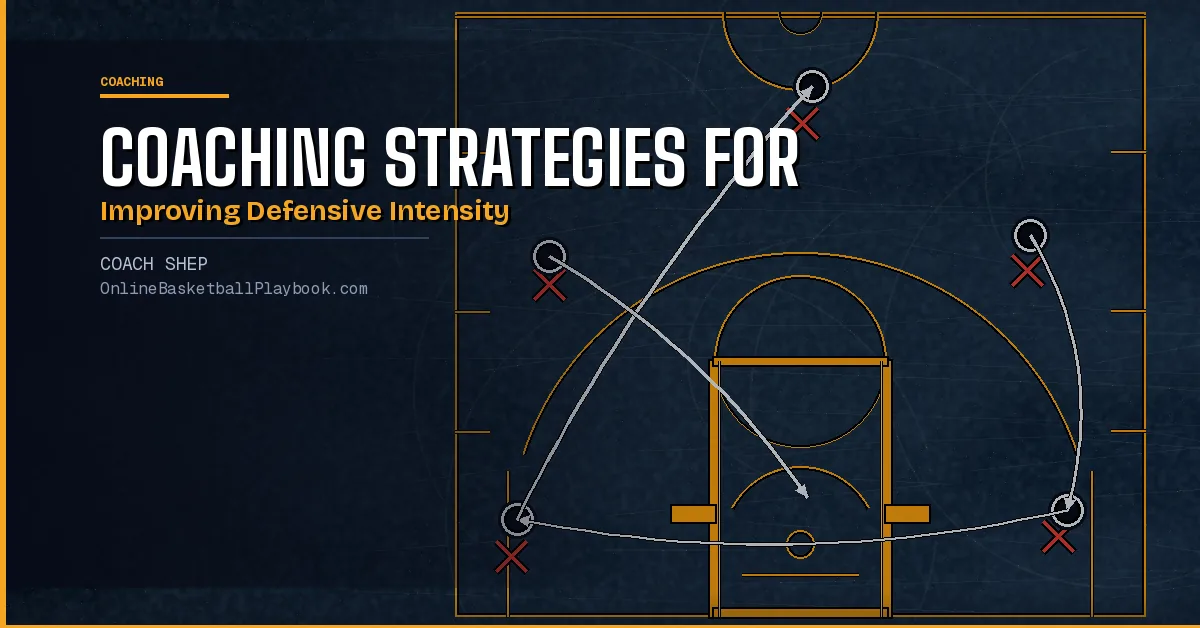
Defensive intensity is built in practice, drill by drill. The coaches who get consistent stops share one thing: they install habits through structured breakdown reps before ever going live five-on-five.
The Whole-Part-Whole Teaching Model
Every elite defensive system (a full-court press, a ball-screen coverage, a half-court shell) can be broken into small, teachable pieces and then reassembled. That is the backbone of effective defensive coaching: show the whole defense first so players understand the destination, drill each component at game-realistic intensity, and then put the pieces back together in five-on-five.
Coaches like Bill Donovan, Sebastian Iisalo, and Steve Clifford all install defense this way. NKU's John Brandon built one of college basketball's most pressure-heavy programs on the same structure, a daily two-segment block of eight to fifteen minutes of breakdown work followed by live five-on-five. The breakdown segment is not warmup. It is the core teaching moment of every practice.
The practical payoff is clarity. When a player has drilled a trap at full speed in a two-on-two setting and won that rep, they understand their assignment in a five-on-five press. The breakdown drill gives them a reference point. Without it, team defense is just a set of rules. With it, team defense is a set of remembered reps.
When you design your defensive breakdown curriculum, organize it the same way: identify each major habit your system requires, isolate each into the smallest drill that trains it at full intensity, and sequence them from simpler to complex before layering in five-on-five. A press needs trap skill, recovery skill, and rotational awareness. Drill each in sequence before connecting them.
Building the Footwork Foundation
Footwork is the single most undertrained element of team defense. Most players know what they are supposed to do on defense. They simply do not have the foot speed, balance, or habit to execute it at game pace. Drilling footwork separately, before any ball is introduced, compresses the learning curve dramatically.
The NKU footwork ladder is one of the cleanest models in circulation. It runs in sequence: boxer stance to establish a low, wide base, half-squat to train hip engagement, step-slide with towels held overhead to force players to stay low (you cannot raise up if the towel overhead gives it away), one-step and two-step "catch the first move" drills that train the big lateral step to cut off an initial drive, and run-recover ("punch the cone, sprint, big-step to cut off") that bridges stationary footwork into live recovery situations. The whole ladder culminates in the Box Drill, which chains all of the movements together under fatigue.
Ettore Messina's ordered drill progression starts with the same philosophy. His first two drills are a two-man zig-zag and a sprint-recover-into-zig-zag, teaching sliding, recovery, and stance as separate skills before any live offense is introduced. The zig-zag is not just a warmup habit. Used correctly, it is a diagnostic. Bob Knight ran zig-zags every single day and used them explicitly as a toughness read: "tough kids will go hard at zig-zags, soft kids won't."
For coaches building from scratch or working with younger players, start with an eight-step man-to-man build: stance and conditioning, on-ball footwork, jump-to-the-ball habits, and then add screens. Teach each stage slowly before adding speed. Run the jump-to-ball habit at half speed first, then full speed, then finally in a live drill. Players who rush to live before owning the habit make the same footwork mistakes in games that they make in practice.
Closeout and Contest Mechanics
Closeouts are where defense either holds or breaks. A poor closeout gives up open threes, invites ball-handler attacks, and teaches bad habits. A great closeout is a skill: sprint the first two-thirds of the distance, "parachute" with choppy steps, hands up, making yourself appear closer and larger than you are.
NKU credits its wall-up and verticals drill series for leading their conference in defensive free-throw rate. The wall-up trains players to form a chest wall when the ball enters the paint two feet away, and then jump straight up (not out) when the offense rises to shoot. The verticals drill adds a jersey-grab to teach timing: the coach holds the defender's jersey and releases late, so the offense leads, forcing the defender to catch up and contest without fouling. The lesson is high-jump-not-long-jump. A defender who jumps out to block a shot commits a foul and gives away easy points.
The contest drill framework identifies three scouting labels: Curry (run the shooter off the three-point line), Wade (close hard and contest on the rise), and Rondo (stay off, invite the pull-up, contest late). These labels let you rep a specific contest type in practice against specific opponent tendencies. The day before a game, you can run closeout reps with the label that matches your scouting report.
Tom Billeter's closeout series (influence-baseline, influence-middle, and closeout-on-a-shooter) adds a direction component that most closeout drills omit. A great closeout does not just challenge the shot; it influences where the ball goes next. Choosing to send the ball baseline or middle is a defensive decision, and it should be rehearsed deliberately before it shows up in a game.
Bob Hurley's Florida 1-on-1 drill trains the closing angle rather than just the closing speed. Two players start shoulder to shoulder, sprint toward an offensive player, and the defender uses body angle to cut off the drive lane before arriving. This teaches the closing path (the geometry of defense) rather than just acceleration.
Competitive Drill Formats That Create Urgency
Intensity in practice does not come from instruction. It comes from structure. Drills that end on a stop, not a clock, create the right urgency. Drills that keep score make effort self-reinforcing. Drills where the loser sprints teach players that winning the defensive rep has consequences both ways.
Bruce Weber's competitive drill bank is one of the most complete in the coaching literature. The 24-Second Drill runs five-on-five half court with the defense holding for a full shot clock (twenty-four seconds). If the offense scores, they go back to offense. If they get an offensive rebound, the clock resets. Weber calls it "very tough, great to end practice," because it requires sustained concentration rather than a single explosive effort.
Cut Throat (three teams rotating in three-on-three or four-on-four) keeps all players engaged. The key rule: you can only win by getting three stops in a row on defense or by scoring three times in a row on offense. You cannot run out the clock. You have to earn the exit.
Weber's Perfection Cut Throat raises the stakes further. The coach designates one specific fundamental before the drill: jump to the ball, closeout with hands up, deny the wing. Any defender who fails that fundamental results in the defense being disqualified. This structure teaches habit execution under competitive pressure. It is the closest drill environment to what players face in a tight game with a scouting report.
NKU validates every drill with a winner and loser, then makes the loser sprint. The principle is simple: if nothing is at stake, players regulate their effort. If something is at stake, they compete. Defensive intensity is a competitive behavior, and competitive drills are how you train it.
Shell Drill Progressions for Team Defense
The shell drill is the universal vehicle for installing team defensive concepts, but most coaches run it the same way every day and extract only a fraction of its teaching value. Shell drills work best when they build progressively, each stage adding one new variable while keeping everything learned before it in play.
Scott Nagy's four-stage shell progression is one of the cleanest ladders available. Stage one: jump to the ball. Every pass, every player without the ball takes one big step toward the new ball position. Stage two: give-and-go. Now the cutter is live. Help defenders must jump the cutter or get face-cut. Stage three: flash. When a player cuts from the weak side to the ball-side, the help defender reads it and stays in help positioning on the flash-out rather than following their man into an unneeded spot. Stage four: live-to-the-paint. The offense can now attack the basket, and the defense executes full rotations. Each stage folds the previous rules in. By stage four, players are doing everything simultaneously.
Mike Young's shell variants add another layer of specificity. Sprint-to-the-ball starts almost every practice session: on the whistle, the defense sprints to a position closer to the ball than they currently occupy. It trains the recovery habit as a reflex. The DeVoe drill places coaches unguarded in the corners and runs drive-help-shrink sequences, teaching the help-and-recover rotation without requiring a full offensive set. The Diamond-out-of-the-shell graduates into ball-screen and pin-down reps, letting the team rehearse the specific actions they will see in their next game.
The Pack-Line drill battery uses scoring to validate habits. The 3v3 and 4v4 Identity drills award plus-two points any time the ball touches the post box, so the defense is scored directly on whether they are executing gap positioning. The shell drill becomes a competition rather than a walk-through, and the scoring tells the coach exactly which habits are breaking down under pressure.
Toughness Drills: Will Over Skill
Toughness is not a character trait. It is a trained behavior. Coaches who treat toughness as something players either have or don't will always be disappointed. Coaches who run specific toughness drills on a schedule develop it reliably.
Bob Knight's three-drill toughness battery is distinct from technical progressions precisely because it trains physical contact and mental persistence as the primary skills. The Zig Zag Drill runs every day for three to five minutes as a diagnostic. Knight used it to identify who competed and who regulated. The 3-on-3 Blockout Drill requires defenders to hold their block for a four-count after the shot before pursuing the ball. The rule forces players to feel and sustain contact rather than brush a body and release. The 2-on-1 Hamburger Drill is every-man-for-himself rebounding with no more than one dribble allowed. The coach can mismatch deliberately to stress smaller players. All three drills end on possession, not on a clock, so toughness is measured by outcome.
Defensive small-sided work approaches toughness from a different angle. The 2v2 Deny-and-Grind drill runs consecutive live reps with physical denial and no respite between them. The 1v2 Rebounding drill puts a single rebounder against two offensive players pursuing the same ball, training the habit of winning disadvantaged situations. These drills reflect the same principle as Knight's work: defense under fatigue, against physical resistance, with a real competitive outcome.
The Pat Riley Drill requires four consecutive successful closeouts without giving up a baseline layup and without jumping to block a shot. The rule "stay in stance, never jump to block a shot" is enforced throughout. What makes the drill demanding is not the individual closeout. It is the consecutive requirement. Players must maintain technique and composure through four live reps in a row, simulating what a fourth-quarter defensive possession actually demands.
Run toughness drills on a fixed weekly schedule rather than pulling them out when you feel the team is soft. When players know the Hamburger Drill or the Blockout Drill is coming every Tuesday, they mentally prepare for it. Toughness becomes part of the culture rather than a punishment, and the competitive habits it builds transfer to games more reliably.
Validation Games That Make Stops Matter
The final step in any defensive installation is making stops matter in practice the same way they matter in games. Standard drills reward good execution but do not create the same accountability a late-game defensive possession carries. Validation game formats close that gap.
Ettore Messina's Defensive Validation format is the simplest and most transferable of these. A team's offensive score only counts if they get a stop on the next possession. Play to five or seven points. The format hides the defensive emphasis. Players are competing to win a scoring game, but accountability follows automatically because every offensive score is immediately conditional on the next stop. Messina's Stop-Score-Stop format chains the two outcomes explicitly: five-on-five does not end until one team strings a stop, then a score, then another stop in sequence.
Weber's No Man's Land Shell adds a spatial rule: the defense cannot allow the offense to get two feet in the paint in a position to make a play. If the offense penetrates, the defense loses the possession. The twenty-second possession limit prevents stalling and keeps intensity high. Three stops in a row to win. The format directly trains the habit of protecting the paint without a lecture. The scoring structure does the teaching.
The Big Stop game, drawn from clinic notes, requires the winning team to get one more stop after scoring. Winning is not enough. You have to hold. This mirrors the actual game situation more closely than any other format: you are up two with twenty seconds left and the other team has the ball. That moment gets rehearsed in practice, with real pressure, as a repeating drill condition rather than something players encounter for the first time in a game.
For younger teams, the Shrink-and-Spread drill trains the defense to collapse on a post entry and then re-expand on the kick-out as a named, rehearsed pattern. Most high school teams know they should help on post catches, but when it becomes a named pattern with a practiced rotation, the timing and execution improve dramatically because players have a shared vocabulary and a remembered rep to reference.
- Run the NKU footwork ladder (boxer stance, step-slide with towels overhead, one-step/two-step big step, run-recover punch-the-cone) as a daily defensive warmup that needs no setup and trains the foot habits that carry into every drill after it.
- Use Iisalo's two-on-two ball-screen coverage at sixty to seventy percent speed before ever going five-on-five. The defensive read (drop, show, switch) must be clean in a small-sided rep before players can execute it in a live offense.
- Score every drill with a winner and a loser; have the losing side sprint a short distance; intensity is a competitive behavior and competitive structure is the most reliable way to train it consistently.
- Name one specific fundamental at the start of Perfection Cut Throat, one habit only, and disqualify the defense immediately when any player breaks it. The single-habit focus trains execution under pressure faster than multi-rule formats.
- Close practice with Messina's Defensive Validation: a score only counts if you get a stop on the next possession; play to five; no setup required and the competitive pressure is immediate.
- Run Knight's 3-on-3 Blockout Drill weekly with a mandatory four-count hold before pursuing the ball. It trains the physical contact and sustained positioning that most young players avoid when allowed to self-regulate.
Want more basketball coaching strategies, drills, and tools?
Join the Online Basketball Playbook newsletter →
Draw this play free in the play drawer →
Membership: the full library, playbook packs, and Pro drawing tools →
Keep Building
Related breakdowns
Teaching Effective Defensive Strategies for Different Matchups
Teaching Effective Defensive Strategies for Different Matchups
Defensive Basketball Drills: Slides, Closeouts, Shell and Games
Defensive basketball drills in teaching order, from stance and defensive slide drills to closeouts, pass denial, shell and scored games, with the versions coaches split on.
Defensive Stance in Basketball: Weight, Feet, Hands and Drills
Defensive stance in basketball: weight, feet, hands and eyes, the footwork out of the stance and the drills that build it.