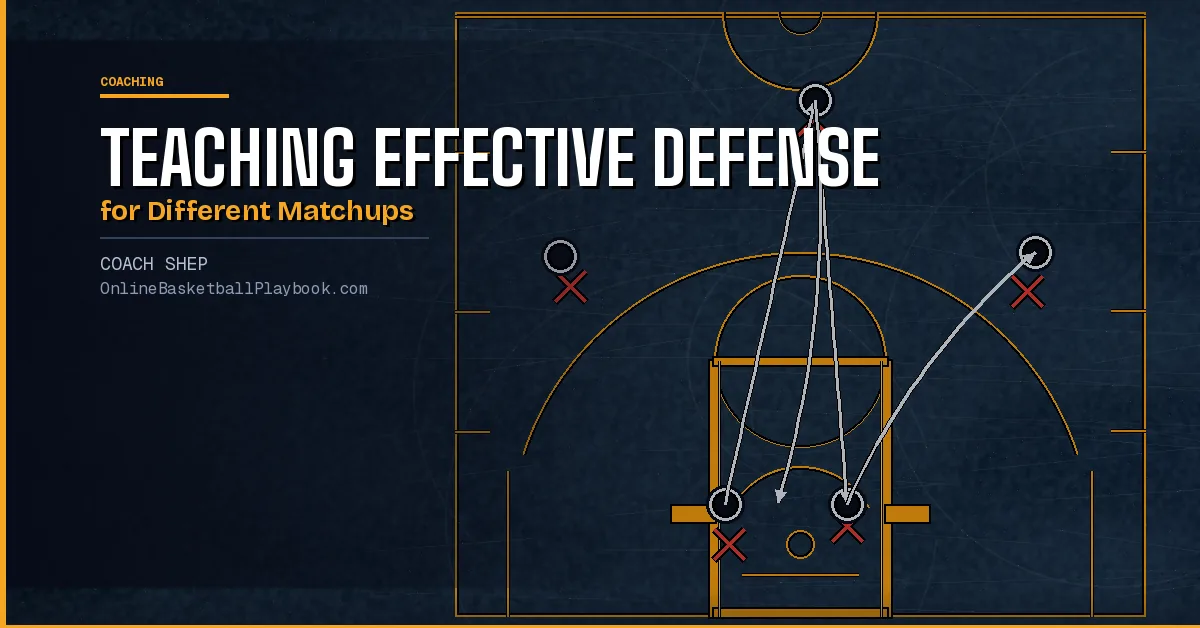
Defense breaks down when players don't know what to do in a specific situation. This guide gives coaches a drill-based system for teaching the right defensive response (on-ball, off-ball, closeout, or ball-screen) for any matchup they face.
The Whole-Part-Whole Teaching Model
The biggest mistake coaches make when installing defense is going straight to 5-on-5. Players get lost, habits don't form, and the coach spends the next three weeks correcting the same read over and over. The fix is a teaching structure that has been validated at every level of the game: whole-part-whole.
Show players the entire defensive system first. Walk them through how a press works, how your half-court man-to-man rotates, or how you want to guard ball screens. Then break it into isolated 1-on-1, 2-on-2, and 4-on-4 reps that train one habit at game-realistic intensity. Once the pieces are clean, reassemble it into 5-on-5 and the players bring their habits with them.
This is the model used by Billy Donovan, Ettore Messina, and the Northern Kentucky press defense system, among others. They all organize practice the same way: an 8-to-15 minute breakdown segment where one skill is drilled in isolation, then a 5-on-5 segment where it gets assembled. The breakdown does the teaching. The 5-on-5 does the testing.
The payoff is faster installation and better retention. When a player has done a 2-on-2 ball-screen coverage rep 40 times at 60 to 70 percent speed and gotten corrected in real time, that read is wired before the defense ever faces it in a game. Without the breakdown step, the first time they see a high ball screen live, they guess.
Every section in this guide follows that principle. You will not find drills that exist for their own sake. Each one targets a specific matchup situation and builds toward 5-on-5 execution.
Teaching On-Ball Defense for Different Matchups
On-ball defense is where matchup-specific teaching starts. Two players can be using the same defensive system and still need completely different individual technique depending on who they are guarding: a quick perimeter scorer, a physical wing driver, or a slower post-up center. The fundamentals are the same; the application changes.
Footwork First
Before any matchup-specific work, players need a functional defensive stance and a footwork ladder that holds up at game speed. The progression used by the NKU press defense is a clean template applicable to any defensive system: boxer stance to half-squat, then step-slide with towels overhead to enforce staying low, then the one-step/two-step "catch the first move" big step, then run-recover with a sprint to cut off the offensive player. The Box Drill chains all four movements together.
Run this footwork ladder daily. It takes 8 to 10 minutes and requires no setup. Coaches who skip it assume their players already know how to slide. Most do not. They backpedal, they reach, they cross their feet. The ladder fixes all three before a ball is ever in play.
The Push-Step and On-Ball Technique
For the on-ball defender, the core mechanic is the push-step: three push-steps, then run to recover if beaten. The defender stays low and wide, with the ear at chest level of the offensive player, and a brush hand ready as a soft arm bar. The ball-hand mirrors the ball at all times. It does not reach for the steal.
A key teaching point for matchup-specific on-ball defense is adjusting the starting gap. Against a quick ball-handler who attacks off the catch, the defender sets up with a shorter gap and a big lead step on the first dribble. Against a slower post-threat who needs to be bodied up, the defender uses a closed stance with full denial. The footwork is the same; the starting position and the trigger are different. Drill each matchup type separately before combining them in a shell.
The 1-on-1 Driving Line Closeout
The driving-line closeout drill from the Alabama practice system is one of the most practical on-ball tools. The defender closes out on the catch from a top-side angle, gets chest to the offensive player's shoulder, and beats them to the spot, no hands, no reach. The goal is to send the offensive player on a driving line with no middle access. Against a perimeter shooter who can attack in either direction, this matchup-specific closeout is the most important rep you can give your defenders.
Closeout Coverage and Perimeter Matchups
Closeout defense is where most teams give up open threes. The problem is usually not a broken scheme. It is a defender who either sprints and flies past the shooter, or jogs and gives up an uncontested look. Teaching matchup-specific closeout technique means teaching players three different responses to three different offensive players.
The Three Closeout Labels
The most practical labeling system for perimeter matchups uses three names tied to player types: Curry, Wade, and Rondo. A Curry closeout is used against your opponent's best shooter. The defender runs off the three-point line and contests hard on the catch, giving nothing. A Wade closeout is used against a shot-or-drive threat. The defender closes and contests on the rise, ready to recover on a drive. A Rondo closeout is used against a non-shooter or pure ball-handler. The defender stays off and contests late, taking away the drive lane instead of the shot.
These labels give players a language they can call in real time during games. When the scout shows the shooter in the corner is a Curry, every player on the floor knows to go get him on a skip pass. When the wing is a Rondo, they know to play off and crowd the driving lane. Labels beat in-game confusion faster than any drawn-up scheme.
The Closeout Drill Progression
Tom Billeter's three-stage closeout series is the cleanest teaching progression available: first, influence-baseline closeouts where the defender takes away the middle by angle; second, influence-middle closeouts for the opposite scenario; third, closeout-on-a-shooter where the defender closes tight to take the shot, then gives arm's length to contest without fouling. Each rep ends in a live 1-on-1 read.
The Pensacola Closeout drill from Bob Hurley's clinic adds a no-middle rule with a two-dribble live attack. It is ideal for teaching the Curry and Wade matchup types because the offensive player is forced to make a decision, and the defender has to execute the correct response in real time, not in a coached walk-through.
Run each closeout type as its own drill for two to three weeks before combining them into a scouting-based shell. The habit has to be formed in the isolated drill before it shows up reliably in 5-on-5.
Contest Without Fouling
Foul trouble on closeouts is usually a technique problem, not a motor problem. The Wall-Up drill is the cure: with the ball two feet into the paint, the defender builds a chest wall and then goes to full extension vertically on the rise. The Verticals drill adds a jersey-hold release. The coach grabs the defender's jersey, releases late so the offense gets a step, and the defender has to catch up and jump straight up. Both drills train the high-jump-not-long-jump principle that eliminates the reaching foul.
Ball-Screen Defense: Teaching Coverage by Matchup Type
Ball-screen coverage is the most matchup-dependent skill in modern basketball. The same team will need to guard a pick-and-roll differently depending on whether the ball-handler is a shooter, an attacker, or a popper. Teaching coverage by matchup type (not by a single rule) is what separates teams that defend ball screens from teams that give up layups and open corner threes all night.
Start With 2-on-2 Before Going 5-on-5
The Iisalo method of installing ball-screen coverage is the standard: run 2-on-2 coverage reps at 60 to 70 percent effort before ever going 5-on-5. The read (drop versus show versus blitz) has to be clean in a two-man environment before the rotations can function in the full scheme. At 60 to 70 percent, the offense is working for the defense. The defensive players get enough reps to build the habit without the complexity of five moving pieces hiding their mistakes.
The Three Coverage Types by Matchup
For a shooter handler, the drop coverage is the riskiest call. A defender who drops below the screen gives the handler a clean pull-up or step-back three. The coverage type needs to change. Either show hard to take away the pull-up or blitz and switch. For an attacker handler who does not shoot threes, a drop with no gap is often the right answer because it protects the paint. One common system teaches three ways for ball-screen coverage and the rule is simple: learn it every day, one rep at a time.
The Clifford blitz progression is the cleanest teaching sequence for teams that want to trap ball screens: blitz from the side first, then the angle, then the high position, then the switch-into-fire action. Run each position as its own 2-on-2 rep at three-quarter speed with full talk and full intensity before moving to the next. The quality of the rep is everything. Sloppy, fast reps do not install coverage. They install chaos.
Ball-Screen Coverage Vocabulary
Name every coverage type before drilling it. Common options include: Jam (stop the handler before he uses the screen), Up-and-Over (the defender goes over the screen and recovers top-side), Up-and-Under (the defender dips under the screen and recovers on the catch), Blitz (two defenders trap the handler at the point of the screen), and Switch (straight swap of assignments). Each name is a call the point guard or the coach can make on the fly. Without the vocabulary, the communication breaks down in the game and every switch becomes a scramble.
When installing ball-screen coverage for the first time, pick one coverage type and drill it for two full weeks before teaching a second option. Coaches who teach all three options in the first week end up with players who do none of them correctly under pressure. One clean read beats three confused ones every time, and once the first one is wired, adding a second is fast.
Using Competitive Drills to Lock In Habits
Technique without competition does not transfer. Players can execute a closeout drill perfectly in a walk-through and completely forget it when a live ball-handler attacks them at game speed. The solution is validated competition built directly into your breakdown drills. Every rep ends with a winner and a loser, and the loser runs.
The Messina Validation Formats
Ettore Messina's two competitive formats are the most efficient tools in this category. Stop-Score-Stop is a 5-on-5 format where the drill does not end until one team chains a stop, a score, and another stop in sequence. It pairs both outcomes and teaches players that defense and offense are inseparable. Defensive Validation is more subtle: a team's score only counts if they get a stop on the very next possession. Players compete to win a point game, and defensive accountability follows automatically without the coach ever having to lecture about effort.
Weber's Competitive Bank for Matchup Habits
Bruce Weber's Perfection Cut Throat drill is the most matchup-specific competitive tool. Before the drill starts, the coach designates one defensive fundamental: jump to the ball, closeout with hands up, deny the wing. Any defender who fails the named fundamental means that defensive team is out of the drill. The drill creates maximum competitive pressure around a single habit. Use it to lock in one matchup-specific read per week. Name it before the drill. Do not add a second one mid-rep.
The 24-Second Drill from the same Weber bank is ideal for teams that struggle to sustain defensive effort. In a 5-on-5 half-court format, the defense must hold the offense scoreless for a full 24 seconds. An offensive rebound resets the clock to 24. The drill is extremely difficult and that is the point. It conditions players to guard for full possessions against a matchup that is trying to attack every second.
Toughness Drills for Physical Matchups
Bob Knight's 3-on-3 Blockout Drill targets a specific physical matchup: the offensive rebounder who beats a passive defender by getting to the ball before the block-out is sustained. Knight's rule is that the defender must hold the block-out for a four-count before going after the ball. The coach throws the ball, says "Get it," and if the defensive player releases the contact before four, they lose the rep. This forces players to feel and sustain contact (the same physical demand they will face when a stronger offensive player tries to rip through a soft block-out in a game).
- Daily footwork ladder (8 min, no setup): boxer stance → step-slide → big-step catch → run-recover → Box Drill. Run before the first ball goes up. This is your baseline on-ball matchup prep for every player.
- Label your shooters before every practice: Assign each offensive player in your shell drill a Curry, Wade, or Rondo closeout type based on that week's scout. Defenders call the label on every pass, and it builds the in-game communication habit during breakdown reps.
- Install one ball-screen coverage type at a time: run 2-on-2 at 60–70% for two weeks before going 5-on-5, and do not add a second coverage call until the first one is automatic under live pressure.
- End every multi-team practice with Messina's Defensive Validation: score only counts if you get a stop on the next possession, play to five points. No setup required. Instantly raises defensive stakes without a conditioning lecture.
- Use Perfection Cut Throat to embed one matchup habit per week: name the one habit before the drill (sprint-on-the-pass, hands-up-on-closeout, deny the wing), then run competitor-pressure reps where a failure by any defender kicks that team out. Change the habit weekly; never run it without naming the one thing first.
- Add the Wall-Up and Verticals series as a daily 10-minute block: These two drills solve the most common foul problem on closeouts and contested shots, which is reaching and fouling on the jump. Run them before you run any live closeout drill and watch your team's foul rate drop within two weeks.
Building a Practice Progression That Actually Transfers
The final piece is assembling these individual matchup drills into a practice structure that builds habits over a full week or a full season. The most effective systems follow the same architecture: a daily breakdown block of 8 to 15 minutes that targets one matchup skill, followed by a 5-on-5 validation block that tests it live.
The Eight-Step Build
An eight-step man-to-man build gives a clear full-season progression. It moves in order: stance and conditioning and footwork, then on-ball defense, then jump-to-ball positioning, then add off-ball screens, then ball screens, then penetration and recovery, then make-it-competitive drills, then a finishing block-out or toughness rep. Each step folds the previous rules in. A player at step six already knows the step-slide, the push-step, and the jump-to-ball. The shell becomes a test of all three at once, not a new skill to learn.
The key to making this progression work in a real practice is the drill filter: every drill must have a score, a time limit, and end on a stop or a rebound. Mike Dunlap's six-component drill audit is the standard: every defensive drill needs time, score, an advantage or disadvantage built in, an element of unpredictability, a communication requirement, and a rebound at the end. If a drill is missing two or more of those components, it is a teaching drill, not a competitive drill, and it belongs in walk-through, not in the main practice block.
Matchup-Specific Scouting Integration
The most advanced application of this system is scouting-based shell work. Instead of running a generic shell drill, the coach assigns offensive players roles based on the upcoming opponent: the Curry shooter in the corner, the Rondo ball-handler at the top of the key, the physical wing driver on the left side. Defenders practice their matchup-specific reads against the exact alignment they will see on Friday night. By the time the game arrives, they have already covered that matchup a hundred times in practice.
The closeout label system makes this easy to implement. Before a scouting-based shell rep, the coach announces the labels: "Number 3 is a Curry, number 14 is a Wade, number 22 is a Rondo." The defenders know exactly how to play each one. When the shell goes live, the communication is already built in. The coach watches for execution, not confusion.
Transition Defense as a Daily Priority
Every matchup-based defensive system breaks down first in transition. The best half-court defense in the world does not matter if the offense beats you down the floor before your scheme sets up. Mike Young's practice structure gives transition defense the most time of any single defensive category, and the design is straightforward: a 4-on-4 get-back drill where the defense sprints and sets up at a disadvantage, and a run-touch-baseline drill where players never send more than two defenders to the offensive glass. Both drills teach the matchup habit that matters most in transition. Getting back before the offense can create a numbers advantage, then finding the right man to guard based on who is where.
Add Hurley's 5-on-3 plus 2 drill for late-season work. Three defenders scramble against five offensive players with two additional defenders running to recover. The drill simulates the exact chaos of a fast-break scramble and forces players to make the most important matchup decision in transition: guard the ball first, find the best shooter second, and communicate third.
Defense is ultimately a communication and will problem more than a scheme problem. The drills in this guide do not replace scheme. They build the individual habits and team reads that allow any scheme to function. Run the footwork ladder, install coverage types one at a time, validate everything competitively, and scout your opponents into the shell drill. When your players can name the matchup, execute the right technique, and communicate the call in real time, the scheme takes care of itself.
Want more basketball coaching strategies, drills, and tools?
Join the Online Basketball Playbook newsletter →
Draw this play free in the play drawer →
Membership: the full library, playbook packs, and Pro drawing tools →
Keep Building
Related breakdowns
How to Coach Defensive Schemes for Different Opponents
How to Coach Defensive Schemes for Different Opponents
Coaching Strategies for Improving Defensive Intensity
Coaching Strategies for Improving Defensive Intensity
Defensive Basketball Drills: Slides, Closeouts, Shell and Games
Defensive basketball drills in teaching order, from stance and defensive slide drills to closeouts, pass denial, shell and scored games, with the versions coaches split on.