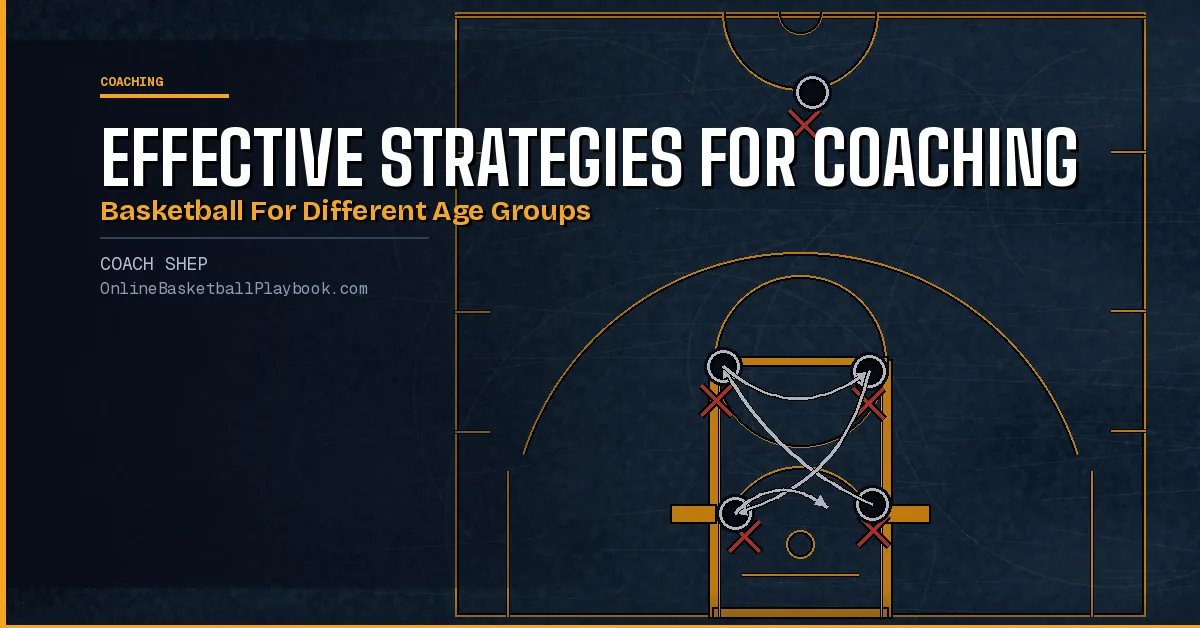
Coaching basketball well means meeting players where they are developmentally. What works for a nine-year-old fails a sixteen-year-old, and vice versa. This guide breaks down the strategies that actually stick at each stage.
The FUNdamental Stage: Ages 6–8
The youngest players need one thing above all else: to enjoy themselves. Canada Basketball's Long-Term Athlete Development framework and other youth programs are clear on this. The primary goal at this stage is not to produce basketball players. The goal is to produce kids who love the game enough to keep showing up.
At ages 6–8, players are egocentric. They have short attention spans, a high center of gravity that makes them fall easily on direction changes, and zero sense of pace. They will genuinely run until they drop if you let them. Attention is highest at the start of practice, so that is when you introduce the new skill. Every drill should last 3–5 minutes at most. Sessions should cap at 45–60 minutes total.
The structure that works: a ball for every child (no lines), several short activities, water breaks built in, and fun games carrying the skill you want to teach. Sharks-and-minnows teaches dribbling under pressure. Red-light/green-light teaches body control and reaction. Musical hoops teaches footwork and spacing awareness. The drill is the vehicle; the game is what the child actually experiences.
The coaching cues that stick at this age are simple visual anchors. "Pizza waiter" gets a flat hand and bent elbow on the shooting form. "Cookie jar" gets the follow-through. "2 hands, 2 eyes, 2 feet" teaches catching. These stick because a 7-year-old cannot process abstract mechanics but can hold a concrete image.
The measuring stick for a successful season at this level is not a win total. A player who could not dribble or make a jump-stop in October and can do both in March (that is success). Track the two things that matter: skill growth and desire to return next year.
Learning to Train: Ages 9–12
Between ages 9 and 12, players enter what Canada Basketball calls the "Learning to Train" window. The body and brain are ready to absorb technical skill at a faster rate than at any other point in development. This is the time to invest heavily in fundamentals. The repetitions laid down here form the base everything competitive will be built on.
The 4:1 practice-to-game ratio is Canada Basketball's benchmark for this stage. Four practices for every game played. That ratio keeps trainable reps high and prevents the common trap of over-scheduling league play at an age when players still need the time to actually learn. If your team plays more games than practices, development gets traded for scoreboard at the exact moment when skill is most absorbable.
The "loading" principle applies here. Instead of running five different drills in a practice, start with one drill and add complexity in place: add a defender, add a second ball, add a constraint like keeping the dribble below the knee. This keeps players in flow, lets the coach read readiness before advancing, and eliminates the setup time that bleeds reps out of short practices. One well-loaded drill beats five short ones that burn time on transitions.
Decision-making starts to matter at this age. Players can handle more than two-option reads now. Begin introducing the triple-threat read (shoot, pass, or drive) and simple scoring situations like 2-on-1 and 3-on-2 that force players to process what the defense is giving them. Keep the rules simple and the reps high.
Position concepts should be taught broadly. Every player handles, passes, finishes, guards, and learns spacing. No fixed positions at this age. A player locked into one role at age 10 has closed doors before they have fully developed as an athlete. The goal is to build complete players first, roles later.
Building the Skill Base: Ages 12–14
The 12–14 window is where the four non-negotiable fundamentals need to deepen into muscle memory. Ball-handling advances from basic cone-slalom work to two-ball drills and pressure-box situations. Passing progressions move from partner challenge drills to drive-and-kick reads and three-person weave timing. Shooting expands from catch-and-shoot to movement shooting and one-dribble pull-ups. Footwork anchors everything: the jump-stop, pivot, triple-threat, and purposeful cutting are non-negotiable at this level.
Ashworth's "repetition with variation" principle is especially useful here. The goal is not to introduce five new drills each week. It is to teach the same skill in different contexts so the pattern becomes automatic under pressure. Keep score on rep quality, not just quantity. Celebrate specific improvement: "You pivoted in balance all three times. That's real growth." Vague praise ("good job") does not teach anything; named precision does.
Video is an underused tool at this age. Players at 12–14 are self-aware enough to watch themselves and absorb corrections far more effectively from footage than from a verbal description. Even one phone camera running during a drill segment and reviewed at the end of practice creates teaching moments that carry across sessions.
Defensive concepts should be built deliberately at this stage. Ball-you-man positioning, help-and-recover rotations, and on-ball pressure should all be drilled and expected. Defense should not be something players "figure out on their own." It needs to be taught with the same intentionality as offensive skill.
The Competitive Window: Ages 14–17
High school-age players can handle the full weight of competitive preparation. Practice structure tightens, accountability rises, and the game is now being analyzed tactically rather than just physically. At this level, coaches have to manage more than drills. They are managing confidence, competitive pressure, and team culture simultaneously.
The five roles of a coach identified by Ashworth apply most visibly at this stage: teacher of fundamentals, builder of confidence, shaper of team culture, example of leadership, and facilitator of fun. Dropping any one breaks the system. Confidence-building is listed before culture-shaping deliberately. Players have to feel psychologically safe with the coach before team culture can take hold. A player afraid to make mistakes in front of the coach will not take the risks that create development.
Correction style matters at this level. The communication rule "shout praise, whisper criticism" from the Canada Basketball LTAD manual runs counter to how most coaches default (loudly correcting mistakes in front of peers and quietly giving positive feedback). Inverted correction inverts results: it kills willingness to experiment and raises anxiety around mistakes. Name the error, give a clear replacement cue, keep the tone encouraging, and move on quickly. Punishment-based correction produces mistake-avoidance, not improvement.
At this age, players old enough to own their development should be invited into the conversation. Self-assessments every two to three weeks, "What's one thing you've improved? What are you still working on? How have you helped the team?" Build ownership of growth rather than dependence on coach judgment. End-of-season individual conversations with each player (what they improved, what you appreciated as a coach, one challenge for next year) take three minutes per player and may be the highest-return investment a coach makes all season.
Culture, Parents, and Retention at Every Level
Team culture is not a speech. It is what you repeat. Ashworth's framework is practical: hold a team meeting and a parent meeting before the first practice, create a short team code of three words or a short phrase and repeat it constantly, begin every practice with a focus word, and end every practice with a "shout-out circle" where players recognize each other. Rotate practice captains who lead a drill. These habits compound into culture that outlasts any single season.
Parent management is a youth coaching fundamental, not an optional add-on. The majority of season-long friction traces back to parents who did not receive clear information before the season started. A parent meeting covering playing time philosophy, game-day behavior expectations, the communication chain, and how families can support the team prevents most of the problems that consume coaching energy mid-season. The 24-hour rule (no playing-time discussions the day of a game) protects the coach's composure and the team's focus. When issues escalate with older players (11 and up), involve the player directly. Part of development at that age is learning to own their role and advocate for themselves.
The greatest measure of a successful youth program, at any age, is retention. If players want to come back next year, the program worked. Track the two indicators that matter: specific skill growth and desire to return. Those two numbers tell you more about coaching effectiveness than the win-loss record.
The Four Non-Negotiable Fundamentals for All Ages
Across every age group, four skills anchor the development pyramid. The skill is the same at every level; the drill vehicle shifts to match the player's stage.
Ball-handling: Eyes-up dribbling with both hands, cone-slalom work for grades 2–4, two-ball and pressure-box drills for grades 5–8 and up. The cue stays consistent: "eyes up, no head bobbing." Players who watch the ball cannot read the defense or find open teammates.
Passing: Partner challenge and monkey-in-the-middle for younger players; drive-and-kick reads and three-person weave for older ones. Step to your target. Catch with soft hands, two-handed. Pass to where the receiver is going, not where they are. These cues travel across all age groups.
Shooting: Close-range form work and make-5-in-a-row targets for younger players; catch-and-shoot off movement and pull-ups off one dribble for older ones. "Hold the follow-through" is the one verbal cue that applies from age 7 to age 17. Fix the foundation before chasing range.
Footwork and movement: Jump-stop and pivot for all ages, triple-threat stance, cutting with purpose, and spacing awareness. These are not optional extras. They are the mechanical foundation that every offensive and defensive concept runs on. A player who cannot stop under control or pivot cleanly without traveling cannot run any offense effectively.
When all coaches across a program use the same four fundamentals and the same verbal cues, players who move between teams, camps, or coaches hear a consistent language. That consistency accelerates learning. Players spend time getting better instead of getting re-oriented every time they step into a new gym.
Before the first practice of any season, hold both a team meeting and a separate parent meeting. Cover your playing time philosophy, communication expectations, and what success looks like for this team. Most mid-season friction with parents comes directly from information gaps that could have been closed in a 20-minute meeting before the season started.
- Ages 6–8: fun is the foundation: one ball per player, drills that are games, 45–60 minute sessions, practice the new skill first when attention is highest, end on a positive every time.
- Ages 9–12: load, don't swap: start one drill and add complexity in place (add defense, add a constraint) instead of burning time switching to new drills; target a 4:1 practice-to-game ratio.
- Ages 12–14: repetition with variation: teach the same skill in different drill contexts until it is automatic under pressure; use video review even once a week for corrections that land 10x better than verbal-only feedback.
- Ages 14–17: shout praise, whisper criticism: correct quickly, name exactly what was wrong, give a short clear replacement cue, keep tone encouraging; self-assessments every 2–3 weeks build player ownership of their own development.
- Every age: define success before the first game: write the season's primary goal as "every player improves one specific measurable skill and wants to come back," then track both things; they tell you more than the record does.
Want more basketball coaching strategies and drills?
Join the Online Basketball Playbook newsletter →
Draw this play free in the play drawer →
Membership: the full library, playbook packs, and Pro drawing tools →
Keep Building
Related breakdowns
Strategies for Coaching Different Offensive Styles
Strategies for Coaching Different Offensive Styles
Basketball Coaching Leadership: 5 Strategies That Hold Up
Basketball coaching leadership in five habits: state who your program is, keep a few standards, build culture in practice, declare roles and develop player leaders.
Teaching Players to Adapt to Different Playing Styles
Teaching Players to Adapt to Different Playing Styles