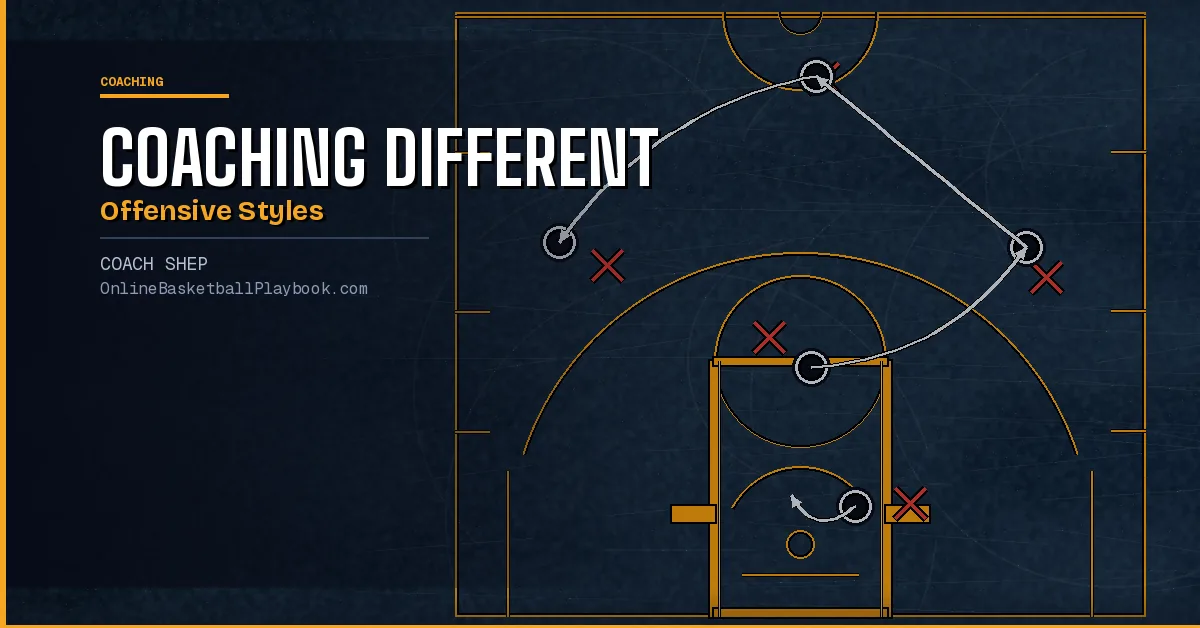
Every offense needs a different teaching path. Whether you run motion, pace-and-space, or a dribble-drive system, the breakdown drill progression you use determines how fast your players actually learn the reads.
Start With Reads, Not Sets
The biggest mistake coaches make when installing a new offense is jumping to 5-on-5 before their players own any of the individual reads. It does not matter whether you are running a Princeton backdoor action, a 5-out motion, or an NBA-style pick-and-roll package. If players cannot make the right decision in a 1-on-1 or 2-on-2 situation, the team-level sets will collapse under defensive pressure.
The part-whole teaching method is the answer. You isolate one read or one skill at a time in a small-sided drill, get hundreds of reps in a short practice window, and then scale up to the connected actions. This approach works across offensive styles because every offense, at its core, is a chain of individual decisions that must be made at game speed.
Before you install any offensive system, ask yourself: what is the primary read my players need to own? For a dribble-drive offense, it is the drive-and-kick. For a motion offense, it is the pass-and-cut. For a pace-and-space system, it is the catch-and-shoot decision. Build your breakdown drills around that primary read and layer in secondary reads only after the first one is automatic.
Teaching the Motion Offense
Motion offense is not a set play. It is a set of rules. And because it is rule-based, it demands that players internalize decision-making rather than memorize actions. The teaching progression that works best starts with 5-on-0 walk-throughs before any defender is added.
The 5-on-0 install exposes the spacing rules, the cutting options, and the timing of the offense without the pressure of a live defender. Bruce Weber's five-out motion teaching sequence is a model here: start with the basic pass-and-cut action in 5-on-0, add the screen-away option, then add the dribble-at action, then go live in 2-on-2 to test whether players own each piece.
Post-split action is one of the most important reads in any motion offense and one of the most frequently skipped in practice. When the ball enters the post, the two perimeter players on the strong side must make a split cut read. One cuts over the top, one cuts backdoor. And they need hundreds of reps of that exact action before it runs cleanly in a game. Build a dedicated 3-on-0 drill for post-entry that forces the split every single time.
The 2-on-2 Live Drill for Motion Reads
Once players can run the motion rules in a 5-on-0 setting, the fastest way to install decision-making is 2-on-2 live. The offense runs their two-player action, whether it is pass-and-cut, dribble handoff, or screen-away, and the defense contests it. The reads that break down live in 2-on-2 are exactly the reads you need to address before going to 5-on-5.
Constrain the drill: tell the offense they can only score off a cut, or off a dribble handoff. That constraint forces them to run the exact action they struggle with rather than retreating to a comfortable dribble-drive. The constraint is the coaching.
Coaching a Pace-and-Space System
Pace-and-space offenses succeed or fail based on three things: transition speed, catch-and-shoot readiness, and drive-and-kick execution. Coaching a pace-and-space system means drilling all three at game speed from the first day of practice.
Nate Oats' Alabama shooting battery is an excellent model. The core drills (three-guy-two-ball, four-guy-three-ball, two-on-one shooting with a contest) force players to catch in a ready position before the ball arrives. The "ready before the pass" rule is not optional: if a player is not squared and loaded when the ball is in the air, they are not running the system correctly, and the drill should stop.
Drive-and-kick is the engine of any pace-and-space offense. The blood drill isolates it perfectly: one player drives, one player spots up, the driver kicks to the shooter on the drift, the shooter shoots. The drill is scored (makes count, turnovers count negatively) and that scoring creates the competitive pressure players need to make accurate reads when tired. Run this drill early in practice, at game speed, before any 5-on-5 work begins.
Transition Spacing in Pace-and-Space
Transition spacing separates good pace-and-space teams from great ones. When the ball is pushed ahead in transition, the two trailing players must sprint to corner spots and be ready to shoot before the ball arrives. A simple two-man drill (one pusher, two trailers who must hit corners before the pass comes) builds this habit faster than any amount of 5-on-5 scrimmaging.
The Livsey simultaneous shooting battery is especially useful for large squads running pace-and-space. Drills like Backpedal (sprint to half-court, return, receive the pass and shoot) and Pepper (sprint to the rim, lob catch, finish) build both conditioning and shooting mechanics in the same rep. With fifteen or more players, having everyone working simultaneously at game speed is far more valuable than waiting in lines for a turn.
Dribble-Drive Motion: The Breakdown Path
The dribble-drive motion offense is built on one primary skill: the ability to finish at the rim off a live-ball drive. Before you install any of the kick-out reads, the skip-pass actions, or the secondary cuts, your players must be able to finish with both hands from multiple angles at game speed. Walberg's principle here is absolute: the drive-and-kick is only as good as the finish.
The layup sequence is the foundation. Straight layups, reverse layups, crossover layups, hesitation layups: all at game speed, both hands, both sides. Add the jump-stop power layup for contact situations. Run this sequence before any offensive drill in practice, because it builds the skill that every other piece of the dribble-drive offense depends on.
The Blood series from the Memphis dribble-drive system provides the best breakdown structure for the reads that come after finishing. Blood 1 isolates the primary drive. Blood 4 adds the kick-out, and the coaching constraint (a mid-range shot counts as a turnover) forces the kick rather than the bail-out pull-up. Blood 11 adds the skip-pass to the weak side when the drive-and-kick defender helps. Each layer adds exactly one read, which is the right way to build any complex offensive system.
Texas 22/33/44: Advantage Drill Design
The Texas series from the Memphis system is one of the most efficient tools in offensive coaching. Texas 22 is a two-on-two drill where the offense has an advantage: one pass has already been made, and the defender must recover. Texas 33 adds a third offensive player. Texas 44 is four-on-four live.
The power of the Texas series is that every version starts the offense from an advantage position. The defense is already behind. That means every rep forces offensive players to attack a scrambling defense, which is exactly what happens in a live game after a drive collapses the paint. Decisions must be fast and accurate, not deliberate. Run these drills at full speed with a real score kept: possessions that end in turnovers subtract from the total, possessions that end in quality shots add to it.
Using Constraints and Scoring to Coach Behavior
The most effective way to change offensive behavior without constant stopping and lecturing is to build the rule into the drill structure. Constraints and scoring systems do the coaching automatically, at game speed, without interrupting the rep.
The constraint principle is simple: if you want players to make a specific decision, make the wrong decision cost them something real. In Blood 4, a mid-range shot counts as a turnover. In the Five-Spot shooting drill, a player who does not validate a make with a free throw does not advance. In the No-Paint constraint game, a drive into the paint is an immediate turnover. These rules change behavior faster than any amount of halftime talk.
Incentive scoring works the same way. The +3/+2/+1/−2 scoring system used in Alabama's 5-on-5 drills rewards quality outcomes: a made three-pointer earns +3, a made two earns +2, an offensive rebound earns +1, a turnover costs −2. The team that loses the rep runs the difference. That negative consequence for turnovers changes how players handle the ball without a coach saying a word about ball security.
Hubie Brown's principle deserves its own space in your coaching philosophy: every drill should end with a make. Not every drill should run until someone misses. Every drill should run until someone makes. That simple rule changes the competitive energy in practice and conditions players to finish, not to give in when tired. Pair that principle with a scored constraint and you have a drill that teaches decisions, builds conditioning, and trains finishing simultaneously.
Small-Sided Games for Live Decision Training
Small-sided games are the bridge between breakdown drills and full 5-on-5. They give players a real defensive read to process while keeping the number of variables manageable. The best small-sided games engineer a specific decision by starting the offense from an advantage position or by applying a spatial constraint.
Alex Sarama's advantage small-sided games are the best framework for this. The coach controls the starting advantage: if the ball is on the offensive player's outside hip, the baseline drive is open. If it is on the inside hip, the middle drive is available. The defender must hi-five the coach before releasing, which means the size of the advantage is the distance the defender covers in that moment. Players must read the advantage and attack it immediately.
Guided defense adds another layer. Instead of playing live defense from the start, the defender is told to play trail coverage on the first rep, cut-off coverage on the second rep, and neutral on the third. The offensive player gets three different reads from the same starting action, which produces "repetition without repetition". The skill is repeated, but the solution changes each time. This is far more effective than drilling the same read against the same defensive position over and over.
Constraint Games That Shape Shot Diet
The No-Paint game and the Paint Game are two of the most useful constraint games for shaping shot diet. In No-Paint, any drive into the painted area is an automatic turnover. That constraint forces players to shoot off the catch or attack gaps from the perimeter rather than defaulting to a drive-and-bail-out pull-up. In the Paint Game, players must attack the paint and the constraint rewards aggression rather than perimeter comfort.
Choose the constraint based on what your team's shot chart reveals. If you are giving up too many mid-range pull-ups, run No-Paint for two weeks. If your players are settling for perimeter shots when drives are available, run the Paint Game. The constraint matches the coaching problem you are solving.
Before any 5-on-5 scrimmage segment, run three minutes of the Livsey simultaneous shooting battery: Backpedal, Pepper, and Crack Back in rotation. With a large squad of fifteen or more, every player gets game-speed reps at the same time instead of waiting in lines. This builds shooting mechanics and conditioning simultaneously and primes players to catch ready before the scrimmage begins.
Connecting the Parts Into 5-on-5
The final step in any offensive installation is connecting the isolated reads into the full 5-on-5 system. But the timing of that step matters enormously. Moving to 5-on-5 before players own the part-drills guarantees that the system will break down under defensive pressure and that players will retreat to instinct rather than running the offense.
The test for readiness is simple: can your players make the primary read correctly in a 2-on-2 or 3-on-3 small-sided game? If yes, add the next layer. If no, stay in the breakdown drill. A coach who can diagnose where the breakdown is occurring (in the footwork, in the read, in the spacing, or in the pass decision) and who matches the drill to that specific breakdown will install offense faster than a coach who simply runs more 5-on-5.
Gregg Popovich's "3 Ways" controlled scrimmage is the right format for the transition from parts to whole. Five-on-five, full court, but structured like a drill: one point for a score, one point for a stop, play to ten, then throw to the coach and restart. The coach controls tempo and can re-teach after each down-and-back without the scrimmage spinning out of control. Players cannot coast through a 3 Ways session because every possession is scored and every stop matters as much as every basket.
A decision-drill progression provides a useful ladder for scaling complexity. Start with 1-on-1 reads (getting open off a cut, reading a ball screen) and add the second defender who changes the read. Then connect two actions: a ball screen into a dribble handoff, or a drive-and-kick into a secondary cut. Finally, connect three actions and let it run live. At each stage, players must keep playing after the first option is covered, which is the only way to build offensive intelligence that holds up in a game.
The key discipline for any coach installing a new offense: never advance to the next layer until the current layer is owned. Patience in the breakdown process pays off in November and December when your team runs their offense cleanly under pressure. The coaches who skip steps in September are the ones calling timeouts in January to re-teach reads that should have been automatic months earlier.
- Install one primary read per practice segment using a 1-on-1 or 2-on-2 breakdown drill before adding defenders or scaling to 5-on-5.
- Use a constraint to coach the shot diet (mid-range equals turnover, no-paint zone, or a required zone) so players correct their own decisions without constant stoppages.
- Score every competitive drill with a point system that rewards quality shots and penalizes turnovers; the losing group runs the difference to build consequence for poor decisions.
- Run the Livsey simultaneous shooting battery before 5-on-5 segments to give every player game-speed reps at the same time rather than waiting in lines.
- Use Popovich's 3 Ways format (score stops and baskets equally, restart after each down-and-back) when transitioning from breakdown drills to full 5-on-5 scrimmage.
- Apply guided defense in small-sided games: give the offense three different defensive looks from the same starting action to build the habit of reading, not memorizing a response.
- Finish every drill with a make, not a miss. That single rule changes competitive energy, trains finishing under fatigue, and conditions players to play through contact.
Want more basketball coaching strategies, drills, and tools?
Join the Online Basketball Playbook newsletter →
Draw this play free in the play drawer →
Membership: the full library, playbook packs, and Pro drawing tools →
Keep Building
Related breakdowns
Teaching Players to Adapt to Different Playing Styles
Teaching Players to Adapt to Different Playing Styles
Effective Strategies for Coaching Basketball for Different Age Groups
Effective Strategies for Coaching Basketball for Different Age Groups
Basketball Coaching Leadership: 5 Strategies That Hold Up
Basketball coaching leadership in five habits: state who your program is, keep a few standards, build culture in practice, declare roles and develop player leaders.