
Most players shoot thousands of reps without improving. The difference between a shooter and someone who just shoots is form, competition, and a recorded score — every single session.
Build the Foundation: Form Before Volume
Before you ever think about volume, the shot has to be built correctly. That sounds obvious, but most players skip this step entirely. They walk into a gym, pick up a ball, and start firing threes. What they're really doing is grooving bad habits at high speed.
The form-first sequence that elite coaches use starts without the ball. Build the stance — balanced base, toes pointing toward the rim, shooting shoulder aligned. Then add the ball: guide hand on the side, shooting hand under the ball in what coaches call the "pizza waiter" position. The elbow goes under the hand, and the hand goes over the knee. On the release, the follow-through finishes high, fingers pointing down toward the rim — the "cookie jar" finish.
Jay Wright at Villanova built his entire shooting culture around two foundational drills run at the start of every practice. The Set Lift has players lifting the ball with elbow under, extending to a full follow-through with no rim contact. The Bradley Drill focuses on getting the ball as high as possible — the closer to the rim the release point, the higher it needs to go. Wright's teaching rhythm: "jumping and lifting, shooting on the way up." Those two drills came first at Villanova, every single practice, for years.
John Beilein at Michigan independently arrived at the same place. His doctrine: "Footwork is more important than any offense you run because the player still has to be able to make a play no matter what the defense does." Form and footwork are the foundation. Everything else — the offense, the sets, the reads — runs on top of them. Build the base right, and the rest follows. Rush past it, and you're building on sand.
For younger players, the on-ramp is even more deliberate. Youth coaches have long used the wall as the starting point — shoot to the wall, not the basket, so the player can watch the ball spin and feel the follow-through without worrying about making shots. You can see the backspin. You can see whether the guide hand pushed across. You can see everything. Only after the form is clean does the player move to the basket. Volume comes last.
Make Every Rep Count With Competition
The single most underrated principle in shooting development is this: every rep needs a winner. Not every practice — every rep. The moment you add a score, a timer, or an opponent, the quality of every attempt in the gym goes up. Players lock in. The brain treats scored reps differently than casual ones.
Coaches who understand shooting at a deep level have been saying versions of this for decades. The most dangerous player, in Jay Hernandez's framing, is the one who is continually improving — and the only way to continually improve is to measure yourself against something. A clock. A partner. Your own previous record. The competition doesn't have to be elaborate. It just has to be real.
Shaka Smart built a full drill library at Texas around this principle. His shooting drills have explicit team records attached to them — not targets, records. The 3-Minute drill has a team record of 157. The Evans drill has a record of 219. When a player steps up to run the 3-Minute drill, they're not shooting to hit a generic "make enough" goal. They're shooting to beat 157. That changes everything about how the rep feels.
Smart also imposed a rule that makes his drills harder to shortcut: you cannot shoot the same spot twice. You must move. That single constraint forces players to practice shooting on the move, off different angles, from different distances — which is exactly what happens in games. The static shooting workout where a player just stands in one corner and fires is useful for early-stage form work, but it has a ceiling. The ceiling breaks the moment you add the "must move" rule.
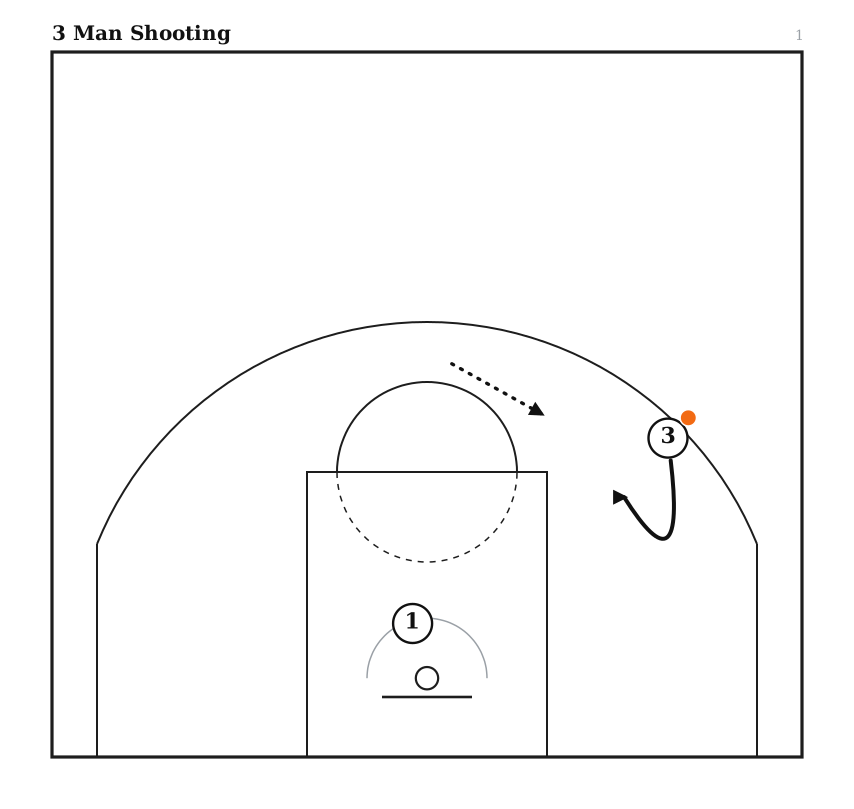
Wright's competitive standard at Villanova: three players, two balls, each gets 10 shots, goal of 6 makes in 30 seconds. All three run if unsuccessful. Beilein's standard at Michigan was higher — 7 makes in 10 shots in 30 seconds, coming off a down screen and flare screen sequence. Fail the standard, and the group runs half-court sprints in 5 seconds. These aren't arbitrary penalties. They teach players that the standard is non-negotiable, that the consequence for falling short is shared, and that every rep in a timed window carries real weight.
Score It, Record It, Post It
A record board is the cheapest competitive infrastructure a program can build. Write the drill names. Write the records. Let players sign their marks when they break them. Post it where the team can see it every day.
This is what turns shooting into a culture rather than a chore. When a player walks into the gym and sees their name next to a record, they're invested. When someone else's name is on the board, they have something to chase. The board creates stakes without requiring a coach to manufacture them artificially every session.
The named-drill system matters here too. Drills need names so players can talk about them, track them, and own them. Hernandez's drill bank — Quarters, Personal Best (the "30-30"), Streak, Star, Around the Horn, M Drill, Burner, Doubles, Over-and-Back — gives each workout a language. A player doesn't say "I worked on my shot." They say "I hit a personal best on the 30-30" or "I finally broke the Burner record." Specific language signals specific improvement.
Smart's "Beat the Pro" drill adds a head-to-head accountability layer: your miss counts as two points for the opponent. That rule forces players to compete against a consequence that compounds — a string of misses doesn't just cost you points, it actively builds the opponent's lead. That's closer to real game pressure than any other shooting drill structure most players experience in practice.
Make every rep competitive — against the clock, an opponent, or yourself. A shooting workout should have a winner. The most dangerous person is the one who is continually improving.
— Shooting Development, Basketball Vault
Diagnose and Fix Your Shot Errors
Most coaches respond to a player's shooting error with a generic cue — "bend your knees," "follow through," "get your elbow in." Those cues aren't wrong, but they're often aimed at the wrong problem. Dr. Hal Wissel developed a systematic diagnostic framework specifically because the root cause of a shooting error is rarely what it looks like on the surface.
The framework works backward: observe the miss pattern, identify the mechanical cause, then prescribe the specific correction drill. Short shots usually come from a release point that's too low — the ball leaves the hand before full arm extension. The fix is a high-extension finish drill where the shooter holds the follow-through with the arm fully extended and fingers pointing down at the rim until the ball lands. That single cue forces the arm to complete the motion.
A shot that consistently goes wide right or wide left is almost always a guide-hand problem. The off-hand thumb pushes across the ball at release, redirecting it off line. The drill fix is the thumb-lock: consciously hold the guide-hand thumb up and away, then shoot one-handed form shots until the ball tracks straight. Most players who work this drill for a week are stunned by how much of their miss pattern disappears.
Line-drive flat shots come from a flat wrist at release — the elbow isn't finishing above eye level. The ceiling target drill works reliably here: pick a point on the gym ceiling above the front of the rim and aim the arc there. Players who shoot line drives consistently pick up four to six inches of arc immediately when they aim at the ceiling point rather than the rim.
Side spin — the ball rotating left or right in the air — signals that the shooting hand is cocked to the side at set-point, the wrist turning rather than flexing forward. The correction is elbow-in alignment: at set-point, the shooting elbow must be directly under the ball and directly over the shooting knee before the wrist snaps. Check both in a mirror or ask a coach to observe from the side. The fix is positional before it's kinetic — get aligned first, then shoot.
Wissel's key coaching discipline: when a player misses consistently, work backward through the diagnostic sequence — arc angle, hand position, elbow alignment, balance and foot — before prescribing a drill. The root cause is rarely where the player thinks it is. A player who thinks their problem is their legs is usually dealing with a hand issue. A player who thinks their problem is their elbow usually has a footwork problem. Diagnosis before prescription, every time.
Train Game Shots From Game Actions
The most common structural flaw in shooting workouts is the spot-up: a player stands in a corner, a manager feeds the ball, the player catches and shoots. Repeat 200 times. The problem isn't the volume. The problem is that basketball almost never gives you a spot-up catch from a stationary position with a clean feed and no defender in your window.
Larry Brown's system at SMU addressed this directly. Every drill in his shooting library begins with a realistic offensive action — a zipper cut, a baseline drive, a ball screen, a drive-and-kick. The player is always responding to a read before pulling the trigger. They're making a decision — closeout angle, roll or pop, curl or fade — and then shooting. The shot comes after the action, not instead of it.
This matters because the decision is part of the skill. A player who can catch a clean pass and shoot is a fraction of the player who can read a closing defender, adjust their footwork, and still get off a clean look. Training one without the other creates a player who looks good in isolated shooting drills and hesitates in games.
The footwork piece inside that action deserves its own attention. Both Jay Wright and John Beilein taught the inside foot principle as a non-negotiable fundamental — on all V-cuts and screen catches, the inside foot plants first. Wright had his players say the sequence aloud during technique work: "1-2, lift, follow through." The verbal sequence forces the brain to process the steps deliberately before they become automatic. It's a teaching method, not just a cue.
The pull-up and hesitation deserve special mention because they're the most neglected shots in player development. Most coaches chase the catch-and-shoot three and the rim finish. The player who can take one or two dribbles and pull up around the free throw line is just as dangerous, and far less common. Rumjahn and Kelbick identified this as a "lost art" — players who spend time developing the pull-up and hesitation consistently find open looks that pure shooters and pure drivers never get, because defenses aren't practiced at guarding the in-between.
Before your next shooting workout, pick one offensive action — a zipper cut, a V-cut off a screen, or a two-dribble pull-up — and run every shot in the session off that action. Don't spot up once. At the end of the session, you'll have trained the shot and the decision simultaneously, which is what your players actually need when the game speeds up and the defense closes.
Free Throws Under Fatigue
Free throws are the most coached and least correctly trained shot in the game. Most programs spend time on free throw mechanics during walk-throughs, at the beginning of practice when players are fresh, or at the end of conditioning as an afterthought. None of those contexts match when free throws actually happen in games.
In games, free throws happen when a player is exhausted. Late in a half, late in a game, after a hard drive to the basket, after being hacked on a rebounding attempt — that's when free throws matter most. Shooting them fresh in a quiet gym does almost nothing to prepare for that moment.
Rick Pitino's approach at Louisville baked free throws into live 1-on-1 games specifically when players were tired, and he tracked the percentages. The data told him where players actually stood, not where they performed under ideal conditions. That number — the tired-and-tracked percentage — is the real number. Everything else is a warm-weather result.
Hernandez's workout structure addressed the same issue differently: free throws were shot after the second turn and after the last drill of every session, not at the start. Ten shots each time, counted, no padding the number with a fresh attempt if the session ran short. The count was the count. That structure means every player in the program knows their real free throw percentage under something resembling game fatigue, not just their gym-fresh percentage.
Pitino also identified a mechanical cue that translates well to any level: the ball and the head should be over the free throw line to project the ball toward the rim. Most players who miss short on free throws are standing too far back in their stance, pushing the ball rather than projecting it. Move the center of gravity forward — head and ball over the line — and the trajectory improves. It's a simple positional fix that coaches at every level can teach in one minute.
- Form before reps: Open every shooting session with at least five minutes of one-handed form shots — no full shot, just the set and release — before moving to full shooting. This grooves the mechanics before fatigue sets in.
- Add a score to every drill: Set a make target or a time window for every shooting drill you run. Write the result down. The score is what makes the rep real — an unscored rep is practice; a scored rep is training.
- Run a record board: Three to four named drills per team, posted results, players sign their personal bests. Takes fifteen minutes to set up and builds a competitive shooting culture that self-sustains across the season.
- Diagnose before you prescribe: When a player has a consistent miss pattern, identify the mechanical root cause first — arc, hand position, elbow alignment, footwork — before assigning a drill. Wrong drill for the right miss wastes time.
- Shoot free throws tired: Never shoot free throws only fresh. Build them into the back half of workouts — after conditioning, after live 1-on-1 play — and track the percentage separately from fresh attempts. That's the number that matters.
Want more basketball coaching strategies and drills?
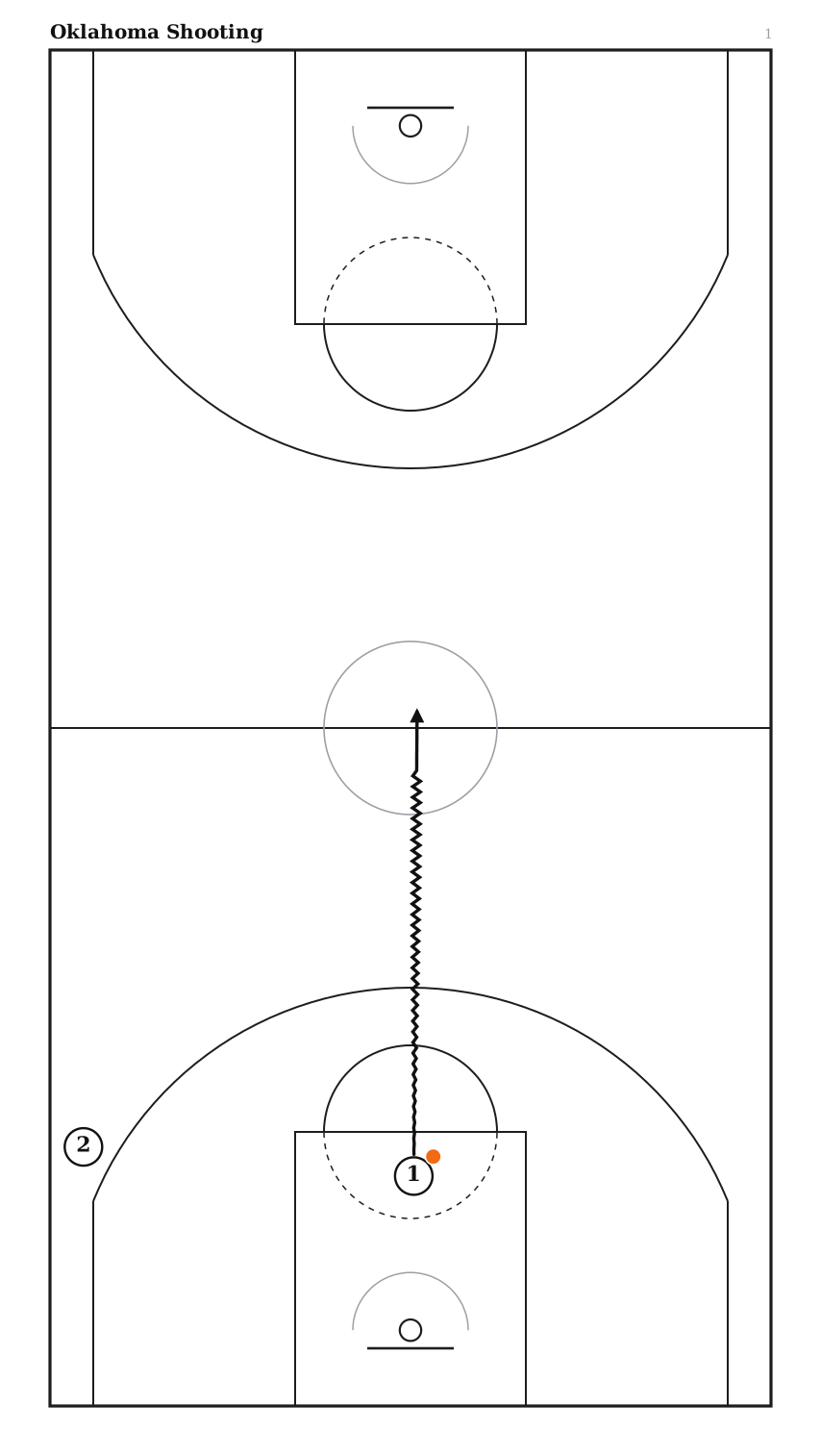
See it drawn up
Related diagrams
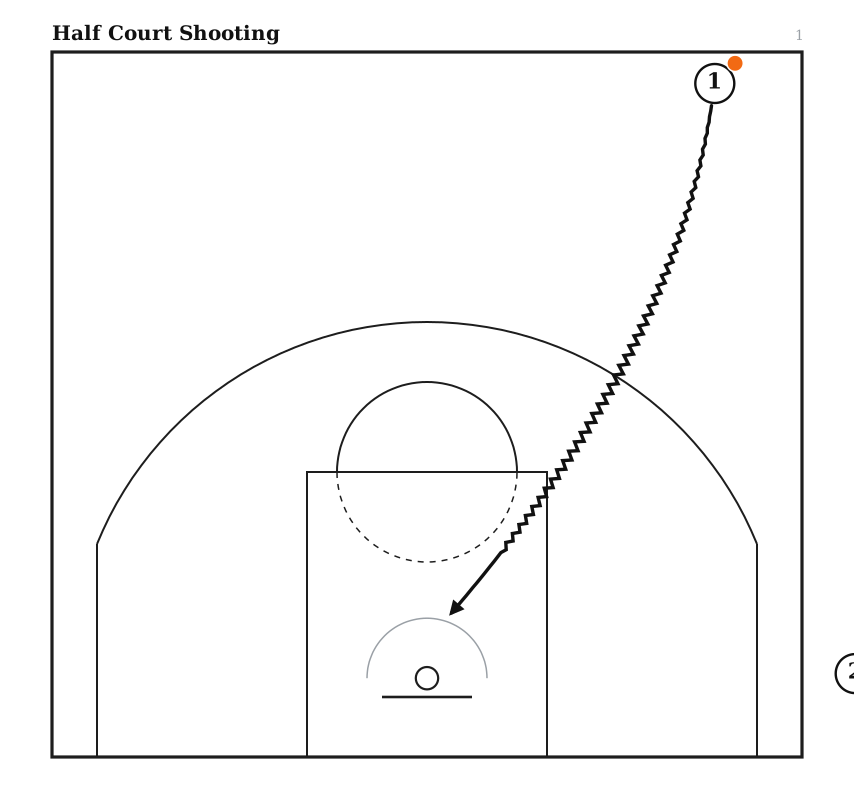
Keep Building
Related breakdowns
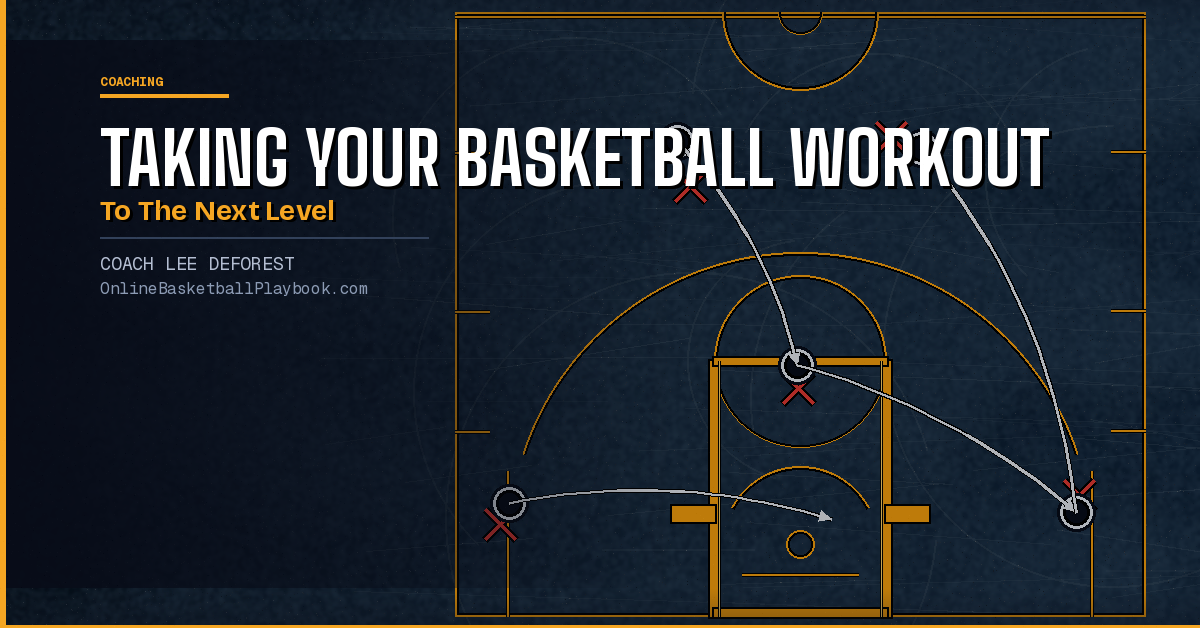
Taking Your Basketball Workout to the Next Level
Taking Your Basketball Workout to the Next Level