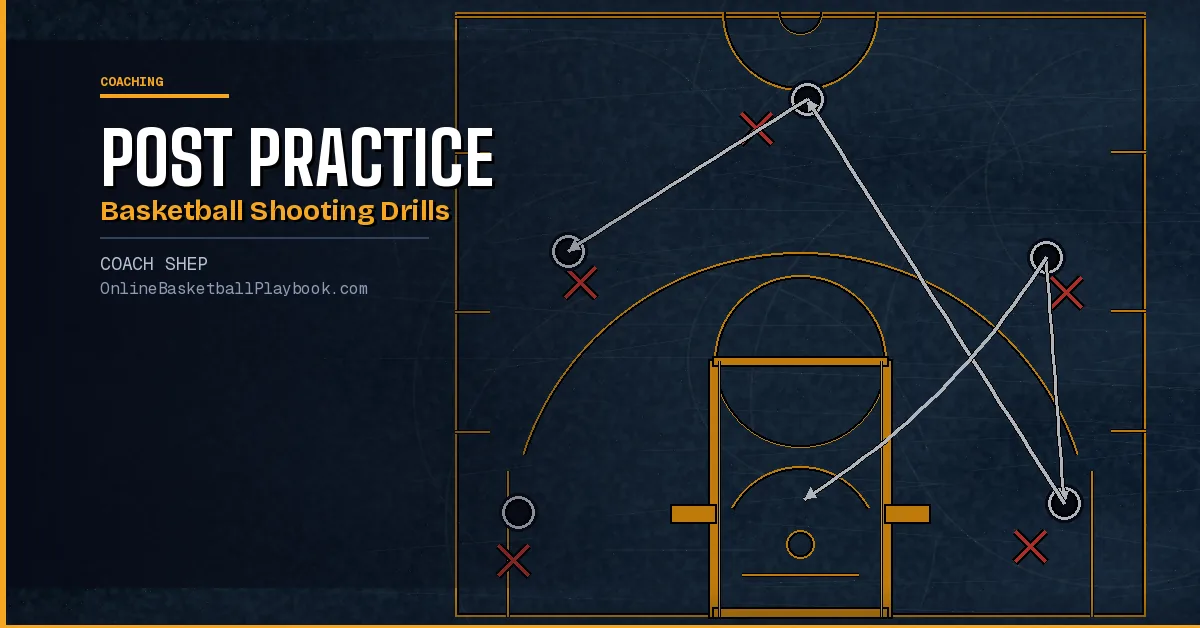
The last ten minutes of practice are where shooters are made. Post practice basketball shooting drills build the concentrated repetitions that carry into games. If you run the right ones with the right intent.
Why Post-Practice Shooting Matters
Most coaches end practice with a conditioning sprint or a team breakdown drill. Shooting is an afterthought. Players drift to the baskets on their own while the coach walks off the floor. That unstructured time is wasted. Post-practice shooting, when structured and supervised, is one of the highest-return activities in your weekly schedule.
The reason is fatigue-state specificity. When your players are fresh, their mechanics feel effortless. When they are tired, as they will be in the fourth quarter, the mechanics break down unless they have been practiced in a tired state. Running shooting drills at the end of practice, when players are physically spent, conditions them to hold form under the exact conditions that matter most in games.
There is also volume. A player who shoots 50 extra shots per day after practice adds 9,000 shots over a six-month season. Quality repetitions compound. The players who reach elite-level shooting consistency are almost always the players who put in the post-practice work. Not because they had a gift, but because they accumulated reps others skipped.
The final reason is transition from team to individual. Practice is about the team system. Post-practice shooting is where a player locks in on their personal mechanics: their footwork, their release point, their rhythm off the catch. This separation matters. Players need dedicated time to work on themselves as shooters, not just as cogs in a team offense.
Principles of Effective Shooting Work
Before breaking down specific drills, there are non-negotiable principles that separate productive post-practice shooting from wasted gym time. Every drill you run should be held against these standards.
Purpose Over Volume
Shooting 300 shots with sloppy footwork and no accountability teaches bad habits faster than no shooting at all. Every repetition should have a defined purpose: footwork, shot pocket, follow-through, catching footwork, or decision speed. When a player finishes a spot shot, they should be able to tell you what they were working on. If they cannot, the drill was not structured well enough.
Game-Speed Catches
One of the most common post-practice shooting mistakes is catching the ball at a slow jog and then setting the feet deliberately before shooting. This does not transfer. In games, passes arrive with defenders closing out hard. Catch-and-shoot drills need to replicate game-speed catches: balls fed crisply, catches made at full footwork speed, shots released without unnecessary extra dribbles.
Tracking Makes and Misses
Players who track their shooting percentages during post-practice work improve faster than those who do not. Accountability changes effort. Keep a simple count: makes out of 10 from each spot. A player who knows they went 6-for-10 from the left wing yesterday will attack that spot differently tomorrow.
Keep It Short and Focused
Post-practice shooting should run 10 to 20 minutes. Not 45. Players who are already fatigued need structure, not more volume to grind through aimlessly. A tight, well-run 12-minute shooting session beats a 40-minute free-for-all every time.
Form and Spot Shooting Drills
Form shooting is the foundation. It is not glamorous, but it is where mechanics get ingrained. Post-practice is the right time for form work precisely because fatigue reveals the lazy habits: the elbow that drifts, the wrist that flicks sideways, the leg push that collapses.
One-Hand Form Shooting
Start two to three feet from the basket. Remove the guide hand entirely. Shoot with the shooting hand only, focusing on the release point and a locked-in follow-through. Make 10 before moving back. This drill is uncomfortable for most players who are used to loading up with both hands. Which is exactly why it works. The one-hand version isolates the mechanics that the guide hand can mask.
5-Spot Shooting
Set five spots around the arc: left corner, left wing, top of the key, right wing, right corner. Shoot five from each spot. Track makes. Rotate through all five spots twice for a total of 50 shots. The goal is not to reach a set number. It is to hold consistent form at each spot regardless of fatigue. Have a rebounder feeding the ball so there is no chasing. The shooter catches and shoots continuously, holding full concentration on mechanics.
The Elbow Series
Position the shooter at the left elbow and the right elbow. The two spots where mid-range pull-ups live in almost every half-court offense. Shoot five from each elbow, focusing on catching off the dribble with a controlled two-foot landing. Add a jab step before each shot to simulate a live ball situation. The elbow is where games are decided in close-out moments, and shooters who own both elbows create immediate value in any system.
Catch-and-Shoot Drills for Game Situations
The majority of perimeter shots in organized basketball come off catches, not off the dribble. Catch-and-shoot proficiency is the core skill for wing players, stretch bigs, and anyone running through a screening system.
Corner Kick-Out Shooting
A player drives the lane (or a coach simulates the drive) and kicks to a shooter stationed in the corner. The shooter must pre-align their feet to the basket as the drive develops. Not after the catch. This alignment under anticipation is the part that breaks down under pressure. The drill trains the shooter to read the drive and prepare feet before the ball arrives, which is the same read they will need in the fourth quarter with a defender closing out.
Curl and Flare Shooting
Set a screener on the wing. The shooter runs a curl cut around the screen (simulating coming off a pin-down) and receives a pass from the opposite side of the floor. Alternate with a flare cut where the shooter moves away from the screen instead of curling it. Both reads appear constantly in motion offenses. The footwork required to convert each is different. Curls land with inside pivot foot down. Flares require a quick gather from lateral momentum. Post-practice is the right time to drill both reads in isolation until the footwork is automatic.
Spot-Up Off Drive Kick
Three players on the perimeter, one driving from the top of the key. The driver attacks, defenders collapse (simulated), and the driver kicks to whichever perimeter player is open. All three perimeter players must pre-read and move their feet before knowing who will receive the ball. The shooter who gets it shoots immediately on the catch. This drill builds the habit of being ready on every possession. Not just the ones where you know the ball is coming your way.
Off-the-Dribble and Pull-Up Drills
Guards and forwards who can create their own shot off the dribble become matchup problems that defenses must account for specifically. Post-practice is where pull-up mechanics get built. Away from the clutter of team practice.
Two-Dribble Pull-Up Series
From the three-point line at the top of the key, take two dribbles right and pull up at the right elbow. Reset. Two dribbles left, pull up at the left elbow. The two-dribble restriction forces players to get into their shot quickly rather than hunting for a perfect look. The pull-up requires a hop-stop or a one-two stop. Both are acceptable, but the player must pick one and drill it consistently so the footwork becomes a reflex under game conditions.
Step-Back Shooting
Drive hard from the wing toward the lane, plant the inside foot, and step back to create space. The step-back must be lateral (not backward), and the gather must be clean. No unnecessary dribbles after the step. This shot has become essential at every level of basketball. Drill it from both wings, tracking a make percentage from 10 attempts per side. Players who shoot under 50% from this range in post-practice should treat it as a mechanics problem, not a volume problem.
Off-Screen Pull-Up
A guard comes off a ball screen at the top of the key. Instead of turning the corner for a layup or a drive-and-kick, they read the big playing drop coverage and pull up from the mid-range. This is one of the most frequent and most under-practiced reads in the game. The ball-screen pull-up requires the guard to see the coverage quickly and stop their momentum cleanly into a balanced shooting position. Ten repetitions per session from each direction builds the read and the footwork simultaneously.
Pressure Shooting Drills
The drills above build mechanics. Pressure drills test whether those mechanics hold when something is on the line. Adding competitive pressure in post-practice shooting sessions elevates the quality of every repetition and better replicates game conditions.
Beat the Clock
Set a two-minute clock. The player shoots from a defined spot, say, left wing, and must make eight shots before the clock expires. If they make eight, they are done. If the clock runs out, they run a sprint and go again. The time pressure compresses the routine, forcing the player to shoot without over-thinking. This drill produces visible separation between players who have automated their mechanics and those who still have to think their way through a shot.
Make It, Take It
Two shooters compete from the same spot. A made shot earns the right to shoot again from the next spot in the rotation. A miss transfers possession to the opponent. First player to complete all five spots wins. Competition, even small-scale, activates a different mental state than solo shooting. Players who thrive in this format are developing the competitive composure they will need in real games.
The 50-Point Challenge
Assign point values to locations: corner three = 3 points, wing three = 3 points, elbow mid-range = 2 points, short corner = 2 points. Players shoot freely for 10 minutes and track their point total. A score of 50 points in 10 minutes represents a high-level post-practice session. This format encourages players to both identify their strongest spots and push into weaker areas to accumulate points, which mimics the decision-making a shooter makes in a game.
That principle, guard what happens most, applies directly to shooting development. The shots that happen most in games are the shots players should drill most in post-practice work. For most players, that means catch-and-shoot threes off movement and mid-range pull-ups off ball screens. Build the highest-frequency shots to mastery before chasing highlight-reel variety.
Building a Post-Practice Shooting Routine
A routine is more powerful than a collection of drills. When players follow the same sequence after every practice, the routine becomes a habit. One that continues even when coaches are not watching, because players internalize its value. Build the routine in three phases.
Phase One: Form (3–4 minutes)
Start close. One-hand form shooting, catching rhythm, finishing with a clean follow-through. No competition, no pressure. Just mechanics reset after the physical toll of practice. This phase tells the body to stop performing and start ingraining.
Phase Two: Volume from Spots (5–7 minutes)
Move through the five-spot sequence or a defined catch-and-shoot rotation. Use a rebounder and a passer if possible. The shooter should not be retrieving their own shots, which wastes time and breaks rhythm. Track makes per spot and note any spot where percentage drops below 50%. That is tomorrow's focus area.
Phase Three: Pressure (3–5 minutes)
Finish with one competitive drill. Beat the Clock, Make It Take It, or the 50-Point Challenge. Ending on competition locks in the emotional context of accountability, which is the context that matters in games.
Over the course of a season, players who commit to this three-phase routine will develop noticeably higher shooting percentages than teammates who skip post-practice work. The gap is not about talent. It is about purposeful repetition delivered consistently over time.
Supervise at least part of every post-practice shooting session. Unsupervised shooting often drifts into comfort-zone shots with no intentional difficulty. Your presence raises the standard and gives you a direct read on each player's individual shooting mechanics. Information that informs how you design sets and screens in your half-court system.
- One-Hand Form Shooting: shoot from 2–3 feet with the guide hand removed to isolate release mechanics and eliminate compensations built by the guide hand.
- 5-Spot Shooting: five shots per spot across all five perimeter locations, tracked for makes. Move to the next spot only after hitting the minimum make threshold.
- Corner Kick-Out Drill: pre-align feet as the drive develops, not after the catch arrives. This single habit correction improves catch-and-shoot percentage immediately.
- Two-Dribble Pull-Up: strictly two dribbles from the arc to the elbow, forcing a quick gather and a repeatable stop footwork pattern.
- Beat the Clock: make 8 from a defined spot in two minutes or run a sprint. Time pressure surfaces which players have automated mechanics and which are still thinking through shots.
- Track everything: makes per spot per session, logged over weeks, reveal exactly which shot zones need the most post-practice attention. Use the data to assign each player a personalized shooting focus area each week.
Want more basketball coaching strategies and drills?
Join the Online Basketball Playbook newsletter →
Draw this play free in the play drawer →
Membership: the full library, playbook packs, and Pro drawing tools →
Keep Building
Related breakdowns
Basketball Shooting Form: Step-by-Step Mechanics
Basketball shooting form step by step, from the ready stance and grip to release and follow-through, with drill progressions and where coaches disagree.
Free Throw Shooting: Routine, Form and Drills
Free throw shooting starts with a routine the player never changes. Form cues, the mental side and drills that copy the fatigue and pressure of a game.
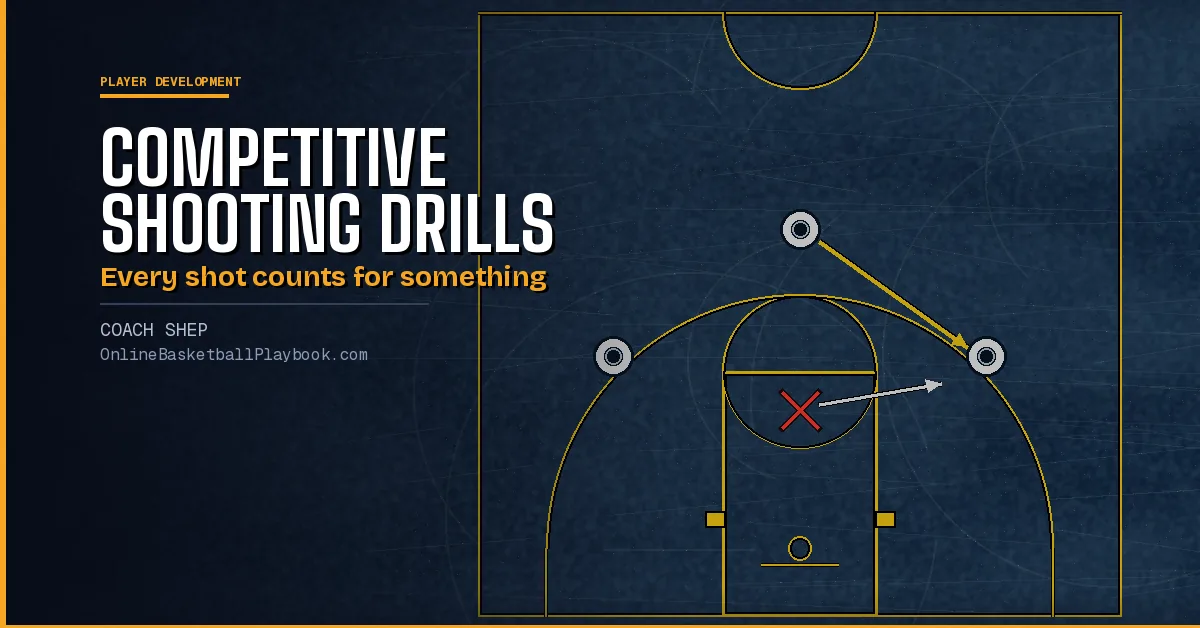
Competitive Shooting Drills: Scored Games and Records
Competitive shooting drills with a score on every shot: streak games, timed targets, Beat the Pro, plus and minus, 2-on-1 shooting and record boards.