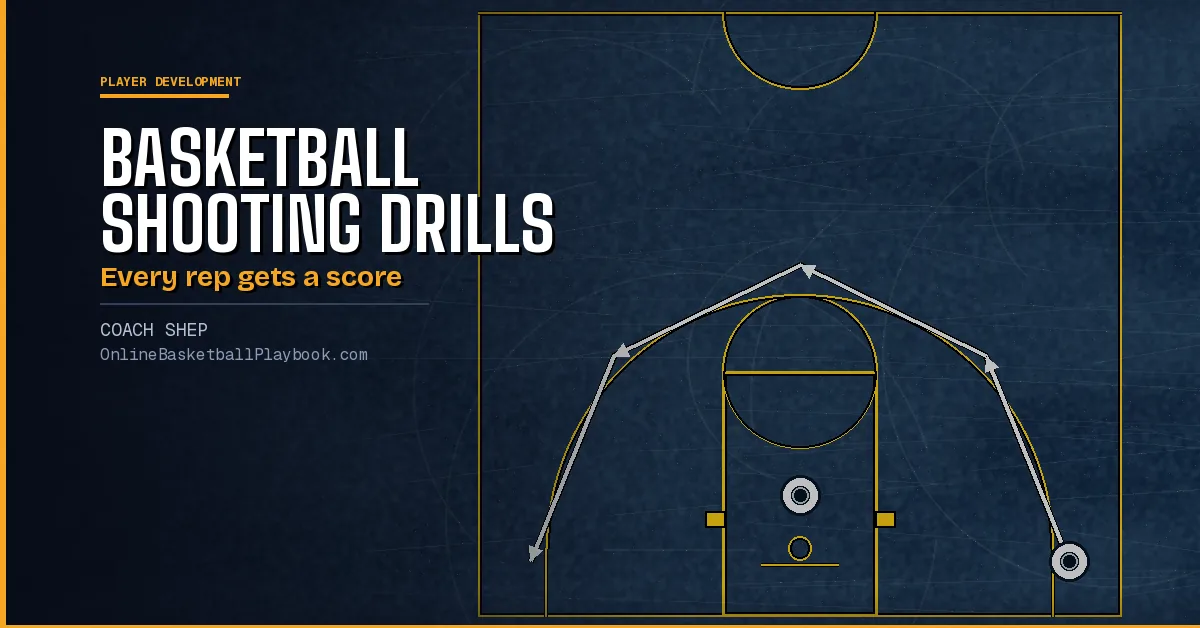
Basketball shooting drills only work when the reps count. A drill needs a target, a clock or a consequence so the shooter feels a little pressure on every shot. This guide covers youth basketball shooting drills, partner and individual work, team shooting drills and free-throw drills. It also explains how to score them and where coaches disagree.
Basketball Shooting Drills at a Glance
| Level | Drills |
|---|---|
| Youth and beginners | Perfects, form shooting, Around the World, Knockout, 21 Cones, Home Run |
| Partner and individual | Partner shooting with a closeout, elbow shooting, the 15-spot workout, lead-up drills |
| Team | 12 Sets, 3-2-1, 45, Celtic, Evans, three-man two-ball, Hand-Off Shooting |
| Three-point | Line Jumps, Full Court 3's, Flash Catch and Shoot, Skip Pass 3's |
| Free throws | 1-and-1, Swish, Plus Minus, Shooter Rebounder Runner, Baseline Free Throws |
Rules for Every Basketball Shooting Drill
- Form comes before volume. Build the shot close to the rim and move out only while the motion stays the same. Volume without form only grooves a flaw. See Basketball Shooting Form.
- Score every rep. Compete against a clock, a partner or your own record, as in these competitive shooting drills. Post the records so players can chase them.
- Shoot game shots from game spots at game speed. Mix block shooting that grooves form with movement shooting off the catch, off the pull-up and to new spots.
- Earn the shot with an action. A cut, a screen or a drive-and-kick before the shot beats standing still and catching.
- Shoot tired. Game shots and free throws come on tired legs, so put a shot after a sprint.
- Track makes. Count makes and not attempts. Log the direction of each miss so you can see the pattern. Reading that pattern is on how to fix common shooting errors.
- Add a failure condition. Two in a row at five spots in a set time feels different from shooting for five minutes.
Youth Basketball Shooting Drills
Teach form first with cues children can check. The pizza waiter is the shooting hand flat under the ball. The cookie jar is the reach up with the wrist bent and the fingers down. Learn the motion without a ball, then shoot to a wall, then to the hoop. Skip the three-point line for young players and lower the rim if you can. Then play games.

- Perfects. Three players per basket rotate through three spots and work on release and arc without jumping.
- Around the World. The nine spots are both blocks, both short corners, both wings, both elbows and the free-throw line. A player moves on only after a make. Move the spots in or out to fit the group. See Around the World.
- Knockout. Two players race to score before the player behind them. The loser is out. See Knockout.
- 21 Cones. Two teams shoot from matched spots. Each make earns a cone from a supply of 21.
- Home Run. One team dribbles a lap while the other shoots. The dribblers are out if a shooter scores first.
- H-O-R-S-E, Golf and Fives. Simple pickup games that a group can play without a coach.
More kid-friendly games are on Best Basketball Drills for Kids.
Partner and Individual Shooting Drills
Form shooting. Stand right in front of the basket, put one hand behind your back and shoot with the other. Follow balance, elbow under the ball, eyes on the target and a follow-through held in a gooseneck. Five minutes a day grooves the motion.
Lead-up drills. A distance ladder starts about 9 feet out. After five good makes at one distance, move back to 12 feet, then 15 feet. The goal is 10 good shots in a row, not just makes. Start each session with a one-hand warm-up with the elbow in, lifting the ball and not throwing it.

Partner shooting with a closeout. Stack four drills on the same five-spot rotation. In the first, the passer closes out and the shooter catches in triple threat and shoots with no dribble. In the second, the shooter shot-fakes and takes one or two dribbles first. In the third, the shooter fakes and drives through the closeout to a layup. In the fourth, the closer plays live defense and the shooter uses any option. The passer never blocks the shot in the early versions.
- Pairs shooting. The shooter shoots, follows, rebounds and passes out to a partner who has spotted up. Then he relocates to a new spot.
- Elbow shooting. Start at one elbow, fake, cut to the other elbow, plant the inside foot and shoot. Reverse and repeat.
- The 15-spot workout. Five spots about 5 feet out, five at 8 to 10 feet and five at 12 feet, with five makes at each spot and free throws between blocks. Rebound every miss and shoot from that spot until it drops. End with one-dribble jumpers.
- Set-Lift scoring. Close form shots earn +1 for a swish, 0 for a rim touch and -1 for a miss. The negative score slows players down.
Team Shooting Drills

- Celtic. The shooter must make two in a row at each of five perimeter spots and tries to get all the way around in two minutes. A miss resets the streak. Then he keeps going to see how far he can extend it.
- Evans. The shooter stays at a spot until he misses two in a row. The team chases an all-time record. More scored games are on competitive shooting drills.
- 12 Sets. Partners use every basket and rotate around 12 spots. Each set is a three-pointer, a shot fake into a jumper, a catch-and-shoot jumper and a layup. Partners swap shooter and rebounder roles.
- 3-2-1. Partners rotate around nine spots. Each set is a three, a shot-fake jumper and a layup, worth 3, 2 and 1 points. Shooters swap after every set.
- 45. Partners rotate around nine spots shooting a three and then a mid-range shot-fake jumper. Threes are worth 3 and jumpers 2, for a perfect 45.
- Team Shooting. A shooting line at the point and a passing line on the wing feed catch-and-shoot threes, shot-fake jumpers and pull-up jumpers off a cut. Finish each round with a dribble-in layup.
- Hand-Off Shooting. Two lines dribble down and hand off to a cutting wing player, who shoots or drives for a layup.
- Drive and Kick. Attack the paint with two hard dribbles twice, then kick to an open corner three. The three is worth 3 and a put-back is worth 2.
- Screen Shooting. Players cycle through four cuts off a screen, flare, straight, curl and backdoor, and the cut changes every one to two minutes.
- Pressure Jump Shots. Four lines shoot at each elbow until every player reaches 8 makes. A miss keeps a player in the same line.
- Speed, Fatigue and Titan Shooting. Each ties a made or missed shot to a sprint before the next rep.

Three-man two-ball. Each group has a shooter, a passer and a rebounder with two balls. The shooter shoots from the left wing, sprints to the opposite wing and spots up again with no dribbling. The rebounder passes to the passer, who feeds the shooter. Run it for one minute and rotate roles. Keep the shooter square and still on the catch. Add a defender who flies at the shooter to force a shot fake and a dribble adjustment.
Three-point drills. Treat three-point shooting as a movement problem first. Line Jumps has waiting players hop the three-point line while others shoot. In Full Court 3's teams race to a target number of threes and a miss sends the team sprinting. Flash, Catch and Shoot starts in the corner and flashes to the wing. Skip Pass 3's reverses the ball and skips it to the wing for the three. More are on Three-Point Shooting Drills and Post-Practice Shooting Drills.
Get the next coaching guide in your inbox
One email when a new guide or diagram set goes up. Free.
Free-Throw Drills
Free throws are taken tired, so practice them tired. Telling players to make five between drills fails because nothing is at stake. Run these after conditioning and attach a consequence.

- 1-and-1. Shoot like a bonus. A miss on the first shot means no second and a lap. Each player has a target number of makes.
- Swish. A score game with 1 point for a swish, 0 for a make that touches iron and -1 for a miss.
- Plus Minus. In pairs, a make is +1 and a miss is -1.
- Shooter, Rebounder, Runner. Groups of three rotate roles after every two free throws, so each shooter arrives from a sprint.
- Baseline Free Throws. The whole team shoots one at a time and any miss sends the team up and back. Youth teams need one make and older teams two in a row.
- Progression. Start 3 feet from the rim and step back to the line, then the three-point line and back in. Demand clean makes close in and ease the demand farther out. See the full guide on Free Throw Shooting.
Where Coaches Split
Coaches split on spot shooting. Some drills keep a shooter on one spot until the shot drops and others force movement so a player cannot shoot the same spot twice. Coaches also split on where to put free throws. One workout shoots them between fresh blocks. Others shoot them only after exertion. Use both.
Coach Cheatsheet
- Open with form close to the rim.
- Put a score, clock or consequence on every drill.
- Count makes and log where the misses go.
- Shoot off a cut, a screen or a dribble.
- Sprint before a free-throw set.
- Post the team records.
Questions Coaches Ask About Shooting Drills
What are the best basketball shooting drills for beginners?
Form shooting close to the rim, Perfects and games such as Around the World, Knockout and 21 Cones.
What are good youth basketball shooting drills?
Games that fit young players, such as Around the World with closer spots, Knockout and Home Run. Teach form first and keep young shooters inside the three-point line.
What are good team shooting drills?
12 Sets, 3-2-1, 45, Celtic and three-man two-ball. Each one adds a score or a target to every rep.
How do you make shooting practice game-like?
Add a closeout, a cut, a screen or a dribble before the shot, and shoot after a sprint.
How should players practice free throws?
Tired, in small sets with a consequence. Use the same routine on every shot.
All skill pages sit under the Player Development hub and Basketball Shooting Form. Related pages are Catch and Shoot, Shooting Off the Dribble, Shooting Off Screens, Shooting Workouts and Shooting at Game Speed.
Want the printable playbook packs?
OBP Pro members get the premium playbook packs: the zone attack, out of bounds and practice plan PDFs, plus each new pack as it is finished. The membership page lists what is in each one. Or draw your own version free in PlayDraw.
See what OBP Pro includesMore Skill Development Guides
Back to Basketball Shooting Form and every Player Development page.
Keep Building
Related breakdowns
Basketball Rebounding Drills for Every Age and Level
Basketball rebounding drills from technique and box-out circles to scored small-group games, War drill and youth drills, with the goals and rules coaches attach.
Layup Drills for Every Level, From One Step to Full Court
Layup drills for youth and teams, from footwork and the Mikan drill to layup lines, full-court drills with a made-shot goal and finishing against a defender.
Basketball Shooting Form: Step-by-Step Mechanics
Basketball shooting form step by step, from the ready stance and grip to release and follow-through, with drill progressions and where coaches disagree.