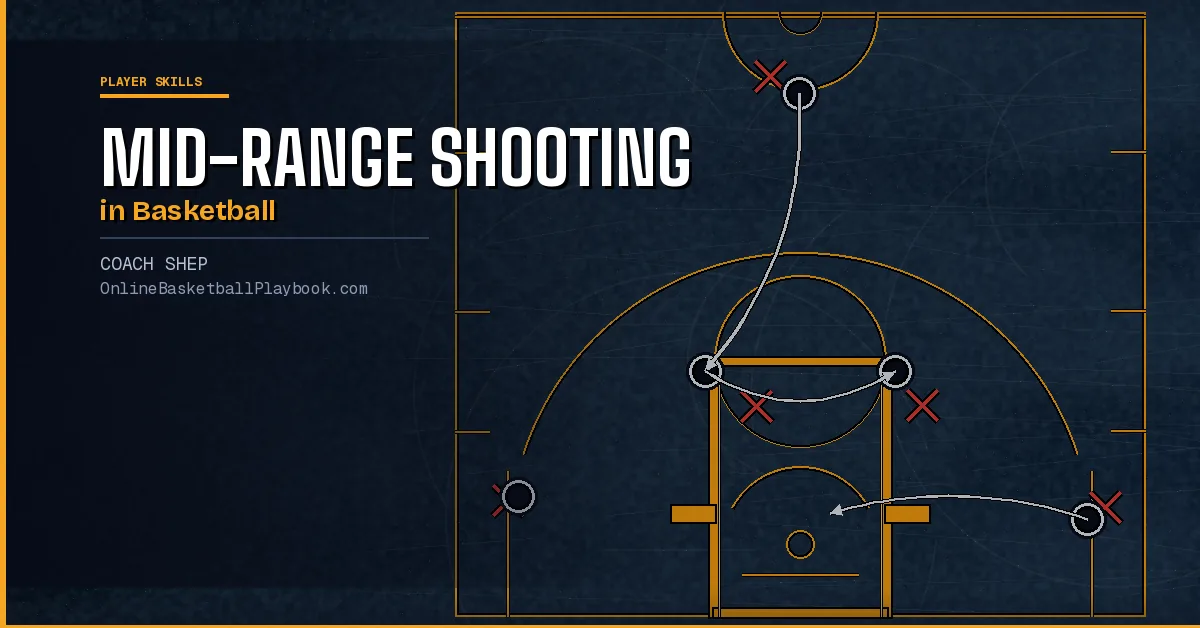
The mid-range shot, from 12 to 20 feet, is one of basketball's most reliable and undervalued scoring weapons. Mastered through sound footwork, repeatable form, and deliberate practice, it gives players a threat at every level of the game.
What Is the Mid-Range Area
The mid-range zone covers the area between the paint and the three-point arc, roughly 12 to 20 feet from the basket. It includes the elbow (where the free-throw line meets the lane), the short corner, and the baseline areas just inside the arc. These spots sit at varying distances depending on where the player sets up relative to the basket, but the unifying factor is that shots from this zone require a full shooting motion without the premium of a three-point reward.
Despite analytics trends pushing teams toward threes and layups, the mid-range remains a vital part of a complete offensive toolkit. Players who command this zone create pressure that opens the floor for everyone else. Defenders who must close out on a credible pull-up threat leave driving lanes. That threat, even when the shot isn't taken, shapes the entire defensive structure around it.
Understanding where the mid-range zone begins and ends matters for practice design too. If players drill pull-ups at 18 feet but never work the short corner or baseline, they develop half a game. A complete mid-range repertoire covers the elbow on both sides, the top of the key at 15–17 feet, and the baseline areas inside the arc. Each spot has unique footwork demands and sight-line adjustments.
Why the Mid-Range Still Matters
The analytics revolution led many programs, at every level, to deprioritize mid-range shooting in favor of maximizing three-point attempts and shots at the rim. That approach has merit in aggregate, but it creates real gaps in individual player development and team offense. Players who can only shoot from distance or finish at the basket are readable and easier to defend. The mid-range pull-up, the elbow jumper off a pick-and-roll, and the short corner catch-and-shoot each force defenders to make decisions they'd rather avoid.
The pull-up and the hesitation are genuinely lost arts at many levels of play. A player who takes one or two dribbles and rises cleanly around the free-throw line is a matchup problem regardless of era or analytics framework. Defenders caught between helping on drives and closing out on threes have no answer for a player who is equally comfortable pulling up at 17 feet. This is especially true in late-game situations, where the shot clock is short and the defense is set.
For teams running motion offense or 5-out motion, mid-range threats become structural necessities. When every player on the floor can catch and pull up in the midrange, defenses cannot sag as heavily into passing lanes or help positions. The floor stays spaced, ball movement improves, and driving lanes open. Teaching the mid-range is not a concession to old-school thinking. It is sound offensive design.
At the youth level, the mid-range shot is often the most developmentally appropriate scoring option. Many players lack the strength to shoot consistently from the three-point line with proper mechanics, yet finishing at the rim against length remains a challenge. The mid-range is where proper shooting form gets built under moderate pressure, and those mechanics transfer directly to deeper shooting as players mature physically.
Shooting Form and Mechanics
Mid-range shooting mechanics mirror the fundamentals of any jump shot, but the distance demands more precision in the base and release than shorter floaters or layups. Form should be built in sequence: stance, grip, load, and release. Skipping steps or layering bad habits under volume creates shooters who groove inconsistency instead of accuracy.
Stance and Balance
A balanced stance is the foundation. Feet should be roughly shoulder-width apart, with slight weight on the balls of the feet. The shooting shoulder aligns toward the basket. Players who catch off movement (off a pin-down, a curl, or a dribble handoff) must gather into this stance quickly, which is why footwork (covered in the next section) is inseparable from shooting form.
Grip and Hand Position
The shooting hand goes under the ball (the "pizza waiter" position) with the elbow tucked under the hand and pointed toward the rim. The guide hand sits on the side of the ball, not under it, and releases cleanly before the ball leaves the shooting hand. A guide hand that pushes or rotates through the shot is one of the most common mid-range accuracy killers, particularly on pull-ups where momentum can cause the off hand to stay engaged too long.
Load and Release
The load phase happens as the player rises from the gather. The ball comes up through the shooting pocket, elbow over the knee, and extends upward in one fluid motion. The release should be at the top of the jump or just past it. Players who release too early on mid-range pull-ups often lose arc and accuracy. The follow-through should be high with fingers pointing down, often described as reaching into a "cookie jar" above the rim. This high finish ensures backspin and proper arc, both critical at 15–20 feet where flat shots are rarely forgiving.
Footwork and Shot Creation
Footwork separates players who can only make open mid-range shots from players who can create and make them. The shot fake, the one-dribble pull-up, the two-dribble change-of-direction pull-up, the off-ball curl. Each requires a distinct footwork pattern that must be trained until it is automatic. When footwork breaks down, players lose balance, rush the release, and reduce a reliable shot to a desperation heave.
The One-Two Gather
The most common pull-up footwork pattern is the one-two gather: the player plants the non-dominant foot (step one) then the dominant foot (step two), creating a stable base before rising. This gather must be practiced at game speed from multiple directions: middle drives, baseline drives, and catch situations where momentum is coming laterally. Players who practice their pull-up only going right in a straight line will struggle the first time they need to pull up fading left off a drive that closes out a lane.
Jump Stop
The jump stop (landing on both feet simultaneously after catching or gathering) gives players maximum flexibility in shot creation because either foot can be the pivot foot. It is particularly effective at the elbow or short corner where a player receives a pass and needs to face up immediately. The jump stop must be low and controlled; players who land stiff-legged lose balance and have a slower, less accurate shot.
Footwork Off Screens
Many mid-range opportunities come off screens: flares, pin-downs, and curls. Each has a different footwork demand. A flare-screen catch often requires a quick inside pivot to face up. A curl past a screen calls for gathering stride steps into a balanced base before rising. These patterns require dedicated repetition in practice, not just open catch-and-shoot drills. See basketball footwork drills for progressions that build these patterns systematically.
Mid-Range Drills and Workouts
Effective mid-range skill development follows the same principle that applies to all shooting: make every repetition competitive. A player standing at the elbow and firing 50 uncontested shots in a row is grooving the motion, but they are not training the decision-making, composure, or shot creation that makes mid-range shooting useful in games. The best mid-range workouts blend block shooting (to groove form) with movement shooting and competitive scoring formats.
Elbow Pull-Up Series
Start at the right elbow. Take one hard dribble baseline, gather, and pull up. Then one hard dribble middle, gather, and pull up. Alternate for 10 makes from each direction, tracking the total shots needed. Repeat from the left elbow. This builds the most common mid-range pull-up scenarios encountered in games while keeping reps scored and recorded.
Short Corner Catch-and-Shoot
A passer positions at the wing. The shooter runs from the block to the short corner, receives a pass, executes a jump stop, and shoots. The key is the footwork discipline. Every rep should land in a balanced jump stop before the shot. Progress to adding a shot fake before shooting to train the timing of a real defender. Short corner mid-range shots are high-efficiency looks that many players never practice at volume.
45-Degree Curl Series
The shooter starts at the block, curls off a chair or cone set at the elbow, receives a pass at the 45-degree area above the block, and shoots. This mirrors the curl action used constantly in player development programs at every level. Track makes out of 10 and compete against personal best each session.
Competitive Mid-Range Shooting Game
Two players. Alternate pull-up attempts from designated spots. Both players shoot from the same spot before rotating. First player to eight makes wins. Losing player runs. This format adds pressure, creates competition, and mirrors the focus required when a mid-range shot matters in a real game. The competitive element is not optional. It is where the skill gets trained for actual use.
Every mid-range workout should have a target score or a winner. Players who shoot without a scoreboard are practicing motion without practicing performance. Set a personal best mark for each drill and post it somewhere players can see it. The pursuit of a record is a more powerful motivator than repetition alone.
Coaching the Mid-Range Game
Coaching mid-range shooting requires intentional practice design, not just time in the gym. The drills above need to be part of a structured basketball practice plan Rather than optional shooting time before or after the main workout. Players develop what gets practiced deliberately and evaluated consistently, not what gets squeezed into warm-up time.
The first coaching priority is identifying which players should develop mid-range as a primary weapon versus which players need it as a complementary skill. A primary ball-handler who collapses defenses with driving threats needs the mid-range pull-up as a core option. A wing player in a spot-up role needs the mid-range catch-and-shoot from the 45 and the short corner, but may not need an extensive pull-up game. Tailor the skill development to the player's role. Not every player needs the full mid-range curriculum.
Second, build form before building volume. A player with poor mechanics should not do 200 mid-range reps per session. They will get faster and more comfortable with a broken shot. Spend time on the mechanics described in the shooting form section first (wall work, one-handed form shots, no-jump shooting), then add distance and competition gradually. Form built correctly from the start compounds; form built incorrectly requires unlearning before it can improve.
Third, create practice situations that mirror game contexts. The mid-range pull-up off a pick-and-roll is different from the catch-and-shoot at the elbow, which is different from the short corner isolation. Each scenario has distinct footwork, timing, and shot selection elements. Players who drill only open stationary mid-range shots will hesitate in games when the look comes off movement or a defensive closeout. Incorporate closeout pressure, live ball-handling, and screen actions into mid-range work as soon as basic mechanics are stable.
Finally, track and post results. Keep a record board with player bests on each named drill. Name the drills after the players who hold the record when possible. Public records create accountability, pride, and voluntary extra work. Players will stay after practice to challenge a record that belongs to a teammate. This is how mid-range shooting becomes a team culture rather than an individual assignment.
- Build form first (stance, hand position, elbow under the ball, high follow-through) before adding volume or competition.
- Practice pull-ups in both directions (baseline and middle) from the right and left elbows every session
- Include jump-stop footwork on every catch-and-shoot drill. Balance at the catch determines accuracy of the shot.
- Score every workout (personal bests, partner competitions, or timed makes) so players train under pressure, not just comfort.
- Add closeout pressure and screen actions to mid-range drills as soon as mechanics are stable; open stationary reps alone don't transfer to games
- Match mid-range skill emphasis to each player's role, pull-up development for primary handlers, short-corner and 45-degree work for wings and cutters
Get free play diagrams, drills, and coaching guides delivered weekly.
Draw this play free in the play drawer →
Membership: the full library, playbook packs, and Pro drawing tools →
Keep Building
Related breakdowns
Basketball Shooting Form: Step-by-Step Mechanics
Basketball shooting form step by step, from the ready stance and grip to release and follow-through, with drill progressions and where coaches disagree.
Free Throw Shooting: Routine, Form and Drills
Free throw shooting starts with a routine the player never changes. Form cues, the mental side and drills that copy the fatigue and pressure of a game.
Competitive Shooting Drills: Scored Games and Records
Competitive shooting drills with a score on every shot: streak games, timed targets, Beat the Pro, plus and minus, 2-on-1 shooting and record boards.