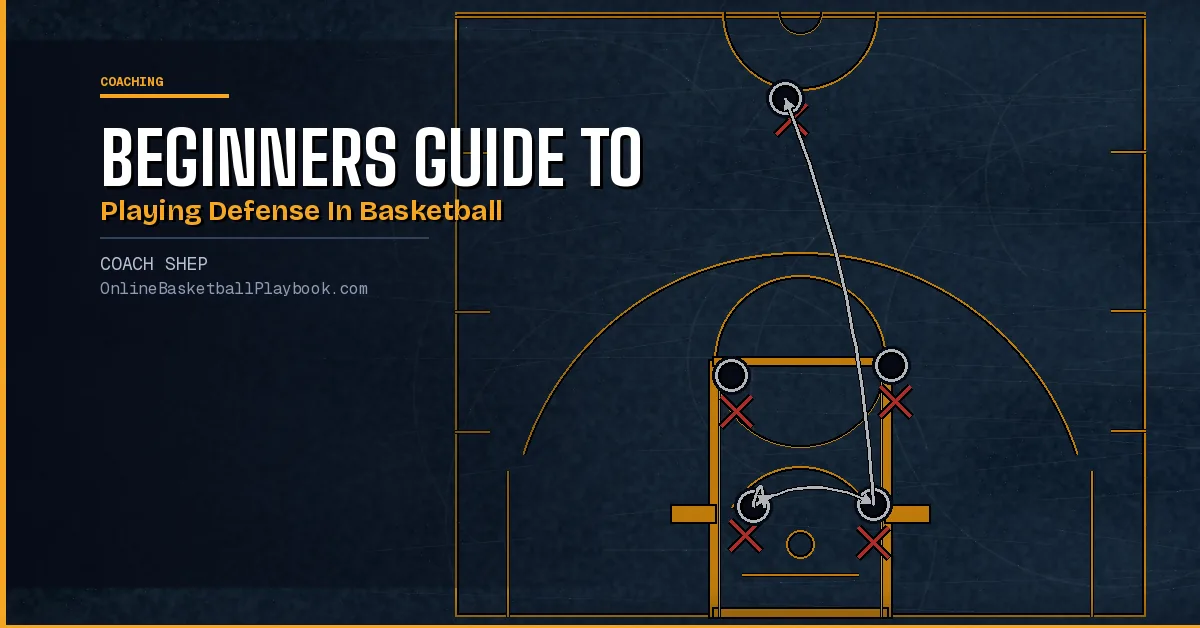
Defense wins games. But most beginners have no idea where to start. This guide breaks down every foundational skill (stance, footwork, positioning, and communication) so you can become a real defender, not just someone standing in the way.
The Defensive Stance: Your Starting Point
Before you can guard anyone, you need a foundation. The defensive stance is that foundation. Get it wrong and every other defensive skill suffers. Get it right and you can guard almost anyone at your level.
Here is what the correct defensive stance looks like:
- Feet wider than shoulder-width apart. A narrow base means you get knocked off balance. A wide base means you can absorb contact and still recover.
- Knees bent, hips low. Think of sitting back into a chair that isn't there. Your weight should be on the balls of your feet, not your heels. If you're flat-footed, you can't move quickly in any direction.
- Back straight, chest up. Don't hunch over. A straight back lets your eyes see the whole court, not just the floor in front of you.
- Hands active. One hand up to bother the pass or shot, one hand low to deflect dribbles. Both palms should face your opponent. This is sometimes called "pistol hands."
- Eyes on the midsection. New defenders watch the ball or the player's head. Veteran defenders watch the belly button. The hips don't fake. Wherever the midsection goes, the body follows.
Hold this stance for 30 seconds right now. Your thighs should burn. That burn means you're doing it right. Most players avoid the low stance because it's hard. That's exactly why the players who commit to it are so much harder to beat.
The "Quick Stance" Concept
Some coaching traditions call this the "quick stance", the idea that you're always one step away from being able to move explosively in any direction. You're not locked in place. You're coiled. Think of a sprinter in the blocks: still, but ready to explode. Your defensive stance should feel exactly like that.
Footwork: How to Move Without Crossing Your Feet
The most common mistake beginners make on defense is crossing their feet when they slide. The moment your feet cross, you lose your base, you lose your balance, and the offensive player blows right past you.
The correct movement is the defensive slide. Here is how it works:
- Lead with the foot in the direction you're moving. If the ball handler goes right, your right foot moves first.
- The trailing foot follows. It never passes the lead foot. Your feet stay roughly shoulder-width apart at all times.
- Stay low throughout the slide. Don't pop up to move, then drop back down. Stay in your stance the whole time.
- Short, quick steps beat long, slow steps. Think about covering ground efficiently, not dramatically.
The Close-Out
A close-out happens when a pass is made to an open shooter and you have to sprint from help position to contest the shot. Beginners close out too fast in a straight line and get blown by. The correct technique is to sprint the first two-thirds of the distance, then chop your steps (short, quick stutter steps) as you arrive. This keeps your momentum under control so you don't fly past the shooter or foul them. Your hand goes up, not into them.
The Drop Step
When your opponent has one foot past you and is driving, you cannot slide fast enough to stay in front. Drop-step: open your hips, pivot, and sprint to cut them off at the next position rather than chasing them from behind. It feels wrong at first. It is the right play every time.
Ball-You-Man Positioning
The most important concept in man-to-man defense is one simple rule: you must be able to see both the ball and your man at the same time. The phrase coaches use is "ball-you-man." Think of it as a triangle. The ball is one corner. Your man is another corner. You are the third, positioned so you can see both without turning your head completely away from either.
This positioning changes based on where your man is relative to the ball:
When Your Man Has the Ball
You guard them directly. Stance, active hands, eyes on the midsection. Force them toward the sideline or toward help, not into the middle of the lane where they can attack the basket easily.
When Your Man is One Pass Away
Step off your man toward the ball. You want to be able to deflect a pass or help on a drive without losing track of your man. One hand is pointing at the ball. One hand is pointing at your man. This is sometimes called the "pistol". It's a physical reminder to track both.
When Your Man is Two or More Passes Away
You can sag deeper into the lane, toward the basket. Now you become a help defender. You're not worrying about your man catching the ball. They're too far away for a quick pass. You're worrying about stopping penetration into the lane and protecting the basket.
On-Ball vs. Help Defense
Many beginner defenders think their only job is to guard the person with the ball. This is the wrong mental model. In good team defense, everyone has a role at all times, whether or not they are near the ball.
On-Ball Defense
This is what most people think of when they imagine defense. You're guarding the person who has the ball or who is about to receive it. Your goals are: contest every shot, prevent easy drives to the basket, and make the offensive player work for every catch and every dribble. You are not trying to steal the ball every time. You are trying to make everything hard.
Help Defense (Weak-Side Defense)
When the ball is on the opposite side of the court from your man, you are a help defender. Your job shifts. You sag toward the lane, keep the ball-you-man triangle intact, and be ready to stop penetration. If a teammate gets beaten off the dribble, you rotate to the basket to protect it, and your teammate rotates to cover your man.
This rotation is where most youth teams break down. Players ball-watch. They watch the action near the ball and forget their assignment entirely. Ball-watching makes you a spectator, not a defender. Keep the triangle. Know where the ball is. Know where your man is. Always.
Communication and Defensive Talk
Defense is not a solo sport. A defense that doesn't talk is a defense that gets beaten. Every great defensive team communicates constantly, calling out screens, alerting teammates to cutters, confirming rotations. The communication is not optional. It's part of the skill.
What to Call Out
- "Ball!": Said by any defender when their teammate is being attacked. Lets everyone know where the play is happening.
- "Screen left!" or "Screen right!": A teammate warns you about an incoming screen before it arrives, not after. After is too late.
- "Hedge!" or "Switch!": Your team's call for what to do when a screen hits. You decide pre-game, and you call it in real time.
- "Help side!": Reminds weak-side defenders to stay in position.
- "Shot!": Everyone boxes out and attacks the rebound the moment a shot goes up.
Why Talking Matters
Every missed communication is a layup for the other team. Screens get set on silent defenders constantly because no one warned them. Cutters get open in the lane because help-side defenders didn't call out the cut. Communication removes the element of surprise, and surprise is how offenses score easy baskets.
If you're not talking on defense, you're not playing defense. Make noise. Be annoying. Let your teammates know you see everything that's happening.
Start every defensive drill with a communication requirement. Players cannot move until they call out the screen, the cutter, or the rotation. At first it feels forced. After two weeks, it becomes automatic, and your defense starts playing like a unit instead of five individuals guarding their own assignment in isolation.
Common Mistakes Beginners Make on Defense
Understanding what not to do is just as valuable as knowing what to do. Here are the mistakes that show up constantly at the beginner level, and how to fix each one.
Standing Straight Up
New players default to an upright stance because it's comfortable. A low stance is hard. Your legs burn. You get tired faster at first. But the upright stance makes you slow. You have to bend down before you can move, which gives the offensive player a half-step head start. Stay low from the beginning and the movement becomes natural over time.
Reaching for the Steal
Reaching is the defensive foul machine. When you lunge for the ball with your hand, your feet stop. The offensive player drives right past you and either gets to the basket or draws the foul. Keep your hands active in their passing and shooting lanes, but keep your feet moving. A ball deflection from good positioning is worth ten reaching fouls.
Ball-Watching
The ball is a magnet for beginner eyes. When the ball is on the other side of the court, untrained defenders watch it and forget their assignment entirely. The cutter then walks into an open layup. Maintain your triangle. Split your awareness between the ball and your man. Trust your peripheral vision.
Gambling for Steals
Every defensive gamble (a steal attempt, a reach, a risky rotation) is a bet. When you win, you get a fast break. When you lose, they get a layup. Beginners gamble too often and lose far more bets than they win. Sound positioning and consistent effort produce more stops than hero defense ever does.
Forgetting to Box Out
The defensive possession isn't over when the shot goes up. If your man gets an offensive rebound, everything your team just did on defense was erased. The moment a shot is taken, find your man, make contact with them, and seal them away from the basket. You don't need to hold them. A second of contact is enough to put yourself between them and the ball.
Drills to Build Your Defensive Foundation
Reading about defense is the starting point. The skills only lock in through repetition. These drills address the most common beginner weaknesses and can be done with a partner or alone.
Defensive Slide Drill (Alone)
Set up two cones or markers about 12 feet apart. Start in your defensive stance at one cone. Slide to the other cone. Don't cross your feet, stay low, and keep your hands active. When you reach the cone, chop your steps, then slide back. Repeat for 30 seconds. Rest for 15. Do five rounds. This drill builds the muscle memory of staying low and moving correctly under fatigue.
One-on-One Containment (Partner)
Place a cone 15 feet from the basket. The offensive player starts at the cone with a ball. Your job is not to steal the ball. Your job is to keep them out of the paint for five full dribbles. No fouling, no reaching. Just footwork and positioning. Switch roles and compare how many times each defender forced the ball handler to change direction.
Close-Out and Contest (Partner)
The offensive player stands at the three-point line. The defender starts under the basket. The coach (or a third player) passes to the offensive player. The defender sprints to close out using the sprint-chop technique described earlier, contests the shot without fouling, and then boxes out for the rebound. Run this from multiple spots on the arc.
Communication Drill (Team)
Run a simple five-on-zero defensive shell. Five defenders, no offensive players. The coach moves a ball around the perimeter and calls "shot" at random. Every defender must rotate to their correct position as the ball moves, calling out their man, any cutters, and confirming help assignments. When "shot" is called, everyone boxes out an imaginary man. This drill ingrains habits before the speed and chaos of live action.
- Stance check: Before every defensive rep, confirm knees bent, hips low, weight on the balls of the feet, and back straight. Correct the stance once and you fix every subsequent rep.
- No crossing feet: In all sliding drills, call out any foot-cross immediately; one repetition of the wrong pattern undoes ten good ones, so stop and reset the moment it happens.
- Eyes on the belly button: Remind players daily to watch the offensive player's midsection, not the ball or the head. Fakes only work when defenders watch the wrong thing.
- Talk or it doesn't count: Any defensive drill where a player moves without calling out the screen or cut is a do-over; communication must be non-negotiable from the first practice, not added later.
- Box out every shot: Make "shot, box out" a two-word reflex by ending every drill that includes a shot attempt with a mandatory box-out, even if no rebound is contested.
Want more basketball coaching strategies and drills?
Join the Online Basketball Playbook newsletter →
Draw this play free in the play drawer →
Membership: the full library, playbook packs, and Pro drawing tools →
Keep Building
Related breakdowns
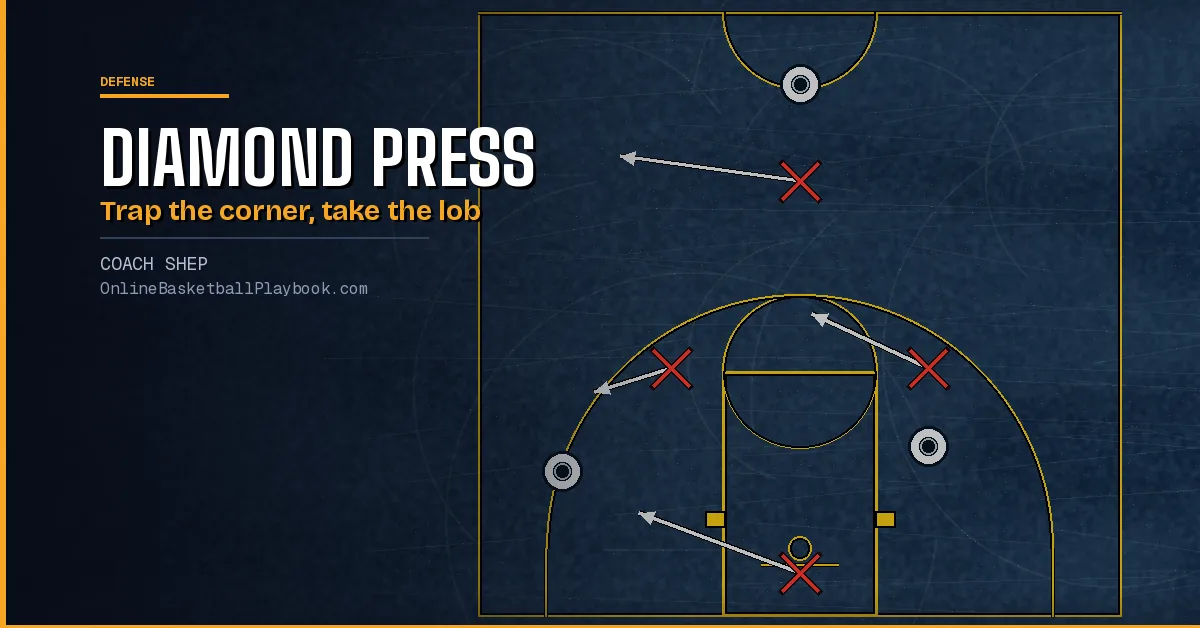
1-2-1-1 Diamond Press Basketball: Roles, Traps and Install
How to run the diamond press in basketball: who plays each role, how to trap the corner, what to do on the reversal and the lob, and how to install it step by step.
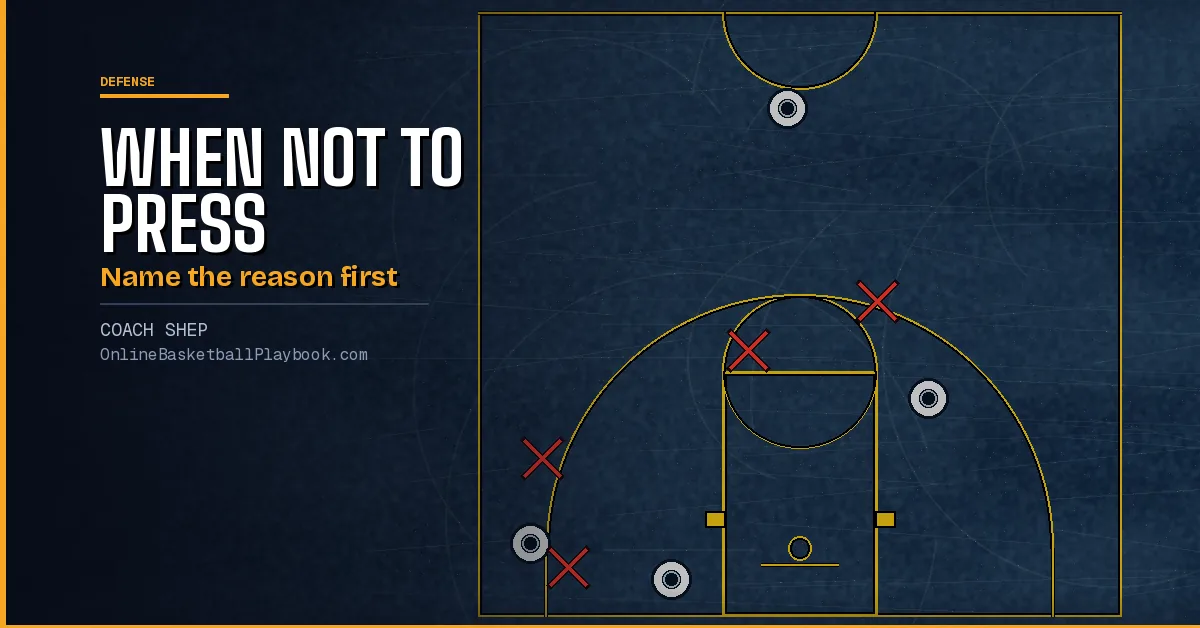
When Not to Press: Bad Reasons, Thin Benches, Poised Guards
When not to press in basketball: the bad reasons, the roster you need first, the opponents who beat it, the moments to drop it and the youth limits.
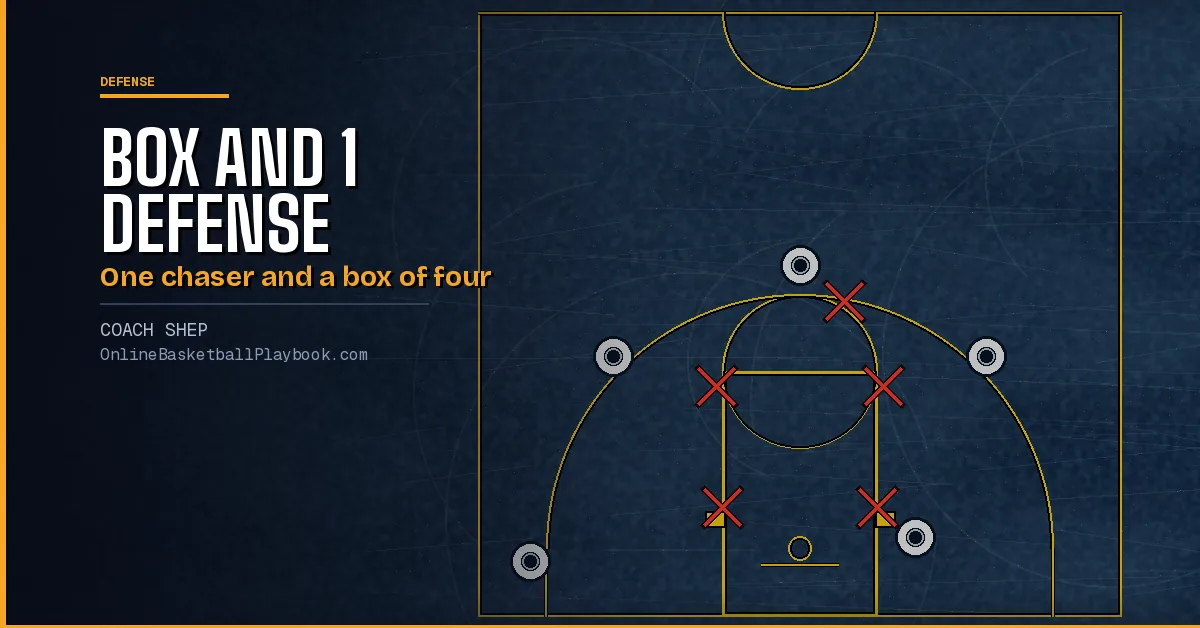
Box and 1 Defense: How It Works and How to Beat It
What the box and 1 defense is, how the chaser and the box play, when coaches call it, where it leaks, and how an offense beats it with a decoy star.