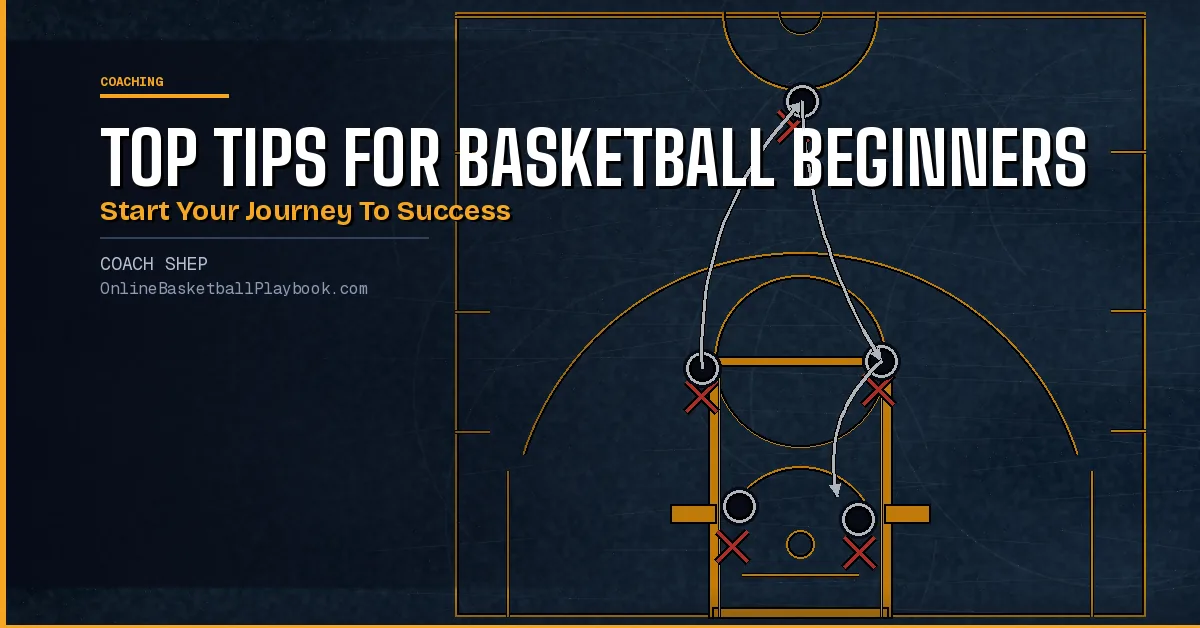
Starting basketball the right way matters more than most players realize. These tips cover the fundamentals every beginner needs, from footwork and ball-handling to shooting form and building practice habits that actually stick.
Get Your Stance and Footwork Right First
Before you pick up a basketball and start shooting around, you need to understand body position. Every skill in basketball (dribbling, passing, catching, defending) runs through your feet. Coaches call this the athletic stance or "ready position," and it looks the same whether you are on offense or defense: feet shoulder-width apart, knees bent, weight on the balls of your feet, back straight, eyes up.
Why does this matter so much at the beginning? Because bad habits in footwork get baked in fast. A player who learns to catch the ball while standing straight up, or who always pivots off the wrong foot, will spend years trying to undo that pattern once competition gets faster. Starting right costs nothing. Fixing it later is expensive.
The Jump Stop
One of the first moves every beginner should learn is the jump stop. Landing on both feet simultaneously after receiving a pass or picking up your dribble. The jump stop gives you two pivot feet to choose from, which opens up passing and shooting options. Practice catching passes on the move, landing in a controlled jump stop, then holding that position before doing anything else. Just that single habit will separate you from most beginners within a few weeks.
Triple Threat Position
Once you can stop under control, learn to receive the ball in triple threat: feet set, ball held at hip level, knees bent. From triple threat you can pass, drive, or shoot without telegraphing your decision. Young players who skip this step either fumble with the ball or rush immediately. Both put the defense in a comfortable spot. Triple threat slows the moment down and puts you in control.
Master Dribbling Before You Worry About Scoring
Shooting is what beginners want to practice. Dribbling is what beginners need to practice. The ability to handle the ball under pressure, change directions, protect the dribble, and keep your eyes up (not on the ball) is what separates a player who can score in the driveway from a player who can contribute in a real game.
Start every ball-handling session with the basics. Pound the ball with your fingertips, not your palm. Keep your elbow in. Dribble low when you need to protect the ball; stand taller when you are scanning the court. Work both hands equally. Most beginners have a strong hand that is comfortable and a weak hand that is nearly useless. The weak hand needs more time, not less. Spend the first two minutes of every dribbling session with your non-dominant hand only.
Eyes-Up Dribbling
The most common beginner problem is dribbling while staring at the ball. It feels necessary at first because the player is not yet confident the ball will come back up to their hand. The fix is forcing yourself to look ahead during practice even when it feels uncomfortable. Set up cones and navigate around them with your head up. Have a partner hold up fingers for you to call out while you dribble. Your eyes need to be free to read the defense, spot open teammates, and find the basket. Train that habit now.
Two Simple Moves to Learn First
You do not need a highlight-reel crossover to start. Learn two moves well before adding more: the crossover and the pull-back. The crossover changes direction in front of your body. The pull-back protects the ball when a defender overcommits. Both are low-risk, effective, and teach your feet and hands to work together under pressure. Drill each one at walking speed until they are automatic, then speed up gradually. Speed before control is the wrong order.
Passing Is the Skill That Speeds Up Everything Else
Good passers make their teammates better immediately. When you can deliver the ball accurately and quickly, suddenly your team creates scoring opportunities that one-on-one play never generates. Passing also forces defenders to guard multiple players instead of one, which is where basketball really opens up.
Every beginner should own three passes before trying anything fancy: the chest pass, the bounce pass, and the overhead pass. The chest pass is your primary weapon: two hands on the ball, step toward your target, extend arms and snap wrists, thumbs finish pointing down. The bounce pass beats a closing defender or feeds a cutter near the basket. The overhead pass clears traffic and is useful from the post or when a defender's hands are low.
Step to Your Target
The single most correctable passing error in beginners is throwing without stepping. A pass thrown with no foot movement is slower, harder to aim, and puts strain on the shoulder. Step toward where you are throwing every single time. That step shifts your weight forward, adds pace to the pass, and improves accuracy. Practice the step before you practice the throw. Get the footwork right first, then worry about the ball.
Two Hands, Two Eyes, Two Feet
A simple cue for catching passes is "two hands, two eyes, two feet": both hands ready to receive, eyes watching the ball all the way into your hands, feet moving to meet the pass rather than waiting for it to arrive. Players who reach late or catch one-handed lose the ball to deflections and turnovers. The cue sounds simple because it is, and it works at every level.
Build a Shooting Foundation From Close Range
Every great shooter started at the elbow, or even closer. The most common beginner mistake is shooting from too far out before the form is solid. Distance makes every flaw bigger. A slight wrist angle that does not matter from six feet becomes a missed shot from fifteen. Before you worry about range, lock in the mechanics from a few feet away.
The shooting framework coaches use most often: BEEF, Balance, Elbow, Eyes, Follow-through. Feet set under your shooting shoulder. Elbow tucked in under the ball, not flared out. Eyes on the front rim. Follow-through held up until the ball hits the net. Do not drop your hand the moment the ball leaves. Hold the finish. That one habit alone will improve your shot arc and consistency faster than anything else.
The Pizza Waiter Cue
One of the best beginner shooting cues is the "pizza waiter". Hold your shooting hand flat under the ball like you are carrying a pizza, elbow at 90 degrees. This puts the ball on your fingertips, not your palm, and gets the elbow positioned correctly before you even think about shooting. A second cue for the guide hand is "cookie jar". Reach up and drop your fingers in like you are pulling a cookie from a high shelf. These cues are not just for children. They describe the correct mechanics quickly and clearly, and they produce good form immediately.
Make Five Before You Move Back
Set a rule for yourself in individual shooting sessions: make five in a row from one spot before moving farther from the basket. This keeps you accountable to accuracy rather than volume. Shooting 200 makes in bad form teaches you nothing useful. Shooting 40 makes in correct form from a close range, then stepping back only when you earn it, builds real range over weeks and months. Earn the distance. Do not assume it.
Practice With a Purpose. Not Just Repetition
Repetition matters, but mindless repetition does not create real improvement. Standing in the driveway and shooting until your arm is tired is not the same as practicing. Practice has a specific skill being targeted, a way to measure improvement, and a standard you are working to meet.
The best approach for beginners is to pick one or two skills per session and attack them deliberately. If today is ball-handling, set up two cones about eight feet apart and work crossovers between them for ten minutes: both hands, low dribble, eyes up. Count how many clean reps you get in one minute, then try to beat that number. If today is passing, find a wall and do chest-pass repetitions for accuracy, stepping every time. Score yourself on how many hit a target you mark. Measurement turns repetition into practice.
Short Sessions Beat Long Sessions
Forty-five to sixty minutes of focused, intentional work on fundamentals will build skill faster than two hours of casual shooting around. Physical skill acquisition requires concentration. When you are tired or distracted, you are reinforcing whatever happens to come out, good or bad. Work hard for a defined window, stop while you are still sharp, and come back fresh the next day. This approach also keeps basketball enjoyable, which matters more than most beginners realize. If practice feels like a punishment, you will start avoiding it.
End Every Session on a Positive
Finish each practice with something you can do well: a dribble move you have already mastered, a short-range shot you are confident in, a drill you know. It seems minor but it is not. Your brain consolidates what happened at the end of a session more strongly than the middle. Ending on a success builds the association that basketball feels good when you work at it. That feeling is what brings you back the next day, and the day after that.
Plan every practice before you step on the court. Decide which skill you are targeting, how long you will spend on it, and how you will measure whether it is improving. A five-minute written plan before the session will produce better results than an extra thirty minutes of undirected reps. The plan is what separates practice from playing around.
The Mental Side: How Beginners Stay Motivated
Skill development in basketball is not linear. You will have sessions where everything clicks and sessions where nothing does. Understanding this before it happens keeps you from reading a bad day as permanent. Every player who has ever gotten good at this game went through long stretches where improvement felt invisible, and then had a week where several things suddenly connected at once. That is how motor learning works. Progress accumulates underneath before it shows on the surface.
The players who develop fastest are not necessarily the most talented. They are the ones who show up consistently, pay attention to what they are doing wrong, and fix it without drama. Feedback, from a coach, a teammate, a video of yourself, is not criticism of who you are. It is information about what to adjust. Beginners who treat correction that way speed up their development significantly compared to those who take feedback personally.
Celebrate Specific Improvement
Instead of measuring yourself only against the best players you see, track your own progression on a few specific skills. Can you dribble with your weak hand at half speed without losing control? Could you do that three weeks ago? Progress is real even when it feels small. Write down one or two things you improved each week. Over a season, that list becomes proof that the work is working, and proof is the best fuel for continuing.
Find Players Slightly Better Than You
The fastest way to develop as a beginner is to play with and against people who are a little ahead of you, not so far ahead that every possession is a disaster, but good enough that they force you to make faster decisions and execute under real pressure. Controlled scrimmages and pickup games in that range accelerate skill development in ways that solo practice cannot fully replicate. Basketball is a decision sport. You need repetitions against real defense to build real basketball instincts.
Keep the Game Enjoyable
Coaches who have spent years working with developing players come back to the same principle repeatedly: the players who stick with the game long enough to get genuinely good are the ones who enjoy it. Enjoyment is not a reward you earn after putting in work. It is part of the process. Play pickup games. Watch games you enjoy. Find aspects of the sport that are genuinely fun for you. The technical work sits on top of a foundation of actually wanting to play. Protect that foundation.
- Athletic stance every rep: feet shoulder-width, knees bent, weight forward, eyes up. Reset to it automatically before every catch or decision.
- Weak hand first: open every ball-handling session with two minutes of your non-dominant hand only before touching your strong hand.
- Step to every pass: no pass leaves your hands without a step toward the target. Build that habit before you build velocity.
- Close range, correct form: shoot from six feet with perfect BEEF mechanics before shooting from fifteen. Earn distance with made shots, not assumptions.
- Eyes up, always: whether dribbling, catching, or moving without the ball, keep your eyes on the game, not the floor or the ball.
- Measure your reps: pick one drill, count your clean reps in sixty seconds, try to improve that number. Measurement turns casual shooting into actual practice.
Want more basketball coaching strategies and drills?
Join the Online Basketball Playbook newsletter →
Draw this play free in the play drawer →
Membership: the full library, playbook packs, and Pro drawing tools →
Keep Building
Related breakdowns
Tips for Basketball Tryouts: How to Prepare and Stand Out
Tips for basketball tryouts from the player's side: how to prepare, what coaches watch, what to show by position, what to wear and what to do if you do not make it.
Basketball Coaching Tips: Practice, Talk, Games and Parents
Basketball coaching tips from real coaches for practice planning, teaching and talking, game day, youth teams and parents, with the versions where they disagree.
Top 10 Coaching Tips for New Basketball Coaches
Top 10 Coaching Tips for New Basketball Coaches