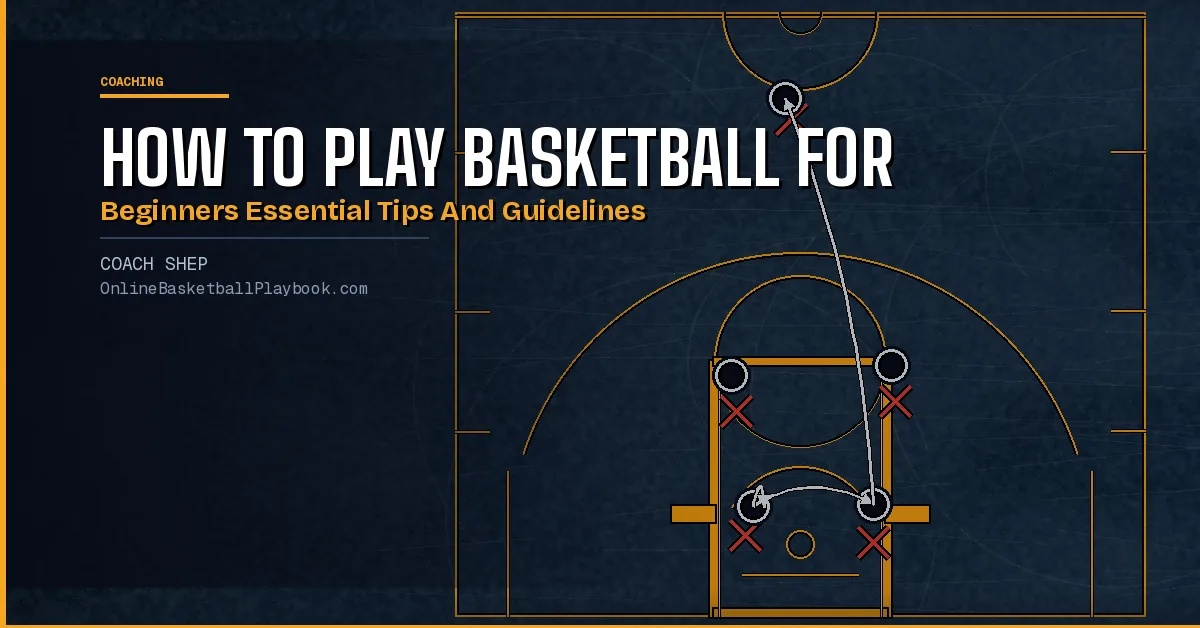
Basketball is one of the most accessible team sports on the planet. All you need is a ball, a hoop, and a willingness to learn. This guide covers everything a beginner needs to start playing with confidence.
Understanding the Basics: Court, Rules, and Positions
Before you touch a basketball, understand the space you're playing in. A standard basketball court is 94 feet long and 50 feet wide at the professional level, but most beginners play on shorter courts, and that's perfectly fine. The key landmarks are the three-point arc, the paint (the rectangular area under each basket), the free-throw line, and the half-court line.
The object of the game is straightforward: score more points than the other team by putting the ball through the hoop. A basket inside the three-point arc is worth two points; a shot from behind the arc is worth three; a free throw counts for one. The team with the ball is on offense. The team without it plays defense. Possession switches whenever the offense scores, turns the ball over, or the defense gets a rebound.
Basic rules every beginner must know:
- Dribbling: You must bounce the ball with one hand while moving. Carrying the ball or using two hands at once is a violation.
- Traveling: Taking more than one step without dribbling is a travel. The other team gets the ball.
- Fouls: Hitting, pushing, or impeding an opponent illegally results in a foul. Too many fouls and you sit out.
- Out of bounds: The ball (or the player holding it) touching the boundary line ends possession.
- Backcourt violation: Once your team advances the ball past half-court, you cannot dribble or pass it back across the line.
On the court, five players from each team play at once. Traditional positions are point guard, shooting guard, small forward, power forward, and center, but beginners should not worry about position labels early on. Focus on learning the game as a whole player first. Handle the ball, move without it, guard an opponent, and space the floor. Positions become meaningful after the fundamentals are solid.
Dribbling: Your First Skill to Master
Dribbling is the foundation of individual basketball. If you can't move the ball on your own, you rely entirely on teammates, and that limits your impact and your learning. Start here before anything else.
The Proper Dribbling Stance
Stand with your feet shoulder-width apart, knees bent, and your weight low. Think of it as an athletic ready position, the same stance you'd use to defend or to catch a pass. Keep your head up. Beginners almost always look down at the ball; train yourself out of that habit from day one. You cannot see the court, your teammates, or your defender if your eyes are on the floor.
Use your fingertips, not your palm, to push the ball down. The ball should bounce up to roughly waist height in a controlled dribble, lower when you're protecting it from a defender. Push the ball slightly in front of and to the side of your body, not directly under you, so you can move forward naturally.
Practice Both Hands Equally
Most beginners default to their strong hand and never develop the weak one. This is a habit you want to break immediately. A defender who knows you can only go right will take away your right hand and force you left, and you'll be stuck. Spend equal time dribbling with each hand in every practice session. Simple stationary drills (dribbling in place, alternating hands, two-ball dribbling) build the muscle memory needed before you add movement.
Stationary to Moving
Learn to dribble standing still before you dribble on the move. Once you're comfortable stationary, walk while dribbling, then jog, then add changes of direction. "Sharks and minnows" (a classic game where dribblers try to cross the gym without getting their ball knocked away) teaches ball protection under pressure better than any formal drill. Make dribbling practice competitive whenever you can; it locks in the skill faster.
Passing: How to Move the Ball as a Team
Basketball is a team sport, and passing is what makes teams work. A well-timed pass creates an open shot, collapses a defense, and keeps the ball moving so opponents can't settle into position. Beginners undervalue passing because scoring gets more attention, but players who pass well are on the court more, trusted more, and improve faster.
The Chest Pass
The chest pass is your standard, go-to pass in open space. Hold the ball at chest height with both hands, fingers spread behind the ball. Step toward your target, extend your arms, and snap your wrists so the ball rotates slightly toward the receiver. Aim for your teammate's hands, not their chest, not above their head. A good pass is easy to catch; a bad pass is a turnover.
The Bounce Pass
The bounce pass travels lower and is harder for defenders to intercept. Aim to bounce the ball about two-thirds of the way to your target so it rises to their hands on the catch. Use it when a defender's hands are up, when feeding a post player, or in traffic where a direct pass would be tipped. One common beginner mistake: bouncing the ball too close to yourself, so it arrives high. Push it further out.
The Overhead Pass
The overhead (or outlet) pass is used to start fast breaks and to pass over pressure. Hold the ball above your head, step in the direction you're passing, and snap forward. Keep both hands on the ball until release. This prevents defenders from knocking it free during the motion. Use it when your teammates are cutting or when you're getting trapped in a corner.
Passing tip that coaches repeat constantly: "step to your target." The step transfers power into the pass and improves accuracy. Players who stand flat-footed and throw arm-only passes are slow, imprecise, and easily read by defenders.
Shooting: Building Form That Actually Works
Every shooter starts with form, not range. A beginning player who shoots from 20 feet with bad mechanics is wasting reps. Get close to the basket, build correct form, and expand distance only after the technique is automatic.
The BEEF Framework
One of the most widely taught beginner shooting frameworks is BEEF: Balance, Eyes, Elbow, Follow-through.
- Balance: Feet shoulder-width apart, toes pointed toward the basket. Weight evenly distributed, knees bent. You generate shooting power from your legs, not your arm.
- Eyes: Pick a specific target on the rim and keep your eyes there throughout the shot. Most beginners look at the ball or the defender instead of the basket.
- Elbow: Your shooting elbow should be under the ball, pointing toward the basket, not flaring out to the side. A flared elbow is the most common cause of shots drifting left or right.
- Follow-through: After releasing the ball, hold your hand up and out as if reaching into a cookie jar on a high shelf. Don't drop your arm the moment the ball leaves your hand. A consistent follow-through means a consistent release.
Start at the Elbow, Work Outward
The "elbow" of the court (where the free-throw line meets the lane line) is about 12-15 feet from the basket. This is the ideal beginner shooting range. Make five in a row from there before moving back. Once you're reliable from 15 feet, move to the wing. Build confidence with a high make percentage before increasing distance. A 40% three-point shooter is less valuable than a 65% mid-range shooter at the youth level.
Defense: How to Guard Without Fouling
Defense wins games and earns playing time. A player who can't score but guards hard will stay on the court. A player who scores but gambles on defense and fouls constantly sits. Every beginner should treat defense as an equal priority to offense, not an afterthought.
The Defensive Stance
Get low. Feet shoulder-width apart or slightly wider, knees bent, back flat, weight on the balls of your feet (not your heels). This position lets you move in any direction quickly. Standing upright on defense is the number-one beginner mistake. A player who is low and ready beats a player who is upright and scrambling every time.
Keep one hand up to contest passes and one hand low to poke at the dribble. This is often called a "pistol" stance: one hand points at the ball, one hand points at your man. It sounds simple, but doing it consistently under game pressure takes deliberate practice.
Ball-You-Man Positioning
When you're defending a player without the ball, you need to see both your player and the ball at the same time. The standard rule: keep yourself on an imaginary line between your player and the ball, positioned one step toward the ball from your man. This "denial" position stops easy passes and forces the offense to work for the ball. If you can only see your player but not the ball, you will get back-door cut and beaten for a layup.
Help Defense
Man-to-man defense is not five individual battles happening independently. When a teammate gets beaten, you rotate to help. Stay aware of where the ball is at all times and be ready to step up if your teammate's player drives to the basket. Communicate: call out "ball" when your teammate needs help, "I've got ball" when you're rotating. Talking on defense takes effort but prevents the easy points that destroy momentum.
Teach beginners to talk on defense from the very first practice. It is a habit, not a personality trait, and once players experience how much easier defense becomes when five people communicate, most of them keep doing it without being asked.
Practice Habits That Accelerate Your Development
Showing up to practice is the minimum. What separates players who improve quickly from those who plateau is how deliberately they practice and what they do outside of organized sessions.
Quality Over Quantity
Thirty minutes of focused shooting practice beats two hours of mindless shooting. Every rep should have a purpose: a target, a checkpoint (is my elbow in? am I balanced?), and a standard (make five before moving). Keep track of your makes. Count your reps. Competition (even against yourself) turns practice into learning.
Work on Your Weakness
Most players practice what they're already good at. The player who can shoot well will shoot for an hour and ignore their left-hand dribble. This is natural. Success feels good. But weaknesses are what limit you in games, and defenders will find them quickly. Set a rule for yourself: every practice session starts with ten minutes on your weakest skill before moving to anything else.
Watch Basketball With Intent
Watching games is a form of practice when you watch with a question in mind. Pick one thing to study per game: how do guards handle defensive pressure? Where does the ball go when a player drives and kicks? How does the best defender on the floor move without the ball? Active watching builds a mental model of the game that your body starts to replicate on the court.
The 4:1 Practice-to-Game Ratio
Canada Basketball's development framework recommends four practices for every one game at the youth level. The reason: games are high pressure and low repetition. Practice is where skills are actually built; games are where you test them. If you play more games than you practice, you are grinding on skills that aren't yet solid instead of building them. Seek out extra practice time (open gyms, pickup games, even solo sessions in a driveway) to stay ahead of that ratio.
Short, Frequent Sessions Beat Long Infrequent Ones
Forty-five minutes of dribbling and shooting three times per week develops faster than one three-hour session once a week. The brain consolidates motor skills during rest. The short recovery between sessions lets the skill "set" before you layer more work on top. Build a consistent daily or near-daily habit, even if some sessions are only 20 minutes. Show up more days, not necessarily for longer each day.
- Ball-handling daily: Dribble with your weak hand for at least ten full minutes every session (stationary first, then moving, then add direction changes). This alone separates quick improvers from slow ones.
- Shoot close before shooting far: Start every shooting session within eight feet of the basket. Make ten in a row with perfect form before stepping back. Never chase distance at the cost of technique.
- Defensive stance reps: Spend two minutes in a low defensive stance at the start of every practice (shuffle left, shuffle right, close out, drop step). Your legs need to remember the position so it becomes automatic in games.
- Pass with a purpose: When working on passing, always have a target and always step toward it on release. Thirty crisp, purposeful passes beats three hundred sloppy, arm-only flicks that build the wrong habit.
- End on a make: Finish every shooting session (no matter how short) by making your last shot. Walk away with a make, not a miss. The last rep of a session sticks in muscle memory longer than any rep in the middle.
Want more basketball coaching strategies and drills?
Join the Online Basketball Playbook newsletter →
Draw this play free in the play drawer →
Membership: the full library, playbook packs, and Pro drawing tools →
Keep Building
Related breakdowns
Learn to Play Basketball: Essential Tips and Techniques for Beginners
Learn to Play Basketball: Essential Tips and Techniques for Beginners
How to Train to Play Basketball: Complete Guide for Beginners
How to Train to Play Basketball: Complete Guide for Beginners
Basketball Quick Hitters: 25 Sets by Action and Formation
Basketball quick hitters sorted by the action you want, catch-and-shoot to post feed, with each set's formation, diagrams, the read and the counter.