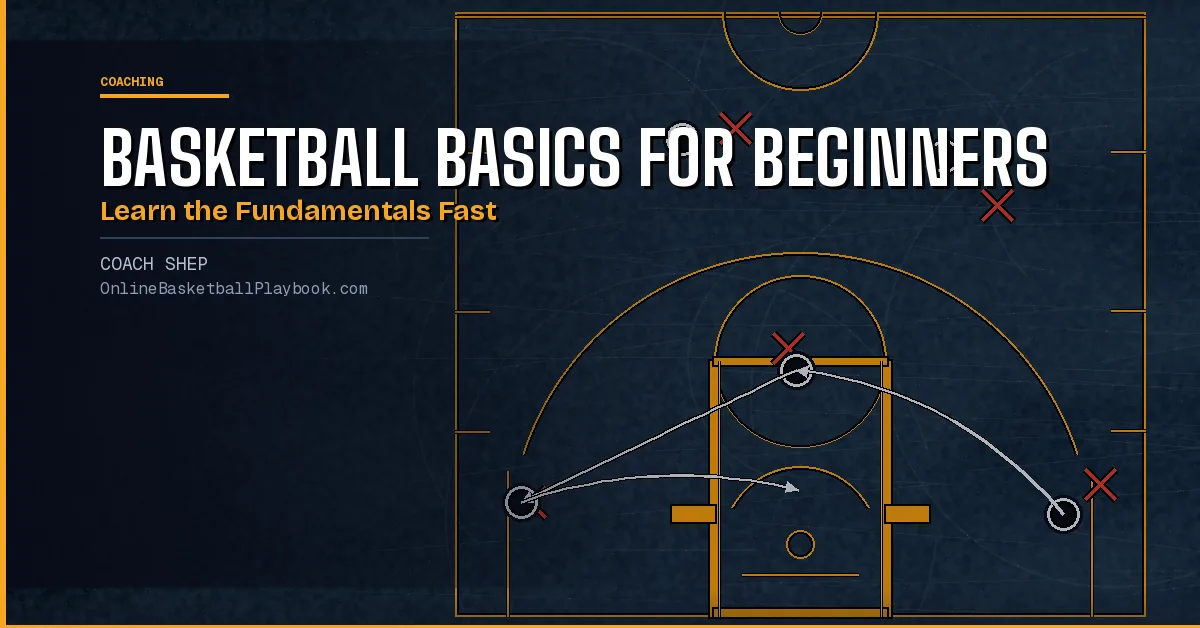
Every great player started with the same five skills. Master dribbling, passing, shooting, defense, and court awareness, and you will have everything you need to play real basketball immediately.
Dribbling: Control the Ball Before It Controls You
Dribbling is the first fundamental every beginner touches, and the one most beginners get wrong by focusing on their hands instead of their eyes. The goal of dribbling is not to show off your handle; the goal is to move the ball efficiently so your team creates better scoring opportunities. Until that mindset is locked in, flashy moves will hurt you more than they help.
Start with your fingertips, not your palm. Pushing with the palm kills your control and slows your pace. Your fingertips give you feel, direction, and the quick release you need to change pace or protect the ball when a defender gets close. Practice every dribble with your eyes up. Look at a spot on the wall, a teammate, or the baseline. Your hand will learn to feel the ball without looking, and that skill becomes critical the moment the game speeds up.
There are two dribbles every beginner must master before anything else: the controlled push dribble and the crossover. The push dribble is how you advance the ball in a straight line while protecting it. Drive your elbow forward, push through the ball, and keep it below your waist. The crossover lets you change direction by switching the ball from one hand to the other at a low, tight angle. Keep the crossover low. A high crossover is an invitation for a defender to steal it.
One of the most common beginner mistakes is dribbling when you should be passing. Dribbling ends your movement options the moment you pick up the ball. Always decide what you are going to do before you put the ball on the floor. Coaches call this "purpose dribbling." Every bounce has a reason. Pick up a bad dribble habit early and you will spend years unlearning it.
Passing: The Skill That Makes Your Team Better
Passing separates players who score from players who win. The best coaches at every level will tell you that most offensive breakdowns come from poor passing decisions, not bad shooting or weak dribbling. If you can put the ball exactly where a teammate can catch it, shoot it, or drive from it, you are already more valuable than a player who only looks for their own shot.
There are three passes every beginner needs to own. The chest pass is the standard. Two hands on the ball, step toward your target, snap your wrists outward, and deliver at chest height. The bounce pass gets under defenders' hands and is particularly useful on drives to the basket when a cutter is running to the rim. The overhead pass is your outlet against pressure. Two hands above your head, step, and release with a forward snap of the wrists. Do not telegraph any pass by staring at your target. A quick flick of the eyes somewhere else before you deliver is enough to freeze a defender for half a second, which is all you need.
Timing matters as much as accuracy. A pass thrown too early arrives before your teammate is ready. A pass thrown too late gets deflected or stolen. Study your teammates' cuts and learn their pace. The best passers in the gym are not the ones who make the toughest passes. They are the ones who make the right pass at the right moment, every possession.
Dean Smith's UNC program had a specific culture rule that captures this perfectly: after a great play, players point to the passer who set it up. Not the scorer but the passer. That habit, when it becomes automatic on every made basket, changes how a team thinks about the game. Beginners who internalize this early develop a completely different offensive instinct than players who were only rewarded for scoring.
Shooting: Build a Repeatable, Reliable Form
Shooting is the fundamental most beginners want to learn first, and the one that requires the most patience to do right. A beginner who rushes their shooting mechanics almost always builds bad habits that take twice as long to fix as it would have taken to learn them properly from the start. Slow down. Build the form correctly. Then gradually add speed and distance.
The foundation of any good shot is your base. Feet shoulder-width apart, toes pointed slightly toward the basket, knees slightly bent. This is your launch pad. Everything above it is only as stable as your base. Your shooting hand goes under the ball, fingertips spread across the seams. Your guide hand sits on the side of the ball for balance only. It does not push or steer. When you release, your shooting hand drives up and forward, fingers pointing toward the rim, with a natural backspin rotation coming from your fingertip snap.
The most common beginner shooting flaw is the "guide hand takeover," where the non-shooting hand pushes the ball during release. This creates a side-spin shot that sprays left or right. Drill your shooting hand independently. Lie on your back and shoot straight up. Sit on the floor and shoot. These isolations force the correct mechanics before you add the full motion, the distance, and the defender.
Start every shooting session from within five feet of the basket. Master that distance before you move back. The temptation to shoot threes before you have a reliable mid-range game is a trap that produces inconsistent players. Great coaches build their offense around their best scorer's two strongest spots on the floor. As a beginner, your job is to identify those spots for yourself by logging makes and misses, not by guessing based on what looks cool.
Defense: Where Real Coaching Shows Up
Defense is where beginners reveal what they actually understand about basketball, and where coaches make the biggest difference. Obradovic, one of the most decorated coaches in European basketball history, put it directly: "Offense is easy; defense is where coaching shows." Anyone wants to score. Sustained defensive effort is the signature of a well-coached player.
Your defensive stance is the starting point. Feet wider than shoulder-width, weight on the balls of your feet, knees bent, back straight, arms out and active. You must be ready to move laterally in either direction without having to first reset your weight. The most common defensive mistake beginners make is crossing their feet when they slide, which kills your lateral speed and takes you off balance. Slide your feet. Keep them on the floor and never let one cross in front of the other.
On-ball defense has one primary objective: make the offensive player uncomfortable. Stay between your player and the basket. Do not reach for the ball unless you are certain you can get it. A reach-in foul rewards the offense with free throws and puts you in foul trouble. Use your position, not your hands, to control the offensive player. Move your feet to cut off the drive, force them toward the sideline or toward help defenders, and contest every shot without fouling.
Help defense is where most beginners fall apart. It requires you to guard someone other than your assigned player, which means you have to read the whole court, not just the ball. Stand in a position where you can see both the ball and your assigned player at the same time. When the ball penetrates, step into the lane to cut off the drive and trust that your teammates will rotate behind you. Help defense is a team skill, which is why coaches spend more time teaching it than any other defensive concept.
Court Awareness: Read the Game, Not Just the Ball
Court awareness is what separates players who are good in drills from players who are good in games. It is the ability to know where you are on the floor, where your teammates are, where the defense is, and what the shot clock is doing, all at the same time. This sounds complicated, but every piece of it is a learnable habit that you build by practicing with your eyes up and your mind engaged.
Spacing is the first awareness concept every beginner needs. On offense, the five players on your team need to be spread across the floor in a way that gives the ball-handler room to operate and opens up passing lanes. When players bunch together, which is the natural instinct for beginners who want to help their teammate, they clog the lane, reduce the number of available passes, and make the defense's job much easier. Your job when you do not have the ball is to find and hold an open spot on the floor where you can receive a pass, shoot, or drive from.
Reading the defense is the next layer. When you catch the ball, you have a split second to evaluate three things: is the defender off me enough to shoot? Is there a driving lane? Is a teammate open in a better position? The best concept coaches teach their players to process exactly these reads on every touch, rather than running a memorized sequence of moves. As Messina put it, the skill is to develop criteria (to know "if this happens, what do we do") so that the read becomes instinctive over time.
Shot clock awareness is often ignored at the youth level, but building the habit early pays dividends for years. David Richman's framework from NDSU is a clean system for beginners: the first eight seconds of a possession are for finding good opportunities without forcing anything. The middle phase is for moving the ball east and west, getting a paint touch, and making the defense make a mistake. The final ten seconds are not a reset. That lets the defense reload. Trust the action you have already set up and play through it. Simple to remember, effective in games.
Team Habits: The Culture Skills Every Beginner Needs
The skills above will make you a better individual player. This section is about what makes you a better teammate, which, at every level above youth basketball, matters more than individual ability. Programs that win consistently are built on a set of daily habits that reinforce the team over the individual, every single practice and game.
The first habit is acknowledging the passer. Dean Smith built it into UNC's culture as a rule: when a teammate makes a great pass that leads to a score, point to them. Not a celebration, just a quick, deliberate recognition. It takes one second and costs nothing. Over a season of daily repetition, it rewires how a team thinks about the game. Scorers become pass-seekers. Ball-stoppers start moving it. The culture shifts because the daily habit shifts.
The second habit is sprinting back on defense. The fastest way to earn a coach's trust and your teammates' is to be first back every time the other team gets the ball. You do not have to be the fastest player on the court. You have to decide to go first every single time. Players who develop this habit as beginners carry it through their entire career. Players who never develop it frustrate every coach they play for.
The third habit is competing in practice. Kelvin Sampson's standard applies at every level: compete, do not just play hard. Everything in practice is a competition. Every sprint, every drill, every two-on-two rep. "The one who wants it most wins," which means you can win any competition in the gym if you want it badly enough to prepare correctly and push past discomfort. Beginners who build this reflex early develop a competitive instinct that no amount of coaching can install in a player who never built it in their first years.
The fourth habit is coachability. When a coach corrects you, the correct response is to say thank you and apply the feedback on the next rep, not to explain why you did what you did. Anson Dorrance, who built a 22-national-title program at UNC Women's Soccer, watched how players responded to correction as his primary evaluation tool. Great players seek to know what they are doing wrong. Players who deflect or explain plateau fast and stay there. The attitude you build toward feedback as a beginner is the attitude you will carry for the rest of your basketball life.
When you run your first week of practice as a beginner, pick one fundamental to focus on per session, not all five at once. On Monday, every repetition is about your dribbling eyes staying up. On Tuesday, every repetition is about pointing to the passer after a score. On Wednesday, your defensive stance is the only thing that matters. When you stack focused daily habits this way, each fundamental locks in before the next one is added, and you build skill faster than any player trying to fix everything at once.
- Dribble with fingertips, eyes up. Look at the floor only until your hand can feel the ball without thinking, then never look again during live play.
- Catch every pass on two feet and two hands. Land balanced, see the floor before you decide to shoot, drive, or pass.
- Point to the passer after every made basket. Make it automatic from the first day, every practice and every game.
- Sprint back on defense every single possession, not sometimes, not when you feel like it, every time without exception.
- When a coach corrects you, say thank you and apply the fix on the very next rep. Never explain, never defend, just use the feedback.
- Start your shooting session within five feet of the basket and earn each step back. Form before distance, always.
Want more basketball coaching strategies, drills, and tools?
Join the Online Basketball Playbook newsletter →
Draw this play free in the play drawer →
Membership: the full library, playbook packs, and Pro drawing tools →
Keep Building
Related breakdowns
Essential Training on Coaching: Elevate Your Skills and Impact Lives
Essential Training on Coaching: Elevate Your Skills and Impact Lives
Top Tips for Basketball Beginners: Start Your Journey to Success
Top Tips for Basketball Beginners: Start Your Journey to Success
Basketball for Beginners: Complete Skill Guide
Basketball for Beginners: Complete Skill Guide