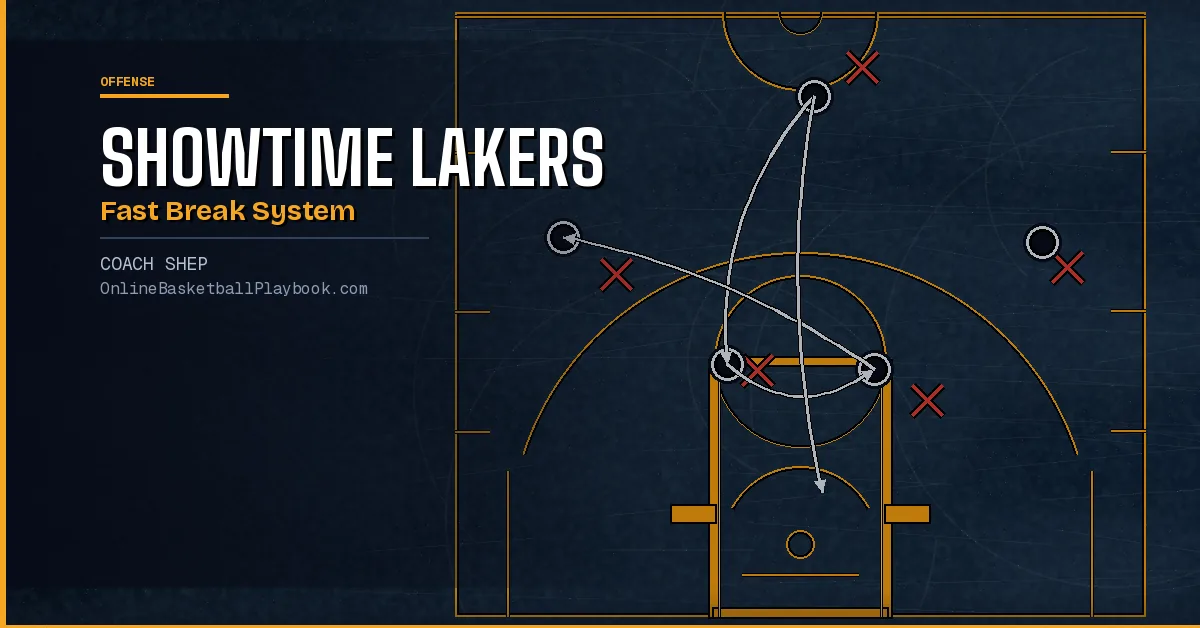
The Showtime Lakers didn't just run. They ran with precision. Pat Riley built a fast break system on outlet rules, lane assignments, and secondary triggers that turned every stop into a near-certain scoring opportunity.
Origins and Philosophy of Showtime
The Showtime Lakers of the 1980s are the most recognizable fast-break team in NBA history. Five championships in nine years. Magic Johnson directing traffic from the point guard spot. Kareem Abdul-Jabbar anchoring the defense that triggered it all. James Worthy and Byron Scott sprinting wide lanes with machine-like discipline. It looked like improvisation. It wasn't.
Pat Riley, who took over as head coach in 1981, inherited Jerry West's roster but rebuilt the system around a single idea: a defensive stop, converted cleanly to an outlet, turned into a layup in under seven seconds. Every piece of the offense (who runs where, who touches the ball and when, what happens when the primary break isn't there) was designed around that seven-second window.
The system's foundation was attitude: transition offense is not a reward for good defense. It is the offense. The Showtime Lakers treated every possession as a fast-break possession until proven otherwise. If the break wasn't there, they slowed down. If it was there, even partially, they attacked it.
This approach aligns directly with what modern transition research confirms. As coaching frameworks from multiple sources note, transition offense is "a structured decision tree for every numbers situation, with each read trained to a recognizable rule." The Showtime Lakers were running that decision tree decades before it had a name.
The Outlet and Lane Rules
The fast break begins on the defensive glass, not at half court. The Lakers' outlet structure followed rules that Hubie Brown has since codified as fundamentals: the rebounder turns in the air toward the outside before landing, the point guard receives the outlet on the wing (not deep, not at half court) and the weak-side forward runs wide immediately, trusting the ball will arrive.
That last point is where most teams fail. Weak-side players hesitate. They watch the rebound. They jog, unsure whether the break is on. The Showtime Lakers drilled the habit out of existence: when a shot goes up, the weak-side forward is already running. He doesn't read the rebound. He sprints his lane and trusts the system.
The Five-Man Break Formation
The Showtime formation on the break was disciplined. Magic handled the ball in the middle. Worthy and Scott filled the wide lanes, sideline to sideline, not drifting toward the ball. Kareem or the trailing big followed in the center lane, available as a dump-off or for a putback if the break stalled. A fifth player stayed back as the preventer, protecting against the opponent's counter-attack.
This lane structure meant the defense had to guard the entire width of the court simultaneously. A defender who cheated toward the ball left a wide-open cutting wing. A defender who stayed wide left Magic a clear path to the paint. The geometry forced a decision, and the Lakers were trained to punish whichever choice the defense made.
One critical rule governed the outlet pass itself: never pass back on the break. Once the ball is ahead, it stays ahead. A backward pass resets the defense and surrenders the advantage that the stop created. The Lakers treated a backward pass in transition as a turnover in spirit, even when possession wasn't technically lost.
Secondary Break Triggers
Not every possession produces a clear primary break. The defense gets back. Numbers are even. This is where most fast-break teams stall. They slow down, reset, and run their half-court sets as if the transition phase never happened. The Showtime system had a different answer: the secondary break.
The secondary break is the gap between "the primary break is over" and "the half-court offense begins." It is the two to four seconds when the defense has retreated but hasn't fully organized, when defenders are communicating assignments and finding their matchups. That window is attackable if you have triggers ready.
Named Actions Off the Make
The Showtime Lakers, like every elite transition team, ran different actions off a stop versus off a made basket. Off a stop (a turnover or a defensive rebound) the mandate was to push. Attack the paint. Drive and kick. No ball screen. Modern frameworks capture this as "freedom off stops": the guard has a clean look at the paint and should take it.
Off a made basket, the math changes. The defense is organized and retreating in order. The Lakers entered a named action (a specific set with a designated read) rather than freelancing. This is the "structure off makes" principle that coaches like Dan Hurley now teach explicitly. A DHO, a pin action for the corner shooter, a high ball screen that forces the defense to switch or hedge before it's set. The trigger is called at half court, before the play develops, so every player knows their role as the ball crosses the arc.
The Trailer as a Weapon
Magic Johnson's genius was his use of the trailer option. As Worthy and Scott attacked the paint or corners, Magic often pulled up at the elbow or the top of the key, reading the defense's collapse. If both defenders loaded to stop the wings, the trailer (often Kareem drifting up from the block, or a guard trailing the play) received a pass for an open mid-range or three-point shot.
The trailer option is the fifth priority in structured numbered secondary breaks: if the first four reads are closed, the trailing player gets the ball for an outside shot. The Showtime system ran this read instinctively, but it was a system, not improvisation. Players knew the trailer was a live option, and Magic knew to look for it.
Numbers-Advantage Reads
The Showtime Lakers' secondary break depended on executing specific reads correctly for each numbers scenario. These reads weren't optional. They were trained rules, rehearsed daily until they were automatic.
Two-on-One
In a two-on-one, attack the hoop first. The ball-handler drives directly at the single defender, forcing a commitment. The pass comes second, only when the defender commits to stopping the drive. The defender's job is to stay low and take away the layup. The attacker's job is to make the defender choose, then punish the choice.
The most common two-on-one mistake at every level is the early pass: the ball-handler passes before the defender has to commit, giving the defense an easy recovery. The Lakers drilled patience: controlled aggression, not reckless speed. Attack first. Pass when the defender reacts.
Three-on-Two
The three-on-two is the most complex and most commonly botched numbers advantage in basketball. The Showtime rule was specific: the point guard stops at the free-throw line. Not the lane. Not below the elbow. The free-throw line.
From there, Magic read the top defender. If the top defender came to stop him, he passed to the wing cutting toward the basket as the second defender had to choose between the cutter and the opposite wing. If the top defender stayed back, Magic drove. The stopping point is everything. A guard who penetrates below the free-throw line collapses the spacing and eliminates the kick-out angle. The Lakers won three-on-two situations at an extraordinary rate because they drilled this one rule until it was a reflex.
When the Break Isn't There
Elite transition teams know when to stop. The Showtime Lakers never forced a bad shot in transition just because they were running. If the defense was set and numbers were even, Magic brought the ball under control and called a half-court action. Pace is a weapon, but the Lakers understood that the weapon is sharpest when you choose when to use it, not when you run without a read.
Installing the System at Any Level
The Showtime system is installable. The principles that made it work at the NBA level are the same principles that work in a high school gym or a youth practice. What changes is the vocabulary and the depth of the progression, not the structure.
Start With the Drill Ladder
The most effective way to install a transition system is a progressive drill ladder: two-on-one first, then three-on-two, then four-on-three, then five-on-four, then five-on-five. Each level has its own trained decision. Each repetition builds the habit of reading numbers and executing the correct rule, rather than improvising under speed pressure.
Dan Hurley runs this ladder daily at UConn. Hubie Brown has used the five-man break as a conditioning substitute for suicides. Players run their lanes at game pace, with a ball, making actual reads. The conditioning value is the same, but the basketball value is vastly higher.
Name the Secondary Break
Pick two named actions and install them from the made-basket side. Early Go and Early Drag are effective starting points. They give players a trigger word that tells them exactly what to run without a timeout or a drawn-up play. Players hear the call at half court and execute. The half-court offense flows from the same structure without a reset.
McKillop's Break-Reversal-Into-Offense model at Davidson is the cleanest example: the secondary break doesn't end, it continues directly into the motion offense. Transition and half-court are one continuous attack. When your players understand this, the pace never fully stops. The defense has to guard the full forty minutes of transition opportunities, not just the first three seconds after a stop.
The Seven-Second Challenge for Guards
Give your guards a concrete target: after a stop, you have seven seconds to get a layup or a corner three. No mid-range. The constraint changes how guards play defense. They're already mentally mapping their outlet route before the shot goes up. It changes what they look for when they receive the outlet. It changes the decisions they make at the three-on-two read point. One number, seven seconds, aligns the entire possession.
Before installing any secondary break action, drill the three-on-two stopping rule as a standalone constraint for at least two weeks. The point guard stops at the free-throw line, no exceptions, no matter what. This single rule fixes the most common transition mistake at the youth and high school level and makes every other secondary break action more effective because spacing is preserved.
- Outlet on the wing: The point guard receives the outlet here, not deep. This positioning gives the maximum angle to attack the paint or find both wings simultaneously.
- Weak-side forward sprints every possession: Don't wait to read the rebound. Sprint the wide lane immediately and trust the pass will come. The habit of running creates the open layup.
- Freedom off stops, structure off makes: attack the paint directly after a defensive stop; call a named action when entering the secondary break off a made basket.
- Point guard stops at the free-throw line in three-on-two: Never penetrate below the line. This preserves the kick-out angle and makes the defense choose between cutter and opposite wing.
- Never pass backward on the break: Once the ball is ahead, it stays ahead. A backward pass resets the defense and surrenders the entire advantage the stop created.
- Name the trailer option: Designate who fills the trailer lane and make sure your guards look for them. An open mid-range or three from the trailer is the most efficient shot in transition when the primary reads are closed.
Culture: What Made Showtime Different
Systems don't win championships. Players executing systems do, and players execute systems when they believe in them and have the cultural reinforcement to run them even when tired, even when behind, even when the break feels slower than usual.
The Showtime Lakers built a culture around transition before the game started. Film sessions focused on fast-break opportunities missed, not because of talent, but because a player jogged when he should have sprinted, or hesitated at the outlet. Riley made the standard visible. Every player knew what was expected.
The RACE Mentality
Modern coaching frameworks use the acronym RACE to capture what the Showtime Lakers lived: every player sprints their lane on every possession, regardless of whether a break seems likely. The habit of sprinting is what creates the occasional uncontested layup. A player who sprints 95 times and gets the ball twice for an open layup has done exactly what the system requires. A player who jogs 95 times creates zero opportunities and trains himself to be late on the two possessions where the break is there.
Pat Riley understood this implicitly. He didn't ask the Lakers to run when it made sense. He asked them to run always, and to make good decisions at speed. The two requirements together (sprint every time, execute the correct read when the ball arrives) are harder to build than either one alone. The Showtime Lakers built both.
Passing Beats Dribbling
One of the clearest rules in the Showtime system: the ball reaches the other end faster when passed. Dribbling across half court burns the advantage window. Magic Johnson was one of the greatest passers in the history of the sport, and the Showtime system was built around that skill. A two-pass break from outlet to wing to layup is faster than any ball-handler dribbling the length of the floor.
This principle extends to the secondary break. When a team has a pass-ahead opportunity in transition (a wing is open ahead of the ball), the rule is to pass ahead and attack from there, not to bring the ball up slowly and let the defense organize. The Showtime Lakers made this look effortless because it was trained, not because it was natural.
Credit the Assist
Riley built a culture around the pass that created the score, not just the score itself. When a kick-out found an open cutter for a dunk, the celebration pointed to the passer. This cultural signal, crediting the assist, reinforced the read-first mindset that every transition system depends on. When guards know the organization values the pass as much as the finish, they look to pass in transition instead of looking to score. That shift in focus is what makes the math of transition offense work.
Teams that run transition offense the right way are teams where no one minds not getting the layup because they know the system produces layups for everyone, over the course of a game and a season. The Showtime Lakers were five players willing to sprint and pass and trust, and that willingness was built over years of cultural reinforcement, one credit-the-assist gesture at a time.
Installing the Showtime system doesn't mean turning your team into Magic Johnson and James Worthy. It means building the habits (sprint the lane, read the number advantage, execute the named action, point to the passer) that the best transition teams share across every era and every level. The Lakers made it look like art. Underneath the art was a system, and the system is coachable.
Want more basketball coaching strategies and drills?
Join the Online Basketball Playbook newsletter →
Draw this play free in the play drawer →
Membership: the full library, playbook packs, and Pro drawing tools →
Keep Building
Related breakdowns
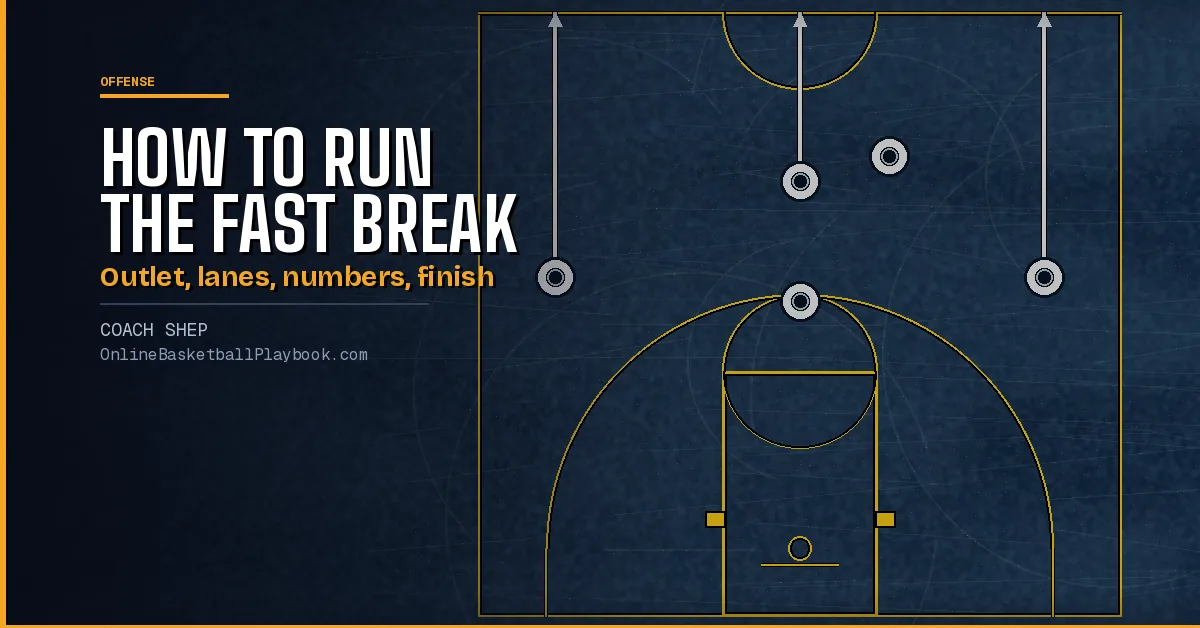
How to Run the Fast Break: Lanes, Reads and Drills
How to run a fast break: start it off a stop, fill three lanes, read each numbers situation, flow into a secondary break and build the habits with a drill ladder.
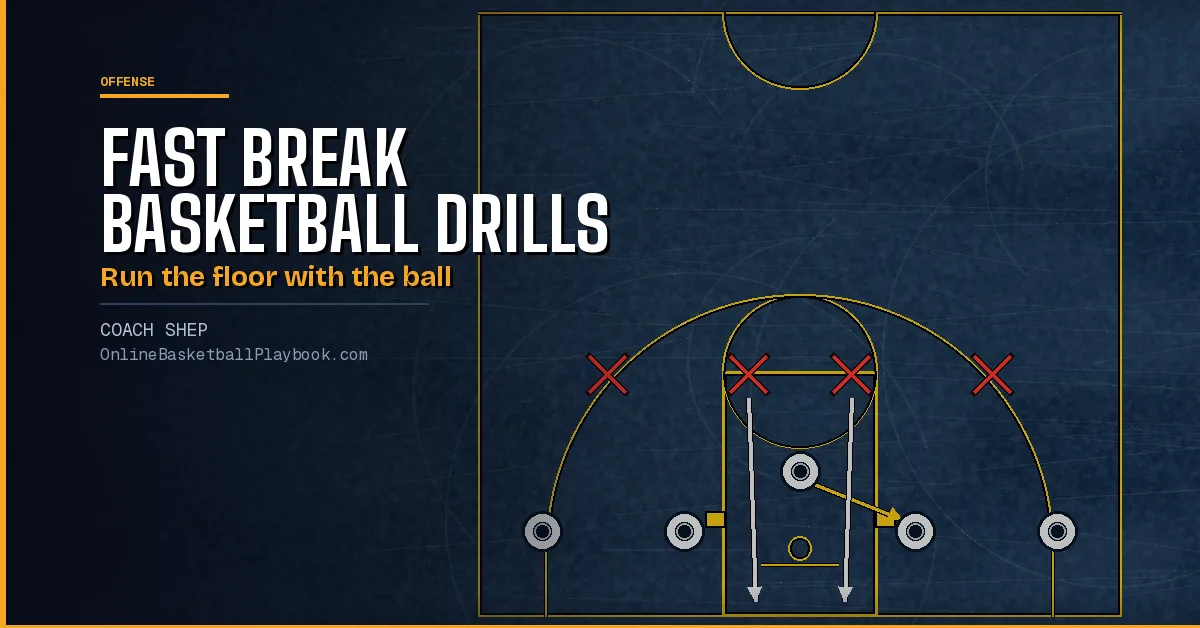
Fast Break Basketball Drills for Youth and Varsity Teams
Fast break basketball drills that run the floor with the ball: weaves, partner and no-dribble drills, catch-up drills, a finishing series and youth versions.
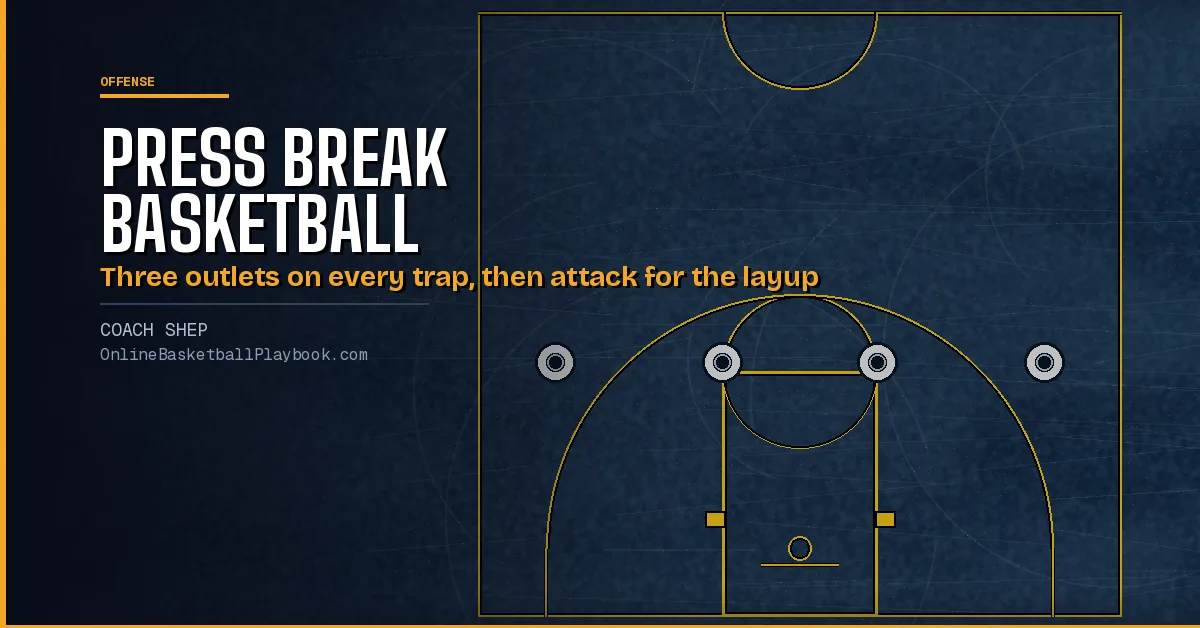
Press Break Basketball: Alignments, Reads and Drills
Press break basketball guide with the 1-4, 80-60-40 and 4-across alignments, reads against the 2-2-1, diamond and 2-1-2 press, and where coaches disagree.