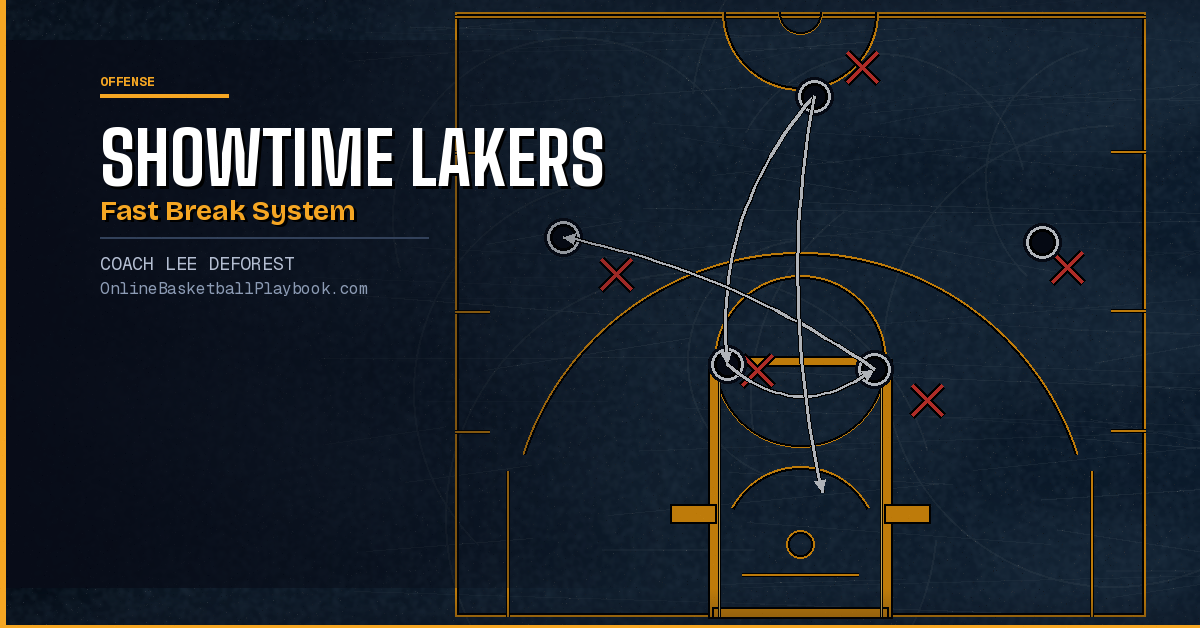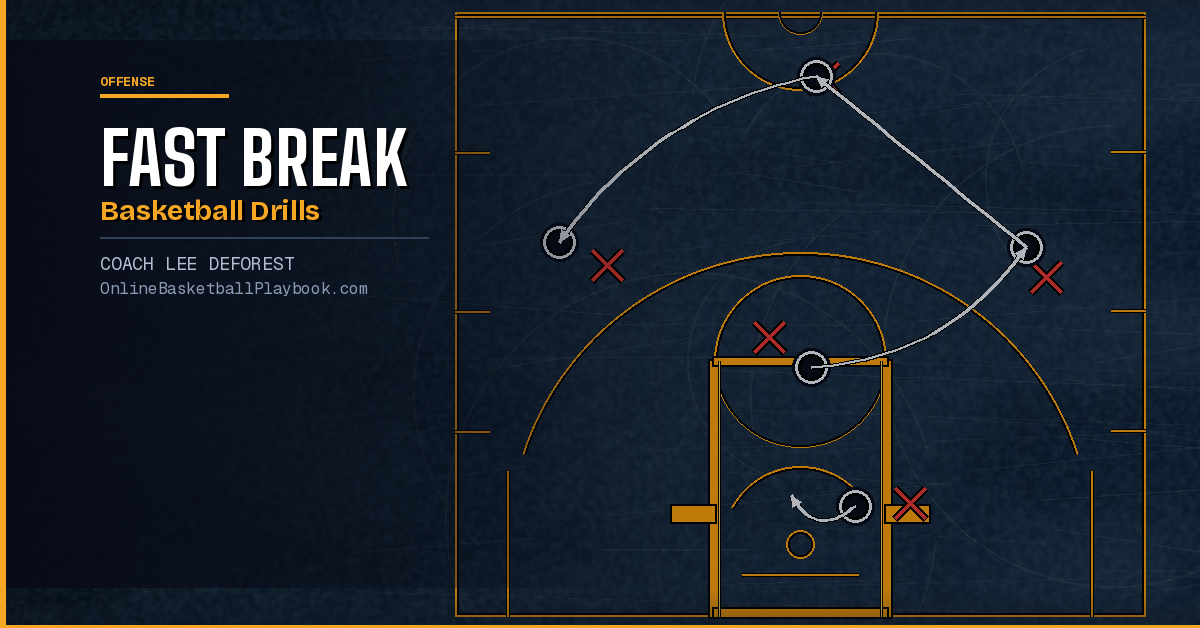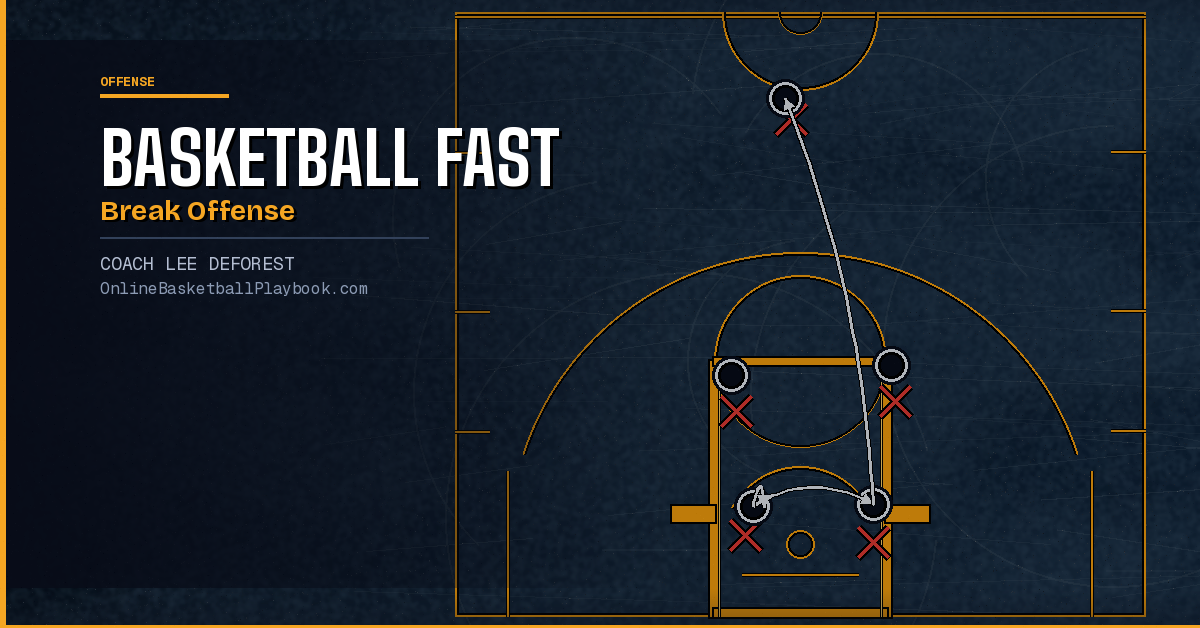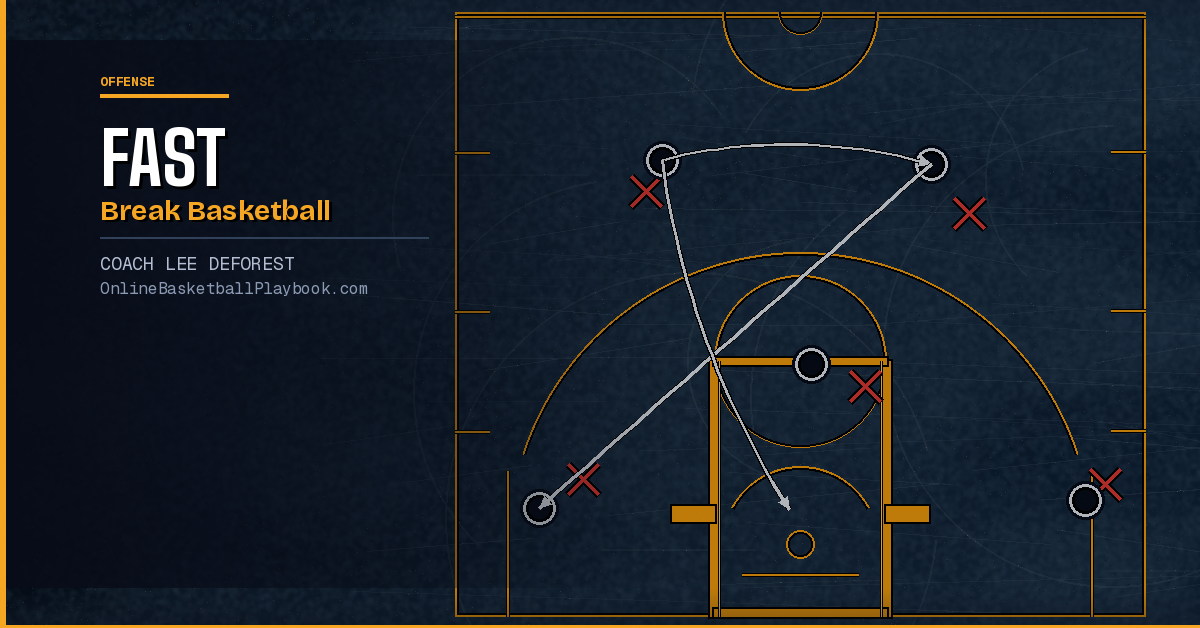

Fast break basketball wins games by attacking before the defense gets set. It is not about running recklessly — it is a structured decision system that turns every stop, miss, and make into a numbers advantage your players can read and finish.
What Fast Break Basketball Really Means
Most coaches say they want to run. Few build a transition offense that actually functions under game pressure. The difference between a team that occasionally gets easy layups and a team that consistently converts in transition is structure. Fast break basketball is not a philosophy — it is a set of trained decisions.
The core idea is straightforward: attack before the defense organizes. From the moment possession changes hands — off a defensive stop, a missed shot, or even a made basket — there is a brief window where the offense has a numbers advantage. The job of a transition system is to identify that advantage, exploit it with a trained read, and score efficiently before it closes.
What separates teams that do this well is not athleticism. It is habit. A team that sprints its lanes on every single possession — regardless of whether a fast break develops — creates the fast break more often than one that only runs when the opportunity is already obvious. The act of sprinting is itself the cause, not the effect.
Coaches like Dan Hurley at UConn run transition as a daily drill ladder: 2-on-1, then 3-on-2, then 4-on-3, then 5-on-4, and finally 5-on-5. Each level has its own decision structure. None is freelance. The players are not improvising — they are executing a trained response to a specific numbers situation. That is the standard worth chasing.
The Five Lane-Filling Rules Every Team Needs
Fast break basketball breaks down when players do not know where to go. A lane-filling system solves this by assigning every player a role the moment a possession changes. When everyone runs their lane automatically, the numbers advantage organizes itself.
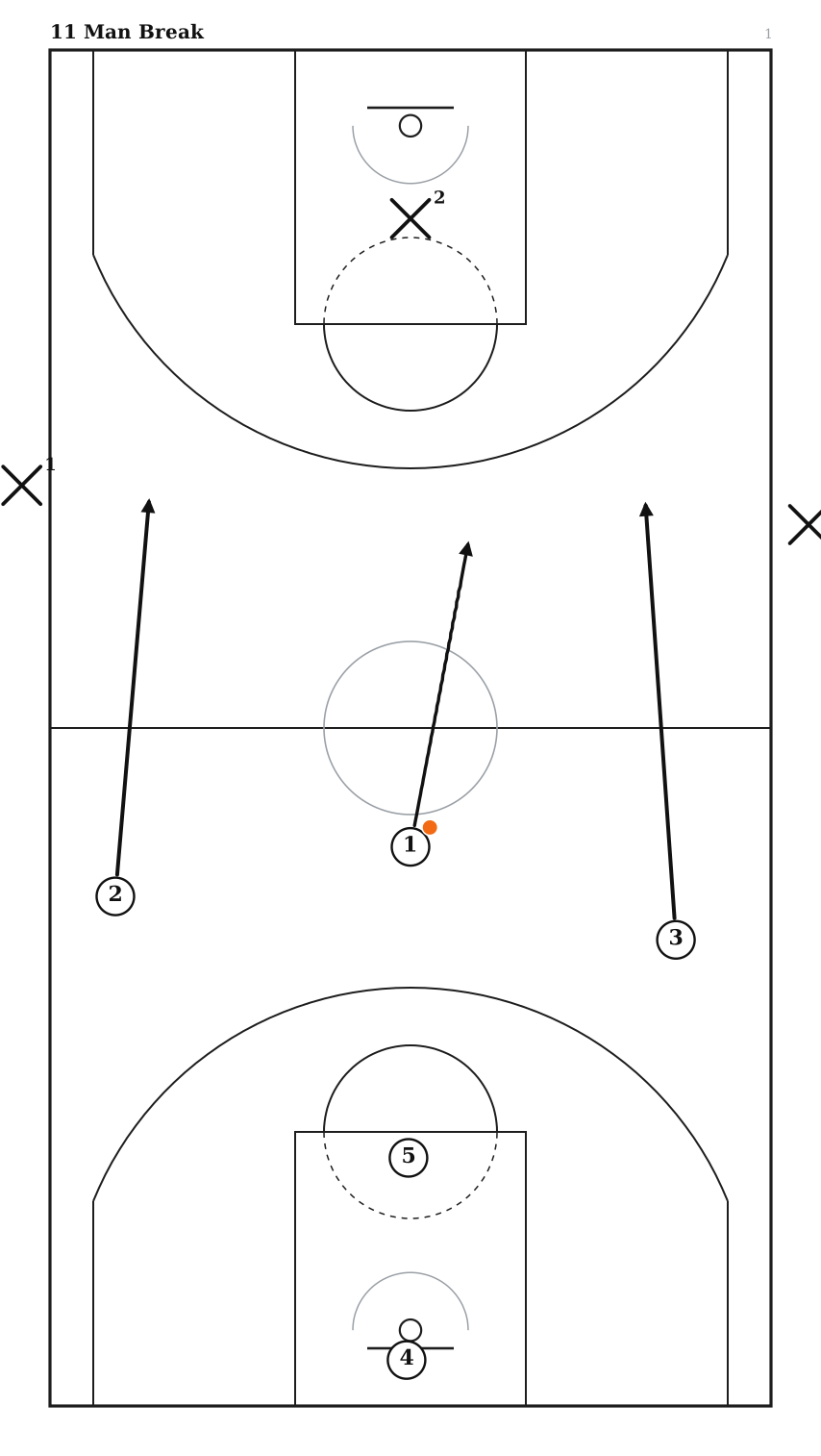
The Point Guard Leads the Middle
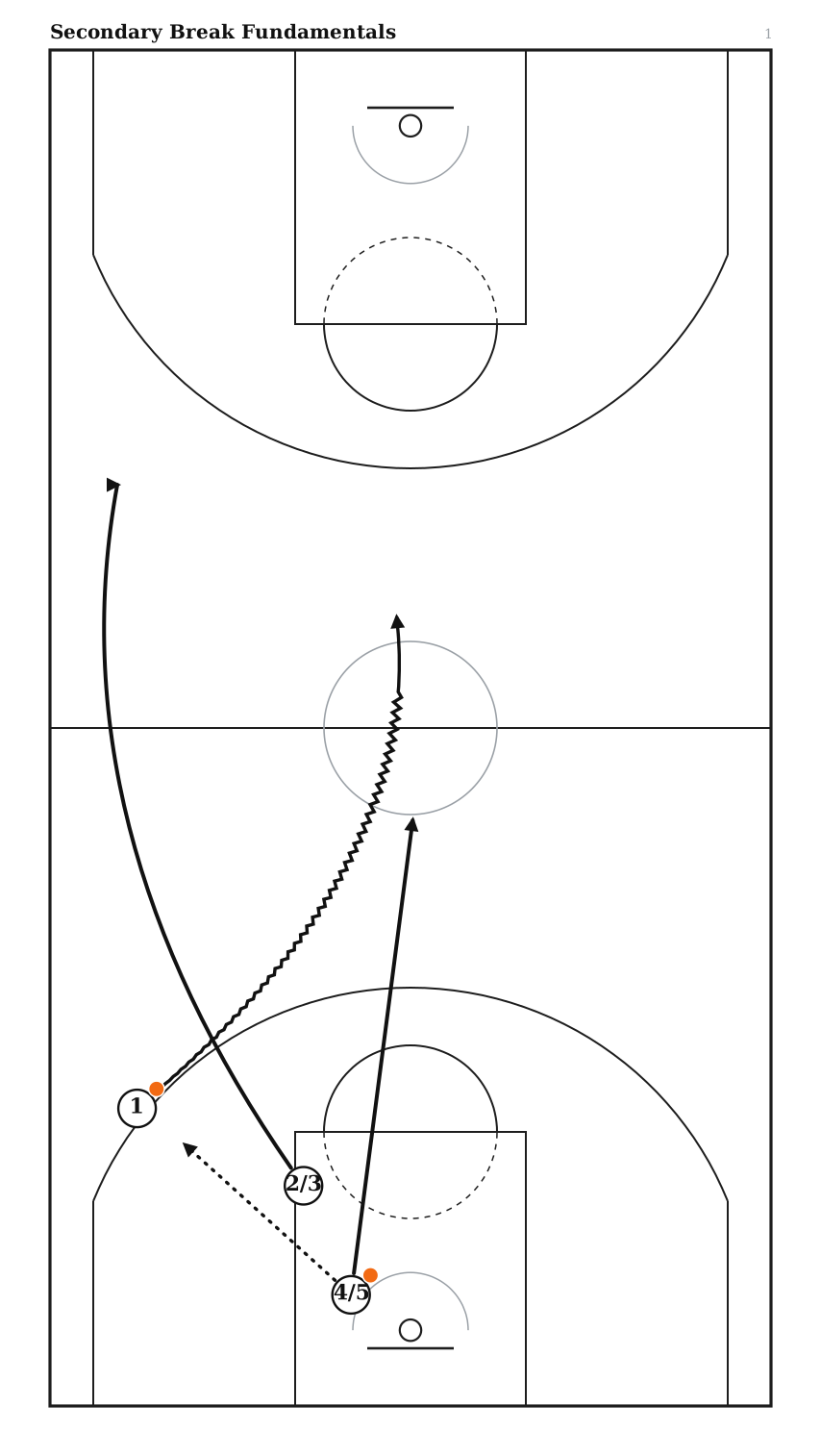
The ball handler takes the middle lane. Every decision on the break flows through this position. The point guard does not hug the sideline, does not dribble diagonally, and does not slow down to wait for teammates. The middle lane is the fastest route to an attack position, and getting there first forces the defense to make a choice.
Hubie Brown's outlet rule supports this directly: the point guard should receive the outlet at free-throw-line extended — not at half court, not near the sideline, but at that specific depth so the break develops with maximum distance still ahead. The earlier the guard gets the ball in the middle, the longer the defense has to scramble back.
Wings Sprint the Sidelines
The two wings take the outside lanes, running as wide as possible toward the sideline extended on each side. Wide lane-running does two things: it spreads the defense horizontally and it ensures the wing arrives at the corner or wing area with space to catch and shoot. A wing who cuts inside narrows the floor and gives the defense a shorter recovery distance.
The weak-side wing in particular must trust the ball will come. Running wide without the ball, away from where the action is happening, is counterintuitive for many players. Training this habit takes repetition, but it is one of the highest-value habits in transition basketball — because when the defense collapses to the ball side, the wide weak-side wing is the open shooter who ends the possession cleanly.
The Trailer Follows in the High Post
A big or secondary ball handler trails the initial three-man break and arrives at the high post or free-throw line area. The trailer is the safety valve on a stalled break and the first look for a skip pass when primary options close. Many teams neglect the trailer, but this position creates the draw-and-kick opportunities that convert transition advantages into good half-court shots when the defense scrambles back in time to stop the initial wave.
One Player Stays as the Preventer
Every fast break offense needs one player who does not go — the preventer or get-back man. This is not optional. Against a team with athletic guards or good transition scorers, an unguarded fast break the other way can erase a 7-point swing in seconds. The get-back assignment should be determined before the possession, not after. The Hubie Brown model ties this to the shot: who crashed the offensive glass is governed by who took the shot, so the fast break and the get-back are one decision made before the shot goes up.
Pass the Ball Up — Do Not Dribble Across Half Court
This is one of the most consistently violated rules in youth and high school transition basketball. Passing the ball up the floor is faster than dribbling it. Every dribble across half court is time given back to the defense. Teams that build the habit of throwing ahead — even when it feels risky — consistently convert more transition opportunities than teams that dribble into the front court first.
2-on-1 and 3-on-2: The Key Decision Rules
The numbers situations that matter most in transition have specific rules that coaches should teach explicitly and players should execute automatically. These are not suggestions — they are the difference between a layup and a contested shot.
2-on-1: Attack the Rim First
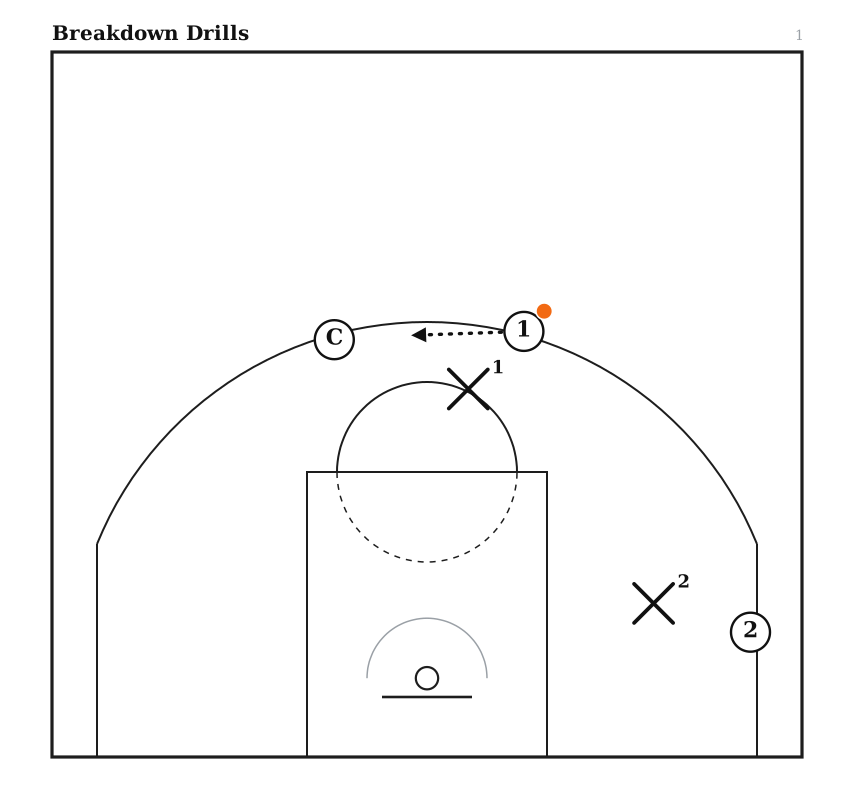
In a 2-on-1, the ball handler attacks the hoop first. The pass is secondary. Give the lone defender the outside shot — defenders stay low to stop the layup, and when they do, the pass to the trailer becomes available. Ball handlers who pass immediately in a 2-on-1 take the defense off the hook. The threat of the drive is what opens the pass, so the drive must come first.
The second attacker positions wide, not behind the ball handler, so the pass angle is clean. A 2-on-1 converted poorly — a forced pass into traffic, a hesitation dribble that lets the defense recover — is almost worse than not running at all, because it trains bad habits under pressure.
3-on-2: The Point Guard Stops at the Free-Throw Line
In a 3-on-2, the point guard stops at the free-throw line and reads. This is the single most commonly violated transition rule in youth and high school basketball. Point guards who penetrate below the free-throw line in a 3-on-2 compress the floor, close the passing angles, and allow one defender to guard both the ball and the wing cut simultaneously.
When the PG stops at the free-throw line, the top defender must choose: guard the ball or drop to help on the wing cut. Either choice is wrong for the defense. The PG passes to the cutting wing, and if the help defender collapses, the skip to the opposite wing is available. The free-throw line stop is the pivot point of the entire decision, and it must be drilled until it becomes automatic.
Dan Hurley's drill ladder treats each numbers situation as its own curriculum. The 3-on-2 is drilled separately from the 2-on-1 and the 4-on-3 — each read is trained to a recognizable rule, not improvised on the fly. That specificity is what allows players to execute correctly at game speed.
Freedom Off Stops, Structure Off Makes
One of the most useful transition frameworks in modern basketball comes from Dan Hurley: "Freedom off stops, structure off makes." It is a single sentence that covers the entire transition philosophy and can be communicated to players at any level.
Freedom Off Stops
When the defense creates a stop — a forced turnover, a missed shot — the offense attacks. The guard receives the outlet and has a 7-second window to get a layup or a three-point shot. No mid-range allowed. No ball screens. "The drag ball screen is a crutch," Hurley says. In the transition window off a stop, the team is looking for threes and layups at pace, with every player sprinting their lane to create the advantage.
The 7-second rule is a cultural signal as much as a tactical one. It tells guards that their job after a defensive stop begins before the shot is even taken — they are already thinking about their outlet route, their lane, their read. Guards who internalize this become better defenders because they want the stop more.
Structure Off Makes
After the other team scores, the defense has organized and the transition window is narrower. Here Hurley calls a structure — a named action that flows from the inbound into an early-offense set. The vocabulary includes actions like pistol, wide pin, dribble hand-off, and step-up. These are not drawn plays; they are triggered reads that attach to a single call word.
This distinction — freedom versus structure — solves a problem that plagues many transition offenses: teams that try to run the same way off stops as they do off makes end up either too slow after stops or too chaotic after makes. Separating the two cases with a clear rule gives players certainty. They know what the situation calls for before it develops.
McKillop's system at Davidson adds another dimension: the named secondary break flowing directly into the half-court offense without a reset. The transition and the half-court are one continuous attack. Players do not stop, re-organize, and call a set — they flow from one into the other. This keeps the defense uncomfortable and the offense at pace even when the initial break closes.
A team that walks the ball up loses transition advantages before they even develop — habit is everything.
— BFC Eight Keys to Fast Break, Basketball Vault
The Secondary Break: Flowing Into Half-Court Offense
The secondary break is what happens when the initial fast break wave does not produce a layup or open three. Rather than stopping and resetting, a well-designed transition offense flows directly into a set of named actions that attack the defense while it is still organizing. This is where the majority of transition scoring actually comes from at the high school and college level.
Name Your Secondary Break Actions
The most installable approach gives players a numbered or named menu of options they can call and execute without a timeout. The CoachesClipboard five-priority system is a strong model: (1) the point guard attacks the seam all the way to the rim; (2) pass to the wing-corner; (3) long pass to the post on the opposite block; (4) pass to the cutting big through the lane; (5) trailer option for the outside shot. Players work through the priority list in order and if no option develops before half court, they slow into the half-court offense.
Two named secondary break actions are enough to start. Early Go (push on the catch, attack the rim) and Early Drag (trail ball screen off the secondary break) give guards a call they can make in real time and give all five players a role they recognize.
The Kokoškov Model: Secondary Break Into Ball Screen
Alexander Kokoškov's NBA model — drawing from the Suns and Pistons lineages — ends the secondary break in a ball screen rather than a reset. The entire offense runs off a single trigger: hit-ahead or kick-ahead to a wing, then shuffle-cut away. Eight named secondary break series attach to that same trigger. Players know what to read from the moment the ball reaches the wing.
The named series — Oklahoma, Point, Weak, Kansas, Thru, Dive, 5-Up — each have denial counters built in. Teaching the counter is the curriculum. "Build counters like chess," in Larry Brown's framing. This is advanced installation, but it illustrates what a complete secondary break system looks like: one trigger, multiple named responses, and a counter for every defensive adjustment.
Early-Offense Actions in the First Two to Three Seconds
Chris Capko's framework targets the first two to three seconds after the offense crosses half court. Before the defense has communicated assignments and loaded into position, a designed action can exploit the gap. The Pistol action — point guard passes and immediately cuts to a corner while a big sets a ball screen — forces two defenders to make simultaneous decisions before either is set. The twist screen re-angles after initial contact, catching a recovering defender off-balance.
Teams that deliberately enter actions while defenders are still sorting assignments get better shots than teams that wait for the defense to set. This is not gambling — it is precision timing, and it is teachable through deliberate practice at game speed.
Building a Transition Culture That Sticks
The tactical rules are the easy part. The harder work is building a program culture where players sprint every possession, value the pass that creates the fast break as much as the finish, and make good decisions under speed pressure without coaching intervention. That culture is built through specific practices, not general exhortation.
The RACE Mentality
Every player sprints their lane on every possession, regardless of whether a break is developing. The habit of sprinting creates the occasional uncontested layup; the habit of walking creates none. Coaches sometimes let players jog when the break is obviously closed — this is a mistake. The decision of whether a break is developing should be made at full speed, not from a half-speed trot at half court.
The RACE mentality is not about being reckless. It is about keeping the decision window open. A player who slows down at half court has already decided the break is closed before the defense has been counted.
Hurry, But Do Not Rush
Brad Winters' organizing phrase for transition identity is the cleanest summary of the right mindset: "Hurry, but don't rush." Pace is a weapon. Ball security and decision-making under pace are the prerequisite. A player who panics with the ball in transition — forcing a pass into traffic, attempting a contested layup against a loaded defense — kills the team's advantage faster than any defender.
The draw-and-kick is the primary transition-to-half-court read in this framework. As the ball handler attacks the elbow with the dribble and draws the help defender, they kick to the open teammate rather than forcing a shot. This creates rhythm between driving and passing that carries from transition into the half-court — and it trains the read-first mindset that every good transition offense depends on.
Credit the Assist
Winters prescribes a specific cultural practice: point to the player who made the pass that created the score. Every time. This changes how players think about transition. The question is not "can I finish?" but "who is open?" — and that shift in framing, reinforced consistently, builds teams that find the right play under pressure rather than defaulting to individual action.
Coaches who implement this practice report that their transition passing improves faster than any drill accounts for. The incentive structure changes: players who make the kick-out get public credit in real time, and the value of the assist becomes visible on every possession.
Install Transition and Press Break Together
The lanes in a fast break offense and the lanes in a press break are the same. Teams that install both systems simultaneously learn two things at once — the point guard leads the middle, wings sprint the sidelines, the trailer fills the high post. Same spacing, same timing, same assignments. When a team is pressed, they are already in their fast break alignment. When they get a stop, they are already in their press break lanes.
This connection makes installation more efficient and gives players a physical memory that reinforces both systems in practice. Coaches who treat them as separate curricula miss the structural overlap that saves practice time and deepens player retention.
The Defense Creates the Fast Break
Transition offense begins with defensive stops. A program that runs well is almost always a program that defends well — because the fast break starts with a forced turnover, a long rebound, or a missed shot against good defensive pressure. Coaches who want to run more should look first at how their defense is playing. The energy and toughness that create stops are the same qualities that power the sprint up the floor on the other end.
Deciding in advance who pushes the ball — point guard only, or any player who gets the rebound? — is a personnel and philosophy decision that should be made before the season, not in the middle of a game. Teams that know the answer do not hesitate at the outlet pass. Teams that improvise it lose a full second of transition time on every possession.
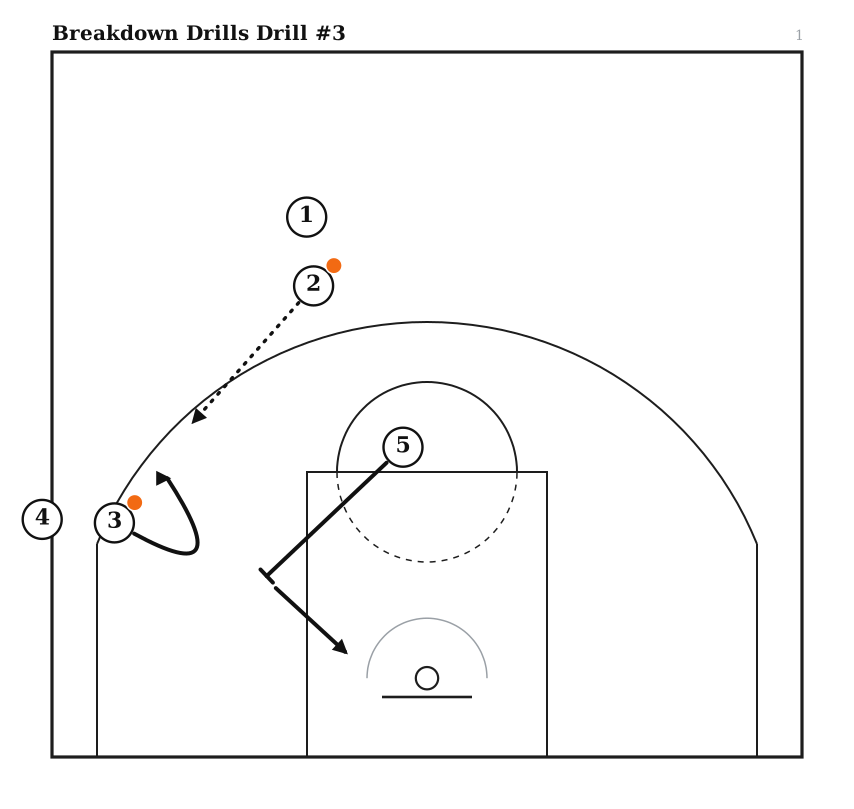
Run Hurley's drill ladder as your daily transition block: 2-on-1, then 3-on-2, then 4-on-3, then 5-on-4, and finish with 5-on-5. Each level has its own trained decision — not a freelance read, but a specific rule the players rehearse until it is automatic at game speed. Replace conditioning runs with the Hubie Brown 5-Man Break drill, which conditions and trains transition habits simultaneously rather than treating them as separate activities.
- Outlet at free-throw-line extended: the point guard receives the outlet at this specific depth — not half court, not near the sideline — so the break develops with maximum attack distance still ahead of them.
- Wings run wide, not inside: wide lane-running spreads the defense horizontally and ensures the wing arrives at a catch-and-shoot position; a wing who cuts inside narrows the floor and shortens the defense's recovery distance.
- PG stops at the free-throw line in a 3-on-2: every time, no exceptions — penetrating below the line is the most common transition mistake at the youth and high school level and it kills the read before it develops.
- Pass beats dribble up the floor: drill the throw-ahead habit deliberately; every dribble across half court is time returned to the defense that sprinting and passing had already taken away.
- Name at least two secondary break actions: players need a call word they can use in real time; Early Go and Early Drag are enough to start, and naming them makes the secondary break teachable rather than reactive.
Want more basketball coaching strategies and drills?
See it drawn up
Related diagrams
Keep Building
Related breakdowns