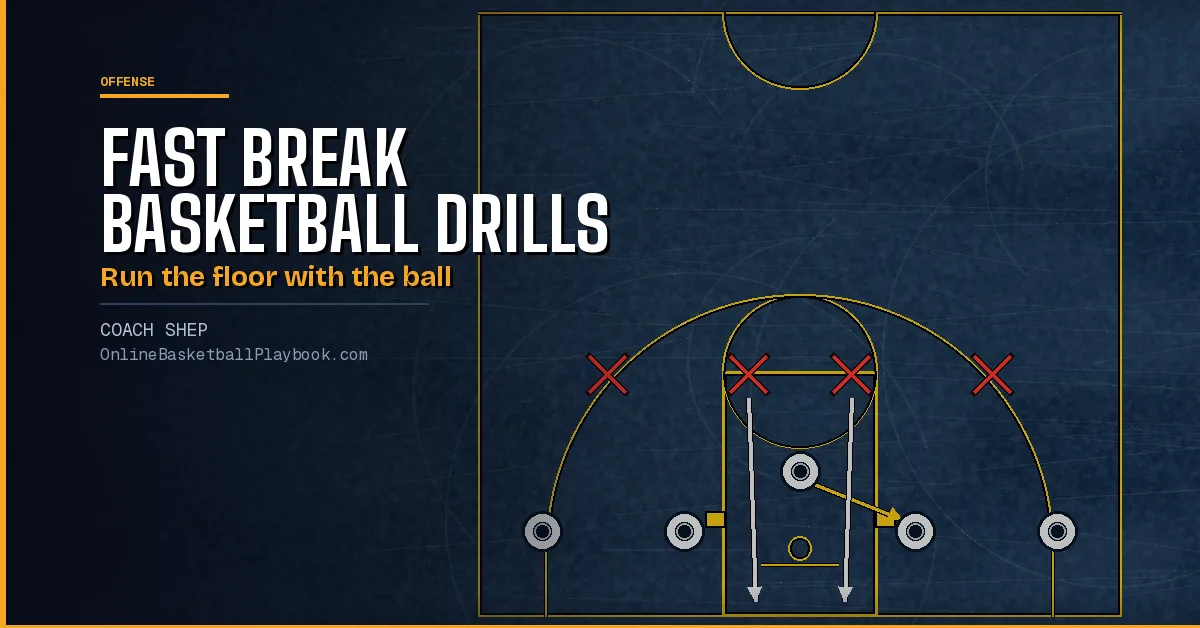
Fast break drills put the ball, the lanes and the finish together at full speed. Most of them also double as conditioning, which is why they can run in place of sprints.
This page collects basketball fast break drills by what they build: weave and partner drills that move the ball, no-dribble and clock drills that force the pass ahead, catch-up drills that give the offense a head start, a finishing series for the bigs and guards who run, and drills for youth teams.
The outlet drill, the 3-on-0, the 2-on-1, the 3-on-2 and the 2-on-1 to 5-on-5 ladder are on transition offense drills, and the rules of the break itself are on how to run the fast break.
Basketball Fast Break Drills at a Glance
| Drill | Players | The rule |
|---|---|---|
| Three-man weave | 3 | No dribble except one bounce to finish, last pass a bounce pass |
| Five-man weave to 3 on 2 | 5 | The shooter and the passer defend the trip back |
| Partner speed-dribble break | 2 | Speed dribble, jump stop, bounce pass, quick inbound |
| Four-man cone transition | Groups of 4 | Two dribbles and a pass, 50 makes in two minutes is perfect |
| 4-Second Box | 4 | No dribble, layup and all four inside the arc in 4 seconds |
| 5-on-0 trips | 5 | Four layups in 18 seconds with no point guard dribble |
| 4 on 4 transition | 8 and a coach | Two named defenders touch the end line before they help |
| Continuous 3 on 2 and 2 on 1 | 14 or more when scored | One shot, then the other way |
| Big man, little man | Pairs | Rebound, outlet and one of about ten finishes |
Weave and Partner Drills
Three-Man Weave
Three lines start on the baseline. The middle player passes to a wing and cuts around and behind him, and the pattern repeats corner to corner up the floor.
- No dribble, bounce pass last. Allow no dribble except a single bounce to finish the layup, and make the last pass a bounce pass.
- Talk. Passers call the receiver's name and the pass number out loud and receivers call "ball."
- Cut the passes. High school teams start by allowing five passes before the layup and then cut it to three, which forces a full sprint.
- Stop slow running. If players are not running full speed, the coach stops the drill and has them run sprints instead.

Score the weave to turn it into a contest.
- Score the layups. Each group earns points for made layups, loses points for misses, bad passes and fumbles, and gets bonus points by stopwatch rank.
- Add threes. A three-point option adds two catch-and-shoot threes per trip, fed from the end line to the trailer and the first passer as they fan out to the wings, for a maximum of 5 points a trip in timed two-minute sets.
- Limit it to four passes. Use exactly four passes and a target of 20 layups in two minutes.
The weave has its own page, 3 man weave.
A caution on the weave: the wide-open chest passes and the cut-behind pattern rarely look like a real break, so keep it as a warm-up and build passing and finishing with live drills instead.
Five-Man Weave Into 3 on 2
Five players run the weave up the floor and finish with a layup. On the way back it becomes a full-court 3 on 2.
- Defend with the finishers. The player who took the layup and the player who made the assist defend, and the other three push the ball and try to score.
- Convert again to 2 on 1. Make it longer, with the last ball handler as the lone defender going the other way.
- Replace suicides. A five-man weave works in place of suicides.
Partner Speed-Dribble Break
Pairs share one ball and the drill never stops.
- Pass in to the wing. One partner sprints to the wing while the other passes the ball in.
- Speed dribble and cut. The wing speed dribbles the length of the floor to the free-throw line while the passer sprints up the sideline and cuts at 45 degrees to the rim.
- Jump stop and bounce pass. The dribbler jump-stops and bounce-passes for the layup.
- Inbound fast. The non-shooter snatches the made basket before the ball can bounce, takes it out of bounds and passes in to his partner on the other wing, and they go back up the floor.
- Start the next pair. The next pair starts when the first reaches half court, so it never stops.
- Reverse the direction. Reverse the direction to make players dribble and finish with the left hand.

Four-Man Cone Transition and the Transition Speed Drill
Cone drills run the break two minutes at a time.
- Run the four-man cone drill. It runs two minutes, full court, and 50 makes is a perfect score. The rebounder throws a baseball pass to a player at half court, who dribbles up the sideline and passes back at the seam for a dribble, rip and shot or a finish in the lane. The rule is two dribbles and a pass.
- Send two groups. Two groups go at once, the second starting when the first passes half court, and the second trip down ends in a jumper instead of a layup.
- Run it continuous. A continuous two-minute drill uses two rebounding lines and two outlet lines, where players rotate through rebounder, outlet and finisher, and the team goal is 28 made layups.
Run every weave and cone drill at full speed or do not run it.
No-Dribble and Clock Drills
4-Second Box
Four players stand in a box, two guards at the elbows and two posts on the blocks, and nobody dribbles.
- Rebound and outlet. A coach tosses the ball off the backboard. One post rebounds and outlets to a guard while the other post sprints wide up the sideline outside a cone at half court.
- Pass through the middle. The outlet receiver jump-stops, pivots and passes to the other guard cutting hard to the middle, who jump-stops, pivots and passes to the sprinting post cutting to the rim.
- Land on the catch. Each receiver's feet must be on the floor on the catch so nobody travels.
- Beat the clock. The layup must be made within 4 seconds of the rebound, and all four players must be inside the arc in the same 4 seconds or the group repeats the drill.
- Talk the whole way. Players say "outlet," "middle" and "ball."

5-on-0 Trips
Run five players with no defense and put numbers on it.
- Beat the clock. Four layups in 18 seconds with no point guard dribble, six trips in 35 seconds, and the ball from net to net in about 3.5 seconds.
- Run every option. Run all five options of the numbered break back to back.
- Time the ball ahead. The ball reaches the three-point line in 3 seconds and 8 feet from the rim in 5.
2 on 0, 2 on 1, 2 on 2
This three-part passing series opens practice in about 10 minutes.
- 2 on 0. Partners run straight up the floor passing back and forth, never shuffling sideways, and finish with a bounce pass for the layup. Trips cycle through chest, bounce, overhead and around-the-back passes, the passer calls the receiver's name and the receiver calls "ball."
- 2 on 1. A defender sprints ahead and may jump any passing lane, and a turnover sends the trio to the far line.
- 2 on 2. A second defender trails and stays on the end line until the offense gets past the top of the key, so a slow read lets him arrive and erase the advantage.
Win the clock with the pass ahead, not the dribble.
Get the next coaching guide in your inbox
One email when a new guide or diagram set goes up. Free.
Catch-Up and Advantage Drills
These drills give the offense a short head start and make the defense chase, which is how a break looks in a game.
- 4 on 4 transition. The offense lines up on the end line and the defense at the free-throw line extended, facing them. The coach yells two defenders' names and throws the ball to the offense at the same moment. Those two must touch the end line before they sprint back. A steal, rebound or make sends the other team the other way. Keep score and have the losers run or do push-ups.
- Continuous 3 on 2. Keep two defenders at each basket and four lines. Each possession gets one shot and the outlet players sweep to the ball. Ban the dribble and make any dribble a turnover, or score it by playing to 8, with an offensive rebound worth a point.
- Continuous 2 on 1. Play to 8 with two-pointers only. The shooter sprints to half court, touches the center and comes back to defend.
- Add a chaser from behind. Attack drills add a defender chasing from behind, grow the attackers from one to four, and turn each score into pressure that denies the inbounder. A speed dribbler can also attack the basket against a chaser and a defender who starts at the jump circle.
- 3 on 2, then 2 on 1. After the 3 on 2 scores, the passer who made the assist gets back to defend the 2 on 1 coming the other way. Add a 1 on 1 phase, or send the highest man back.
- Send a defender to the baseline. A 4-man transition drill sends the defender in front of the ball to touch the baseline, so the offense plays 4 on 3 until he returns.
- Change. A 4 on 4 where the coach calls "Change" and the team with the ball converts to defense and picks up a new man. Five minutes a day.

The defensive half of these drills, finding the ball and protecting the rim, is on transition defense. Give the offense the head start and make the defense earn its way back.
A Finishing Series for the Break
A high school team can set a goal of converting 40 percent of its primary and secondary break chances and run a big man, little man drill two or three times a week to get there. Bigs usually start under the basket and guards on the sideline. Each rep starts with a toss off the backboard.
- Take the rebound high. The rebounder takes the ball at its highest point, makes a quarter turn over the outside shoulder and throws a two-hand overhead outlet.
- Come back on a line. The receiver steps away and comes back on a line, makes a two-foot stop, rips and pushes out.
- Run the wing. The rebounder then runs the wing, touching the sideline at half court, while his partner pushes the ball up the middle and looks to give it back before the runner reaches the arc.
- Stop on two feet. Every stop is a two-foot jump stop and the two swap roles each trip.
The finishes change by rep:
- Finish off the outlet. A layup.
- Attack the elbow. A jumper or a cross-court pass.
- Shot fake and drive. Against a closeout.
- Hit the trailer. On a sideline break.
The same drill trains the team's first motion entries, a shallow cut, a screen and roll and a handoff, and coaches write new sequences from film. For finishing at speed see layup drills, and for the plays that follow the first wave see secondary break basketball. Finish every rep at game speed with a two-foot stop.
Fast Break Drills for Youth Basketball
Young teams use the same drills with simpler rules.
- Run free-flow lanes. Skip numbered breaks for youth and high school teams, because players end up in the wrong spot after contesting a shot, substitutions scramble the roles and assigned lanes stop players from reading the floor. The rule is that players ahead of the ball run wide, players behind it fill the middle, and anyone may push.
- Three passes, no dribble. The conditioning drill, a three-man fast break, requires three passes and no dribbling, and the group rotates passer, cutter and rebounder across three trips so each player finishes a layup.
- Lower targets. A made-in-a-row 3-on-0 standard of 13 clean trips comes with a lower target for younger teams, and a scrimmage bonus for crossing the far foul line in 4 seconds allows 6 seconds for younger players.
More on running a young team's practice is on coaching youth basketball, and passing work is on basketball passing drills. Keep the rules simple and let the young players run.
Where Coaches Split
| Question | Approach |
|---|---|
| Is the weave worth practice time? | A warm-up only, because the passing lanes and layups are rarely that open in a game |
| A scored, timed drill with a pass limit and a make target | |
| Dribble or not? | No dribble at all, with a 4-second clock |
| A limit, such as two dribbles and a pass | |
| A speed dribble the length of the floor as the skill being trained | |
| Fixed lanes or free flow? | Numbered lanes run the same way every trip |
| Ahead of the ball run wide, behind it fill the middle, anyone pushes | |
| Conditioning? | Fast break drills replace sprints |
| Timed runs set apart from skill work |
Choose the approach that matches how your team runs. Pace and the first actions after the break are on early offense, and set plays for quick scores are on transition offense plays.
Want the printable playbook packs?
OBP Pro members get the premium playbook packs: the zone attack, out of bounds and practice plan PDFs, plus each new pack as it is finished. The membership page lists what is in each one. Or draw your own version free in PlayDraw.
See what OBP Pro includesQuestions Coaches Ask
What are the best fast break drills in basketball?
The three-man weave, the partner speed-dribble break, a no-dribble drill like the 4-Second Box, catch-up drills such as 4 on 4 transition, and a numbers ladder from 2 on 1 to 5 on 5.
What are good fast break drills for youth basketball?
A three-pass, no-dribble three-man break, the 2 on 0, 2 on 1, 2 on 2 passing series, and free-flow lanes instead of numbered ones.
How do you practice the fast break without a full team?
Partner drills such as the speed-dribble break need two players and one ball, and the 4-Second Box needs four.
Is the three-man weave a good drill?
Coaches split between a warm-up, because it does not look like a real break, and a scored drill with a pass limit and a make target.
How long should fast break drills last?
Many run on a clock. The four-man cone drill and the transition speed drill run two minutes, and the passing series takes about 10.
Can fast break drills replace conditioning?
Yes. A five-man break or a weave can take the place of suicides.
More Guides From This Batch
- Basketball Speed and Agility Drills: Sprints, Starts and Stops
- Pick and Roll Basketball Drills: From 2 on 0 to Live Reads
- Flagrant Foul in Basketball: Rule, Penalties and Calls by Level
- Jab Step Basketball: How to Do It and How to Teach It
Back to Early Offense in Basketball and every Offense page.
Keep Building
Related breakdowns
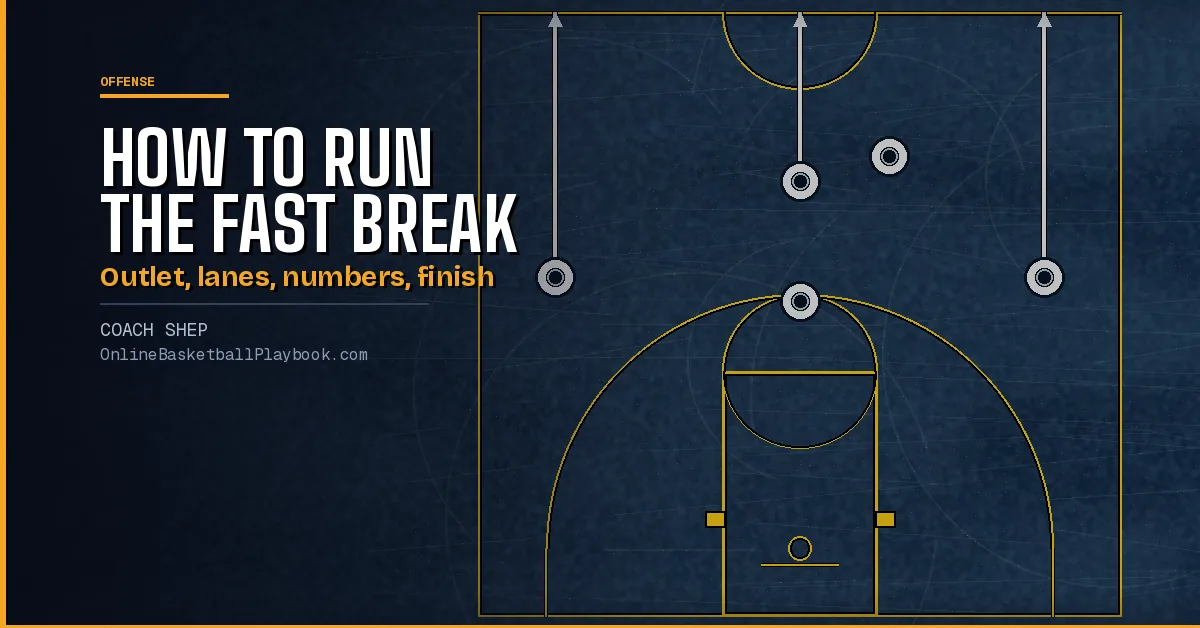
How to Run the Fast Break: Lanes, Reads and Drills
How to run a fast break: start it off a stop, fill three lanes, read each numbers situation, flow into a secondary break and build the habits with a drill ladder.
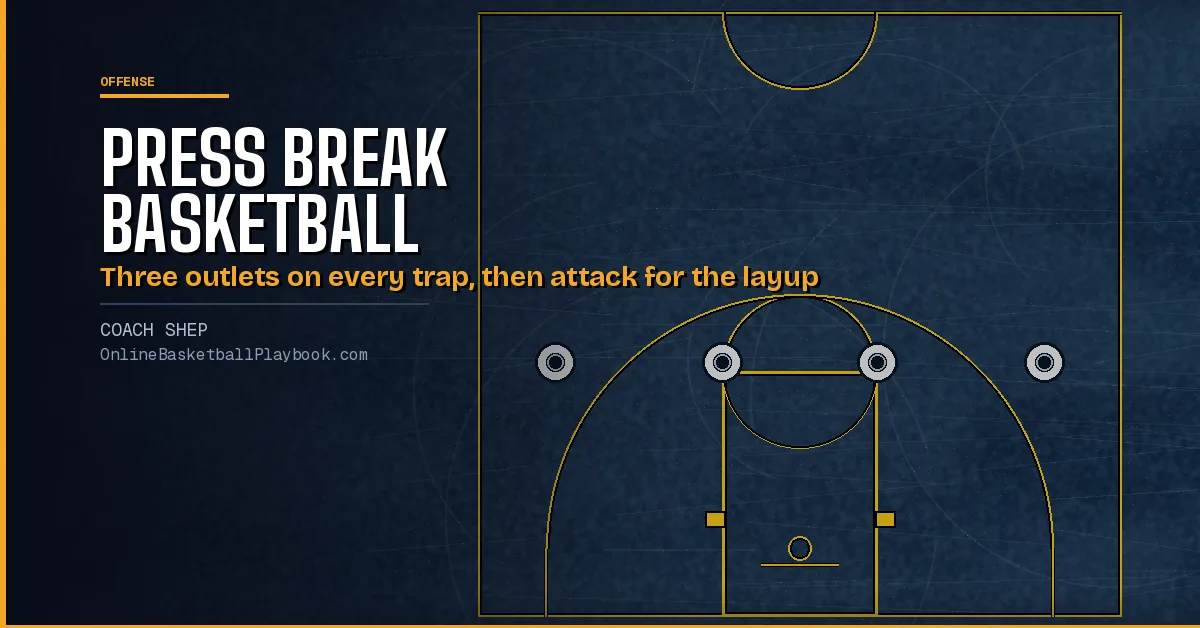
Press Break Basketball: Alignments, Reads and Drills
Press break basketball guide with the 1-4, 80-60-40 and 4-across alignments, reads against the 2-2-1, diamond and 2-1-2 press, and where coaches disagree.