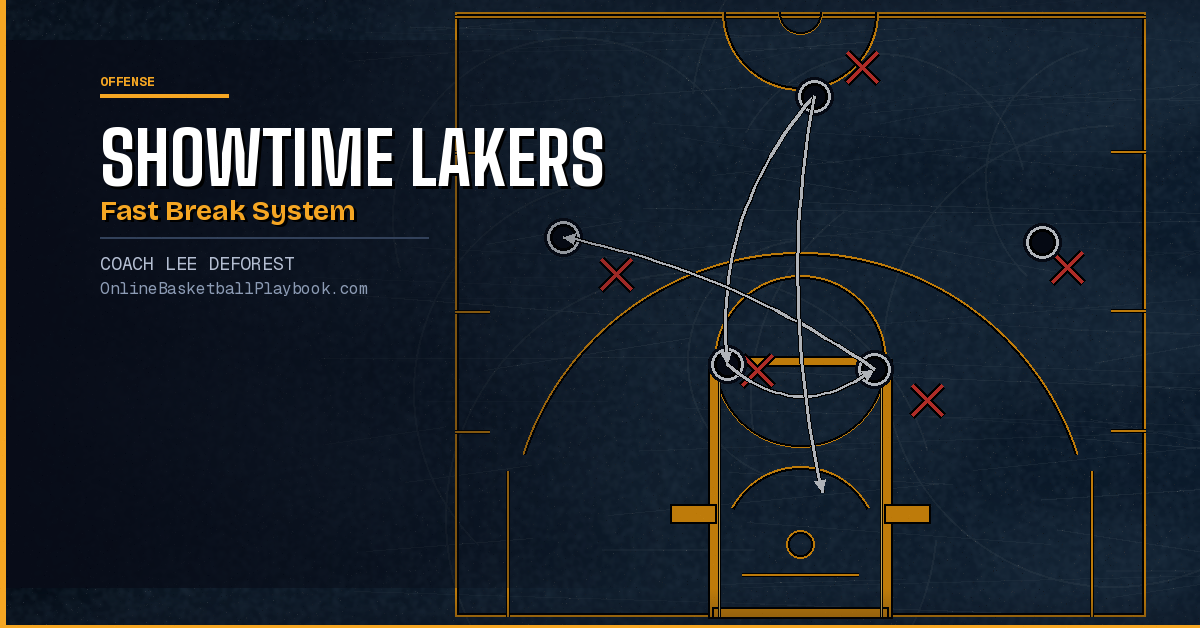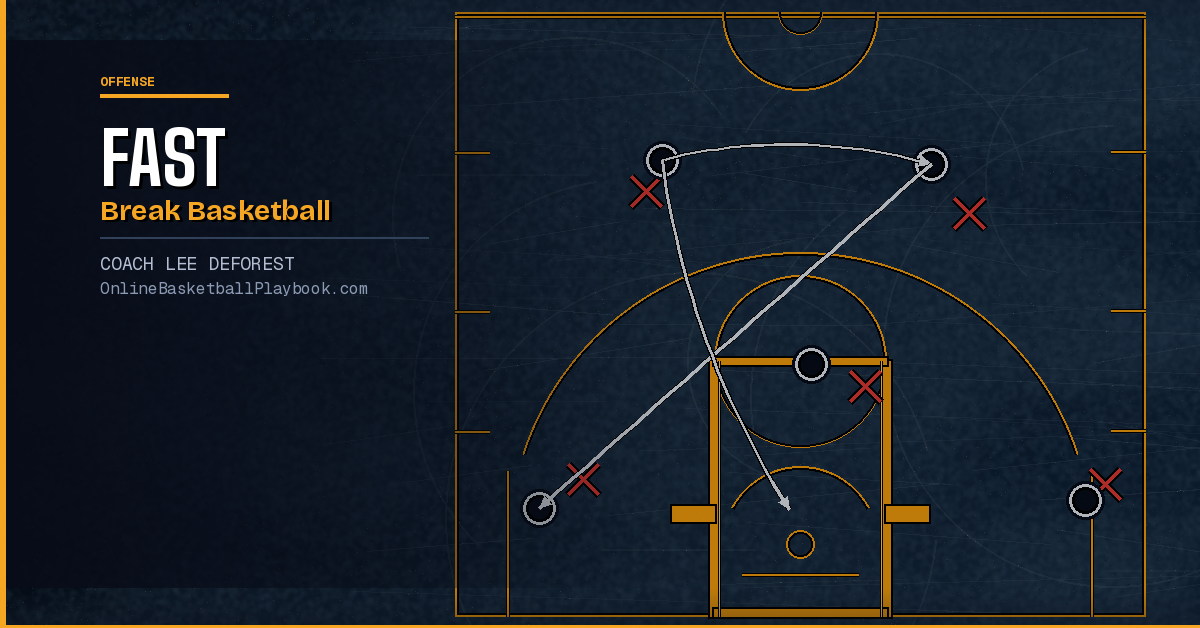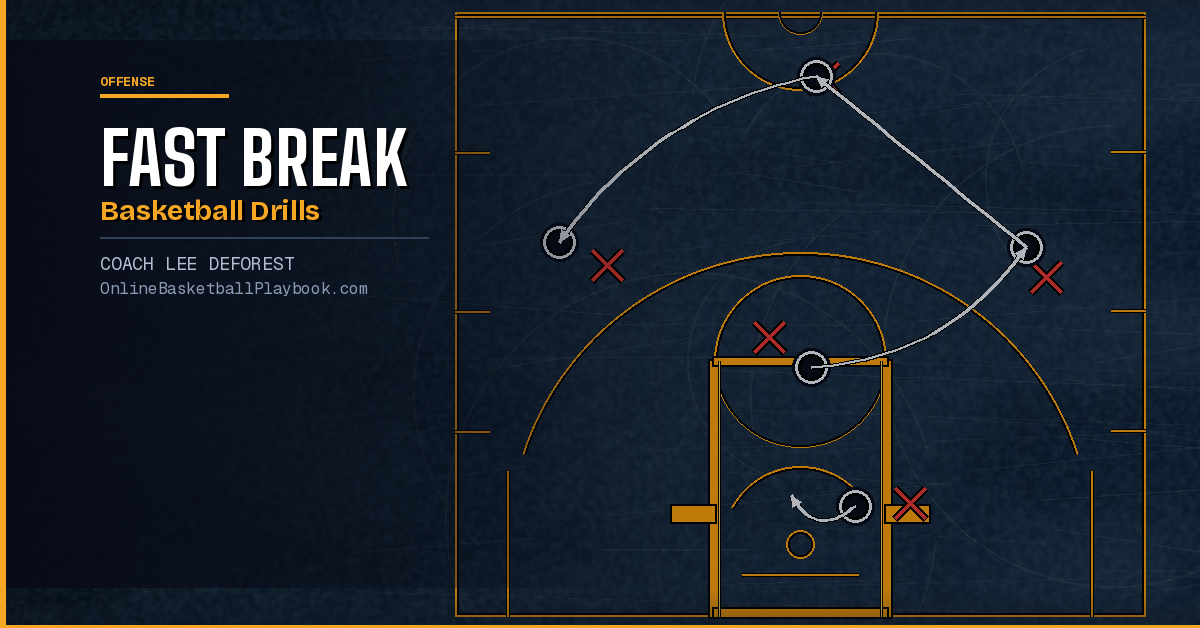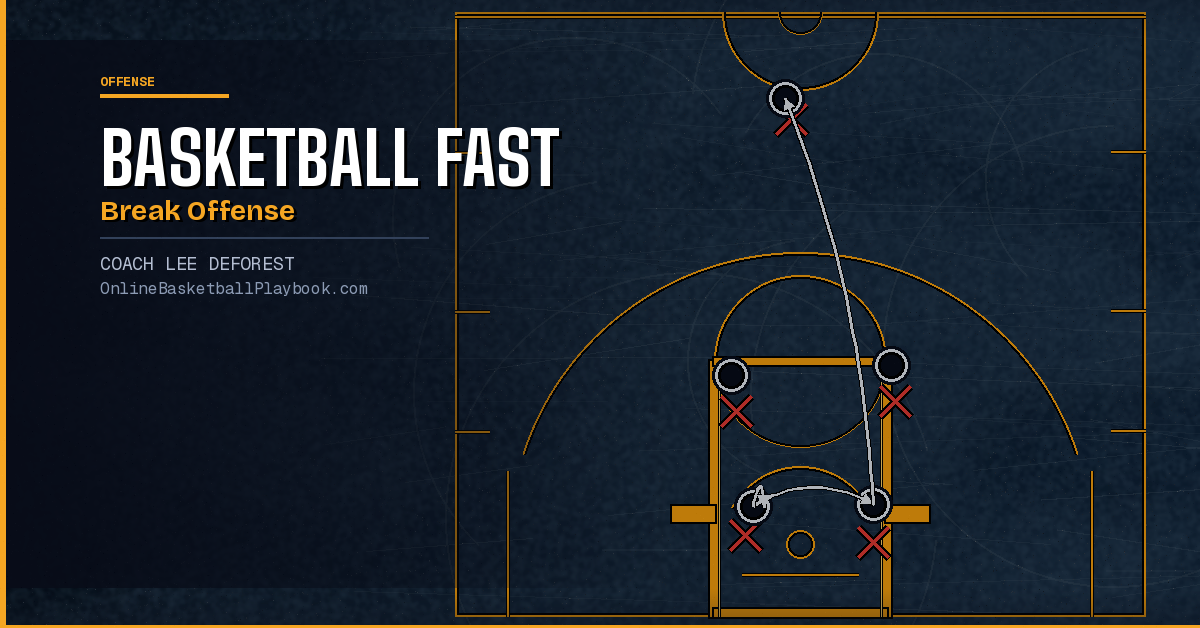

The fast break is the most efficient shot in basketball — a layup or open three before the defense can organize. This guide breaks down exactly how to build, drill, and run a transition attack that produces those shots consistently.
Why the Fast Break Wins Games
Most coaches agree that transition offense is important. Fewer coaches have a structured system for it. The difference between a team that "tries to push pace" and a team that actually converts fast breaks at a high rate comes down to one thing: trained decisions at every numbers situation.
When a turnover happens or a shot misses, players who have rehearsed what to do — which lane to fill, when to pass, when to attack the rim — make the right call automatically. Players who haven't rehearsed it hesitate, and that half-second of hesitation is exactly when the defense recovers.
Pace is a competitive edge, not entertainment. A team that consistently pushes the ball forces opponents to sprint back on every possession, wears them down in the fourth quarter, and creates layup opportunities that no half-court scheme can generate. The fast break isn't a bonus — for teams with athletes, it's the primary offensive weapon.
The other reason to prioritize transition offense: it starts on the defensive end. Teams that build a tough defensive identity — one that generates stops and deflections — earn more fast break opportunities than teams that wait to outscore opponents in the half court. Defense and transition offense are the same possession viewed from opposite ends of the floor.
Outlet Rules and Lane Assignments
The fast break begins the moment a player secures a rebound or intercepts a pass. What happens in the next two seconds determines whether the advantage is real or wasted.
The Outlet
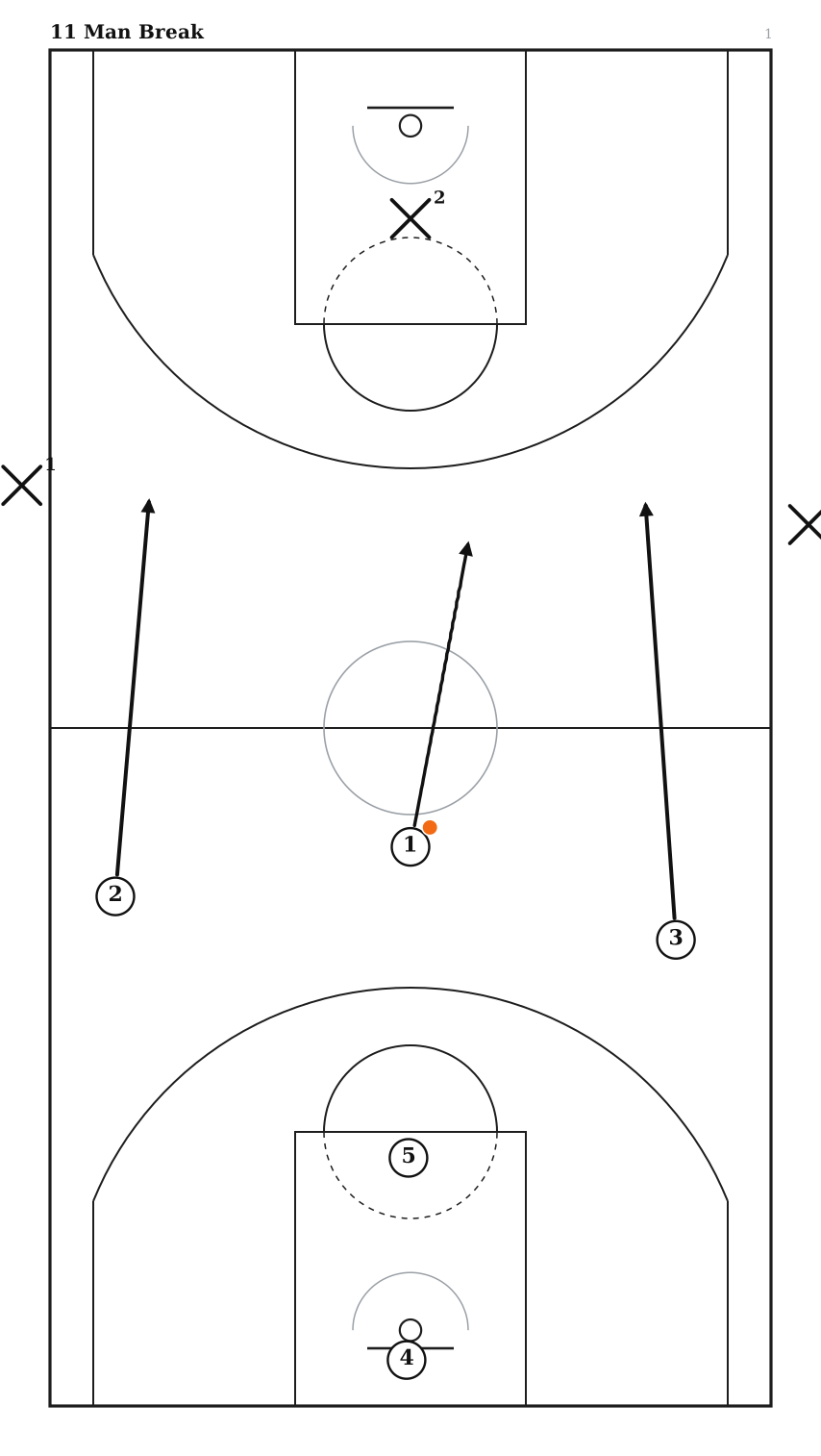
Hubie Brown's outlet rules are among the most precise in coaching literature. The rebounder turns in the air toward the outside — not toward the middle of the floor — so the outlet pass is immediate and away from defensive traffic. The point guard receives the outlet at free-throw-line extended, not at half-court. Receiving at half-court means the advantage is already shrinking; receiving at free-throw-line extended means the attack begins 28 feet closer to the basket.
One rule that coaches often underteach: never pass back on the break. Once the ball is moving downcourt, it stays moving downcourt. A backward pass kills momentum, invites a trap, and gives the trailing defense time to recover. Every player on the floor needs to understand this as a hard rule, not a suggestion.
Lane Filling
A functional fast break requires all five players sprinting their lanes on every possession — not just the possessions where a break looks obvious. The point guard leads the middle. Wings sprint the sidelines. A trailer follows behind the ball. A fifth player (often a big) acts as a preventer, staying back to protect against a counter-attack turnover.
The weak-side forward sprinting wide for the layup must trust that the ball will come. This is a cultural point as much as a technical one: a wing who jogs because "it probably won't come to me" is the reason it doesn't come. The habit of sprinting creates the occasional uncontested layup; the habit of walking creates none.
Passing beats dribbling in transition. The ball travels faster via the pass than via a dribble across half-court. Every extra dribble is a second of recovery time gifted to the defense. Teach players to keep the ball moving with passes until someone has a clear lane to the rim.
Numbers Situations: 2-on-1, 3-on-2, and Beyond
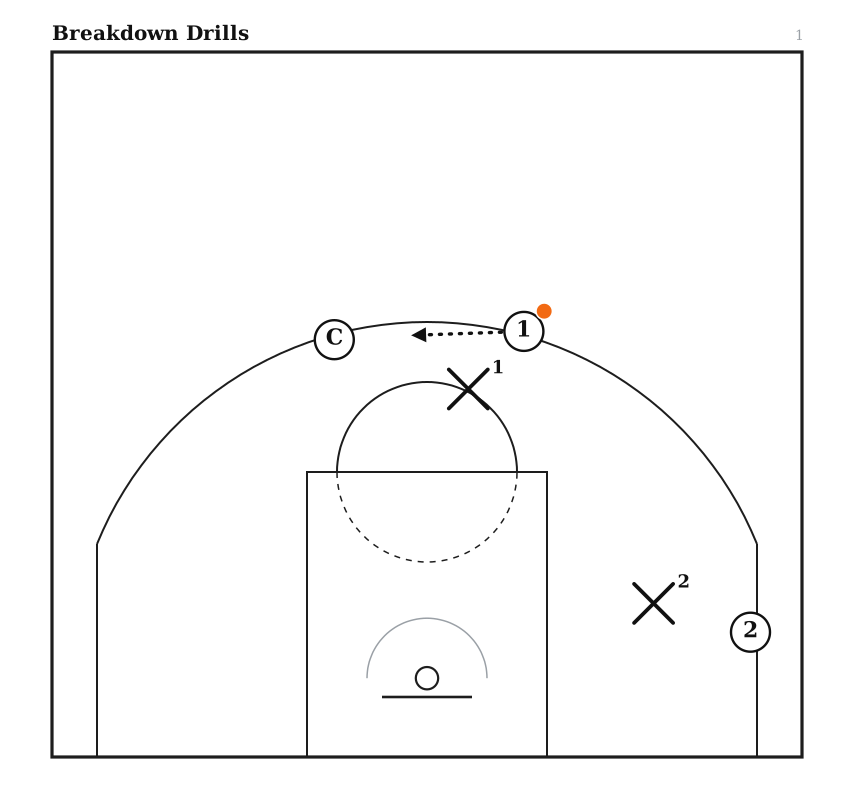
The most commonly mismanaged moments in fast break offense are numbers situations — 2-on-1 and 3-on-2 — because players either freeze or make undisciplined decisions. Good transition teams have rules for each scenario that are drilled until they're automatic.
2-on-1
Attack the hoop first; the pass is second. The ball-handler drives at the defender, forcing a commitment. The pass comes after the defender commits — not before. A premature pass telegraphs the read and allows a deflection. Give the defender the outside shot, not the layup. Defenders are trained to stay low, so attackers should stay aggressive until the defender's positioning demands a pass.
The Obradović principle applies here: if no one guards you, don't pass — wait for the defender, then it's 2-on-1. Running into an uncontested lane and passing out of it converts a 1-on-0 into a contested 2-on-1. Let the defense catch up enough to create the advantage, then exploit it.
3-on-2
The most commonly violated transition rule at the youth and high school level: the point guard stops at the free-throw line and reads. The PG does not drive below the free-throw line in a 3-on-2. Stopping at the free-throw line holds both defenders — the top defender must respect the ball, and the low defender must respect the cutting wings. The moment a PG penetrates below the line, one defender can sag to protect the rim and the passing angle closes.
From the free-throw line, the read is: pass to the wing cutting toward the hoop as the top defender commits to the ball. This is a timing play, not a guessing game — the wing cutting hard creates the commitment, and the commitment creates the pass.
4-on-3 and 5-on-4
Higher-number advantage situations should be run as distinct drills, not treated as a generic "run faster." Dan Hurley's progressive drill ladder — 2-on-1, 3-on-2 tandem, 4-on-3, 5-on-4 diamond, 5-on-5 — trains a specific decision at each level. Each rung of the ladder has its own structure. None is freelance.
Coaches who run 5-on-4 like a 5-on-5 are wasting the advantage. The extra attacker creates a specific seam; players need to know where it is and how to attack it before they're in a game.
The Numbered Secondary Break System
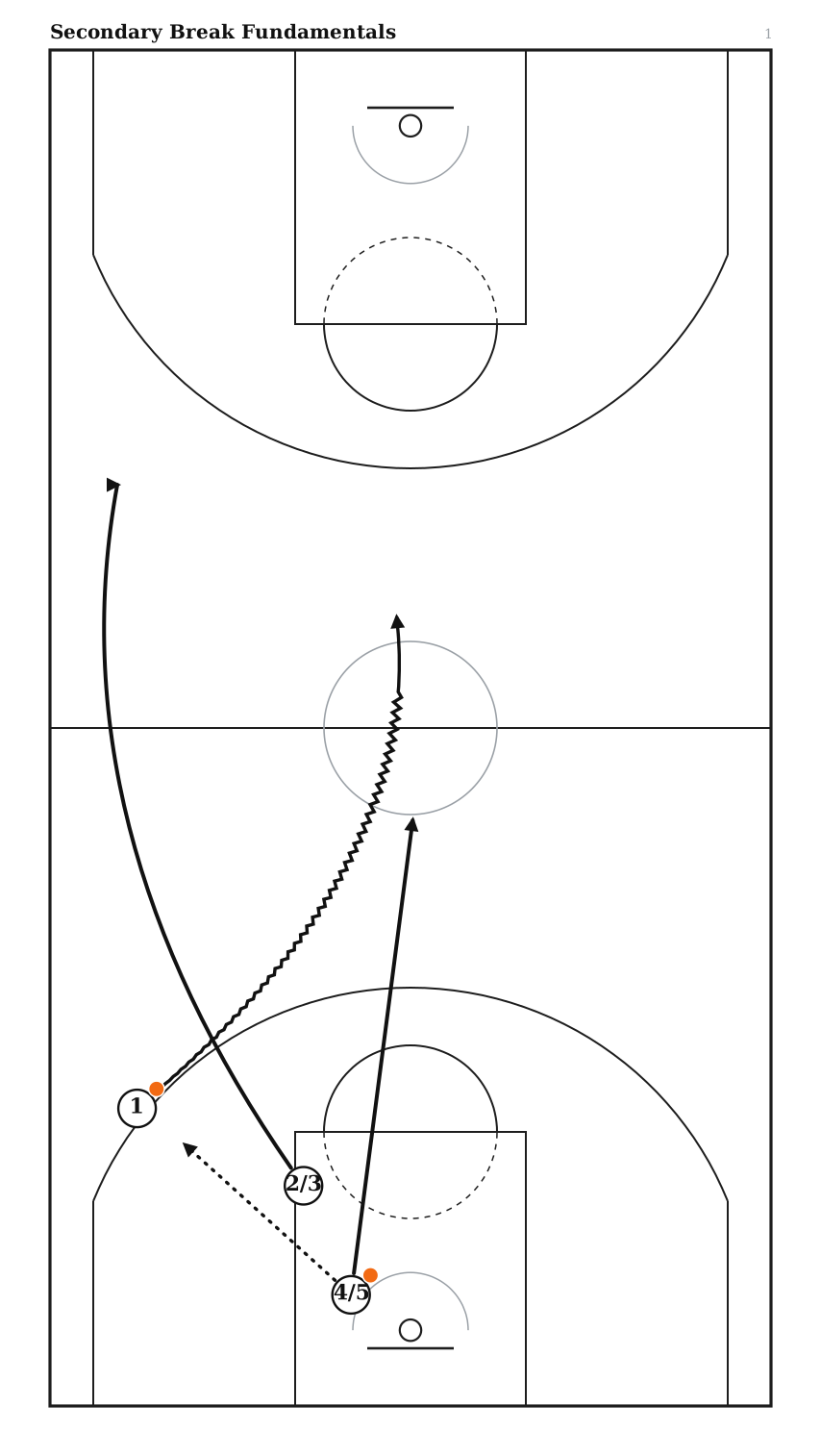
When the primary break — the immediate attack after a turnover or missed shot — doesn't produce a layup, the offense flows into the secondary break. The most installable secondary break system is a numbered priority list: five options in order, called by number so the point guard can direct traffic verbally on the fly.
The five priorities: (1) PG attacks the seam all the way to the rim; (2) pass to the wing-corner; (3) long pass to the post on the opposite block; (4) pass to the cutting big through the lane; (5) trailer option for the outside shot. If no option is available before the half-court, slow it down and let the half-court offense take over.
What makes this system practical is the coordinated lane-running that sets it up. O3 inbounds quickly after a made basket. O1 catches on the ball-side wing. O2, O4, and O5 sprint their lanes simultaneously. The timing — all five players moving at once — is what creates the advantage before the defense can organize. One player jogging breaks the system for everyone.
One structural bonus: the numbered break uses the same lanes as a press-break alignment. Teams that know their press-break formation already know the secondary break. Installing one teaches both, which is a significant time-saver in a crowded practice schedule.
When the primary and secondary options are both closed, the offense flows directly into a flex-cut continuity sequence rather than stopping and resetting. Transition becomes the half-court offense without a re-alignment call. This is the most seamless form of transition offense — the defense never gets a "reset" signal from the offense, because there isn't one.
A team that walks the ball up loses transition advantages before they even develop — habit is everything.
— BFC Eight Keys to Fast Break, Basketball Vault
Freedom Off Stops, Structure Off Makes
Dan Hurley's transition rule is one of the most efficient pieces of basketball coaching language ever written: freedom off stops, structure off makes. It covers every transition situation in six words.
Off a defensive stop or turnover, the offense attacks with freedom — blast the ball ahead, attack the paint, drive and kick. No ball screen. The drag ball-screen is a crutch that slows the advantage and lets the defense organize. Attack with the dribble, get to the rim or get an open three. The target is seven seconds or less from the rebound to the shot.
Off a made basket by the opponent, call a structure. This is where named actions become essential: a Pistol action, a Wide Pin, a DHO (dribble handoff), a Step-Up screen. The offense doesn't slow down — it enters a specific designed action at speed rather than pushing into a scramble situation. Guards need a vocabulary of two or three named actions they can call verbally after the opponent scores.
This rule creates a simple decision tree that any player at any level can learn. After a stop? Attack immediately, no ball screen. After a make? Call a name and run it. Two rules for every transition situation. Coaches who adopt this report that guards make better decisions in live games within two or three sessions of drilling it.
Building Transition Culture Through Daily Drills
Transition offense is a habit before it's a system. Habits are built through repetition at game speed, not through walk-throughs. The structure of daily practice determines whether players have trained decisions or improvisations when a game-speed break develops.
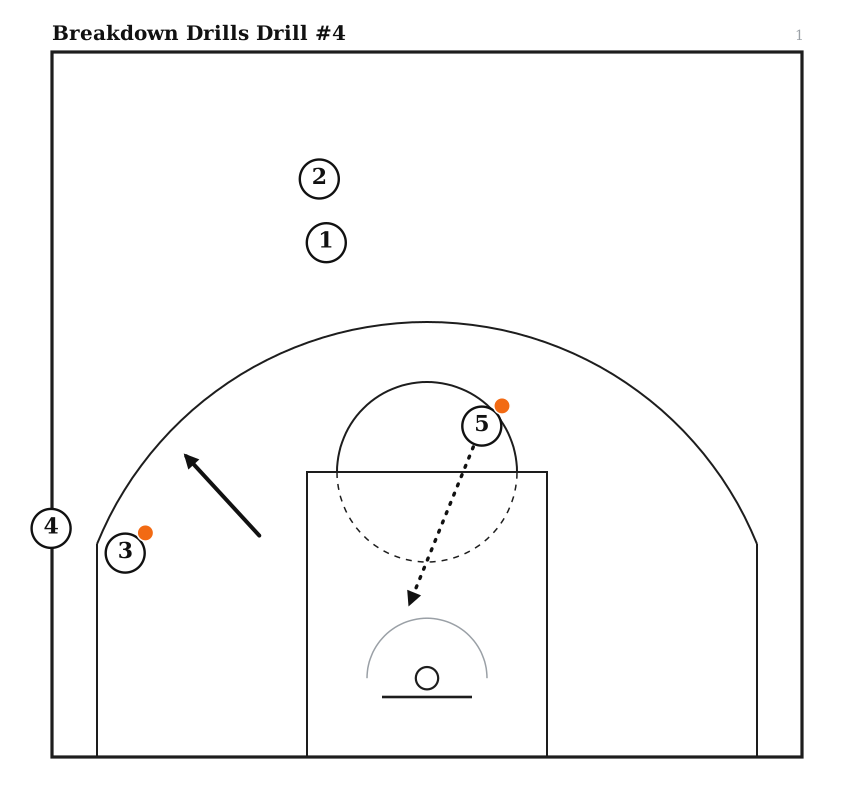
The most effective daily transition structure is a progressive drill ladder: 2-on-1, then 3-on-2 tandem, then 4-on-3, then 5-on-4 diamond, then 5-on-5. Each level is run as its own drill with its own rules — not a generic "full-speed scrimmage." The ladder forces players to solve each numbers problem hundreds of times across a season. By February, the decisions are reflexive.
Replace suicides with the Five-Man Break as the conditioning component. The Five-Man Break runs the same lanes as the fast break, conditions all five players simultaneously, and transfers directly to game situations. Suicides build individual conditioning; the Five-Man Break builds conditioning and basketball skill at the same time.
Cultural practices matter as much as drill structure. Hurry, but don't rush is the right organizing phrase for a transition-minded team. Pace is a weapon, but ball security and decision-making under pace are the prerequisite. A player who panics with the ball in transition kills the team's advantage faster than any defender. Teaching players to evaluate options before dribbling — catch and face, read, then act — is the behavioral skill that separates teams that score in transition from teams that just run fast and turn it over.
One specific cultural practice worth adopting from day one: credit the assist. After every transition score that came from a kick-out or dump-off, the scorer points to the passer. This small habit changes how guards think about fast break situations — not "can I finish?" but "who is open?" — which is the read-first mindset the entire system depends on.
The RACE mentality captures the physical discipline: every player sprints their lane on every possession, regardless of whether a break looks likely. The occasional uncontested layup that comes from a sprinting habit is the reward for fifty possessions of thankless lane-filling. It's invisible work that creates visible results.
Early Offense: The 2–3 Second Window
When the primary break doesn't produce a layup and the secondary break options are closed, there's still a narrow window — roughly two to three seconds after the ball crosses half-court — when the defense isn't fully set. This is the early offense window, and it's where designed actions pay off.
Stephen Silas identifies three early drive-and-kick initiators that attack before the defense loads: the pass-ahead (with a wing advantage, pass ahead and rip to the baseline), the skip-pass in transition (the defense is loading to the ball, so a skip attacks a closeout from a defender who's still moving), and the slip (slip to the rim to open the driving gap). These three reads convert transition advantages without waiting for the half-court to set.
The Pistol action is the most versatile early-offense entry: the point guard passes and immediately cuts to a corner while a big sets a ball screen, forcing two defenders to make simultaneous decisions before either is set. Run at transition speed, before defenders have reached their assignments, the Pistol consistently produces good shots from either the ball-screen action or the cutting guard.
Off-ball screens run in the early-offense window exploit a specific defensive communication gap. Wing defenders who are still sorting out who covers whom are vulnerable to a screen that arrives before they've locked in their assignment. The first communication mistake becomes an open shot. Teams that deliberately enter screens at the moment defenders are still organizing get better shots than teams that wait for the defense to set and communicate.
Approximately 70% of standard half-court actions can be run inside the transition window, according to Sergio Laso's analysis. This means the hard separation between "transition" and "half-court" is largely artificial. Transition is how a team gets into its offense at speed — not a separate fast-break phase that ends when a set play begins. The most efficient offenses treat them as one continuous attack.
When installing the numbered secondary break, connect it explicitly to your press-break alignment. If your players already know their press-break lanes, they already know the secondary break formation — same spacing, same timing, same floor spots. This cuts installation time significantly and reinforces both systems simultaneously during drills.
- Freedom off stops, structure off makes — blast ahead with no ball screen after a stop (7-second target); call a named action (Pistol, DHO, Wide Pin) after a made basket.
- PG stops at the free-throw line in a 3-on-2 — never below the line; hold both defenders before passing to the cutting wing.
- Outlet at free-throw-line extended, not half-court — receiving the outlet 28 feet closer to the basket preserves the transition window before the defense recovers.
- Credit the assist after every kick-out score — scorer points to the passer; this shifts the team's decision-making from "can I finish?" to "who is open?" across the entire fast break.
- Use the Five-Man Break instead of suicides — builds transition conditioning and lane discipline simultaneously; every conditioning rep is also a basketball rep.
Want more basketball coaching strategies and drills?
See it drawn up
Related diagrams
Keep Building
Related breakdowns