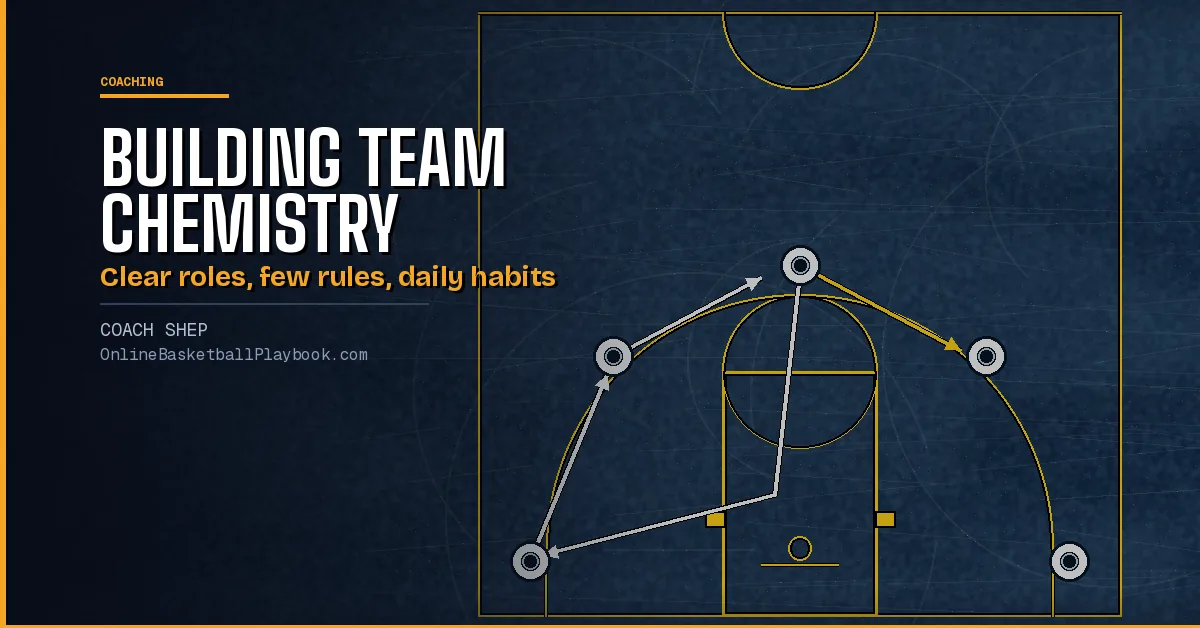
Building team chemistry in basketball starts with decisions the coach controls. Who is this team? Which few rules hold? What is each player's job? What does practice ask of everyone every day? Chemistry is what those decisions look like after a season of consistent repetition. This guide covers identity, standards, roles, accountability, practice habits and shared language, then where coaches split and three drills that put it to work.
Team Chemistry at a Glance
| Lever | What it looks like | First step |
|---|---|---|
| Identity | A few public words the team plays by | Write the identity in one short line and tie every rule back to it |
| Standards | A short list, written down, enforced equally | Write four to six rules and post them |
| Roles | Every player knows his job and when he plays | Talk to each player about his role before the first game |
| Accountability | Mistakes are owned and not blamed on others | Teach self-first questions and announce consequences before a drill |
| Practice | Hard, scored and loud | Add no-dribble work and a scoreboard |
| Language | Short phrases and small rituals | Pick one huddle call and one way to honor the passer |
Building Team Chemistry Starts With Identity
Say who you are in a few words and say it in public. It takes different shapes:
- Four objectives that never change. Four team objectives that never change with the roster or the record: play hard, play smart, play together, have fun.
- A mission, a vision and goals. A mission, a vision and three player goals.
- An act you perform. Having an act you perform whatever the scoreboard says.
The shared move is to keep the identity short and tie every later rule back to it.
The argument is that how a team is assembled matters more than how it is coached, which puts culture and roster fit upstream of X's and O's. If you pick your own roster, that makes selection your first chemistry decision. Coaches who screen for traits look at self-discipline, competitive fire, self-belief and coachability, and coachability can rank above talent.
Gather four kinds of information before signing anyone:
- Film.
- Past coaches. Include coaches with a different philosophy.
- The player's own network.
- The player himself.
More on selection is on Basketball Tryouts.
Say it short, say it often, and tie every rule back to it.
Standards: Few, Written and Equal
Keep the list short. People remember rules in groups of two, three or four.
- Four rules. One well-known set is to be on time, play hard, know your job and know when to pass or shoot.
- Two non-negotiables. Attitude and effort, held to the same standard every day.
Whatever your list, write it down, post it and explain the reason behind each rule before you hold anyone to it.
Enforce the list equally. Apply each rule to the best scorer exactly as you apply it to the last player on the bench. A star who is spared a consequence collapses the standard for everyone, and inconsistency erodes trust faster than any single missed correction.
A concrete example: a missed practice without notice costs minutes, for a starter too. The same thinking applies to status. Over-elevating one player relative to the group poisons a locker room, and no game and no player should be treated as bigger than the others.
Consider letting players help write the rules.
- The coach sets them. The coach writes the rules himself.
- Players help write them. A youth-coaching view says rules hold better when players help write them and commit to them in public.
Either way, post the list where players see it. The standards sheet is also a good place to review the wider Basketball Team Culture guide.
Write it, post it and apply it to everyone.
Roles Before Minutes
Declare roles explicitly and early, before players play, and revisit them when performance shifts. A simple process has four steps for every player:
- Define the role.
- Make sure he understands it.
- Get him to accept it.
- Hold him to fulfilling it.
Write it down.
Reserves need the same clarity.
- Give reserves a predictable entry. They come in as a unit, always in the first half, and play a short stretch together, so the ninth player knows when he plays and stays engaged.
- Sub on a pattern. Substitution habits send a message too. Sub on a mistake only when it is a pattern, not an isolated error, as long as the player is trying.
- Build the offense for your best player. Get him to his best spots, and say something to every player every day.
When a player misses an assignment, ask first whether he was prepared. A mental error can be a sign that the coach has not finished preparing the player.
Say the role out loud before the game.
Accountability Without Blame
Teach self-first language. Train players to ask only What and How questions that begin with I, and drop the Why, When and Who questions that push the problem onto someone else.
Decide how teammates correct each other.
- Ban the yelling. Teammates do not yell at one another.
- Share the consequence. When one player errs, the whole team runs, and the talk happens between players and not through the coach, so teammates coach each other.
Announce the consequence before the drill, and deliver individual corrections privately and promptly once you have the facts. If running is the consequence, be clear about why. Coaches who run call sprints a matter of pride and not punishment.
Own the mistake, fix it and move on.
Practice Habits That Build Chemistry
Practice is where chemistry gets made. Four habits help.
- No-dribble work every day. Fifteen to twenty minutes of no-dribble drills forces cutting, passing, pivoting and communication, and it shows you each player's personality under constraint. The coach who uses it calls toughness inch by inch and day by day, a daily structure and not a speech.
- A scoreboard on live drills. Split the team into two groups that start at 50 points and score every live drill with a point key. A turnover costs points, a charge earns them, and failing to talk costs points on both ends. The group that loses runs. Keep the categories tied to that week's teaching emphasis and score consistently all practice.
- Visible effort. Chart breakdowns, post a running deflection total or keep an attitude chart, so effort is something players can see. Hold the best scorer to the same charge and floor-dive standard as everyone else.
- Assigned communication. Name one player to echo every call in a drill. When he does exactly that and nothing more, ask what he can add.

A no-dribble 5-out drill is an easy place to start, and Drills to Teach Motion Offense has more of them. Mistakes made in these drills are a good time to ask the preparation question from the roles section.
Make effort something every player can see.
Get the next coaching guide in your inbox
One email when a new guide or diagram set goes up. Free.
Words and Rituals
A word or a ritual makes a standard repeatable. Short, sticky terms become the culture, and the staff needs to use the same vocabulary as the players. A few devices coaches use:
- A shared huddle call. Break every huddle with the same call and response.
- A thought for the day. Discuss one principle briefly before and after practice.
- A character checklist. Improvement, no excuses, communication, health, energy and enthusiasm, and selflessness. Each word names a behavior a coach can check.
- Point to the passer. After a made basket, the scorer points to the player who passed him the ball, and the assist is honored the same as the score.
- An active bench. Bench players stand and applaud team plays and substitutes coming to the sideline.

Pick the words, then use them every day.
Relationships and the Coach
Relationships are scheduled, not hoped for.
- A daily conversation. Hold a 15 to 20 minute conversation each day with one player.
- A season-end meeting. Meet each returning player after the season and collect written goals in academics, basketball and strength work.
Both aim at the same result: each player sees that the program is invested in him. Trust in the coach as a person and trust in him as a basketball mind are separate, and each is earned player by player.
The coach is the first test of the culture. A team takes on its coach's personality, so audit whether your actual behavior matches your intended behavior, and take the blame when you lose. Staff count too. Define each assistant's role and expectations before day one.
Be the culture you want to see.
Handling a Selfish Star
Use steps and go only as far as the situation needs. Prevention comes first, in the preseason. During a game, give a quick positive, ask, positive word. Then a private talk, then the bench, and a parent meeting before the parent asks for one. Do not yell at a scorer to pass or cap his shots, because that punishes skill without teaching the behavior. A 34-4 team that disliked each other has been called a failure.
Start with prevention and go only as far as the situation needs.
Where Coaches Split on Team Chemistry
- Team consequence or individual consequence. A shared consequence makes teammates police each other. The same individual consequence for everyone, delivered privately, is the other path. Both are coherent systems. Pick one and stay consistent.
- Running as the consequence. Isolated sprints at the end of practice teach players to save energy. A scored drill can give the losing group a sprint instead. The two agree on consequences and differ on whether running should be the consequence.
- Announced or random consequences. Set the consequence before the drill, or argue for random consequences so a player cannot price the punishment against skipping the job. The random view fits a program with managers and older players, so try it with an older team first.
- Emergent or coached leaders. You can pick captains but you cannot pick leaders. The other view says leadership has to be coached, with roles, captains by area and regular captains' meetings. See How to Foster Leadership Skills Among Your Players.
- Short list or long code. A short, exact list, or a long conduct code with curfews and dismissal terms, or a player handbook in as much detail as the offense.
- Outcomes or process. Steer players away from outcomes, such as a pregame talk that never uses the word win, or count behavior, such as possessions won or team covenants completed. The two fit together when the numbers measure behavior and not the score.
Choose your system, then stick with it all season.
Chemistry Drills
- No-dribble pass and cut. Run no-dribble work for 15 to 20 minutes of every practice.
- Point to the passer. Run it in every scrimmage from the first day. The scorer points on every made basket that came off a pass.
- Echo the call. In any defensive drill, name one player to echo every call he hears.
- Scored live period. Run one live period a week with a point key and a consequence announced in advance.
- Standards sheet. In the first team meeting, have players help write four to six rules, post them and state one consequence per rule.
- Captains' meeting. Meet weekly for 15 minutes. Check mood, name one thing the team is letting slide, give each leader a job for the week and agree on one message to carry back.

Shell work builds the talking habit on defense, and Man-to-Man Defense covers the shell in detail.
Coach Cheatsheet
- Say the identity in one short line and tie each rule to it.
- Four to six rules, written, posted and applied to the star the same as to the twelfth man.
- Declare every role before games and revisit it when performance changes.
- Sub on a pattern of mistakes, not on one mistake.
- Announce the consequence before the drill.
- Score live drills and make effort visible.
- Pick one huddle call and one way to honor the passer.
Questions Coaches Ask About Team Chemistry
How do you build team chemistry in basketball?
Start with a short identity, a short list of rules applied equally, clear roles declared early and daily practice habits such as no-dribble work, scored drills and shared language.
Does team chemistry come from team-building activities?
Activities can help, and this guide puts the main work in daily structure: roles, standards and practice habits. Look at the ideas on Effective Team-Building Exercises for Basketball Teams as a supplement.
How do you handle a selfish player?
Use steps. Prevent it in the preseason, give a quick word in the game, have a private talk, use the bench, then meet with the parent. Do not yell at a scorer to pass.
How many team rules should a coach have?
Keep the list short enough that every player can recite it. Examples run from two non-negotiables to four rules, and a longer code is also used.
Should the whole team run when one player makes a mistake?
A team run lets teammates coach each other, and a private individual consequence is the other path. Choose one system, announce it in advance and keep it consistent.
All coaching and program pages sit under the Coaching hub. Related guides include Winning Cultures in Basketball, Leadership in Basketball, Ten Ways to Transform Your Players Into Team Leaders and Basketball Player Development.
Want the printable playbook packs?
OBP Pro members get the premium playbook packs: the zone attack, out of bounds and practice plan PDFs, plus each new pack as it is finished. The membership page lists what is in each one. Or draw your own version free in PlayDraw.
See what OBP Pro includesMore Coaching Guides
- Blocker-Mover Offense: Roles, Alignments, Reads and Install
- Defending Screens in Basketball: 5 Keys for Every Coverage
- 1-3-1 Baseline Out of Bounds Defense: Shape, Jobs, Traps
Back to Basketball Team Culture and every Coaching page.
Keep Building
Related breakdowns
Basketball Team Culture: Standards, Roles and Daily Habits
Basketball team culture as winning coaches build it: identity, recruiting, written standards, accountability, roles, shared language and daily habits.
Maintaining and Building Team Chemistry Mid Season
Maintaining and Building Team Chemistry Mid Season
Jay Wright's Villanova System: Habits Over Plays
Jay Wright's Villanova system: the habit doctrine, the daily skill block, shooting and footwork drills, 4 out 1 in spacing, Calculated Risk defense and culture.