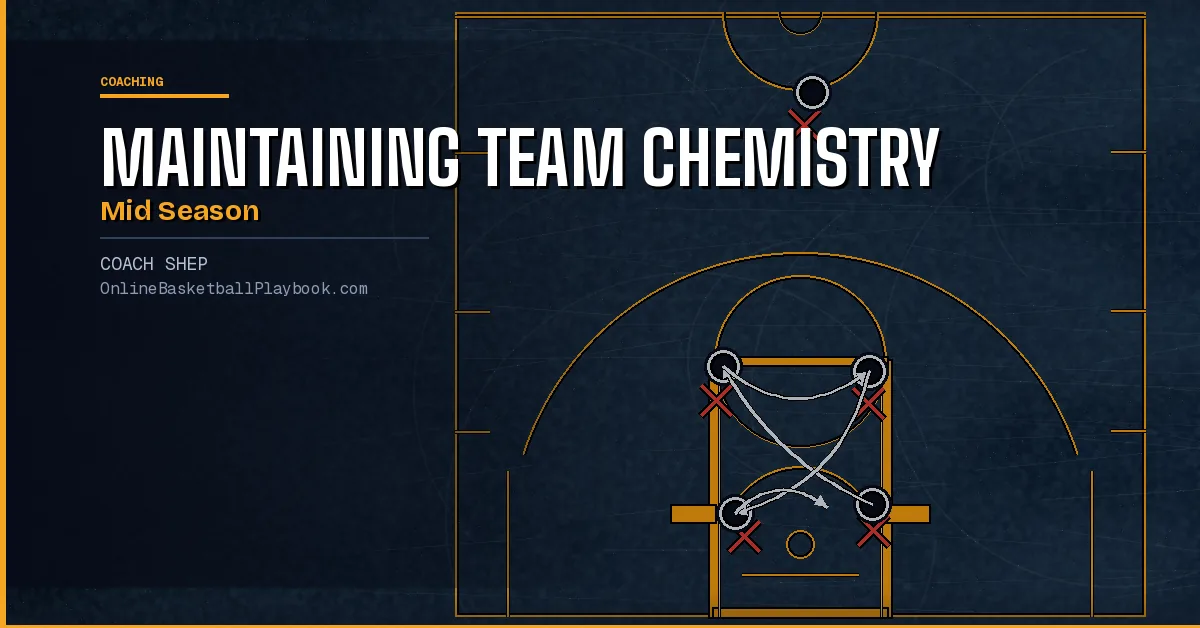
Mid-season is when team chemistry either compounds or cracks. Roles blur, fatigue sets in, and the locker room gets tested. Here is exactly what great coaches do to hold it together and even strengthen it.
Why Mid-Season Is the Real Test of Chemistry
Every team looks unified in October. The real question is what the locker room looks like in January, when the record is mixed, the starters are banged up, and the reserves are frustrated. That is where team chemistry either becomes a real asset or reveals itself as nothing more than preseason enthusiasm.
Mid-season is where the pre-game speeches stop mattering and daily behavior becomes everything. The coaches who manage this stretch well are not the ones with the best slogans. They are the ones who have built structures that hold without constant reinforcement. The culture is either load-bearing by mid-season or it was never really there.
Fatigue is the great revealer. When players are tired and the wins are not coming easily, three things show up: who actually believes in the system, who is protecting their own stats, and who the younger players look to when nobody is watching. A coach's job in this window is to protect the chemistry that was built and, if the team is doing the right things, accelerate it.
The coaches who lose the locker room mid-season almost always make the same mistake: they wait for chemistry problems to surface before addressing them. By then, the fractures are visible to everyone. The coaches who sustain chemistry treat it as a daily practice, not a crisis response.
Role Clarity Stops the Locker Room from Fracturing
Ambiguity about roles is one of the fastest ways to poison team chemistry. When players do not know exactly what is expected of them, they fill the vacuum with assumptions, and those assumptions almost always trend toward entitlement or resentment. The sixth man who thinks he should start. The starter who does not know if his minutes are safe. The defensive specialist who wonders whether the coaching staff actually values what he does.
Mike Dunlap's coaching framework is direct on this point: role declaration is a culture act. Before players play, they need to know their role. Declare it explicitly, early, and revisit when performance shifts. This is not purely tactical. It signals to every player that the coach has thought about them specifically. That signal matters more than the content of the conversation.
Mid-season is the right time to revisit roles, not just because the roster picture has clarified, but because players have now earned or shifted their standing through actual games. A coach who locks in roles in preseason and never revisits them sends a message that effort and performance do not actually move the needle. That is a chemistry killer.
Have individual conversations, not team announcements, about role adjustments. A player who hears about a reduced role in front of the group will protect his ego in ways that damage the team. A player who hears it privately, with specific reasoning and a clear path forward, is far more likely to buy in. The conversation format matters as much as the content.
The Blue Team concept from Dean Smith's UNC program is a practical model here. Reserve players (positions 7 through 10 on the roster) enter as a unit, always in the first half, always together for one to two minutes. Role predictability keeps reserves engaged and eliminates the disengagement pattern that comes from players never knowing when they are going in. A bench player who knows his role and trusts it will cheer louder and work harder in practice than one who is guessing.
Daily Standards: The Only Thing That Survives a Long Season
Speeches do not survive a long season. Standards do. The coaches who maintain chemistry through a 25-game schedule are not the ones who gave the best halftime talk. They are the ones who established non-negotiable daily behaviors and enforced them the same way in game 3 as in game 23.
Obradovic's framework from his Euroleague clinic makes this point with unusual clarity: non-negotiables must be repeated every single day with no exceptions and no shortcuts. The drills are simple by design and run daily precisely because standards erode the moment enforcement becomes selective. The value is in the unconditional repetition, not the complexity of the drill.
What this looks like in practice is a short list of behaviors that are always tracked and always enforced. Punctuality. Sprint to the coach on the whistle. Acknowledge the passer after every made basket. These are not motivational themes. They are daily behavioral signals that tell players the standard is the same today as it was last Tuesday. When the standard holds, chemistry holds.
Kelvin Sampson's framework reinforces this from a different angle: "how you do anything is how you do everything." The non-negotiables he returns to are attitude and effort, held the same every day regardless of the opponent, the score, or the mood of the gym. The trap coaches fall into mid-season is giving fatigue a pass, letting a sluggish Wednesday practice slide because Thursday's game is a big one. That selective enforcement is precisely when players learn what the standard actually is.
One daily habit that pays outsized dividends in mid-season chemistry: point to the passer on every made basket. Dean Smith called it explicitly, "acknowledge the passer." It is a no-cost, daily culture rep that rewards the assist and reinforces team-over-self identity. Run it from the first day of practice, keep running it in January. A team that consistently acknowledges the passer is a team that has internalized the idea that what brought the ball to the scorer matters as much as the score itself.
Accountability Without Blame
One of the most underrated chemistry skills a coach can develop is the ability to hold players accountable without triggering a defensive, blame-seeking response. Mid-season, when the stakes are higher and emotions are closer to the surface, this skill becomes the difference between a team that self-corrects and one that points fingers.
The Bethel basketball program's "Me First, For Us" language framework is one of the most practical accountability tools available to coaches. Players are trained to replace three specific question types (Why (victim thinking), When (procrastination), and Who (blame)) with questions that begin with "I." What can I do? How can I support the team? What action can I take? This is a vocabulary drill as much as a philosophy. Post the three forbidden question stems and the three replacement starters in the locker room and practice them after a loss.
Anson Dorrance's coaching framework adds a useful filter for identifying the players who will sustain chemistry versus the ones who will corrode it: watch how a player responds to correction. Players who actively seek to know their weaknesses (who hear "here is what you are doing wrong" and respond with curiosity rather than deflection) are the ones who pull the team up. Players who routinely deflect ("the system does not fit me," "my last coach did it differently") are accountability problems that compound mid-season. The pattern is more important than the individual instance.
Parcells' framework on mental errors is worth installing permanently: when a player makes an assignment mistake under pressure, the first question a coach should ask is not "why did you do that?" but "did we drill it until it was automatic?" This reframes mental errors as a coaching checkpoint, not a character verdict. It removes the defensive reaction because the accountability moves to the preparation process, which both coach and player own together. A team that holds errors this way does not blame. It adjusts.
Practice Habits That Build Chemistry On the Court
Chemistry is not built in team dinners or motivational videos. It is built in practice, specifically in the moments where players have to rely on each other under competitive pressure. The mid-season practice window is an opportunity to build on the foundation from preseason, not just maintain it.
No-Dribble drills are one of the highest-return investments a coach can make in mid-season chemistry. Mike Dunlap recommends 15 to 20 minutes of no-dribble work daily. The constraint forces cutting, passing, pivoting, communication, and movement without the ball. It reveals personalities: who panics without the dribble, who creates for teammates, who communicates under pressure. Dunlap calls it the thing that "puts the WE in your gym." At mid-season, when players are tempted to iso and force, this constraint is a powerful reset to team basketball fundamentals.
Dorrance's competitive cauldron principle applies directly here: practice must be harder and more competitive than games. If practice is the easiest competitive environment your players face all week, they will shrink under game pressure. At mid-season, when the schedule is grinding, it is tempting to protect players from intensity in practice to manage fatigue. The better approach is to keep the competitive pressure high and manage the physical load separately. More efficient reps, not softer ones.
Scored competitions in practice, with actual consequences for the losing group, are chemistry accelerators. When players compete against each other in a structured setting with stakes, two things happen. First, they learn to compete without blaming teammates, because the competitive framework makes winning and losing communal. Second, they develop the trust that comes from having pushed each other hard. Teams that compete against each other in practice compete harder for each other in games.
One final practice habit worth building mid-season: a consistent call-and-response break at every huddle. Bethel Basketball uses "Together we attack" as a structural signal at the close of every practice, every game, and every conditioning session. The ritual makes the team's identity tangible and daily. A team that breaks huddles the same way in January as they did in November is a team that has internalized the culture, not just heard about it.
Pick one daily accountability habit (pointing to the passer, sprinting to the huddle on the whistle, or a shared break phrase) and enforce it without exception for three straight weeks. Chemistry is compounded through small, consistent behaviors that signal the standard is real, not through periodic team talks. The habit you enforce in week 14 is the one that tells your players who you actually are as a coach, and what this team actually stands for when things get hard.
What Coaches Get Wrong About Team Unity
The most common mistake coaches make with mid-season chemistry is treating it as a morale problem instead of a structural problem. When chemistry dips, many coaches respond with a team dinner, a motivational speaker, or an emotional address. These have their place, but they address the symptom rather than the cause. Chemistry problems are almost always downstream of structural failures: unclear roles, inconsistent enforcement, accountability conversations that have not happened.
Morgan Wootten's philosophy-first program model is instructive here. His program at DeMatha Catholic High School held to five foundational principles across 46 years of coaching, and none of them were about winning. Culture was built in daily routines: a thought for the day discussed before and after practice, written evaluations from graduating seniors, postseason reports from every assistant. The daily structure was the culture. The speeches were just decoration on top of it.
Erik Spoelstra's framework from his Miami Heat work adds a related point: "don't allow separation or gurus." Mid-season is when cliques form: the starters and the bench mob, the veterans and the freshmen, the players who think they are getting enough minutes and the ones who do not. A coach who allows these separations to solidify by doing nothing is as responsible for the fracture as the players who created it. The antidote is radical honesty, surface-level conversations replaced with direct ones, and a consistent signal that the team's identity belongs to everyone in the locker room equally.
Tom Crean's "10 Truths" framework includes a principle worth posting mid-season: the legacy of leadership is the feel a player leaves when he is gone. This reframe helps senior players, who often become chemistry problems when their roles shrink late in a season, understand that their impact is bigger than their minutes. A senior who handles a reduced role with maturity, who communicates positively in the huddle and works hard in practice, is building something that outlasts the season. A coach who frames it that way explicitly, in a one-on-one conversation, will get a different response than one who simply announces a rotation change.
Finally, the Wootten standard for daily evaluation is worth adopting outright: did we give a winning effort today? Not did we win. Did we play hard, play smart, play together, and have fun? A team that evaluates itself on process rather than outcomes is more resilient to the losing streaks that inevitably come mid-season. The scoreboard is not the daily standard. The effort, the communication, and the execution are. A coach who has that standard clearly defined and returns to it consistently after tough losses gives the team something to hold onto when the results are not cooperating.
- Have individual role-clarification conversations with every player at the mid-season mark. Not team announcements, one-on-one sessions that explain each player's role with specific reasoning and a clear path forward if they want to expand it.
- Run 15 to 20 minutes of No-Dribble drills at every practice to force cutting, passing, and communication. This single drill builds more team chemistry than any motivational speech delivered from the front of the gym.
- Post the Bethel "Me First, For Us" question filter in the locker room: forbidden stems are Why / When / Who, replacement starters are "What can I do?" and "How can I support?". Practice the language after losses until it becomes the team's default.
- Implement Dean Smith's Blue Team rule for your reserves: players 7 through 10 enter as a unit, in the first half, for a predictable window. Role clarity keeps bench players engaged and competing in practice rather than disengaging from the process.
- Run Parcells' 4th-quarter role test once a week: ask each player to state their specific assignment in a late-game situation without prompting. If they cannot answer cleanly, the coach has more preparation work to do, not the player.
- Break every huddle with the same call-and-response phrase all season long. The consistent ritual is a daily signal that the team's identity is intact, regardless of the score or the stretch of the schedule.
Want more basketball coaching strategies, drills, and tools?
Join the Online Basketball Playbook newsletter →
Draw this play free in the play drawer →
Membership: the full library, playbook packs, and Pro drawing tools →
Keep Building
Related breakdowns
Building Team Chemistry in Basketball: Roles, Rules and Habits
Building team chemistry in basketball comes from clear roles, a few rules applied to everyone and daily habits. Here is how to set up each one and how to drill it.
Basketball Season Planning: The Four Phases of the Year
Basketball season planning: plan backward from March, the four phases of the year, the post-season review, summer plans, preseason install and the in-season week.