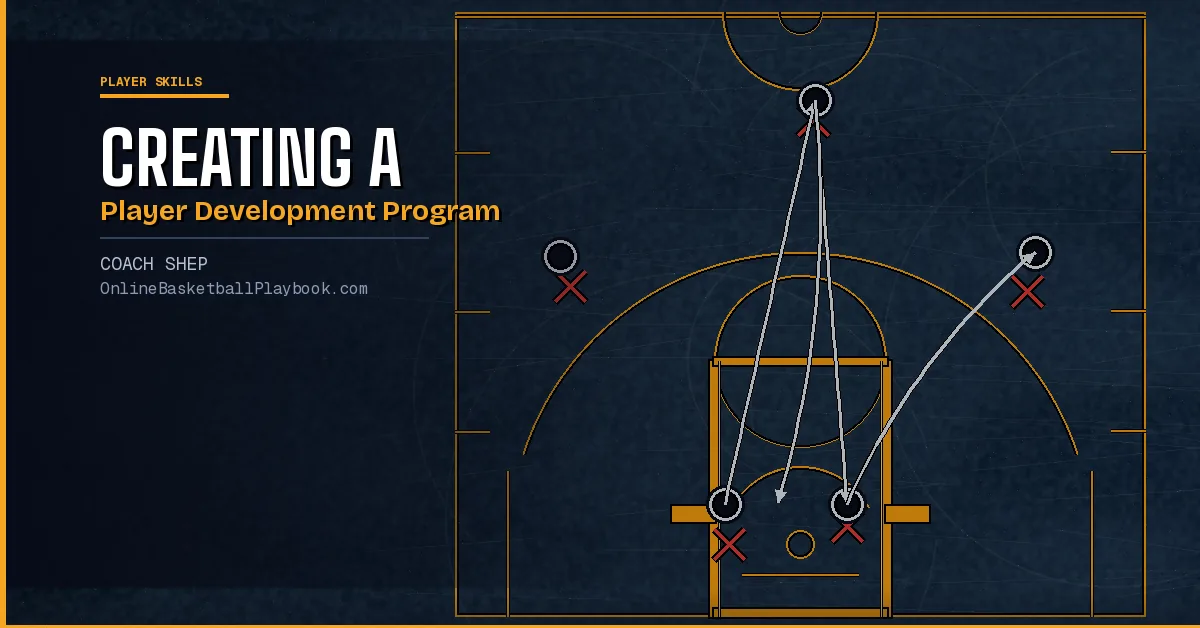
Most players plateau not because they lack talent but because their development program lacks structure. This guide gives you a proven framework (from shooting form to competitive drills to accountability standards) that turns daily reps into measurable growth.
Start With Form, Not Volume
Every elite player development program starts in the same place: form before volume. Coaches who hand a player 200 makes at game speed before fixing their mechanics are locking in bad habits at scale. The right sequence is to build the shot without the ball first, then add a wall, then the rim.
For youth players, this means teaching the "pizza waiter" position (hand under the ball like they're carrying a pizza tray) along with the elbow under the hand, elbow over the shooting knee, and a high follow-through often called the "cookie jar" finish with fingers pointing down at the rim. Jay Wright at Villanova opened every practice with Set Lifts and the Bradley Drill: elbow under, lift and follow through, no rim contact. These are the first two drills every Villanova practice regardless of the player's level. Wright's doctrine was simple: teach form before volume at every level.
John Beilein at Michigan said it this way: "Footwork is more important than any offense you run because the player still has to be able to make a play no matter what the defense does." Both coaches arrived at the same first principle independently. The physical foundation comes first, and shortcuts here cost you two seasons to undo.
The progression looks like this: balanced stance on the catch, ball on the finger pads (not the palm) with a visible gap, elbow in and under, eyes on the target before the ball leaves the hand, and the arm finishing fully extended with the wrist snapped through so the index finger is the last point of contact. Run these in sequence, one stage at a time, and only add game-speed volume once each piece holds up under pressure.
Build a Shooting Culture With a Record Board
The cheapest upgrade in any player development program is a record board: a visible, team-facing scoreboard of shooting benchmarks that players set, break, and sign their own marks on. This single idea converts shooting from a chore into a team culture.
Shaka Smart's Texas program formalized this with named, recorded drills: the 3-Minute drill carried an explicit team record of 157 makes; the Evans drill had a record of 219. The "Beat the Pro" drill put players head-to-head against a fictional elite shooter where your miss was worth two points for the opponent. Every drill had a record. Every record had a name on it. That detail (the name on the board) is what makes players care about the number instead of just finishing the drill.
Named drills worth putting on a record board include the Purdue Drill (make 4 threes in a minute with a rebounder and passer, sprint baseline to half-court between shots. You run for each point you fall short of 4), Around the Horn, Star Shooting, M Drill, Streak, Burner, and Personal Best (also called the 30-30). Each drill should have a posted team record, an individual record column, and a blank line for the next player's signature when they break it.
For a multi-team program, run one record board per team. Keep the benchmarks age-appropriate so younger players are chasing marks they can actually break. The competitive pressure matters more than the absolute number. A 12-year-old who breaks the team record for 12-year-olds feels the same pride as a college player breaking his.
Make Every Rep Competitive
A player development program without a winner is a workout, not development. The principle that runs through every elite shooting program is the same: make every rep competitive against the clock, an opponent, or your own record. "The most dangerous person is the one who is continually improving." That quote captures why scored reps beat aimless reps every time.
Jay Hernandez's competitive shooting framework opens workouts with Quarters (form shots, always one-handed, always starting from short range and progressing outward), then moves to scored movement drills where the player competes against a timer. The rule is that the workout should always have a winner. Someone beats the target, or the player fails to and runs a consequence. Either outcome creates accountability.
Competitive structure does not have to be elaborate. A partner drill where both players track their makes and the loser runs is competitive. A solo drill where you record your score every session and post it on the record board is competitive. The mechanism matters less than the fact that there is a mechanism, a number that gets written down and compared.
Rick Pitino added a contest dimension to practice defense that applies directly here: Louisville shot 22% on challenged shots versus the NBA baseline of roughly 42%. His practice rule was that if a shot would be challenged, the player passes it back and restarts the action. No exceptions. The rule is taught as a number, not a feeling. That is the same mindset applied to offense: measurable, specific, enforced in real time.
Train Game Shots, Game Spots, Game Speed
Kevin Eastman's framework (game shots, game spots, game speed) is the organizing principle for the movement portion of any player development program. Once form is established and competitive structure is in place, the question shifts to whether the shots players are practicing are actually the shots they'll take in games.
The answer for most programs is no. Players stand in one spot and catch-and-shoot far more in practice than they do in games, where virtually every shot comes off movement: a V-cut, a screen, a drive-and-kick, a pull-up after two dribbles. Shaka Smart's Texas drill bank built in a movement rule (you cannot shoot the same spot twice, you must relocate between shots) to force players to generate a shot off their feet rather than standing and catching.
Larry Brown's SMU system went further: every drill built around a realistic offensive action before the shot. Zipper cuts, baseline drives, ball screens, drag screen catches. Players were always responding to a defensive read before pulling the trigger. The principle is that you earn the shot with an action. Standing still and catching is never a game-rep.
The pull-up and the hesitation deserve specific attention here. These shots are what coaches and players who study the game call the "lost arts": a player who can pull up from the wing after one or two dribbles, or hesitate to freeze a closeout before stepping into a three, is as valuable as a pure catch-and-shoot player. Player development programs that only train spot-up shooting leave this entire skill set unaddressed. Add pull-up progressions (catch ready to attack, one dribble pull-up, two-dribble pull-up, hesitation into the mid-range) to every workout plan.
Diagnosing Shooting Errors Like a Pro
Dr. Hal Wissel's diagnostic framework changed how shooting coaches think about correction. The principle is straightforward: when a player misses consistently, work backward through the mechanical cause before prescribing a drill. The root cause is rarely what the player or the coach thinks it is, and repeating a generic cue like "bend your knees" rarely fixes anything.
The framework maps each error pattern to its mechanical cause and then to a specific correction drill. A flat arc, for example, comes from a flat wrist at release and an elbow that does not finish above eye level, not from the player not trying hard enough. The correction drill is to pick a target point on the gym ceiling above the front of the rim and aim the arc there. Players who shoot line drives consistently gain four to six inches of arc immediately using this cue, because it gives them a physical target rather than a feeling.
A wide-right miss almost always comes from the off-hand thumb pushing across the ball at release. The correction is the thumb-lock drill: hold the guide-hand thumb up and away from the ball, then shoot one-handed form shots until the ball tracks straight. Short shots come from a release point that is too low. The correction is the high-extension finish, where the player holds the follow-through with the arm fully extended and fingers pointing down at the rim until the ball lands.
The discipline coaches need to adopt is to run this diagnostic sequence before saying anything to the player: arc angle first, then hand position, then elbow alignment, then balance and foot position. The root cause is typically one specific mechanical breakdown, and once you identify it, the correction drill addresses it directly rather than hoping a generic cue lands.
Before you correct a player's shot, identify the specific error pattern (short, flat, wide, inconsistent release) and match it to its mechanical cause using a diagnostic sequence. A precisely prescribed correction drill outperforms any generic cue repeated across multiple practices. Players improve faster when the correction targets the actual breakdown rather than a symptom.
Free Throws Under Fatigue
Free throws are a skill that transfers from practice to games exactly as well as the conditions under which they are practiced. That means the standard practice of shooting free throws when fresh, as a transition between drills, produces players who shoot well when rested and poorly when tired, which is the opposite of what you need.
The fix is structural: bake free throws into the workout under fatigue. Shoot them at the end of a live 1-on-1 game when players are already winded. Shoot them after a timed sprint or the consequence set at the end of a competitive drill. Shoot them in sets of ten after the second and last turns of the workout. Track the percentages, not just the makes, but the percentage under fatigue over multiple sessions so you can see whether the player is improving.
Pitino's approach at Louisville built free throws into 1-on-1 games. After the live possession was finished, the loser or both players shot free throws while still recovering from the sprint. The percentage was recorded. That data is what the player takes into games, not the fresh-legs percentage from warm-up lines, but the tired-legs number from the end of a hard possession.
John Beilein's qualifying standard gives a related principle: Michigan players ran 17 sideline sprints in one minute before earning practice reps. Practice was a reward for fitness. That same logic applies to free throw standards. If a player cannot make 70% of their free throws at the end of a competitive drill block when tired, they have not earned the right to complain about late-game free throw situations.
Accountability Standards That Stick
The final piece of a player development program is the accountability structure: the explicit, measurable standards that players are held to and that have real consequences when not met. Without this layer, everything else is optional, and players know it.
Jay Wright's standard at Villanova was six makes out of ten shots in 30 seconds in a three-man, two-ball shooting drill. All three players ran if the group failed. John Beilein's standard at Michigan was seven makes out of ten coming off a down screen and flare screen sequence in 30 seconds, with a half-court sprint if the group failed. The screener was exempt. The make rate difference (60% versus 70%) reflects how much program culture shapes the ceiling. Wright's "sloppy drills create bad habits" doctrine says the same thing from the other direction: bad reps are actively harmful, not neutral. Run fewer drills at 100% discipline rather than more drills carelessly.
Tom Billeter's Purdue Drill gives another accountability model: make 4 threes in a minute with a rebounder and passer, sprinting baseline to half-court between shots. The player runs one sprint for each make below 4. The consequence is immediate and proportional, not arbitrary, but directly tied to the standard the player failed to meet.
For a multi-team program, build in team-level and individual-level standards separately. A team that collectively fails a make target runs together. An individual who cannot meet the minimum standard works on it in skill sessions until they do. The standard is not a punishment. It is the definition of what ready means, and getting there is the whole point of the program.
- Form before volume, always: Start every player development block with one-handed form shots progressing from close range outward. Never skip this even with veterans, because form degrades under volume and fatigue.
- Post a record board with named drills: Put three to five competitive shooting drills on a visible board with team records and individual signatures. The names on the board create accountability that coaching alone cannot.
- Earn the shot with an action: Build every movement shooting drill around a realistic offensive read first (a V-cut, screen, drive, or DHO) before the shot, so players are training the actual sequence they use in games, not a stationary catch.
- Shoot free throws tired and tracked: Never shoot free throws fresh and uncounted in a player development session; embed them after competitive drill sets with the percentage recorded so improvement is measurable across weeks.
- Apply the diagnostic before the cue: When a player misses consistently, identify the mechanical cause (arc, hand position, elbow alignment, balance) before prescribing anything. A targeted correction drill beats a repeated generic cue every time.
Want more basketball coaching strategies and drills?
Join the Online Basketball Playbook newsletter →
Draw this play free in the play drawer →
Membership: the full library, playbook packs, and Pro drawing tools →
Keep Building
Related breakdowns
Master Your Game with Our Top Basketball Skill Training Program
Master Your Game with Our Top Basketball Skill Training Program
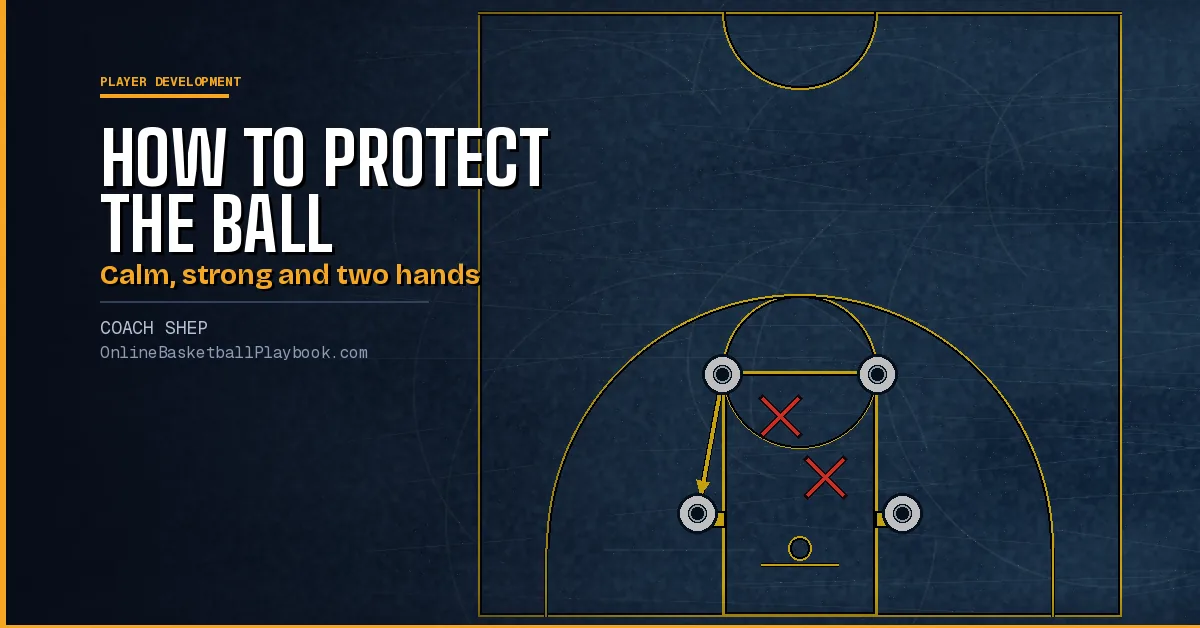
How to Protect the Ball: Ball Security and Fewer Turnovers
How to protect the ball in basketball: where turnovers come from, ripping and catching, the sure pass, beating a trap, ball security drills and pricing turnovers.