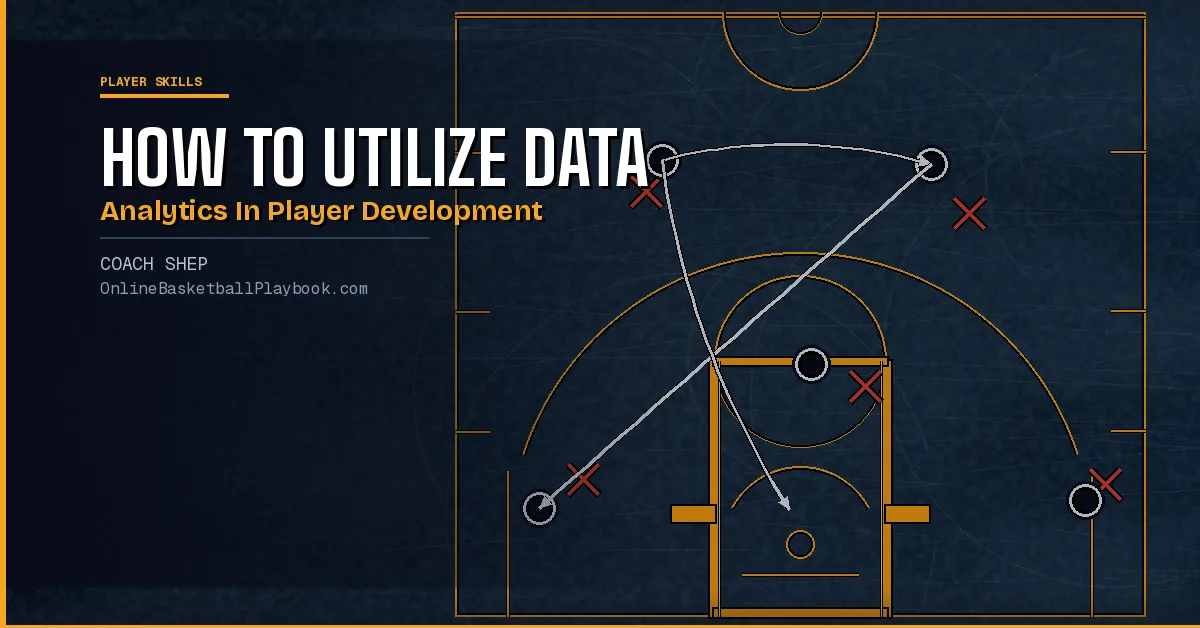
Data analytics has moved from NBA war rooms to high school gyms. Coaches who track the right numbers (shot quality, contested-shot rate, timed make totals) develop players faster than those running the same drills on feel alone.
Why Analytics Belong in Player Development
For decades, player development was almost entirely subjective. A coach watched a player shoot, offered a cue ("bend your knees," "follow through") and hoped the rep would stick. The problem with that approach is not that the cue is wrong. The problem is that without a number attached, neither the coach nor the player knows whether anything actually changed.
Analytics fix that. When you score every rep, time every shooting block, and record the results in a visible place, you transform practice from a collection of drills into a feedback loop. Players see their numbers improve or stagnate. Coaches can trace a missed pattern back to a mechanical cause instead of guessing. And the workout itself becomes competitive, which is how development actually accelerates.
This is not about buying expensive hardware or subscribing to a player-tracking platform. Most of what elite coaches do with data requires nothing more than a stopwatch, a whiteboard, and the discipline to record what happens. The analytics mindset is available to any coach at any level who decides to use it.
The Contested-Shot Rate: Your Most Actionable Metric
Rick Pitino's Louisville teams tracked a statistic that most coaches never think to measure: the percentage of their shots that were challenged by a defender. When his staff pulled the numbers, they found Louisville was shooting 22% on contested attempts, compared to an NBA baseline of roughly 42% on the same category of shot.
That single number told Pitino everything he needed to change. It was not a motivation problem or a talent problem. It was a decision-making problem. His players were taking shots they should not be taking, at a rate that was costing them points every game. So he installed a practice rule: if a shot would be challenged, pass it back and restart the action. No exceptions.
The power of this approach is that it gave players a concrete number rather than a vague instruction. "22%: restart" is teachable. "Make better decisions" is not. When you attach a threshold to a behavior, you give the player something to reason with in real time. They are no longer guessing whether a shot is acceptable. They have a standard.
To apply this at your level, you do not need shot-tracking software. Film two or three games, categorize every field goal attempt as open, lightly contested, or heavily contested, and count the makes. You will almost certainly find that your contested-shot percentage is dragging down your offense. Once you have the number, you can set the rule. Once you set the rule, you can enforce it in practice with the same logic Pitino used: contested shot means the possession continues, not ends.
Karl's "no tough twos" mandate works from the same principle. The specific phrasing is less important than the underlying discipline. You are using a data-derived boundary to modify player behavior in real time, and you are doing it through a practice rule rather than a post-game lecture.
Scored Shooting Sessions: Turning Reps Into Data
The single most efficient upgrade a coach can make to any shooting workout is to attach a score to every drill. Not a vague count, but a target number, a time window, and a consequence for falling short.
This approach runs through virtually every high-level shooting system on record. Shaka Smart's Texas drill bank posts explicit team records next to named drills ("3-Minute: need 100, record 157") so players are not just shooting, they are chasing a number that someone they respect actually reached. The record board creates an external standard that is more motivating than any instruction a coach can give in the moment.
Tom Billeter's Purdue Drill asks players to make four three-pointers in sixty seconds with a rebounder and passer, sprinting baseline to half-court between each shot. For every point below four, the shooter runs. The consequence is attached directly to the make count, which means the data from each drill immediately produces a training response. Miss two makes, run two sprints. The accountability is built into the structure.
Jay Hernandez's competitive shooting philosophy adds another layer: "the most dangerous person is the one who is continually improving." The record board is not just motivating because players want to beat each other. It is motivating because the data shows them their own trajectory. A player who shot 14 makes last Tuesday and 17 this Tuesday does not need a coach to tell them they are improving. The number tells them.
The practical implementation for any coach is straightforward. Pick three to five named drills. Establish a make target and a time limit for each. Post the results every session. Do not skip the posting. The visible record is what converts a shooting drill into a data system. Players who see their numbers on a board behave differently than players who simply finish a set and move on.
Timed Standards and What the Numbers Tell You
Timed shooting standards are one of the clearest examples of analytics applied directly to player development, because they force coaches to define what "good" actually means.
Jay Wright's Villanova program set a concrete standard for screener-cutter shooting: six makes out of ten attempts in thirty seconds, coming off a screen catch. John Beilein's Michigan program used an even more demanding threshold: seven out of ten in thirty seconds, following a down screen plus flare screen sequence. In both programs, failure to hit the standard had a group consequence. The entire group ran if any player fell short.
What these standards do analytically is define acceptable performance at the skill level, not just at the outcome level. Most coaches track game statistics (points per game, shooting percentage), but those numbers reflect the combined result of skill, shot selection, and defensive pressure. A timed shooting standard isolates the skill itself. A player who shoots 38% in games but cannot hit seven out of ten coming off a screen in thirty seconds during practice has a mechanical or footwork gap, not just a shot-selection problem.
Tracking timed standards over weeks also reveals development curves that game statistics obscure. A player might hold steady at 38% in games while moving from four makes to seven makes in the timed drill, which means the skill is developing but the shot selection in games has not yet caught up. That is different information than a static game percentage, and it points to a different coaching response.
For coaches without sophisticated tracking systems, timed standards are entirely achievable with a phone and a whiteboard. Run the same drill at the start of every week, record the make total, and chart the results over a month. You will have a development curve for every player in your program at essentially zero cost.
Using the Error-Correction Diagnostic
Dr. Hal Wissel's diagnostic framework treats every shooting error as a data point that traces back to a mechanical cause. Instead of repeating a generic cue when a player misses consistently, the framework asks coaches to identify the specific error pattern first, then trace it to its root cause, then prescribe the exact correction drill for that cause.
A flat arc is not just "bad mechanics." It traces specifically to a flat wrist at release and an elbow that is not finishing above eye level. The correction is equally specific: have the player pick a point on the gym ceiling above the front of the rim and aim the arc there. Players who make this adjustment gain four to six inches of arc immediately, which is a measurable, observable change on the very next rep.
A wide-right miss does not just mean the player needs to shoot straighter. It traces to the guide-hand thumb pushing across the ball at release. The correction is the thumb-lock drill, shooting one-handed form shots until the ball tracks straight with no side influence from the guide hand.
What makes this analytical is the discipline of working backward from symptom to cause before prescribing a drill. When a coach skips that diagnostic step and jumps straight to a generic cue, they are guessing. When they identify the specific error pattern, match it to the correct mechanical cause, and apply the targeted correction, they are operating from a structured framework that produces faster results and allows them to track whether the correction is working.
The data-tracking application here is to log each player's error patterns over a season. Which players show persistent flat arcs? Which show guide-hand influence? A pattern that reappears across multiple sessions despite correction is a signal that the drill is right but the volume or the specific execution needs adjustment. Without the log, a coach will forget what they tried six weeks ago. With it, they can avoid repeating ineffective interventions.
Building a Data-Driven Shooting Culture
The final piece of a data-driven development system is cultural. Individual metrics and diagnostic frameworks only compound when the entire program values the numbers, records them consistently, and treats them as real feedback rather than extra paperwork.
The record board is the most powerful cultural tool available. When a player's name and personal best are posted on the gym wall next to a named drill, that number does several things at once. It sets a visible standard for every player who walks in behind them. It gives the individual player a specific target to beat, their own previous mark. And it signals that the coaching staff takes the numbers seriously, which tells players to take them seriously as well.
Jay Wright's "sloppy drills create bad habits" doctrine is the flip side of the same principle. If you record every make from a drill run at half-speed with poor footwork, the data is misleading. The number looks fine but the skill is not being trained. A commitment to data integrity in practice means running fewer drills with complete discipline rather than more drills carelessly. The numbers are only useful if the conditions that produced them were real.
Connecting the data loop back to individual players also matters. A coach who reviews timed standards and contested-shot rates in individual meetings is communicating that the numbers are not just administrative. They are the language the program uses to define development. Players who understand their own data are more engaged with their development, more specific in their self-assessment, and more likely to work on the right things when training on their own.
Start small. Pick one metric: make percentage in a timed drill, contested-shot rate from film, or free throw percentage under fatigue. Track it consistently for four weeks. Share the numbers with your players. Build from there. The infrastructure for a data-driven development culture does not require technology. It requires the discipline to measure the same things, in the same way, every week, and to take the results seriously enough to let them change how you coach.
You do not need shot-tracking technology to apply analytics in player development. A stopwatch, a whiteboard for recording make totals, and two or three named drills run the same way every week give you more useful development data than most coaches ever collect. Consistency in measurement is what creates insight, not the sophistication of the tools.
- Post a record board with 3–4 named drills: include the drill name, the target make count, the time window, and the current record holder, visible to every player every session.
- Track contested-shot rate from film: categorize every field goal attempt as open, lightly contested, or heavily contested across two or three games, then count makes by category to find your threshold.
- Run the same timed shooting standard weekly: same drill, same time limit, same make target. Log the results so you can chart each player's development curve over a month or a season.
- Use the error-correction diagnostic before prescribing a drill: identify the specific error pattern (flat arc, wide miss, side spin), match it to the mechanical cause, and apply the targeted correction. Don't repeat a generic cue that hasn't worked.
- Shoot free throws under fatigue at the end of live drills: track makes and misses separately from fresh free throws. Game free throws happen when players are exhausted, so that's when the data is most predictive.
Want more basketball coaching strategies and drills?
Join the Online Basketball Playbook newsletter →
Draw this play free in the play drawer →
Membership: the full library, playbook packs, and Pro drawing tools →
Keep Building
Related breakdowns
How to Protect the Ball: Ball Security and Fewer Turnovers
How to protect the ball in basketball: where turnovers come from, ripping and catching, the sure pass, beating a trap, ball security drills and pricing turnovers.
Hook Shot Basketball: How to Do It and How to Teach It
Hook shot basketball for post players and coaches: the classic hook, sky hook and jump hook, the footwork steps, when to use it, the pivot foot rules and drills.
Youth Basketball Dribbling Drills: Cone Drills and Games by Age
Youth basketball dribbling drills for kids: finger-pad work, eyes-up games, cone dribbling drills, line drills and harder drills by age.