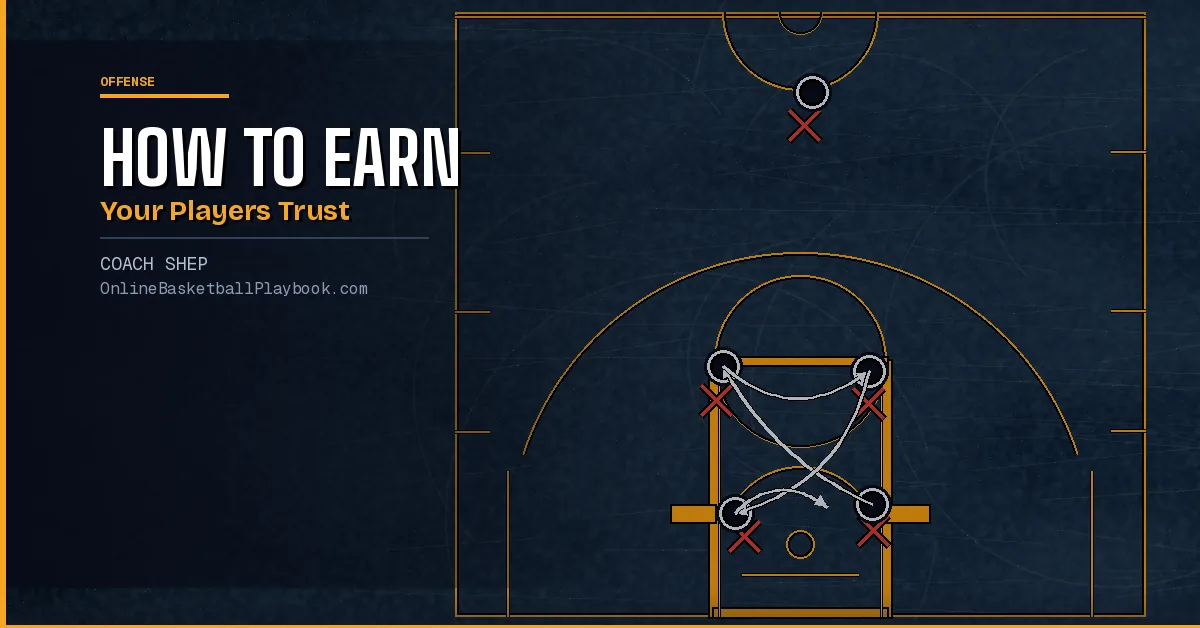
Players don't trust a title. They trust what they see you do every single day: how you treat them when practice is grinding, when they're struggling, and when the stakes are highest.
Trust Is Built Daily, Not Declared
Every coach wants their players to trust them. Almost none of them sit down and think about what trust actually requires from the coach. Not the players.
Trust is not a speech at the start of the season. It is not a motivational poster in the locker room. It is not a team bonding trip or a "we're a family" speech before tip-off. Trust is the accumulation of how you behave when things are hard, when players are frustrated, and when your decisions are not popular.
Tom Crean breaks it down simply: players expect four things from their coaches: competence, sincerity, reliability, and trustworthiness. Not inspiration. Not fire-and-brimstone. Four concrete things that a player observes over weeks and months before deciding whether the coach has earned their belief.
Competence means you know what you're doing and you can teach it. Sincerity means you mean what you say and you do it the way you say it. Reliability means you show up the same way every day, and the player can count on what you'll be. And trustworthiness is the sum of the other three, compounded over time.
The coaches who lose their players mid-season almost always fail on reliability. They're intense in September and checked out by January. They demand effort but skip film. They say "we hold everyone to the same standard" and then give the starting point guard a free pass. Players notice every single inconsistency. And they file it away.
If you want your players to trust you, you have to earn it the same way they earn a spot in the rotation, by showing up with the right behavior long enough that it becomes the expectation.
Say Something to Every Player, Every Day
Hubie Brown coached at the highest levels of professional basketball for decades. One of his core operational rules was deceptively simple: say something to every kid, every day. Look them in the eye. Make them feel seen.
After a win, he personally congratulated every player. Not the starters. Every player.
This is not soft. This is strategy. A player who feels invisible on your roster (who goes three practices in a row without the head coach acknowledging them) quietly disengages. They stop competing for their spot. They stop buying in. And when you need them in a game, they are mentally and emotionally gone.
The daily acknowledgment does not have to be long. It does not have to be lavish praise. It can be a comment about their effort in a drill, a question about how their body feels, a note about something you noticed on film. What matters is that the player registers that the coach sees them as an individual, not just as a body filling a practice roster slot.
At the high school and club level, this matters even more than at the pro level. A 15-year-old playing for your program is still figuring out who they are. When a coach they respect takes thirty seconds to personally acknowledge their work, it lands differently than any motivational speech ever could. It tells them: this coach is watching me, this coach cares about me, this coach thinks I matter to what we're building.
That belief (that I matter here) is the foundation of trust. You cannot shortcut it. You build it thirty seconds at a time, practice by practice, season by season.
Be Consistent With Your Standards
Ke Sampson's coaching philosophy rests on a single idea that most coaches say they believe but far fewer actually execute: non-negotiables are only non-negotiable if you enforce them the same way every day for every player.
His two standards, attitude and effort, are not aspirational slogans. They are evaluated with the same bar in game one as in game thirty. And critically, they apply to the best player on the roster the same way they apply to the last player off the bench.
This is where coaches lose their players. When the team watches a star player dog it in practice without consequence, every other player in the gym makes a mental note. The coach said the standard. The coach broke the standard. The coach cannot be fully trusted.
Steve Alford built his program on the same principle: be fair in all situations, no matter if it is your best or worst player. He went further. You cannot treat any game bigger than any other. The emotional investment you bring to a rivalry game should match what you bring to a road game against a struggling opponent. Players are watching your consistency against external pressure too, not just internal roster decisions.
Bill Parcells held his best players to the highest standard, publicly. The reason was not to be hard on stars. It was because the entire team is watching how stars are held. When the locker room sees that no one gets a pass, the standard becomes real. And the standard becoming real is what makes the culture real.
Pick your non-negotiables before the season starts. Write them down. Communicate them clearly. And then enforce them identically every time, regardless of who is involved. Your players will trust you not because you demand the standard, but because you never look the other way from it.
Take the Blame Publicly After a Loss
Bob Thomason coached college basketball for decades and built a reputation for one specific post-game habit that most coaches never develop: after a loss, he told his players it was his fault, not theirs.
Not as a deflection. Not as a trick. He meant it and he said it in front of the whole team.
This does two things simultaneously. First, it models the kind of accountability he expects from players without ever having to deliver a speech about accountability. Second, it builds trust faster than almost anything else a coach can do, because the players know most coaches do the opposite. Most coaches walk into the locker room after a tough loss and start finding the play that broke down, the rotation mistake, the defensive breakdown, and attach a player's name to it.
When you take responsibility, players stop being defensive. They stop bracing for blame. And in that space, they become more honest with themselves about their own performance, because the coach just modeled what honesty looks like when it's uncomfortable.
Pitino's concept of the One Day Contract runs parallel here. The idea is that EGO (he defines it as Edging Greatness Out) is the primary thing that prevents coaches from doing the hard, humble work that actually builds programs. Cynicism, moodiness, and defensiveness are ego behaviors. Taking blame publicly is the opposite of ego. It is what coaches who have nothing to prove do naturally, and it is what coaches who are still performing for the wrong audience never quite manage.
The next time your team loses a game you prepared them for, try walking in and leading with what you would have done differently. Watch what happens to the room.
Declare Roles Early and Revisit Them in practice
Mike Dunlap's coaching framework identifies one specific source of culture failure that rarely gets discussed: ambiguity about player roles is corrosive. Not toxic players. Not losing streaks. Role ambiguity.
When a player does not know what the coaching staff expects of them specifically (what they're on the floor to do, what decisions are theirs to make, what the ceiling of their role looks like this season), they spend mental and emotional energy managing that uncertainty instead of competing. They read into every substitution pattern. They second-guess every possession. They assume the worst.
Declaring roles explicitly, early, and individually is a trust-building act. It signals that the coach has thought about each player specifically, that this is not a generic system being applied uniformly, but a structure that accounts for who they actually are and what they actually do well.
John Tauer takes this further with his "raise your hand if you're a role player" exercise on the first day of practice. The room goes quiet. It immediately confronts the ego that every player carries into preseason and forces a real conversation about what this team will look like and what it requires from each individual.
Revisiting roles in practice when performance shifts is equally important. If a player earned more responsibility and the coaching staff is slow to acknowledge it, the player loses faith that the staff is paying attention. If a player is struggling and the coaching staff continues to run the same assignments without adjustment or conversation, the player feels unseen. Either way, the relationship erodes.
The solution is simple but requires discipline: have individual role conversations before the season, and revisit them in practice at natural inflection points (after a losing streak, after a breakout performance, after a roster change). Those conversations, done consistently, communicate that the coach sees the player and is actively managing their development rather than just plugging them into a predetermined slot.
Build the Relationship Through Service
Dan Hurley's coaching philosophy makes a distinction that separates great coaches from good ones: the coach gets after people in practice, but on game night, the job is to support the players. The relationship is built through relentless service (to their skill development, to their personal development, to their success as individuals) so that when the coach is demanding, the player knows the demand comes from investment, not from ego or frustration.
Coaches call it servant leadership. If you want to lead, the saying goes, you first need to be a servant. This is not about being soft. It is about the sequence. You earn the right to demand by first demonstrating that you are working for the player, not the other way around.
Obradovic's onboarding process at the professional level makes this concrete: during the first weeks of preseason, the coaching staff is available around the clock to help new players with logistics (apartments, schools, transportation, family needs). Before they have spent a single minute on basketball-specific skill development with those players, they have shown that this program takes care of its people as human beings first. That investment pays back every time a tough coaching moment comes and the player has to decide whether they trust the standard being set.
At the youth and high school level, this principle applies directly. The players who trust their coaches most are almost always the ones whose coaches showed up for them outside the gym. The coach who attended a player's school event. The coach who called to check in during a family difficulty. The coach who remembered a detail the player shared once and referenced it three weeks later. Small acts of genuine investment compound into deep loyalty over a long season.
A three-question relational test cuts to the heart of it: Can I trust you? Are you committed? Do you care about me? When a player can answer yes to all three, they will run through walls for the coaching staff. When they cannot answer yes to all three, nothing on the whiteboard will move them. Scheme cannot substitute for relationship. Role declaration cannot substitute for genuine care. The players know which coaches are performing care versus the ones who actually mean it, and they make their decisions accordingly.
At the start of your next practice week, pick one player you have not personally spoken to in more than two days. Find a specific, genuine observation (something from film, from their effort in a drill, from their body language in a team huddle) and deliver it directly before practice starts. Do this for a different player every day for two weeks and track what changes in how your roster responds to your coaching.
- Say something specific and genuine to every player every day, not generic praise, but something you actually observed. Players cannot trust a coach they feel invisible to.
- Enforce your non-negotiable standards identically for your best player and your last player off the bench. The team is watching how you hold your stars. Inconsistency there breaks the entire culture.
- After a tough loss, lead with what you would have done differently as the coach before identifying player errors. Modeling accountability builds more of it than any speech about accountability will.
- Declare each player's role explicitly and in a one-on-one conversation before the season begins. Then revisit it in practice when their performance or situation meaningfully changes.
- Invest in players as people outside the gym: attend their events, ask about their lives, remember details they shared. The relationship that earns loyalty is built before the hard coaching moments arrive, not during them.
Want more basketball coaching strategies, drills, and tools?
Join the Online Basketball Playbook newsletter →
Draw this play free in the play drawer →
Membership: the full library, playbook packs, and Pro drawing tools →
Keep Building
Related breakdowns
Cutting Players: What to Say and How to Say It
Cutting players: what to say on day one, in the meeting and to parents, the words to use and avoid, what to hand the player, and how to keep the door open.
Coaching Communication: How to Explain Basketball to Players
Coaching communication for basketball: the teaching order, fewer and clearer words, how to correct a mistake, one team vocabulary and calls taught inside the drill.
Teaching Players to Adapt to Different Playing Styles
Teaching Players to Adapt to Different Playing Styles