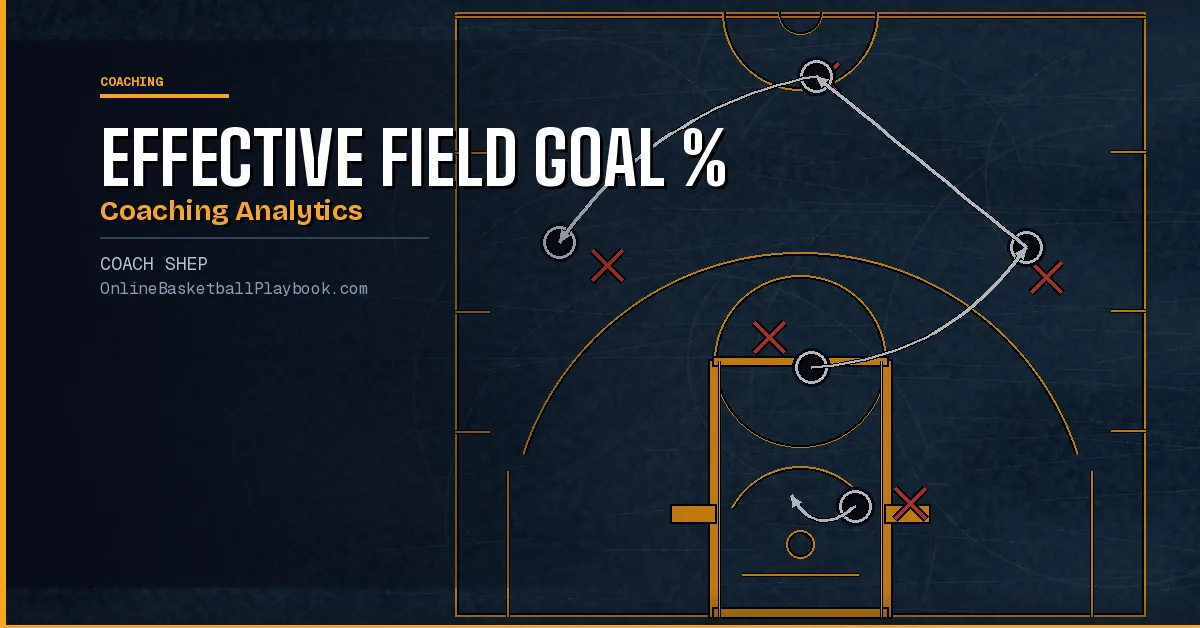
Effective field goal percentage (eFG%) adjusts for the fact that a made three-pointer is worth 50% more than a two. It is the single most useful shooting efficiency metric for coaches who want to measure shooting efficiency accurately.
What Is Effective Field Goal Percentage?
Effective field goal percentage is a shooting efficiency statistic that accounts for the extra value of a made three-point field goal. The formula adds half the value of each three-pointer made to the total field goals made, then divides by total field goal attempts. The result is a single number that tells you how efficiently a player or team converts their shot attempts into points on a per-possession basis.
Traditional field goal percentage treats every made basket equally. A corner three and a mid-range two count exactly the same. That distorts reality. A player who shoots 45% from three is actually producing more value per attempt than a player who shoots 50% on two-point jumpers. eFG% corrects for that by weighting threes appropriately.
The statistic was popularized in the early analytics movement in professional basketball but has become standard vocabulary at every level, from elite prep programs down to youth coaching. If you are evaluating shooters, designing offense, or scouting opponents, eFG% is the number to reach for first.
For coaches who have built their evaluation around box-score field goal percentage, eFG% is not a replacement so much as an upgrade. It answers the same basic question (how well is this player or team shooting?), but it answers it more accurately because it reflects how basketball is actually scored.
eFG% vs. Standard FG%: Why It Matters
Consider two guards on your roster. Guard A shoots 47% from the field, a solid mark by any traditional standard. Guard B shoots 42% from the field, which looks noticeably worse. But Guard A takes all his shots from inside the arc, while Guard B shoots primarily from three-point range. When you apply eFG%, the picture flips: Guard B's eFG% is 63%, while Guard A's is still 47%.
That gap has real consequences. Over the course of a season, Guard B is generating far more points per shot than Guard A, even though his traditional FG% is lower. Coaches who rely only on standard field goal percentage may undervalue their best offensive weapon or misidentify which players deserve more possessions.
This is not an abstract concern. Shot selection is one of the most consequential decisions a basketball team makes, and eFG% is the clearest window into whether that selection is working. Teams that generate high-eFG% shots (corner threes, layups, dunks, free throws) are more efficient than teams that settle for long twos, even if their raw FG% looks similar.
At the team level, the difference between a 50% eFG% offense and a 54% eFG% offense is enormous across a full season. Research consistently shows eFG% is one of the strongest predictors of winning percentage in both professional and college basketball. Coaches who understand this metric can make better decisions about which sets to run, which players to feature in creation roles, and which shot types to train relentlessly.
How to Calculate eFG%
The formula is straightforward:
eFG% = (FGM + 0.5 × 3PM) ÷ FGA
Where FGM is total field goals made, 3PM is three-pointers made, and FGA is total field goal attempts. The 0.5 multiplier on three-pointers made captures the additional half-point of value that each made three represents relative to a two-pointer.
Walk through an example. A player takes 10 shots in a game. He makes 4 of them. Two of his makes are three-pointers. His standard FG% is 40%. His eFG% is (4 + 0.5 × 2) ÷ 10 = 5 ÷ 10 = 50%. That 10-point gap between his raw FG% and his eFG% is entirely explained by his three-point shooting, which was genuinely valuable even though it did not show up in traditional counting stats.
At the team level, you run the same formula using team totals. Most modern statistics platforms (including Synergy, HoopMath, and Krossover) calculate eFG% automatically, but understanding the formula helps you catch errors, explain the metric to players and parents, and build your own tracking sheets for practice.
You can also calculate eFG% by shot zone if your video platform provides zone data. Knowing that a player shoots 61% eFG% from the corner but 48% eFG% from the wing tells you exactly where to design actions to get him the ball. That zone-level breakdown is where eFG% becomes a coaching tool rather than just a report card.
eFG% Benchmarks by Level and Shot Type
Understanding what a good eFG% looks like requires context. The number shifts meaningfully by level, by role, and by shot type, and coaches who apply professional benchmarks to high school players will set impossible standards.
At the NBA level, league-average eFG% has climbed steadily as teams have shifted toward threes and layups. In recent seasons, league-average eFG% has hovered between 53% and 55%. Elite offensive teams routinely post 57% or higher. An individual player shooting 55%+ eFG% on a reasonable volume of attempts is a significant offensive weapon.
At the college level, high-major teams typically range from 49% to 54% eFG% in effective offenses. Below 48% is a warning sign that the offense is leaning too heavily on long twos or generating poor looks. The same thresholds apply at the high school level, though variance is higher because shot-making quality is less consistent.
By shot type, benchmarks vary widely. A layup or dunk should produce eFG% in the 60–75% range; if your team's paint efficiency is below that, finishing development needs attention. Mid-range jumpers from 15–18 feet typically land in the 40–46% range, efficient only for elite mid-range specialists. Three-pointers from the corner are the highest-value non-paint shot in basketball, with typical eFG% of 55–62% at all levels, since corner threes count the same as any other three but are physically shorter shots. Above-the-break threes range from 48% to 56% eFG% for capable shooters.
Understanding these benchmarks helps coaches make concrete shot-selection decisions. If your corner three eFG% is 58% and your mid-range eFG% is 41%, the math tells you clearly which shot type to prioritize in your offensive system. That is not opinion. It is arithmetic applied to your own data.
How Coaches Use eFG% to Build Better Offenses
eFG% becomes most powerful when coaches use it to make proactive offensive design decisions rather than just post-game analysis. The metric tells you which shot types to prioritize, which players to put in creation roles, and which sets are generating value versus wasting possessions.
Start with shot-type hierarchy. Every offense should have a clear priority list for shot types ranked by expected eFG%. Layups and dunks first. Corner threes second. Above-the-break threes for proven shooters third. Free throws fourth. Mid-range jumpers and floaters as a safety valve, not a primary option. When your offensive sets consistently generate shots at the top of that hierarchy, your eFG% will reflect it.
Next, use eFG% to evaluate sets and plays over a sample of games. If your horns action generates 58% eFG% and your side pick-and-roll generates 49% eFG%, you have a real reason to run horns more. This kind of set-by-set analysis used to require expensive software, but today many schools have access to video platforms that make it accessible to any coaching staff willing to build the habit.
Player deployment is another application. When you know each player's eFG% by zone, you can design actions specifically to get those players shots in their best zones. A player who shoots 61% eFG% in the corner but 44% from the wing should receive almost all of his catch-and-shoot attempts in the corner. That sounds obvious, but without zone-level eFG% data, coaches often run actions that put shooters in their weaker zones out of habit or familiarity.
Opponent scouting works the same way in reverse. When you know an opposing shooter's eFG% by zone, you know exactly where you cannot afford to give him open looks. If an opponent shoots 64% eFG% from the right corner but 46% from the left wing, your defensive scheme should account for that asymmetry. Close out toward the right corner, accept the left-wing attempt.
- Run eFG% on your whole roster by shot zone at the midpoint of the season. It reveals mismatches between how you're using players and where they actually score
- Set a team eFG% floor (e.g., 52%) as a season-long goal and review it weekly against your game log
- Track eFG% by set play over 20+ possessions before drawing conclusions. Small samples mislead
- In practice, design competitive shooting drills from your team's highest-eFG% zones, not from convenient spots on the floor
- Use opponent eFG% by zone in your scouting report to assign defensive responsibility. Send help toward high-eFG% zones first
- When a player's eFG% drops more than 5 points from practice to games, investigate whether they're getting shots in their best zones or settling for a different look under pressure
eFG% and Player Development
eFG% has a direct role in guiding individual player development. When players understand their own eFG% by zone, they have a concrete, data-driven picture of where they are a genuine offensive weapon and where they are hurting the team by forcing shots.
This transparency is motivating when used correctly. A player who learns his corner three eFG% is 58% (genuinely elite) now has a reason to sprint to the corner on every kick-out possession. A player who learns his above-the-break pull-up eFG% is 38% has data that makes the coaching point ("stop forcing that shot") impossible to dismiss as preference. The number is the argument.
Development planning flows naturally from eFG% data. If a guard's eFG% in the paint is 47% (below what even a modest finishing rate should produce), you know exactly what to work on. Paint finishing drills, contact-finishing repetitions, and left-hand development should be daily priorities until that number moves. If a wing's above-the-break three eFG% is 43%, you can either build a practice plan to improve his mechanics and shot quality from that zone, or adjust his role to feature him more in the corners where his eFG% is already viable.
For younger players and developing shooters, eFG% is especially useful as a long-term tracking tool. A player whose eFG% improves from 44% to 50% over two seasons has made a genuine, measurable offensive leap even if his usage numbers stayed flat and his points per game barely changed. That improvement represents real development, and it shows up in eFG% before it shows up in box scores.
The discipline of recording and measuring is itself part of development. Players who track their own eFG% in workouts (know their shooting record, set personal bests, compete against a standard) develop a relationship with measurement that carries into games. The principle holds: build a shooting culture where players set, break, and own their own marks, and eFG% gives you the scoreboard to make that culture real.
Limitations and What eFG% Misses
eFG% is a powerful metric, but it is not complete. Understanding its limitations is part of using it well rather than over-relying on it.
The most significant omission is free throws. eFG% measures only field goal efficiency. A player who draws fouls at a high rate and converts them at 80% is generating enormous value that eFG% does not capture. True shooting percentage (TS%) fills this gap by incorporating free throw attempts into the efficiency calculation. For a complete picture of a player's offensive value, TS% is often more informative than eFG%, though eFG% is simpler to explain and calculate from game film.
Second, eFG% does not account for shot quality or difficulty. A catch-and-shoot corner three off a perfectly run action and a heavily contested pull-up three both count equally in the formula. Two players with identical eFG% numbers may be achieving them under very different levels of defensive pressure. Shot quality metrics and contested versus open shot breakdowns provide that context, but they require video tagging that not all programs have access to.
Third, eFG% says nothing about shot creation, playmaking, or offensive rebounding, all of which contribute to a team's scoring efficiency. A player with a modest eFG% who creates open threes for teammates through his driving threat may be more valuable offensively than a player with a higher eFG% who only catches and shoots. Offensive rating and points per possession at the team level capture the full picture; eFG% is one important input, not the entire answer.
Finally, sample size matters. eFG% from fewer than 50 attempts is noisy data. A player who goes 4-for-7 from three in the first two games of the season has an eFG% over 85%, meaningless as a predictor. Use eFG% as a scouting and evaluation tool over meaningful samples, not as a game-to-game snapshot.
None of these limitations reduce eFG%'s value. They clarify where it belongs in your analytical toolkit: as the primary shooting efficiency metric, used alongside free throw data, shot quality context, and team-level possession efficiency to build a complete offensive evaluation system.
Want more coaching tools, efficiency breakdowns, and offensive system breakdowns delivered to your inbox?
Join the Online Basketball Playbook newsletter →
Draw this play free in the play drawer →
Membership: the full library, playbook packs, and Pro drawing tools →
Keep Building
Related breakdowns
Basketball Positions: What Each of the 5 Positions Does
The point guard, shooting guard, small forward, power forward and center, what each one does on offense and defense, and when to ignore the numbers.
Basketball Game Clock Rules: When It Stops and When It Starts
Basketball game clock rules by level: when the clock stops, when it starts on a throw-in or a missed free throw, made baskets late and the last-two-minute rules.

FIBA vs NFHS Rules for Coaches Who Play Internationally
FIBA vs NFHS rules for coaches: goaltending and the ball on the ring, timeouts, travel and the gather, the clock, the throw-in, plus Olympic rules vs the NBA.