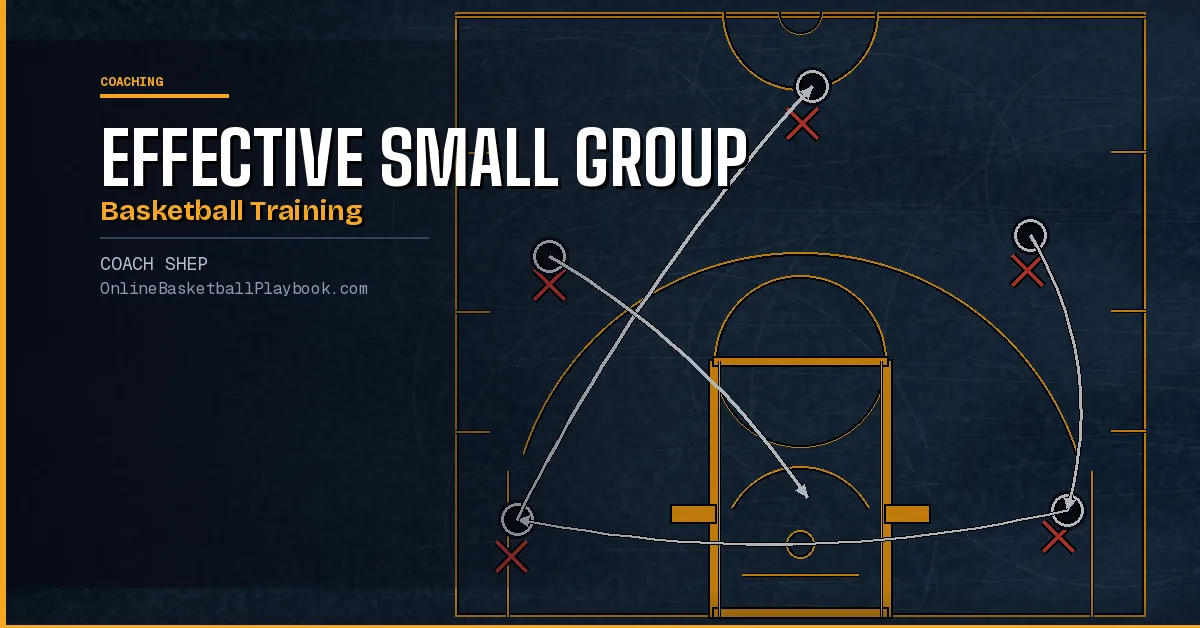
Small group training is the fastest way to build real basketball skills. Fewer players mean more reps, more coaching cues, and more decisions. Everything a guard needs to develop faster than the team setting allows.
Why Small Groups Work for Skill Development
The math is simple. Put twelve players in a full-team practice and any individual guard might touch the ball thirty times. Put three guards in a small group session and that same player might get three hundred purposeful reps in the same hour. Volume matters, but the quality of those reps matters more.
Small group training creates a feedback loop that full-team settings can't replicate. A coach can watch one player's inside heel on a pull-up, catch the error, give the cue, and watch it corrected on the very next rep. That loop (mistake, cue, correction, rep) is nearly impossible when you're managing a twelve-player drill with three lines and a manager running the clock.
There's a second advantage that most coaches undervalue: decision density. In small group work, players face real defensive reads on almost every possession. A 3-on-3 constraint game forces more decisions per minute than any individual drill, and the decisions are live. A defender is actually there, actually reacting. Players who train in small groups build the habit of reading situations, not just executing moves.
The research and coaching science behind guard development consistently point to three ingredients that small groups deliver: high rep volume, immediate corrective feedback, and progressive defensive pressure. A well-designed small group session sequences all three inside a single workout: from open skill work, to passive-defender reads, to live competitive reps. That progression turns isolated skill into game-applicable ability.
How to Structure a Small Group Session
A well-run small group session has a clear arc. It doesn't wander from drill to drill hoping something sticks. The structure flows from simpler to more complex, from no defender to live defender, and from skill work to conditioned skill work.
Start with ball handling. No defense, no pressure. Just reps that train the hands and free the mind. This is not warm-up; this is the foundation that makes everything else possible. Guards who dribble too much in games do so because they haven't dribbled enough in practice. The goal is to make the ball an extension of the body so the eyes can stay up and read the floor.
Move into individual skill work with a passive defender. A coach or teammate provides token resistance, enough to simulate contact and force the guard to make a decision, but not enough to turn the rep into a scramble. This is where named moves get installed. The guard runs the hesitation, the body fake, or the rip-through while the "defender" does just enough to make the read real.
Finish with live competitive reps. This is where skill gets stress-tested. Constraint games (drills with specific scoring rules that reward the skill you're training) work better than open 1-on-1 here because they keep the decision the same for multiple possessions in a row. Guards face repetitions of the same read without the coach having to stop and reset the scenario.
Keep sessions between 45 and 75 minutes. Beyond that, the quality of reps drops and fatigue erodes technique rather than building conditioning into it. End every session with game-speed shooting, at least one station of catch-and-shoot or pull-up shooting on tired legs, so the reps mirror actual game conditions rather than the perfectly-rested form shooting that doesn't transfer.
Ball Handling: The Foundation That Frees the Mind
The goal of ball handling training is counterintuitive: the more you dribble in practice, the less you dribble in the game. Guards who are uncomfortable with the ball use dribbles as a security blanket. They bounce it to think, they dribble when they should catch and shoot, they put the ball on the floor when a pass would be faster. Genuine handle removes that crutch and replaces it with decisive play.
Two-ball work is the most efficient way to build handle fast. Stationary two-ball drills (dribbling both balls together, then alternating, then crossing over, then behind the back) force each hand to work independently. When a guard can keep two balls going without looking down, one ball becomes easy. Run these drills with eyes up, chin level, reading an imaginary screen or defender on the opposite wall.
From stationary, move to non-stationary two-ball work. The guard dribbles to half court, changing moves on jump stops without letting either ball die. The jump stop trains the habit of gathering under control, which is exactly what a pull-up jumper demands. Guards who skip this work tend to carry momentum into their shots and either travel or launch off-balance.
One-on-three full-court ball handling is an advanced drill that belongs in any serious small group session. The ball handler beats three defenders in succession, each covering a third of the floor. The drill installs composure under pressure. Guards learn that a defender in front doesn't mean panic, it means apply a move and accelerate through. It also teaches the change-of-angle dribble: stopping, faking, going backward to reopen the lane, then attacking again.
The pull-back crossover deserves special attention. Most programs teach guards to attack forward and stop there. The pull-back is the escape valve, the hesitation's second option when the pull-up isn't there. A guard who knows the pull-back is never truly trapped on the ball handler, because they can always reset and reload. Teach it explicitly, name it, and give it rep volume alongside the forward attack moves.
Footwork and Finishing Under Pressure
Every guard move runs on footwork. The hesitation, the body fake, the rip-through, the pull-up. Strip away the handles and the reads and what's left is footwork. Small group sessions are the right environment to teach it because a coach can crouch down, watch the feet, and give a cue in real time without stopping a twelve-player practice.
The inside-heel pivot is the single most transferable footwork mechanic in guard development. Whether a guard is catching off a V-cut, coming off a screen, or pulling up off the dribble, the action is the same: the inside heel drives into the floor at the moment of catch or last dribble to brake lateral momentum and square up to the basket. This one mechanic corrects the most common guard shooting errors (drifting, falling away, landing out of the shooting pocket) without a lengthy explanation. The cue is short: "last dribble down, inside heel down, same instant."
Balance is the organizing skill beneath all of it. Every move starts in balance and returns to it. Challenge balance deliberately (step-off moves, separation dribbles, 90-degree and 180-degree spin moves) so that when a guard is off-balance in a game, recovery is automatic rather than a scramble. The floater off the wrong foot and the fade-away pull-up are natural only when the guard has trained balance as a skill, not a side effect.
Finishing at the rim requires a separate battery. Reverse layups using the rim as a protector, the one-step floater, the run-around hook, and the surprise finish off the wrong foot all need their own reps. These aren't flashy additions. They're answers to specific defensive problems guards face in games: a help defender in the paint, a shot-blocker at the rim, a closeout that turns a pull-up into a drive. Teach the finish, name the problem it solves, then put a passive defender there to force the read.
The V-cut is the off-ball counterpart to the live-ball jab series. Many coaches treat it as a single jab step, but it's a minimum three-step sequence. The extra steps are what sell the false direction and make the cut open. Guards who run a real V-cut get open; guards who take one jab and drift get denied. In small group work, run V-cut reps with a defender present and insist on the full footwork sequence before the pass is caught.
Shooting on Tired Legs: Building Real Percentages
Practice shooting percentages are inflated numbers. A guard who shoots 70% in a drill after standing in a line for forty-five seconds bears no resemblance to the same guard late in the fourth quarter after running a pick-and-roll, a transition sprint, and a closeout rotation. The percentage that matters is the one on tired legs, and that's the one most programs never actually train.
Build conditioning into the skill work rather than separating them. An all-game-shots circuit (seven to ten stations, each built around a real action) closes with five-spot shooting after the guard has already run through catch-and-shoot off a handoff, a side pick-and-roll into the lane, and an elbow pull-up. The shooting happens at the end of real exertion, not after a passive wait in line. That's the rep that transfers to games.
The "make 11" format turns each station into a team accountability tool. The group doesn't move until someone makes eleven consecutive shots or a set number from a spot. The target is achievable enough to reach, demanding enough to require focus, and shared enough to build pressure tolerance. When a guard has made nine and misses, the team waits. That's exactly the pressure of a late-game free throw or a must-make pull-up. Train it.
Shooting off screens deserves its own station with footwork emphasis. Coming off a down screen, the inside heel pivots immediately on catch, same mechanic as the pull-up, applied to a catch-and-shoot. Coming off a flare, the guard is mostly facing the basket already, so minimal pivot is needed. The key is consistency: regardless of how you come off the screen, the inside heel fires if you expect to shoot. Run each screen type in small groups with a passer, a screener, and a defender providing token pressure on the catch.
The Named-Move Library: Teaching Guards to Self-Correct
Naming moves after players who execute them at the highest level does three things simultaneously. It credits the player whose film your guards should be studying. It gives the coach a one-word cue during a drill instead of a two-sentence correction. And it assigns each guard a self-directed learning task: go find Nash's hesitation, watch it, understand why it works, then bring it to practice.
The Nash hesitation is the anchor move for any guard skill library. Knee up, read, pull-up or pull-back pump-fake, the "shake and bake." The pull-back is the part most programs never teach explicitly. It's the hesitation's escape valve when the pull-up isn't there, and guards who don't know it by name tend to panic and put the ball on the floor instead. Teach both options, name both options, rep both options.
The Bodiroga body fake is the most underused guard move in high school basketball because it isn't flashy. Shoulders fake, ball stays in front, hands switch. That's it. The ball never goes wide, which preserves the live dribble and the shot fake simultaneously. It's the correct answer to a defender cheating on the crossover, and it exists in every great isolation scorer's toolkit. Put it in your small group curriculum in the first week of pre-season and rep it until it's automatic.
Tony Parker's never-expose rule applies to every screen read: if the defender goes under the screen, stop right behind it and shoot. Don't keep moving. The screen is the shot. Guards who run past a free pull-up behind a screen have trained the wrong read, and the fix isn't a tactical conversation. It's a named rule ("Parker rule, stop and shoot") applied on every rep until the guard stops second-guessing.
The Al-cut (a body-positioning seal cut where the guard makes contact with the defender, seals, catches, and rips through) rounds out a practical four-move library for any small group curriculum. Introduce one move per week of pre-season. Post a player clip on the team film account for that week's move. Guards who have a named library make self-corrections without a coach present, which is ultimately the goal of any skill development program.
Introduce one named move per week during pre-season small group sessions. Post a short player clip (Nash, Parker, Bodiroga, Ginobili) to the team film account for that week's move. Guards who can watch the move on film, name it, and practice it develop the habit of self-coaching, which accelerates improvement far beyond what in-session reps alone can produce.
Constraint Games That Install Decision-Making
The individual skill battery (ball handling, footwork, shooting, named moves) installs the vocabulary. Constraint games make guards fluent. The difference is pressure. A guard who can run a Nash hesitation in an open drill but can't use it against a live defender hasn't actually acquired the skill for games. The constraint game bridges that gap.
The Get Open Drill teaches the foundational off-screen read in live 2v2. If the defender goes over the top of the screen, the cutter fades to the corner. If the defender goes under, the cutter curls. Run this drill before teaching the move names and the read locks in faster than any chalk-talk session, because the guard discovers the answer by doing rather than by listening. The constraint (a defender who chooses a coverage) forces the read every single possession.
The Combination Screen Drill chains four screen types in one possession before going live 3v3: pindown, UCLA cut, back screen, ball screen in sequence. Guards encounter all four coverages in a single drill; defenders practice all four responses. The design creates efficiency: one drill, four reps of game-relevant decision-making, with the competitive pressure of live defense on every read.
No-Paint and constraint scoring games instruct shot diet without stopping play. Scoring one point for two feet in the paint and two points for reaching the charge circle teaches guards when to drive and when to kick out, without a lecture, without a stoppage, without a coach pointing at a whiteboard. The scoring system is the instruction. Guards learn shot selection the same way they learn everything else that sticks: by doing it under pressure, with consequences, in a competitive environment.
The half-court with second-defender progression is the most practical structure for small groups finishing a session. Run the individual drill (hesitation, rip-through, pull-up) with no defender first, then add a live closeout defender on the catch. The two-stage format installs the skill in the first stage and pressure-tests it in the second, inside the same session. Guards leave having not just practiced the move but competed with it.
- Start every small group session with two-ball stationary work, eyes up (alternate, crossover, behind the back) before adding movement or defenders to the drill sequence.
- Use the "make 11" format for shooting stations so players finish on tired legs and under the team pressure of a shared make target, not a comfortable personal rep count.
- Teach the inside-heel pull-up mechanic explicitly: last dribble down and inside heel down at the same moment, drill it as footwork first, then add the shot.
- Run each named move with a passive defender before going live so guards face a real stimulus but can execute the technique without scrambling to defend first.
- Build every session from open skill to passive-defender reads to live constraint games. The arc from competence to pressure should happen within one session, not across multiple weeks.
- Introduce one named move per week (Nash hesitation, Bodiroga body fake, Parker never-expose rule, Al-cut) and post a player clip to film so guards study the move outside of practice.
Want more basketball coaching strategies, drills, and tools?
Join the Online Basketball Playbook newsletter →
Draw this play free in the play drawer →
Membership: the full library, playbook packs, and Pro drawing tools →
Keep Building
Related breakdowns
Master Your Game with Our Top Basketball Skill Training Program
Master Your Game with Our Top Basketball Skill Training Program
Basketball Player Development: Workouts and Skill Progressions
Basketball player development runs on a plan, game speed and a make count. Learn the skill progression, scoring, error fixes, drills and how to program a season.
A Free Sample Basketball Training Workout
A Free Sample Basketball Training Workout