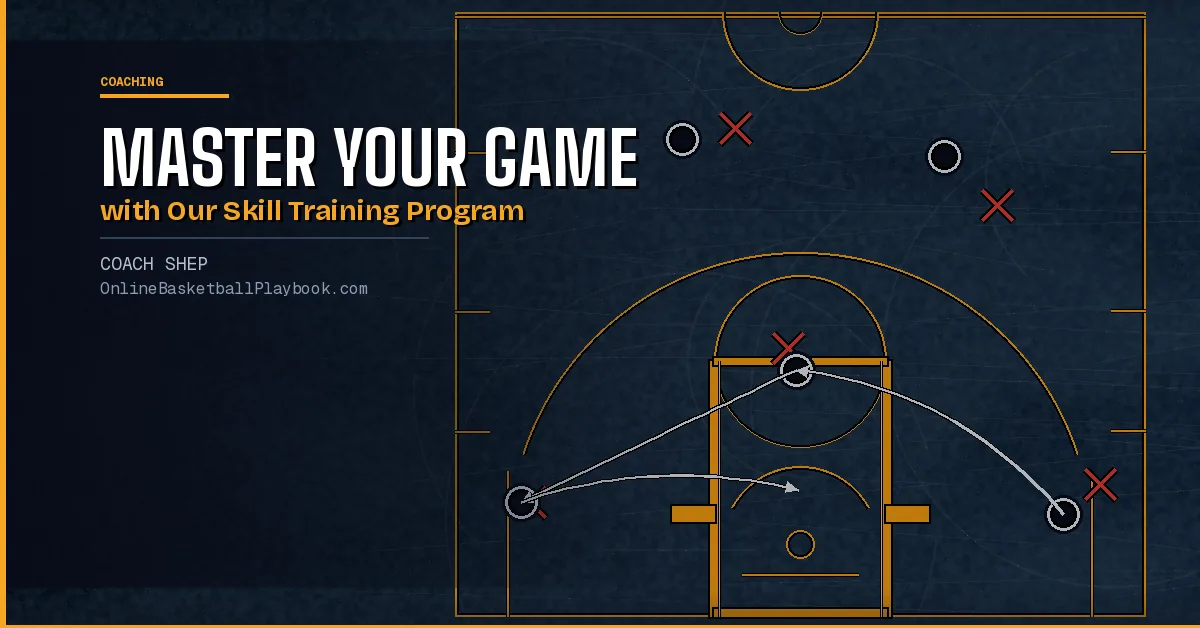
The best guard skill training programs share one thing: they build real skills under real pressure, using game-speed reps, named moves, and a balance foundation that holds up when defenders close out hard.
Balance as the Foundation of Every Guard Move
Every rep in a serious guard skill training program starts and returns to one thing: perfect balance, eyes up, with the same distance between the feet on recovery. This sounds simple. Most programs skip right past it and wonder why their guards look smooth in drills and sloppy in games.
One guard routine, built around the Steve Nash–era workout system, makes balance the organizing principle of the entire battery. The logic is tight: if a guard can only shoot or finish from a comfortable, pre-set position, they're easy to read. Defenders take away the comfort spot, and the skill disappears. But if every rep challenges the feet (step-offs, separation moves, 90-degree spins, 180-degree spins, even 360-degree recovery turns), then the "crazy" game shots, the floaters and fades and contested pull-ups, become natural. They've already been trained.
The coaching cue that ties it together: "Life is about balance." That's not inspirational filler. It's a technical reminder that every move, every catch, every step into a shot must return to a stable base. Guards who internalize this stop drifting on pull-ups, stop falling away on catch-and-shoot reps, and stop losing their footing when a defender bumps them on the drive.
In practice, this means the warm-up isn't a warm-up. It's skill installation. Before touching a ball at speed, guards work through balance challenges: jump stops with foot-width checks, step-out drills that force recovery, and catch-and-square repetitions where the goal is the position reached, not the make scored. Build the base right and the rest of the battery clicks into place faster.
The Named-Move Library: Why Naming Moves Accelerates Learning
One of the most underrated tools in guard skill development is a named-move library. The deepest contribution of this approach is not the drills themselves but the habit of naming every move after a player who made it famous. Nash's hesitation. Parker's never-expose. Jordan's cross-step. Bodiroga's body fake.
The name does three jobs simultaneously. First, it credits the player, building a culture where guards understand they're learning from a lineage of great players, not just running through drills. Second, it gives the guard a film-study assignment. Every named move becomes a prompt to go watch film on the player it's attached to, which is self-directed learning at no extra cost to the coach. Third, it gives the coach a one-word cue instead of a two-sentence description during live reps. "Nash hesitation" replaces "remember the knee-up move where you read the defender and either pull up or pull back." One word. Same information.
Here's how the core named moves break down:
The Nash hesitation is knee up, read the defender, then choose: pull-up jumper or a pull-back dribble-pump-fake (the "shake and bake" escape valve). Most programs teach the first option. The pull-back is what makes the move genuinely two-sided and hard to guard.
The Bodiroga body fake: Also credited to Petrović and Ginóbili keeps the ball in front while the shoulders fake and the hands switch. Crucially, the ball never goes wide. This preserves the live dribble and the shot fake at the same time. It's underused at the high school level because it isn't flashy, but it's extremely hard to guard when executed correctly.
The Tony Parker never-expose is a screen read, not a ball-handling move: if the defender goes under the screen, stop right behind it and shoot. The screen is the shot. Guards who keep running past a free pull-up are self-teaching the wrong decision. Parker's name makes the read memorable and gives coaches an instant correction during film: "What's the Parker rule? You had a free pull-up."
The practical install: introduce one named move per week during pre-season workouts, and post a player clip on the team film account for that week's move. Guards who have a named library make self-corrections without a coach present, which is the mark of a program that's actually developing players rather than just drilling them.
Guard Footwork Fundamentals That Coaches Overlook
Footwork is where guard skill training either earns or loses its value. You can have the right move library and the right drill design, and still produce guards who look good in a cone drill and fall apart against a real closeout. The missing piece is almost always the footwork mechanics layer (the precise pivot-foot rules and first-step details that make every move legal, efficient, and repeatable).
The inside-heel pivot is the most important single mechanic for perimeter players. At the moment of catch on the wing, most guards do one of two things: they take a dribble immediately (killing their options) or they catch and square up with vague footwork that leaves their pivot foot in a poor position for the move they want. The correct mechanic is specific: front pivot off the inside heel, where the inside foot is the foot closest to the basket at the moment of catch. The heel drives into the floor to brake the momentum of the cut, and the free foot swings to square the shoulders to the basket.
This same inside-heel pivot applies off every screen type. Coming off a down screen with your back to the basket? Front pivot off the inside heel as the pass is caught, scraping off the screener's high shoulder to position the pivot foot correctly. Coming off a flare screen already facing the basket? Slight front pivot off the inside heel, short swing of the free foot. Coming off a ball screen and pulling up? Inside foot is the pivot, outside foot swings around. The consistency of this mechanic across all catch scenarios is what makes it worth drilling explicitly. The cue works everywhere.
The pull-up jumper footwork is worth its own focused attention. The last dribble before the shot should be the lowest and hardest dribble in the sequence, because that dribble generates the upward energy for the jump. The inside heel drives into the floor at the exact instant that last dribble contacts the floor. This stops the lateral drift that plagues most pull-up shooters and allows the free foot to swing around and square up as the ball comes into the shooting pocket. A guard who executes this correctly lands in roughly the same spot they jumped from (no drift, no fall-away).
The V-cut is another area where most players and coaches operate on a misconception. A V-cut is a minimum three-step sequence, not a single jab step. The steps sell the defender on a false direction before the actual cut happens. Guards who treat a V-cut as a single-jab move are broadcasting their real direction immediately, which is why they struggle to get open off the ball even when their coach calls their number.
Training at Game Speed: The All-Game-Shots Circuit
Skill training that doesn't account for conditioning produces players who look good in practice and fade in the fourth quarter. The all-game-shots circuit is the structural fix for this problem. The design principle: build conditioning into skill work so the reps are always taken on tired legs, which is when games are actually decided.
The "make 11" circuit, drawn from one guard battery, sequences 9 to 10 stations built around real game actions: elbow catch-and-shoot off the dribble, handoffs, side pick-and-roll into the lane, and finishes at the rim. The target at each station is a team "make 11", not an individual quota, but a collective one. This structure does two things: it turns skill work into a conditioning drill without adding a separate running segment, and it builds team accountability into individual skill reps. A guard who loafs through a pull-up at station four is costing the team at station six.
The Florida guard development arc, drawn from Donovan's system, adds a full-court structure to this thinking. The sprint-and-catches sequence starts players behind half court, has them push the ball, execute a dribble move at a coach stationed on the wing, and finish with a one-push layup or pull-up. The next player goes as soon as the previous player shoots. Continuous reps, game-tempo spacing, no standing around waiting. This simulates the transition catch-and-attack moment that decides games far more often than half-court execution.
The pullup-change station (a hesitation or inside-out move followed by a pull-up three) is where the skill library and the conditioning circuit meet. Run this on tired legs, with "all players have a basketball" for simultaneous reps, and you're getting meaningful volume without sacrificing game-realistic fatigue. The 5-spot shooting finisher on tired legs rounds out the circuit: real percentage, not fresh percentage. That's the only number that transfers to games.
Run your all-game-shots circuit in the final 15 minutes of practice, not the first 15. Guards need to be fatigued when they shoot their last 20 reps. The percentage they shoot tired is the only percentage that tells you anything true about where they are as shooters. Fresh shooting numbers flatter everyone; tired shooting numbers expose who actually has the skill installed.
Teaching Reads, Not Just Moves
The hardest transition in guard development is moving from a player who executes drills to a player who makes decisions. Most skill training programs get guards sharp on the moves and then hand them back to a scrimmage and hope the transfer happens. It usually doesn't, not automatically, and not fast. The fix is to train reads directly, inside the same workout that trains the moves.
The skeleton offense model is how this works: a passive-defender workout that isolates the decision without introducing full defensive pressure. Guards practice specific reads (come to a stop and create contact against a passive defender, go-under versus go-over off a screen, the hesitation off the show) in a controlled setting where the coach can stop the rep, name the read, and replay it immediately. The repetition builds a decision library alongside the move library.
Two reads deserve focused installation in any guard development program. The first is "come to a stop and create contact." Most guards are trained, explicitly or implicitly, to avoid contact on the drive. They pull up early, release the ball before making real contact with the defender. This produces floaters that are off-balance and drives that stall against any physical defense. Teaching guards to lean on the defender, to seek the contact and initiate it rather than avoid it, shifts the balance of the drive-and-finish equation. The contact doesn't end the possession; used correctly, it ends the defender's leverage.
The second read is the hesitation off the show. When a big defender steps out to hedge on a ball screen, most guards react by pulling up immediately or dribbling backward. The correct read is more patient: reverse away from the hedge, then hesitate as the big recovers back toward the paint. That hesitation, a beat, a knee up, a shoulder fake, catches the recovering big mid-step and creates a clean lane to the rim or a live pull-up. Tony Parker built a Hall of Fame career on this one read. Your guards can learn it in six weeks if you drill it deliberately.
Constraint games add the final layer: competitive scoring systems that coach decisions without coaching words. The No Paint drill scores one point for two feet in the paint and two points for penetrating to the charge circle. The scoring structure itself teaches guards when to attack and when to kick, without a lecture or a stoppage. The Paint Game scores closeout-and-gap skill with no shots taken. Run these games at the end of skill sessions and you'll see the decisions from the skeleton offense work show up under pressure almost immediately.
The Pressure Progression: From Solo Work to Live Defenders
Florida's guard development system contributes one structural principle that most programs miss: every drill should have a pressure progression built in. The model is not "teach the skill Monday, add a defender Thursday." The progression lives inside a single session. You train the form, then immediately pressure-test it in the same workout.
The two-stage structure is clean. In the first stage, guards run the full sequence (full-court shooting arc, sprint-and-catches, rip-thrus, pullup-change) without a defender. The goal is clean execution: correct footwork, correct ball-handling move, correct finish decision. In the second stage, a live closeout defender is added at the catch point. The guard now executes the same sequence, but must read the closeout and make a decision: shoot over it, drive past it, or pull back and reset. The skill installed in stage one is immediately pressure-tested in stage two, in the same session, while the mechanics are still fresh.
The rip-through drill deserves specific attention because it covers ground most programs ignore. Guards catch on the wing with a passive or active defender, rip the ball through the defender's reach to create a driving angle, and attack. This trains ball security under catch pressure (the moment when most turnovers actually happen) and installs a clear driving path through contact. It's the one guard technique that tends to be underrepresented in most individual skill batteries, which means most guards arrive at the high school level without a reliable rip-through and pick up bad habits (wide carries, ball-exposure on the dribble initiation) instead.
The 2-ball battery from the Billeter and Augustana system is the handling complement to the pressure progression: stationary 2-ball work (together, alternate, shoulder, crossover, push-pull), then non-stationary 2-ball to half court changing moves on jump stops without stopping the dribble, then 2-ball versus a defender using only the pull-back to work side-to-side. The 1-on-3 full-court ball-handling drill (where one handler beats three defenders in succession, each covering a third of the floor) is the pressure peak of the entire handling battery. It's a staple at elite programs for a reason: nothing else builds handle confidence under sustained pressure quite like it.
- Balance check every rep: before adding speed or a defender to any drill, confirm guards can recover to feet-shoulder-width, eyes up, after every move. This is the quality gate, not the make percentage.
- Install one named move per week: introduce the move, name the player, post a clip, and drill it daily for seven days. Guards who have a named move library self-correct without a coach present, which compounds over a full season.
- Inside-heel pivot as a universal cue: teach guards to fire the inside heel at the moment of catch (or at the moment the last dribble lands for pull-ups). This single mechanic applies to wing catches, screen reads, and pull-up footwork and removes confusion about which foot is the pivot.
- Circuit ends on tired legs: run the all-game-shots "make 11" circuit and the 5-spot shooting finish at the end of practice, not the beginning. Tired shooting percentage is the only number that transfers to late-game situations.
- Two reads to install first: prioritize "come to a stop and create contact on the drive" and "hesitate off the show as the big recovers". Both are underdrilled at most levels and both produce scoring opportunities that straightforward drives and pull-ups cannot generate.
- Pressure progression within sessions: don't wait until Thursday to add a defender. Run the drill clean, then add a live closeout in the same session. Guards who see the pressure progression in real time install the skill and the decision together, not separately.
The guard skill training system described here isn't a collection of clever drills. It's a framework: balance first, named moves as a vocabulary, footwork as a universal mechanic, game-speed conditioning, reads trained alongside moves, and pressure built into every session progression. Programs that put all six elements together produce guards who play well in practice and play the same way when the game is on the line. That transfer is the whole point.
Start with the balance check. Add one named move this week. Build the inside-heel pivot into every catch-and-shoot rep. Run the circuit tired. The skills compound. The decisions sharpen. The guard who looked capable in practice starts making the right play in the fourth quarter, not because the coach yelled louder, but because the training design made it inevitable.
Want more basketball coaching strategies, drills, and tools?
Join the Online Basketball Playbook newsletter →
Draw this play free in the play drawer →
Membership: the full library, playbook packs, and Pro drawing tools →
Keep Building
Related breakdowns
Effective Small Group Basketball Training for Skill Improvement
Effective Small Group Basketball Training for Skill Improvement
Basketball Player Development: Workouts and Skill Progressions
Basketball player development runs on a plan, game speed and a make count. Learn the skill progression, scoring, error fixes, drills and how to program a season.
Master Your Game: The Ultimate Basketball Workout Home Regimen
Master Your Game: The Ultimate Basketball Workout Home Regimen