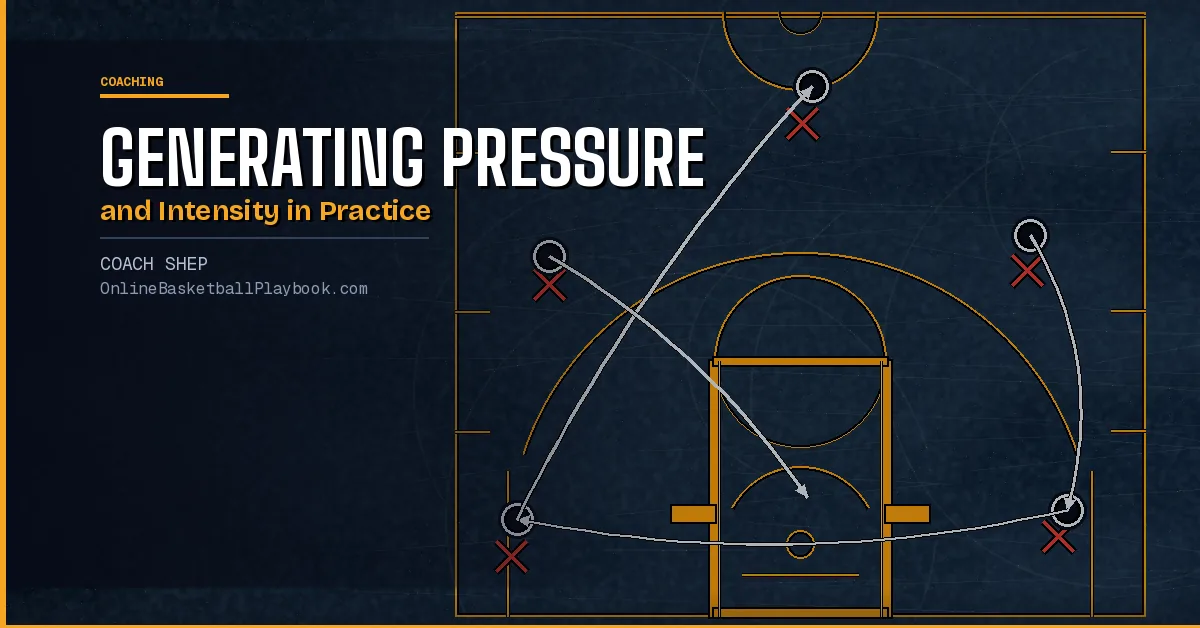
Practice without stakes is just exercise. The coaches who consistently produce tough, competitive teams build pressure into every drill through scoring, consequences, and relentless pace that mirrors game conditions.
Score Every Drill, Every Rep
The single fastest way to generate intensity in practice is to put points on the board. When there is nothing at stake, players coast. When there is a winner and a loser determined by a visible score, players compete. This is not theory. It is the foundational structure that coaches like Nate Oats at Alabama have built their entire practice model around.
The scoring system Oats uses is straightforward and worth copying directly: +3 for a made three-pointer, +2 for a made two, +1 for a putback, and −2 for a turnover. Turnovers are charted separately, not just counted. The losing team runs. That combination (a real score, public turnover tracking, and a physical consequence for losing) turns every drill rep into a mini-game that players care about.
The consequence piece matters just as much as the score itself. When nothing bad happens to the losing team, the score becomes decoration. When the losers run, every player on the floor fights harder to avoid being on the wrong side of the scoreboard at the whistle. You do not need a complicated scoring system. You need a visible score, a clear winner, and a real consequence. Set those three things up and intensity follows.
Beyond turnovers, scoring also captures the blue-collar plays that practices often ignore: offensive rebounds, charges taken, deflections, and assists. Oats's full performance rating system adds +2 for an offensive board, +1 for a defensive board, +3 for an assist that leads to a score, +1 for a steal, +3 for drawing a charge, and −2 for a foul. That rubric rewards the habits that win close games, not just the flashy ones.
The validation rule ties it together: every competitive drill needs a winner and a loser, every time. If a drill can end without a declared outcome, players learn that outcomes are optional. "Validate every drill" means running it until someone wins, and enforcing the consequence without exception.
Reps Over Survival: Attack Practice to Get Better
One of the most important mindset shifts a coaching staff can install is the difference between enduring practice and attacking practice. The language matters. When a player shows up mentally prepared to survive the next two hours, his body and mind are both in a defensive posture (protecting, conserving, waiting for it to end). That player is not getting better. He is just getting through.
The "reps-over-survival" principle, drawn from Oats's Alabama practices and traced back to Kobe Bryant's training philosophy, is direct: the only way you improve is through reps. Sitting out, conserving energy, or mentally checking out during a drill is not rest. It is a withdrawal from the development account. "We can't develop the attitude that we're going to endure practice. That's a dangerous place."
What does attacking practice actually look like on the floor? It means players sprint from one drill to the next without being told. It means injured players who cannot participate physically still coach their team, track the score, and hold teammates accountable because engagement is the requirement, not running. It means the energy a player brings to a half-court drill is the same energy he brings in transition, because the coach holds that standard from the first minute to the last.
This mindset extends to pushing past exhaustion. The Kobe-sourced principle is blunt: "If you don't struggle in practice you never get better. You can't get in shape if every time you start to get tired you quit. You'll stop at that point every time." Practice is where the ceiling gets raised, but only when players consistently push through the point where quitting becomes tempting. The coaching staff's job is to make sure players never get the option to quietly stop at that threshold.
The practical implementation: hold the same energy standard across every segment. "Energy must be the same in the half court as in transition." When the intensity visibly drops in a half-court drill, call it out immediately and restart the segment. Do not let soft reps accumulate. One soft rep gives the next player permission to take a soft rep.
Hard Time Caps and the Energy Leak Problem
The biggest killer of practice intensity is not poor drill selection. It is energy leak between reps: the slow shuffling between stations, the casual listening while a coach over-explains, the thirty-second gap between one group finishing and the next group starting. Bob Knight identified this precisely and built his entire practice structure around eliminating it.
Knight's rules are worth adopting almost verbatim. Individual drills get exactly five minutes. Team drills get exactly ten. When the time is up, the drill ends (not when it feels done, not after one more rep). Kids lose focus and attitude in long drills, and a mediocre rep at minute twelve undoes three sharp reps at minute two. Put the clock where players can see it. When the buzzer sounds, the drill ends and the team sprints to the next one.
The sprint-to-the-next-drill rule is not cosmetic. Players should be in position and ready to go before the coach finishes explaining the next drill. That standard (arrive early, start immediately) keeps the heart rate elevated between reps and signals to the team that dead time has no place in practice. It also builds the habit of urgency that shows up in games when a team needs to get set quickly after a timeout or a dead ball.
The assistant coach role in this system is equally specific. Assistants cannot stop practice to correct an individual. Instead, they pull one player, correct him on the sideline until the error is fixed, then put him back into the drill. The main group never stops. This keeps the pace continuous and prevents the most common practice-killer: one mistake freezing the entire team while a coach lectures.
Assigning a manager to track missed layups and poor passes as a concentration audit adds one more layer of accountability. Those are not skill errors. They are attention errors. Posting that number on the board at the end of practice tells the team where their focus went, which is more useful feedback than a vague "we were sloppy today."
Competitive Structures That Create Real Pressure
Scoring drills and running losers creates baseline competition. But the most pressure-tested teams practice inside structures that are deliberately designed to replicate specific game stress, not just competitive drills, but competitive situations with the exact texture of what players will face on game night.
The "5-on-5 Restrictions" concept does exactly this. Rather than running open scrimmage and hoping the defense plays hard, you script the defense: one possession they play with extreme pressure, the next they sag completely, then they switch everything, then they trap on the first dribble, then they run and jump, then they zone. The offense faces every look it will see in a real game, in practice, before the first game is played. Nothing is new on game night because nothing was left unaddressed in practice.
The end-of-practice situation drill is another pressure-generation tool that most programs underuse. Martelli's "35 Index Cards" approach captures it well: write one end-game situation on an index card every practice day (seven seconds left, down two, need a stop, thirty seconds left, tied, opponent's ball) and run it with the clock running and consequences attached. Over a thirty-five day stretch, your team has rehearsed thirty-five distinct game situations. The "Big Stop" game rehearsal (from Dunlap and Thomason) adds the rule that the winning team must get one more stop to close it. So even victory has a cost that must be earned.
Del Harris's possession-game designs offer a compact competitive structure for mid-practice use. The ODO Game (Offense/Defense/Offense, three-point sequence, two-to-one or three-to-zero to win, one point per sequence) gives a team a fully competitive game in under ten minutes with zero setup. The nine-possession game sequences nine specific game situations back to back: man press, zone press, three-quarter press, sideline out of bounds man, sideline out of bounds zone, baseline length man, baseline length zone, need-play man, need-play zone. Run all nine and you have covered more game scenarios in a single segment than most teams cover in a week of open scrimmage.
Small-sided games with constraints add another pressure layer by concentrating the skill being trained. A 3-on-3 game where all passes must go through the middle lane before going to the wing, or a rebounding game where three consecutive outlet passes are required before the rotation happens. These rules force the specific behavior you are trying to build without turning the session into a static drill. The coach's job during these games is to stop the action precisely at the teachable moment, not randomly, and not because a timer hit but because the situation on the floor just taught the exact lesson the drill was designed to deliver.
Practice Pace as Conditioning
The conventional approach to conditioning is to run sprints after practice ends. The better approach is to structure practice so conditioning happens inside every drill. When the pace is high enough and the transitions are tight enough, players arrive at game night already conditioned, not because you ran them, but because you practiced at game speed consistently enough that game speed feels normal.
The "half full" adjustment solves the numbers problem. When a team is short on players due to injury or availability, the instinct is to cut a drill or run it at reduced intensity. The better option is to run "half full": players sprint both ways, reset quickly, and keep the intensity up even with fewer bodies. The drill changes shape, but the energy standard does not drop. This also prevents the culture shift that happens when players notice practice gets softer on low-attendance days.
Pace is also a standard, not just a tempo. Nate Oats insists that energy in the half court must match energy in transition. When that gap opens up (when players play hard in the open floor but go through the motions in half-court sets), it means the competitive structure of practice is not reaching the half-court segments. The fix is to apply the same score-everything principle to half-court drills that you apply to full-court work. A half-court defensive drill with a score attached and a loser consequence generates the same energy a full-court drill does, because the stakes are the same.
The coach who builds conditioning into practice pace rather than tacking it on at the end also earns something else: players who associate hard work with basketball, not with punishment. Sprints after a bad practice teach players that conditioning is what happens when they mess up. Practicing at high pace every day teaches them that conditioning is the standard, and that the standard belongs to them.
Stat the Scrimmage and Run Restrictions
Open scrimmage without a scoring system has the same ceiling as open gym. Players default to comfortable habits, avoid risk, and protect their individual standing. A scrimmage with a live scoring rubric and a visible board is a different environment entirely.
A performance rating system scores live play across every possession: +2/−2 for made/missed twos, +3/−3 for made/missed threes, +1/−2 for free throws, +2 for an offensive board, +1 for a defensive board, +3 for an assist-to-score, −2 for a turnover, +1 for a steal, +3 for drawing a charge, −2 for a foul. This rubric rewards ball security, defense, and blue-collar plays at a level that makes them matter more than scoring, which is exactly the behavior most programs are trying to build.
Pitino's daily plus-minus system runs the same idea in possession terms: a manager records a plus for every possession gained (stop, turnover forced, defensive rebound, charge) and a minus for every possession lost (turnover, offensive rebound allowed, foul). At the end of practice, the possession differential is the score. It is the clearest possible statement about what the game is actually about.
Statting the scrimmage also surfaces what informal observation misses. A team can feel like it played hard and still have given up eight offensive boards and turned it over eleven times. The number does not lie, and it does not argue. Posting it after practice and reviewing it before the next session closes the feedback loop that most scrimmages leave open.
Start with one change before overhauling your entire practice structure: add a visible score and a loser consequence to one drill you already run every day. Track it for two weeks and notice how the energy in that drill shifts compared to your unscored drills. Once you see the difference, you will want to score everything.
- Post a score on the board for every competitive drill: use a simple rubric (+2 make, −2 turnover, +1 board) and keep a manager or assistant tracking it in real time so players know the score at all times.
- Make losers run every time, without exception. The moment a consequence becomes optional, the score becomes decoration and intensity drops back to baseline.
- Set a visible countdown timer: five minutes for individual drills, ten minutes for team drills, and rotate when it hits zero whether the drill feels finished or not.
- Run 5-on-5 Restrictions instead of open scrimmage: script the defense through every look the offense will see in games (pressure, sag, switch, trap, zone, run-and-jump) so nothing is new on game night.
- Go "half full" when numbers are short so players sprint both ways and reset quickly, keeping the pace and energy standard intact even with fewer bodies on the floor.
- Use a Performance Rating System to stat every live scrimmage: track boards, turnovers, charges, and assists alongside scoring so players see that winning the possession battle is what the score reflects.
- End practice on a drill players enjoy, not a punishment, so they leave wanting to come back and attack tomorrow at the same level.
Want more basketball coaching strategies, drills, and tools?
Join the Online Basketball Playbook newsletter →
Draw this play free in the play drawer →
Membership: the full library, playbook packs, and Pro drawing tools →
Keep Building
Related breakdowns
Fun Basketball Games for Practice: Scored Games for Any Team
Fun basketball games for practice at any level: shooting games, defense-only scoring, rebounding contests and passing games, with scoring rules and records.
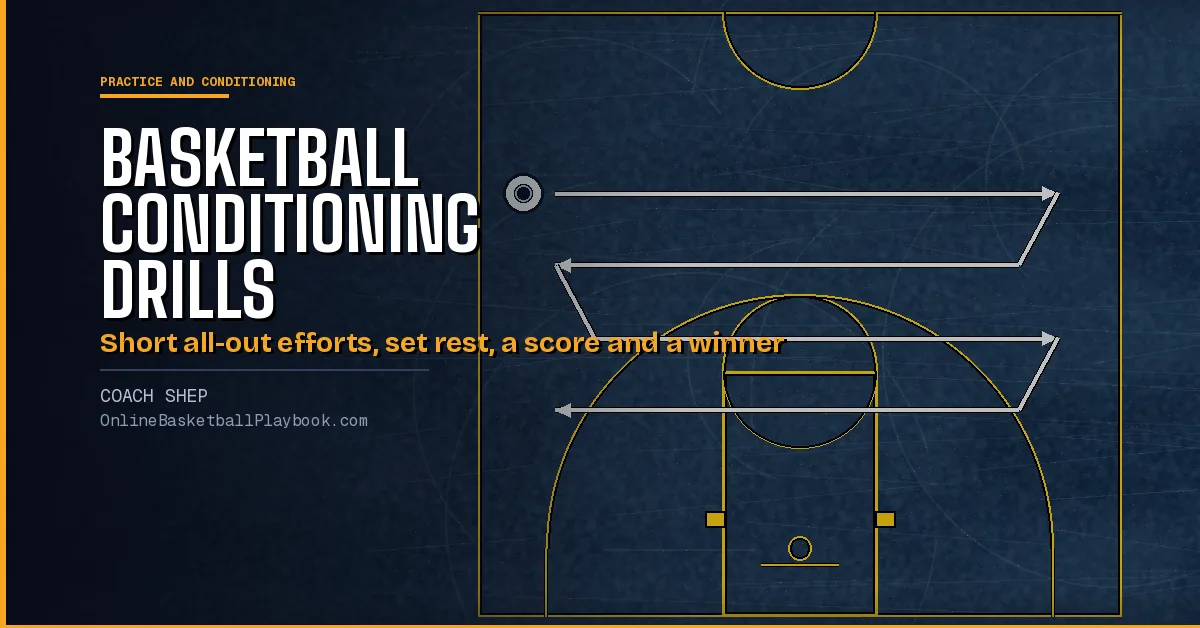
Basketball Conditioning Drills for Teams: Runs, Games and Tests
Basketball conditioning drills in three styles, timed runs, conditioning inside skill drills and scored games, with the tests and yearly plans coaches use.
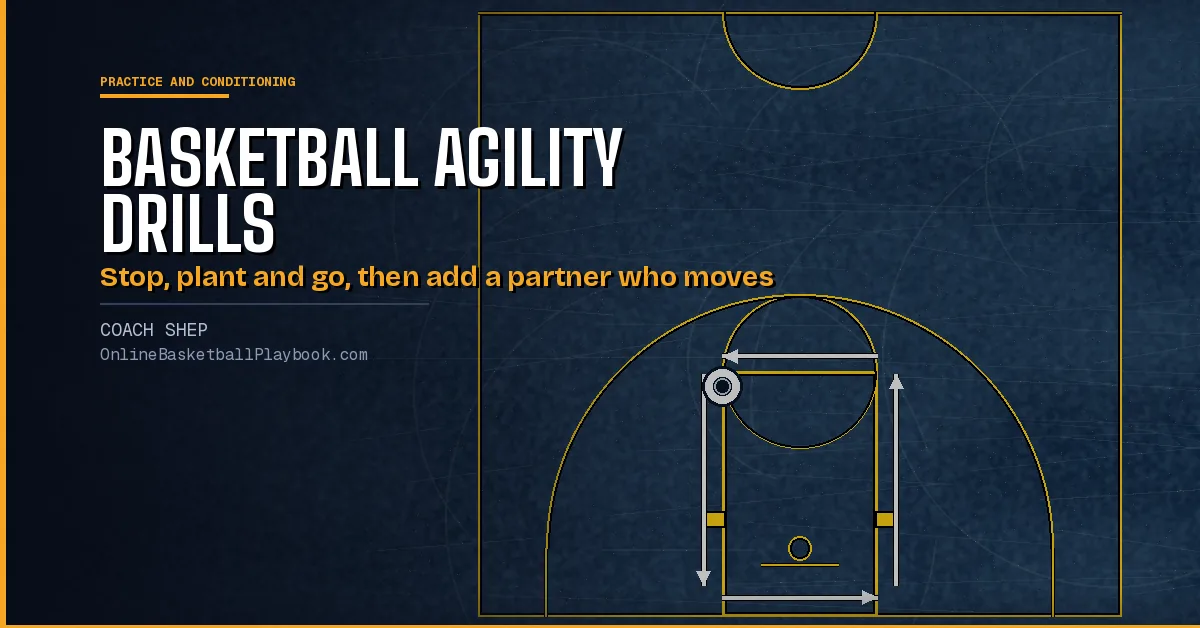
Basketball Agility Drills: Cone, Reaction and Ladder Drills
Basketball agility drills from timed cone tests to reaction, mirror and ladder drills and defensive circuits, with schedules and where coaches differ.