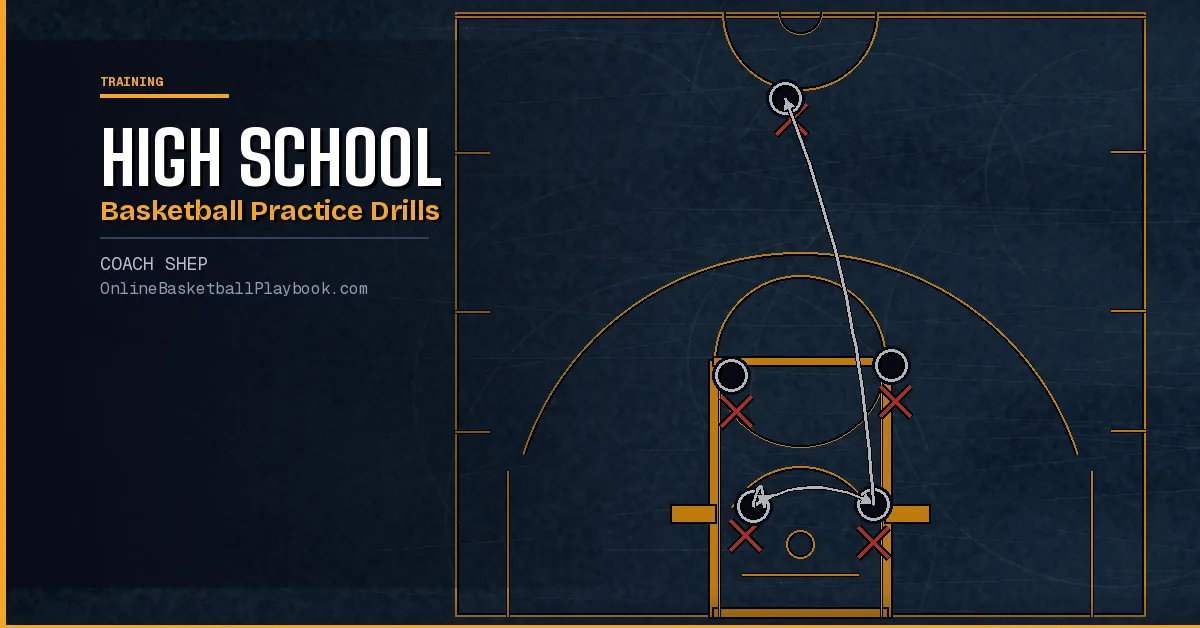
The best high school teams are built in practice. This guide covers the drills that develop ball-handlers, shooters, defenders, and pick-and-roll execution, structured so every rep translates directly to game situations.
Why Drill Design Determines Team Development
Most coaches know what they want their team to do in games. Fewer have a drill for every decision they want players to make. That gap is where development slows down and bad habits cement themselves.
The principle behind every drill on this list is the same: isolate one decision, give players immediate feedback, and repeat it under enough pressure that the correct response becomes automatic. A drill that lets players cheat or that doesn't match a real game read is training the wrong behavior at full speed.
For high school players especially, the gap between knowing a concept and executing it in traffic is enormous. Repetition in controlled conditions narrows that gap faster than anything else. When you design practice around that idea, every minute on the floor compounds into better performances on game night.
Before running any drill, establish three things: the exact decision the drill is training, the consequence for the wrong decision, and a minimum speed threshold so players don't coast through reps. If you can't answer all three, the drill needs reworking before it hits your practice schedule.
Ball-Handling and Dribble Penetration Drills
Ball-handling at the high school level is not just about tight dribbles in place. It is about controlling pace, changing speed in traffic, and finishing at the rim against length. The drills below address all three.
Two-Ball Stationary Series
Players work two basketballs simultaneously: same-time dribbles, alternating dribbles, and crossovers, for 45-second rounds. The dual-ball constraint forces genuine ambidexterity because the weak hand cannot piggyback on the strong one. Do this at the start of every practice, not at the end when hands are tired and form breaks down.
Ball-Handling Attack Series (1-on-0 Decision Drill)
Set up three cones at the three-point line: left wing, top of the key, right wing. Players start at half-court, sprint to a cone, execute a pre-assigned move (crossover, between-the-legs, behind-the-back), attack the basket, and finish with either a layup or pull-up jumper at a coach-signaled distance. The signal forces real-time reads rather than pre-programmed finishes.
Live Dribble-Drive 1-on-1 from the Wing
Offense receives a pass at the wing and has four seconds to attack before a defender recovers. The time constraint stops ball-handling displays that stall possessions. Defenders must contain without fouling for two points; offense scores on any basket for one point. First to five wins. Competitive stakes compress practice time and raise intensity without a coach running sprints.
Two-Man Weave to Finish
Two players weave coast to coast without a dribble between passes, then the ball-handler attacks a live defender placed at the charge circle. The decision, drive or kick, must be made before the defender commits. This develops the pocket pass that opens up when help arrives late, which is one of the most underdrilled reads at the high school level.
Shooting Drills That Build Game-Ready Mechanics
The worst shooting drill is one where players catch the ball, reset their feet, and fire at leisure. Games don't give you leisure. Every shooting drill should include either a sprint to the catch, a shot fake, or a defensive closeout or all three.
Catch-and-Shoot Off the Screen (Lane Slide Series)
Players start in the lane, slide to a wing, receive a skip pass, and shoot in rhythm. A manager or teammate simulates a closeout from the opposite side. The slide before the catch trains the footwork players need coming off pin-down and curl actions, the most common ways guards get open at the high school level. Run this for five minutes early in practice before players' legs are worn and mechanics suffer.
Spot Shooting with Pressure Clock
Five spots around the arc. Players have 90 seconds to make as many as possible. Track makes, not attempts. A running leaderboard posted in the gym creates buy-in without any extra coaching required. When makes are tracked over a season, players can see their own development curve, which is a more powerful motivator than any speech.
Elbow Mid-Range Drill
The mid-range jumper off the pick-and-roll is one of the most efficient shots in high school basketball because defenses are not organized to contest it consistently. Two coaches feed balls alternately from each elbow. Shooters catch, pivot to face-up, and fire without a second dribble. Volume matters here: 50 makes per session before the drill ends. Set the make goal, not a time limit.
Competition Shooting (Knockout)
Full team lines up at the free-throw line. First player shoots; if they make it before the player behind them, they stay. If not, they are eliminated. This is the simplest pressure-shooting drill in basketball and it works because every player experiences genuine stakes during practice. Run it at the end of sessions when legs are heavy and form is tested.
Pick-and-Roll Defense Breakdown Drills
Pick-and-roll defense is the single highest-leverage skill set to develop on the defensive end. At the high school level, most teams run some variation of ball-screen offense, and the team that can guard it consistently wins more games than its talent alone would suggest.
The modern framework for guarding ball screens is not a single coverage. It is a menu of coverages chosen by situation, built around three phases: the two-man coverage on the ball, the protection from the three off-ball defenders, and the recovery closeouts when a pass gets out. Teaching this framework to high school players starts with 2-on-2 breakdown drills before adding the protection layer.
2-on-2 Drop Coverage Drill
Ball-handler dribbles into a ball screen. The on-ball defender calls "screen" and fights over. The big drops to heel-level with the arc, traces the roller, and does not commit until the ball is passed. No help defenders. Players must solve it with correct positioning, not with a rotation. Run this until the drop coverage looks automatic, roughly 10 live reps per player per session.
2-on-2 Show ("Dance") Coverage Drill
Use the same setup, but now both men are attached at the arc when the screen is set. The big shows hard, arriving with the screen, not after it, and the on-ball defender fights back in front over the top. Emphasize the timing: the big must arrive with the screen or the coverage is a hedge, which is a different call with a different protection assignment. Sloppy timing in practice becomes a broken coverage in games.
3-on-3 Drop with Low Man Assignment
Add one off-ball defender. Assign the low man explicitly: he owns the roller until the big recovers. The key coaching point from this drill is that over-helping is as bad as under-helping. If the low man collapses too early, the corner three opens up. Make this a live 3-on-3 possession where the offense can use the corner as a release valve. The drill teaches the low man to read roll versus flare, which is the read most high school defenders miss.
Closeout Recovery Drill
After the ball-screen coverage, the ball gets kicked out to a shooter. The on-ball defender must sprint into a short closeout and contest without fouling. Drill this as a standalone: one skip pass, one closeout, one contest. The "bluff" closeout, where the defender fakes absorption of the shot rather than challenging aggressively, is a useful teaching point here because it deters the catch-and-shoot without surrendering a foul.
Competitive Conditioning Drills
Conditioning done wrong is punishment. Conditioning done right is competition. The drills below push cardiovascular intensity while keeping a basketball in players' hands, which means every conditioning rep is also a skill rep.
Shell Drill Transition
Four defenders and four offensive players. After each defensive stop, the defensive team sprints to offense and must score within six seconds. After each basket, offense sprints back to defend. The drill never stops. Five minutes of this produces more conditioning benefit than a standard sprint set and simultaneously trains transition execution, which is the fastest way to score in high school basketball.
Full-Court 3-on-2 to 2-on-1 Continuous
Three offensive players attack two defenders full court. After the stop or score, two of the original attackers sprint back to defend against two new players going the other way. The group left behind becomes the new offensive group going the other direction. Continuous for five minutes. Players learn to sprint into their roles, both offensively and defensively, because the drill punishes anyone who coasts to their spot.
Defensive Slide Ladder
Cone ladder set up on the lane line. Players slide through each rung, sprint to the opposite elbow, slide back through, and sprint to the starting cone. Three rounds, timed. Post times publicly. The lateral slide pattern mirrors the footwork needed for on-ball defense and drop coverage exits, so the conditioning is specific to the movements players need most in games.
Conditioning drills should have a basketball in players' hands whenever possible. A player who is tired and still making correct decisions with the ball in their hands is a player who will make correct decisions in the fourth quarter of a close game. Generic sprints teach players to run. Competitive drills with a ball teach them to compete while tired, which is what games actually require.
Putting It Together: Sample Practice Structure
A 90-minute high school practice needs a structure that builds intensity progressively, covers all skill areas without spreading reps too thin, and ends with competitive situations that mirror late-game pressure. The following template reflects those priorities.
The first 15 minutes are individual skill work: two-ball ball-handling, stationary shooting mechanics, and footwork patterns. Players arrive knowing the rotation and execute without coaching interruption. This segment sets the physical and mental tone for everything that follows.
Minutes 15 through 40 are breakdown drills: 1-on-1 live from the wing, 2-on-2 pick-and-roll defense coverage reps, and the closeout recovery series. These are the highest-coaching-density minutes of practice. Coaches are actively correcting decisions and reinforcing the coverage menu language. The word is the behavior: drop, show, dance, early, last, bluff. Use the terms every rep.
Minutes 40 through 65 are team-level 5-on-5 work built around your offensive and defensive systems. Run live possessions with a shot clock. Every possession should have a clear objective. Execute the offense against a specific defensive look, or defend a specific set play the upcoming opponent runs. This is not scrimmage; it is intentional practice with coaching stops when the teaching moment arrives.
The final 25 minutes are competitive: shell drill transition, full-court 3-on-2 to 2-on-1 continuous, then knockout or a game-situation free-throw drill to close. End on competition. Players leave with elevated intensity rather than exhausted from conditioning-as-punishment, which sets a better physical and psychological state for recovery and the next practice.
The sequence matters as much as the drills themselves. Building from individual to pairs to small groups to five-on-five mirrors how players learn. Foundational mechanics first, then decisions in increasing traffic, then full-speed execution in team situations. Coaches who reverse this sequence often wonder why their drills don't transfer. The order is the curriculum.
- Name the coverage out loud on every pick-and-roll rep: "drop" or "dance" so players develop the verbal habit that translates to in-game communication under pressure.
- Track shooting makes, not attempts, during every shooting drill: Counting attempts trains volume. Counting makes trains accuracy and trains players to care about the outcome of each shot.
- Assign the low man explicitly before every 3-on-3 defensive rep: Verbal pre-assignment removes guesswork and teaches players the protection layer of pick-and-roll coverage before they need it in a live game.
- Run competitive conditioning drills last in practice, not first: Tired players executing competitive reps with a ball develop fourth-quarter toughness. Fresh players running sprints develop only fitness.
- Post conditioning times and shooting leaderboards in the gym: Public tracking creates accountability without a speech. Players compete against their own previous marks as much as against teammates.
Want more basketball coaching strategies and drills?
Join the Online Basketball Playbook newsletter →
Draw this play free in the play drawer →
Membership: the full library, playbook packs, and Pro drawing tools →
Keep Building
Related breakdowns
Fun Basketball Games for Practice: Scored Games for Any Team
Fun basketball games for practice at any level: shooting games, defense-only scoring, rebounding contests and passing games, with scoring rules and records.
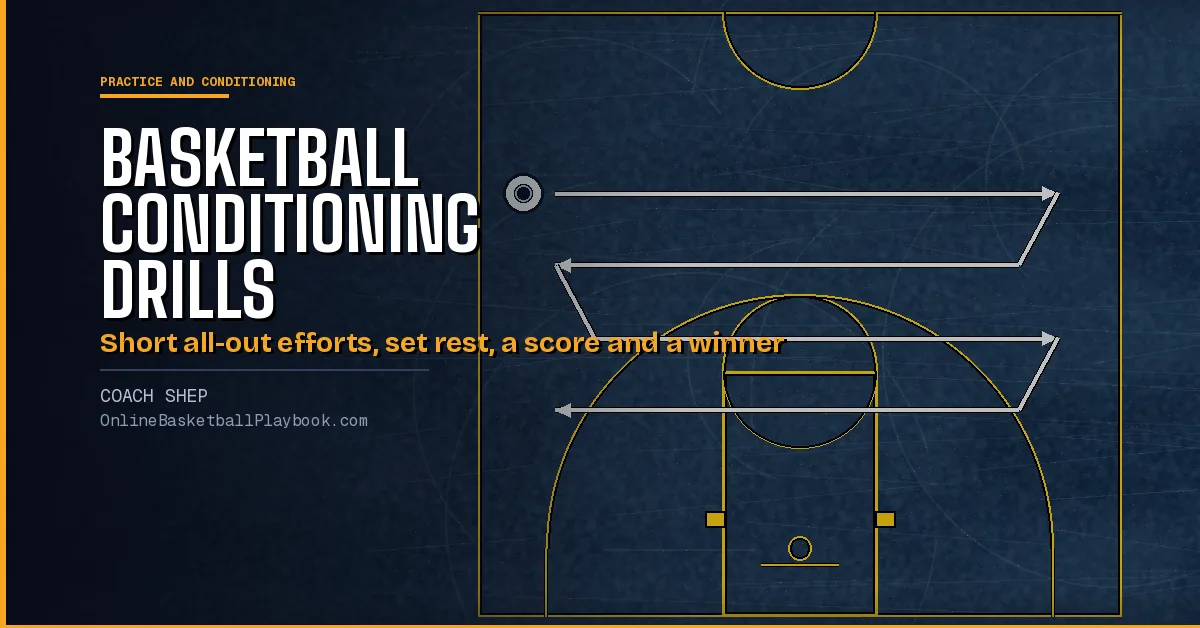
Basketball Conditioning Drills for Teams: Runs, Games and Tests
Basketball conditioning drills in three styles, timed runs, conditioning inside skill drills and scored games, with the tests and yearly plans coaches use.
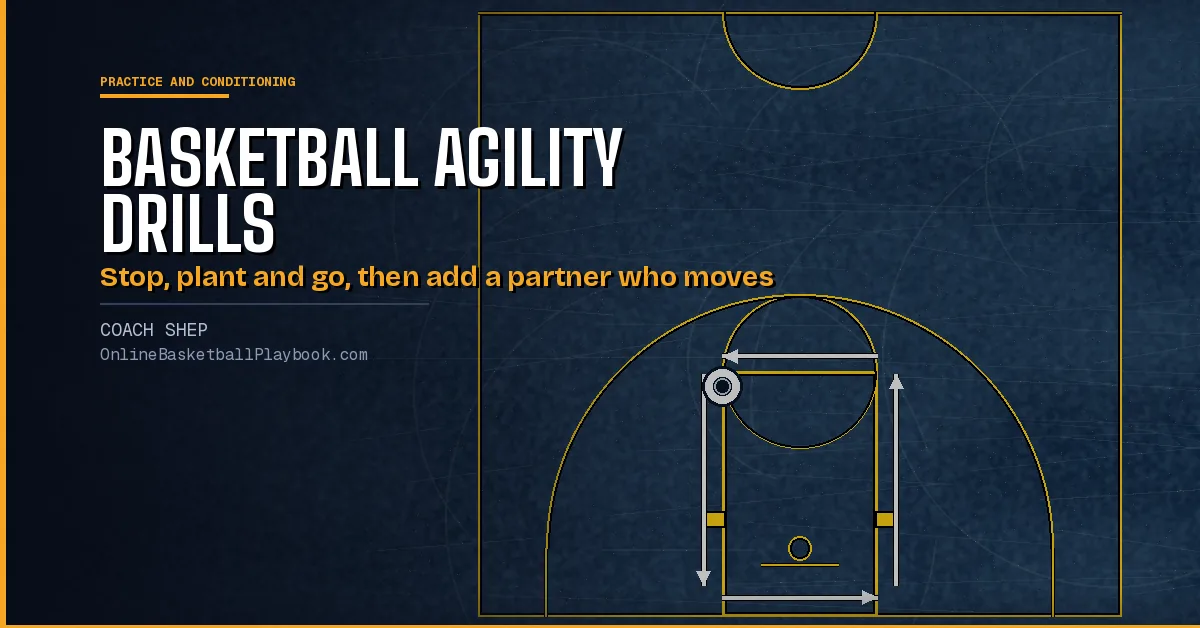
Basketball Agility Drills: Cone, Reaction and Ladder Drills
Basketball agility drills from timed cone tests to reaction, mirror and ladder drills and defensive circuits, with schedules and where coaches differ.