Game situations in practice are the reps that make a game feel familiar: the clock, the score, the foul count, the press coming after a timeout. The loss between practice and games has a name, game slippage, and the old line on it is that the coach whose team slips less has a definite edge.
A staff can measure that gap. Rick Majerus's breakdown chart, scored by the staff from film, compares breakdowns in practice and in games, and a player with fewer breakdowns than minutes has played well.
The late-game decisions themselves are on basketball late game situations and the clock rules on basketball clock management. Every planning guide is in the practice plans section.
Why Situations Belong in the Plan
Practice is rehearsal. Drills that reproduce the game, at game speed and held to a game standard, are what show up on game night.
- Habits do not change at tip-off. Habits are conditioned reflexes and do not change during a game, so whatever effort, execution or discipline a coach tolerates in practice shows up in games.
- Nothing new on game night. Players should never face anything in a game they have not already seen in practice. Most games are decided by seven or fewer points, three to four possessions.
- Close margins. Most games are won or lost by eight or fewer points, so late-game work should be repeated every day and coached like a game, with timeouts and subs.
- Fewer reps at full speed. Fewer reps at full intensity, with turnovers penalized and a rebound battle to finish, beat double the reps without accountability. Del Harris agrees that good practices copy game conditions.
- Finish everything. Bob McKillop's capstone point is to finish possessions, finish screens and finish cuts.
- Venue. Great teams play the same at home, on the road and on a neutral floor. The right play, player and defense for a situation may differ at home and on the road, so rehearse both.
Coach practice the way you want the game played.
Game Situations in Practice: How Much Time
Coaches split on the dose.
| Plan | How much and when |
|---|---|
| Mike Krzyzewski | 10 percent of a practice of under 2 hours (30 percent offense, 30 defense, 30 transition), run with the top 7 or 8 players, not just the top 5. End of half (one minute left, a 2-for-1), end of game, and a simulated 8 to 10 minute halftime in the locker room. |
| Own segment, rotated | Situations written into the plan as their own segment, for example the last 30 minutes, rotated week to week |
| Daily minutes | 10 to 15 minutes a day, or 15 to 20, or the last ten minutes of practice |
| One situation a day | One game situation every day, such as one minute left and tied |
| Phil Martelli | 35 index cards, one situation a day at the end of practice, tried by different teams, then coached together. Examples: down 4 with 7 seconds, best players fouled out in the bonus |
| Daily overtime | Overtime practiced every practice day |
| Six-minute game | Three times a week: take care of the ball, make free throws and be solid on defense |
| Special situation day | One practice every two weeks, about an hour and a half on about 20 situations |
| Install early | The hardest pressure situations go in during August and September |
Where the situation block sits among the other segments is on basketball practice structure. Whatever the dose, put it on paper and keep it.
Three Kinds of Situations
Sort situations into three groups and rotate the group week to week, so players see variety over a season.
- End-of-game scenarios. Final possessions and clock management.
- In-game adjustments. The opponent changes its scheme and your team has to respond.
- Special situations. Last-second free throws, inbounds plays and defending a last-second shot.
Then pick the tools that make the group feel like a game:
- A shot clock in drills. It forces the quick decisions a real shot clock does.
- Changed scrimmages. Play with a lead, from behind, or a two-minute drill with limited timeouts.
- Game pace. Full-court drills such as a 5-on-5 fast break that flows straight into half-court offense.
- Talk it through first. Players talk through how they would handle a scenario in a team meeting before they practice it.
Last-second sets for the special situations are on last second basketball plays. Pick the group for the week and rep it.
What Goes on a Situation Card
Write the situation as score, time and who has the ball, then add the fouls and the personnel. Everyone on the floor must know time, score and situation.
- The score range. Work up big, up a little, tied, down a little and down big, at different times left.
- A starter list of situations. One minute to go and tied, with the ball or on defense. Trailing or leading by one to three. Behind by four or five. Ten seconds to go after the opponent scores. Two seconds to go with the opponent holding the ball or inbounding under your basket.
- Last-shot bands. Organized plays with 5 to 3 seconds and with 8 to 12 seconds, from the full-court endline, the backcourt sideline, the frontcourt sideline and under the basket, against man and zone.
- Personnel and fouls. Different foul situations, segments with no point guard on the floor, and a fouled-out player.
- Odd matchups. Varsity down 10 against the JV.
- The occasional bad call. Make one now and then to see how players react.
Settle the questions behind the cards as a staff before the season: when behind, foul or play for a steal, and who fouls. Foul up 3 or not. Down 1, 2 or tied, hold for the last shot or take the first good one. After a rebound, turnover or make, call timeout, push and then call it, or go. With a shot clock, play 2 for 1 or not, and have a play from every spot.
Answer the staff questions before the season, then write the cards.
Formats Side by Side
Every format below puts a clock and a score on the rep.
| Format | How it runs |
|---|---|
| Card box | 21 scenario cards (score, time, who has the ball, foul status). One is pulled at the end of every practice and played with coaches on the bench, timeouts, subs, the clock and officials. Practice ends in a locker-room mindset, like a halftime built into practice |
| Series by clock | A one point series with five seconds on the clock and six scenarios (a one-point lead with a free throw, sideline, endline or under-the-basket out of bounds, with or without the ball). The two, three and four point series use ten, twenty and thirty seconds |
| Exact scripts | Down 3 at half court with 1:00, down 2 on a baseline out of bounds play with 40 seconds, down 5 at the side with 24 seconds, one timeout, both teams in the bonus |
| Down 8, up 8 | Three minutes to go, one timeout each, both teams in the double bonus. Teach how to foul, when and who |
| 76-76 start | Five minutes starting at 76-76 off a tip, first team to 80 wins, so many situations come up without a script |
| 56-56 start | The scoreboard starts at 56-56, play runs until a team reaches 60, then 2 minutes go on the clock for a close finish |
| Same scenario both ways | The coach gives a team a situation, such as down one with 20 seconds left, then gives the other team the same one |
| Situation tournament | 20 clock, score and possession scenarios in four sets. A set goes to the first team to win 3 of 5 situations (2 of 3 in the third set), one timeout per situation, and overtime is sudden death to a 2-point lead |
| Delay game drill | Team A shoots a one-and-one down 8 with 2 minutes left and one timeout. Team B must inbound against pressure and get into its delay game |
| Del Harris, nine-situation game | Nine situations in order: man press, zone press, three-quarter press, side out against man, side out against zone, baseline out against man, baseline out against zone, need play against man, need play against zone |
| Del Harris, possession games | 4-possession and 6-possession games to match real game sequences, and an offense-defense-offense game worth 3 points a sequence, won 2-1 or 3-0 |
| Jay Wright, out of bounds by clock | Base, side and endline out-of-bounds plays practiced by clock window: 0 to 3 seconds, 4 to 7, and 8 or more |
| Eric Musselman | Special situations run during the opponent's free throws |
| Coach Shep's two-minute tie game | A two-minute game from a tie, plus a perfect-possession rule on defense: no score for 35 seconds, or go again |


The card-box list includes up 4 with 45 seconds while the other team inbounds at three-quarter court, a tie game with no point guards on the floor for either team, and down 3 with 4 seconds when the leading team fouls on the inbound to stop a tying three.

Inbound sets for these windows are on sideline out of bounds plays and baseline out of bounds plays. Pick one format and run it until the team recognizes the situation.
Get the next coaching guide in your inbox
One email when a new guide or diagram set goes up. Free.
Scrimmage Rules That Carry a Lesson
Instead of a set scenario, change one rule of the scrimmage. The rule change carries the lesson.
- Score, then stop. A basket counts only if a defensive stop follows it, so teams cannot trade baskets.
- No dribble. Any dribble is a violation early in preseason, so players start cutting away from the ball.
- Defensive subs. When a player's man scores, a sub waiting under the defensive basket comes in and guards the scorer.
- Free throws to sub in. Ten straight free throws before a player may sub in, credited to John Wooden's scrimmages at UCLA.
- Mini-games and officials. Mini-scrimmages of 6 or 7 baskets, win by two, with assistants refereeing every scrimmage and real officials for intrasquad games, plus kept statistics.
- Start the press off a make. When practicing a full-court press or attacking one, start with a made free throw.
- Situation days. Run situation scrimmages with the clock and the score, offense and defense on different days, each assistant coaching a team from a planned agenda.
Coach Shep's teams run a rotating-coverage scrimmage. The defense plays one coverage at a time (switching, extreme pressure, sagging, half-court traps, run-and-jump, zone, a triangle or box) so the offense has faced each one before its first game, and a plus-and-minus stat sheet scores the live play.
An overload scrimmage breaks the rules on purpose:
- Extra defenders. Six, seven or eight defenders to practice half-court trap, three-quarter and full-court press offense.
- Extra offense. More offensive players to strengthen a zone defense.
- Defense down a player.
- Two-ball dribbling.
- Hands for the scout defense. A scout defense is allowed to use its hands.

End-of-game styles get their own rules too. A delay game keeps the clock running and takes a sure shot. A freeze game allows no shot unless it is a layup or a free throw. Scrimmage formats are on basketball scrimmages and scoring systems on competitive basketball drills.
Change one rule and let the scrimmage teach.
Pressure Free Throws and Playing With a Lead
Put a price on the free throw. Pressure free throws can run on a team goal: split the team between both baskets on a 6-minute clock and score each trip 0, 1 or 2 of 2. If the team misses its 70 percent goal, everyone runs. Missed free throws let a trailing team believe, and that doubt spreads through the rest of the game.
Coach Shep's teams split into two squads and score every drill. The winning squad shoots a bonus free throw and the loser runs a timed sprint, and a missed bonus free throw costs the winner 10 push-ups.
Rehearse the lead, not only the deficit.
- Coach as if behind. Keep coaching as if behind, and do not sub freely or try a new defense up 10 to 20 points.
- Watch the glass. Watch defensive rebounding, the first thing a team gives away once it is ahead.
- Split late pressure. Run two drills: live-ball turnovers under full-court pressure, and running offense with poise once the ball crosses half court.
- Show the good shot. Use film to show what a good shot looks like for the time and the score.
More formats are on free throw drills. Put a price on every free throw.
Stop the Rep or Let It Play
Coaches split on interrupting a game-like rep.
- Correct between segments. Del Harris.
- Teach through rules. Rule changes and mini-games.
- Instant replay. Don Meyer re-runs the failed possession against a dummy defense.
- Stop and repeat. Repeat a possession below standard until it is right.
- Stop to praise. Stop only when a possession makes the gym react.
The full stopping debate is on how to run an effective basketball practice, and the climb from air to a live test on breakdown drills.
Decide before practice when you will stop the rep.
Rehearse the Opponent
Rehearse the next opponent on the floor, not only in a report.
- Split the walk-through. Rick Pitino splits the pregame walk-through 50/50: half on defending their offense, half on how they defend yours.
- Tendencies, not too much. Mike Krzyzewski walks through the opponent's tendencies without giving the team too much.
- Copy their style. Run scenarios in the opponent's style, fast transition or slow half court, with role-playing, so players react instead of recalling a report.
- Scout into practice. Write notes right after playing a team, then bring them to practice as segments: post defense against a post team, zone offense against a zone team, press offense against a press team.
- Keep the base. Late in the season, tune practice to the next opponent but leave the base offense and defense alone, since changing them late usually hurts your own team more than the opponent.
Rehearse the opponent without losing your own base.
Check What Transferred
A situation rep only helps if it shows up in the next game. Check it in both places.
- Video review. Review situations on video after practice and after games so the team shares one picture of handling it right. Mike Krzyzewski videos every 4-on-4 and 5-on-5.
- Show what did not transfer. When players screen air in games, the fix is the film plus a whole practice on screening.
- One-minute assessments. Don Meyer uses one-minute timeout assessments: one thing done well, one thing to fix.
- Teach-back video. Players record a short private phone video explaining their own job on a new concept, and the coach reviews them before the next practice.
Film formats are on how to run basketball film sessions. Check the next game, not just the last practice.
Questions Coaches Ask
How do you incorporate game situations into practice?
Write a situation into the plan with a set clock, score and foul count, play it with timeouts and subs, and attach a result.
How much practice time should go to situations?
Mike Krzyzewski gives situations 10 percent of a practice of under 2 hours. Other plans run from 10 to 15 minutes a day to the last 30 minutes as a situation block.
What is game slippage?
The drop in performance from practice to games. The less a team slips, the bigger its edge.
What game situations should a team practice?
End-of-game possessions, in-game adjustments when the opponent changes its scheme, and special situations such as last-second free throws, inbounds plays and defending a last shot.
Want the printable playbook packs?
OBP Pro members get the premium playbook packs: the zone attack, out of bounds and practice plan PDFs, plus each new pack as it is finished. The membership page lists what is in each one. Or draw your own version free in PlayDraw.
See what OBP Pro includesMore Post, Passing and Practice Guides
- Big Man Workout Basketball: Drills, Make Counts and Order
- Types of Passes in Basketball: When to Use Each One
Back to Practice Plans and every Practice and Conditioning page.
Keep Building
Related breakdowns
Basketball Conditioning: How to Build a Program That Lasts
Basketball conditioning built as a program. The energy system, work and rest, the runs and tests, cardio, a preseason ramp and how programs split the year.
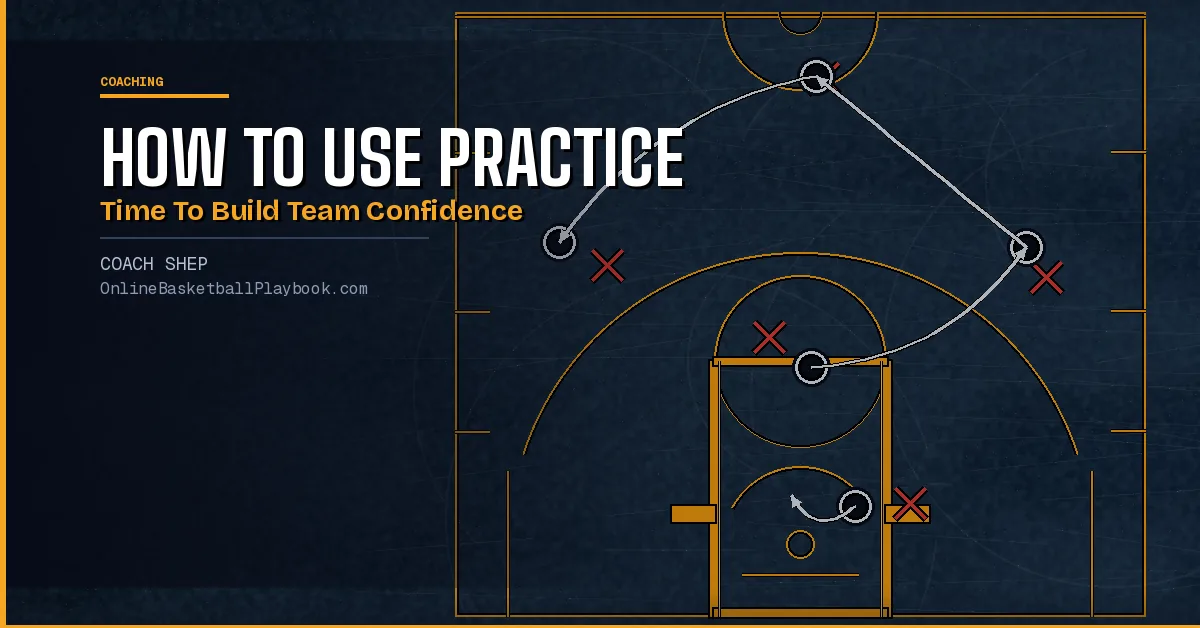
How to Use Practice Time to Build Team Confidence
How to Use Practice Time to Build Team Confidence
Fun Basketball Games for Practice: Scored Games for Any Team
Fun basketball games for practice at any level: shooting games, defense-only scoring, rebounding contests and passing games, with scoring rules and records.