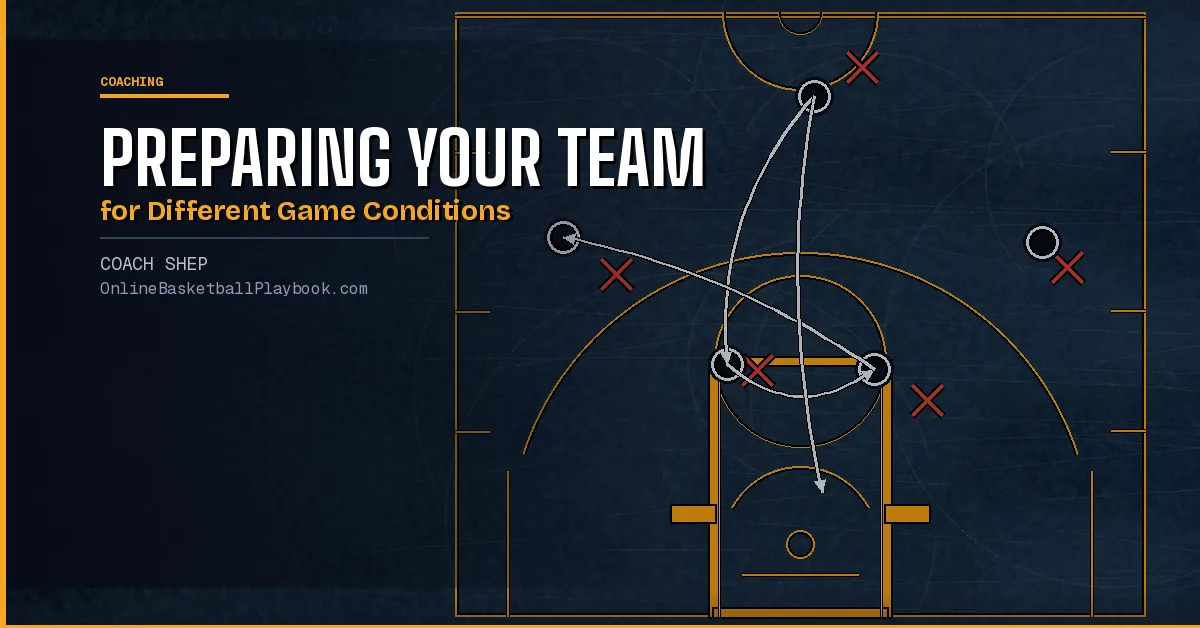
Great teams don't just play well at home on a good night. They execute in hostile gyms, bounce back from slow starts, and hold leads when the game gets tight. That adaptability is built in practice, not discovered on game night.
Why Habits Beat Schemes When Conditions Change
Every coach has a game plan. But game plans fall apart. A hostile crowd, foul trouble in the first four minutes, a 10-point deficit at halftime. These conditions don't care how clever your scheme is. What carries you through them is what your players have internalized so deeply that they don't have to think.
Bill Parcells put it plainly: a game plan can break down under maximum pressure, but the habits built in practice cannot. His goal in preparation was simple. He didn't want players thinking during a game. He wanted them reacting. Thinking takes too long. By the time a player sorts through options in a fourth-quarter possession, the play is already dead.
This means the question coaches need to ask before every season isn't "what's our system?" It's "what habits are we building, and are we drilling them until they're automatic?" Systems are for the whiteboard. Habits are what show up in March when the crowd is loud, the refs are tight, and your best player has three fouls.
The practical implication: every drill you run should be depositing into the reflex bank. When your point guard knows (not thinks, knows) where to go when the pick-and-roll gets switched, that's a habit. When your wing automatically locates the help-side rotation after a drive, that's a habit. Coaches who over-scheme give their players a decision to make at the exact moment they need to act. The antidote is volume of correct reps at game speed until the action has no cognitive cost.
Start there. Before you install any new wrinkle for a specific opponent, ask whether your base habits are automatic. If they aren't, adding complexity just gives players more to forget when conditions get hard.
Make Practice Harder Than Any Game You'll Play
Anson Dorrance built a 22-national-title program at UNC around one uncompromising principle: practice must be more competitive than games. If practice is a safer environment than competition (less pressure, less consequence, less intensity), your players will shrink when the real thing arrives. The goal of the competitive cauldron is to invert that dynamic so games feel like relief.
This applies directly to preparing for different game conditions. Your team will face hostile road environments, must-win games, and moments when everything goes wrong in the first four minutes. If the hardest place they've ever competed all week is a regular-season away game, they haven't been prepared. But if practice regularly tops that intensity level, with consequences for losers, scored competitions built into every segment, and nothing purely instructional without a competitive wrapper, then road noise and a quick deficit are familiar territory.
Practically, this means designing adversity into your practice structure, not waiting for games to provide it. Mike Dunlap recommends 15–20 minutes of no-dribble drills daily, not because basketball is played without dribbling but because it forces cutting, communication, pivoting, and collective problem-solving. It puts the "we" in your gym. When players are comfortable solving problems together under constraint in practice, they can solve problems together under pressure in games.
The secondary benefit is personnel revelation. You don't know who your competitors are until you've put them in a competitive pressure situation. Scoring your drills, posting results, and creating clear winners and losers tells you things about your roster that a regular walk-through never will. That information matters when you're deciding who plays crunch time minutes in an away game that could decide your season.
Role Clarity Is Your Best Pressure Valve
One of the most underrated sources of poor play under pressure isn't a lack of talent or toughness. It's ambiguity. Players who aren't sure of their role make hesitant decisions. Hesitant decisions look like mental errors. Mental errors look like choking. But the root cause is often a coach who never made the role explicit enough for the player to trust it.
Mike Dunlap is direct about this: role declaration is a culture act. Before players play, they need to know their specific job. Ambiguity about who does what is corrosive, not just to performance but to trust within the group. When roles are unclear, players either freelance (overstepping) or defer (underperforming), and either version falls apart faster under pressure than in comfortable home games.
Declaring roles means more than telling a player they're a "backup point guard." It means telling them specifically what they're responsible for in late-game situations, what their defensive assignment looks like against a particular type of player, and where you expect them to make plays. It means having a conversation with them about their realistic impact and checking that they've actually absorbed it, not just nodded in the film room.
Dean Smith's Blue Team concept is one of the cleanest implementations of role clarity for a full roster. Players 7 through 12 enter as a unit, always in the first half, and always play together for one to two minutes. Every player knows when they're going in and what they're expected to do. Role predictability keeps reserves engaged and prevents the disengagement that comes from never knowing if or when you'll play. When a reserve player knows their role and trusts the rotation, they stay locked into the game, which means they're ready to produce when conditions require a lineup change.
The 4th-Quarter Role Test Every Coach Should Run
Parcells used a specific accountability tool before every game: every player had to be able to describe their fourth-quarter assignment from memory, under pressure, without prompting. If they couldn't articulate their specific role in a late-game situation, they weren't prepared. And the verdict wasn't on the player. It was on the coach. The coach hadn't finished the preparation job yet.
This reframe is powerful because it changes the ownership of readiness. Most coaches run drills and assume absorption. The 4th-quarter role test makes absorption visible. You ask. They answer. If the answer is vague or wrong, you have work to do before the next game, and you know it before the game reveals it.
The test works particularly well for preparing teams to play in unfamiliar conditions. An away game in a hostile environment, a rivalry game with extra pressure, a playoff game with a short preparation window. All of these conditions raise the cognitive load on players. The player who has their assignment truly memorized, not just practiced, will execute it under load. The player who knows it "pretty well" will hesitate at the worst possible moment.
Run the test at the end of each week of preparation, not just before big games. Make it routine enough that players expect it and start self-testing in their own preparation. When the standard becomes internal (when players quiz themselves because they want to be ready, not because they fear being caught flat), you've built something durable.
Building a Road-Game Culture
Home court is real. Crowd noise, hostile fans, travel fatigue, unfamiliar rims, and small locker rooms all affect performance. Coaches who treat road games as simply "away versions of home games" are leaving preparation on the table.
The foundation of a road-game culture is the same foundation that supports any culture under pressure: non-negotiable standards enforced identically regardless of environment. Jakov Obradovic's insight applies directly here: "non-negotiables repeated every single day, no exceptions, no shortcuts." The value isn't in the specific rule. The value is in the unconditional repetition. A team that sprints to the bench on the whistle at home and does the same thing without being asked on the road has built a behavioral habit, not a home-gym habit.
Bob Hurley's approach adds an operational layer: respect routines matter. Players acknowledge coaches in the hallway, sprint to the bench on the whistle, and follow defined travel procedures. These aren't bureaucratic details. They're the behavioral infrastructure that keeps the team's identity stable when everything else changes: the gym, the crowd, the officials, the travel schedule.
The psychological piece is equally important. Prepare your players to view road environments as a proving ground, not a disadvantage. John Tauer's "Dare to Be Great" framing is useful: doing something great requires exiting the comfort level. A road game in a difficult environment is exactly that moment. Teams that reframe the road environment as an opportunity, rather than an obstacle, arrive differently than teams that approach it with dread.
You can also simulate road-game conditions in practice. Playing crowd noise over speakers during competitive drills, adjusting gym lighting, running practices with unfamiliar officiating. Small disruptions in the practice environment train the adaptation muscle. Players who've competed under mild discomfort at practice are less rattled by real discomfort in games.
Preparing Your Team to Respond to a Slow Start
Every team has games where the opening minutes go wrong. The opponent hits three straight threes, your best player picks up two early fouls, and suddenly you're down eight before the crowd has settled in. How a team responds to that moment is almost entirely a preparation question. It has very little to do with what happens on the sideline in the timeout.
The first layer of preparation is psychological. Players need a pre-installed frame for adversity that doesn't involve panic or blame. Bethel University's "Me First, For Us" framework targets exactly this. Players are trained to ask only "What can I do?" and "How can I support the team?" when things go wrong, not "Why is this happening to us?" or "Who dropped the ball?" Those forbidden question types are victim thinking and blame, and they spread. When one player goes there, others follow. When the standard is "What can I do right now?", the team stays action-oriented even in a deficit.
The second layer is structural: your team needs a specific response to a slow start built into your system. What does your first timeout call look like when you're down eight in the first quarter? Which personnel adjust? What do you emphasize? If your team only ever prepares for starts where they're winning or neutral, they have no practiced response when conditions turn. Walk through slow-start scenarios in film. Run practices where you spot the opponent points and force your team to claw back. Make fighting through a bad start a known procedure, not a crisis.
Bob Thomason's principle of taking responsibility as a coach matters here too. When things go wrong early, how a coach responds sets the tone for how players respond. A coach who broadcasts frustration or searches visibly for someone to blame teaches the team to do the same. A coach who stays steady, gives clear direction, and communicates confidence in the group's ability to respond gives the team a behavioral model to follow. Taking the blame (telling players "we're going to fix this together, and it starts with me") is a trust-building act that pays off in exactly these moments.
Teaching Shot-Clock Intelligence for Every Condition
Different game conditions create different shot-clock pressures. A comfortable home game lets players flow naturally. An away game in a hostile environment, a physical defensive opponent, or a must-win late-season game raises the cognitive load and degrades shot-clock management faster than almost any other skill.
David Richman's 8-to-Great-to-Late framework gives players a self-regulating structure that holds up regardless of condition. The first eight seconds of the shot clock (from 30 to 22): look for good opportunities without forcing anything. The "Great" window (22 to 10): move east and west, get to multiple sides of the floor, force a paint touch, make the defense make a mistake. The "Late" window (10 to 0): do not reset. Resetting lets the defense reload and take away time. Trust your players to play through it.
The reason this framework works under pressure is that it's simple enough to remember when the environment is loud and the cognitive load is high. Rather than calling sets from the sideline in every late-clock situation, players who have internalized this three-phase structure can self-regulate. The coach becomes a checkpoint, not an instruction source, in the moments that matter most.
Teaching shot-clock intelligence also means building awareness of where your best players score. Hubie Brown's design principle applies directly: your best scorer can shoot well from two or three spots on the floor. After every game, the first question should be whether your best scorers actually got high-percentage shots from their spots. If they didn't, the offense isn't serving its people, and that problem compounds under difficult game conditions when the margin for error shrinks.
Pair this with Richman's possession-win standard: the goal is to win 65 of 100 possessions. Not run the most possessions, not score the most, but win the exchange. That framing focuses your team on quality over volume and gives them a standard that applies equally in a blowout, a tight game, on the road, or at home. Conditions change; the standard stays the same.
At the end of each week, ask every player on your roster to describe their specific fourth-quarter assignment without prompting. If a player cannot answer clearly and immediately, add more reps before the next game. That gap in articulation is a preparation gap, and games will expose it faster than any practice ever will. This weekly check takes less than ten minutes and tells you more about readiness than any film session.
- Run at least two practice segments each week that are harder and higher-stakes than any game you'll play. Scored competitions with real consequences for losers build the adaptation muscle that shows up in road games and pressure moments.
- Declare each player's role explicitly before the season opens, including their specific responsibility in late-game situations, and revisit those declarations when performance shifts. Ambiguity about roles accelerates breakdown under pressure.
- Build a defined slow-start response into your system: decide in advance which personnel adjustments you make, what you emphasize in the first timeout, and how you communicate with your team. Make fighting through a bad start a known procedure, not a crisis.
- Teach the 8-to-Great-to-Late shot-clock framework so players can self-regulate their pace and decision-making without needing a set called from the sideline in every difficult possession.
- Eliminate blame language from your team's response to adversity by training the "What can I do?" reflex. Post the three forbidden question stems (Why? When? Who?) and the replacement starters (What can I do? How can I support?) in your locker room and practice them as a vocabulary drill after hard losses.
- Use crowd noise, altered lighting, and unfamiliar officiating in practice to simulate road-game conditions at least once per week. Players who have competed under mild environmental disruption in practice are far less rattled when conditions change in real games.
Want more basketball coaching strategies, drills, and tools?
Join the Online Basketball Playbook newsletter →
Draw this play free in the play drawer →
Membership: the full library, playbook packs, and Pro drawing tools →
Keep Building
Related breakdowns
Fun Basketball Games for Practice: Scored Games for Any Team
Fun basketball games for practice at any level: shooting games, defense-only scoring, rebounding contests and passing games, with scoring rules and records.
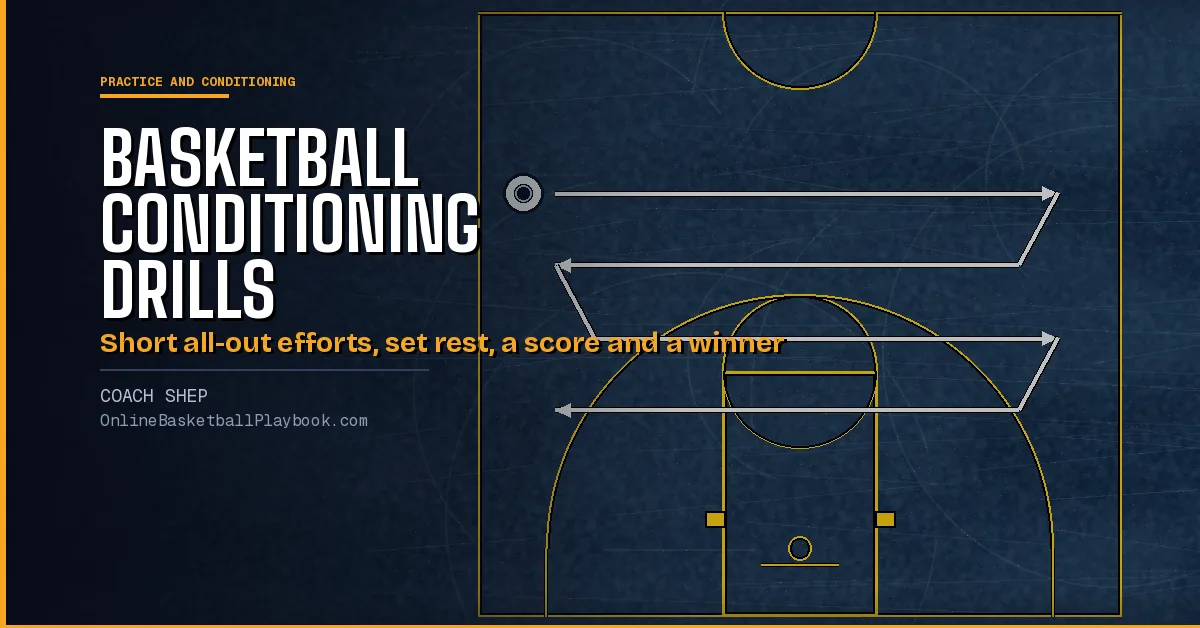
Basketball Conditioning Drills for Teams: Runs, Games and Tests
Basketball conditioning drills in three styles, timed runs, conditioning inside skill drills and scored games, with the tests and yearly plans coaches use.
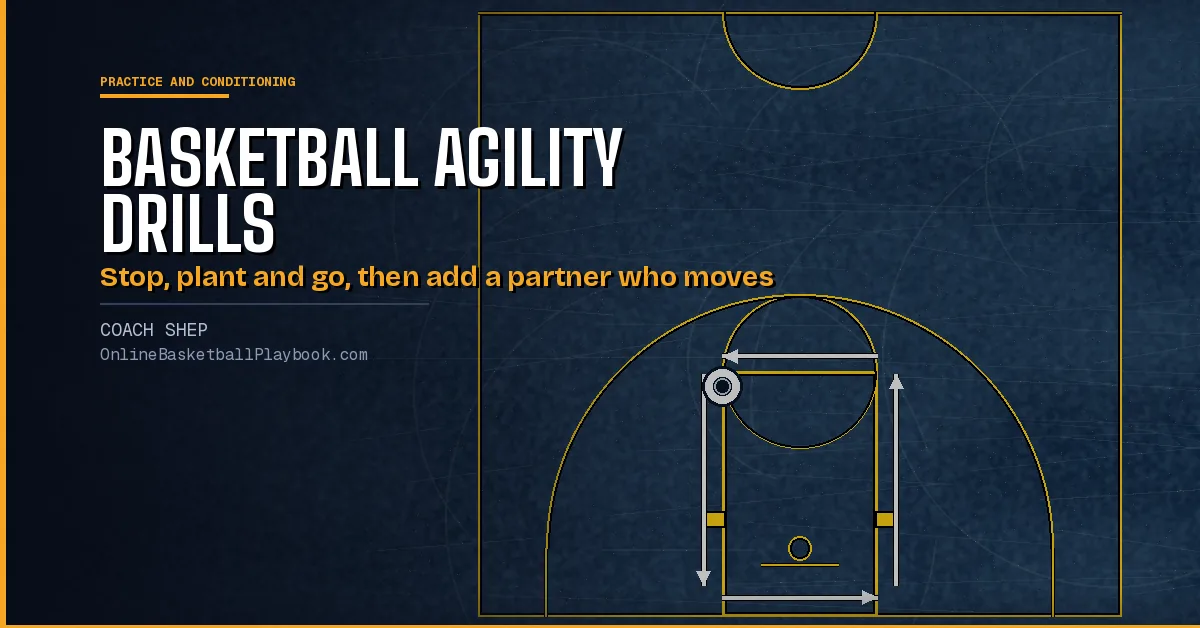
Basketball Agility Drills: Cone, Reaction and Ladder Drills
Basketball agility drills from timed cone tests to reaction, mirror and ladder drills and defensive circuits, with schedules and where coaches differ.