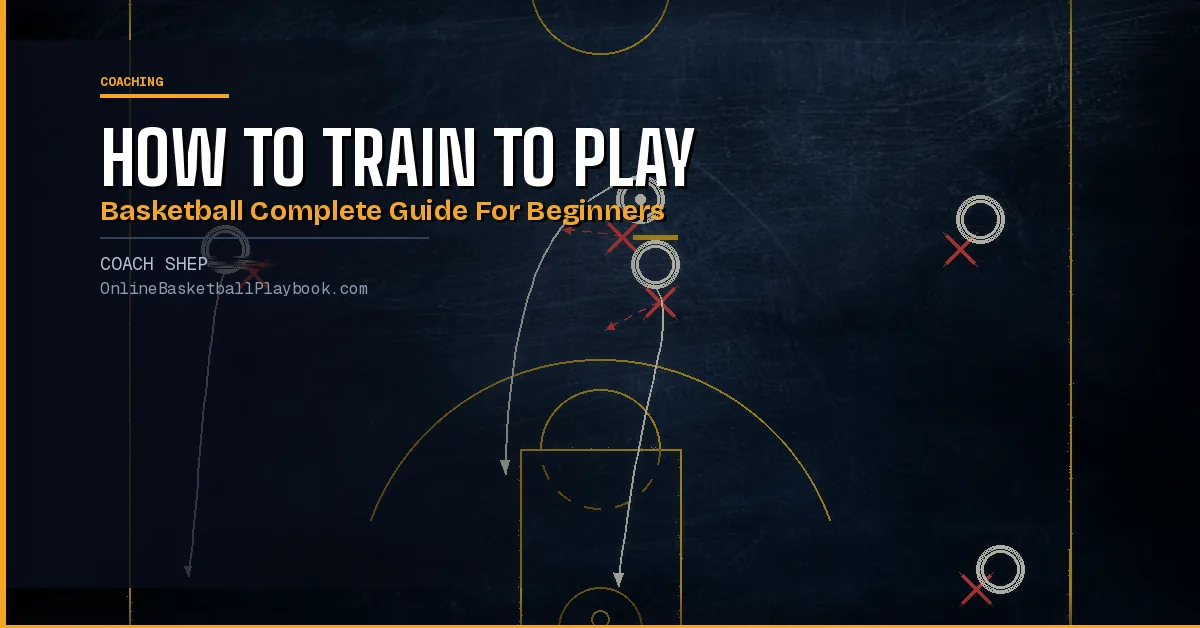
Basketball rewards players who build their fundamentals first. This guide walks you through exactly how to train (footwork, dribbling, passing, shooting, and defense) so you develop real skills that hold up in a game.
Before You Train: The Right Mindset and Setup
Most beginners want to skip straight to shooting three-pointers and between-the-legs dribbles. That approach will slow you down. Every player who develops real skill (at any level) started by mastering the basics and then built on top of them. The order matters.
Before your first training session, understand this: basketball is a movement sport first and a ball sport second. Your ability to start, stop, change direction, and stay balanced under pressure determines how well every other skill performs. A player with shaky footwork cannot shoot consistently. A player who can't stay low on defense cannot guard anyone. The physical base comes first.
For setup, you need minimal equipment to start: a ball that fits your hand (size 5 for younger players, size 7 for adult males, size 6 for adult females and youth), proper athletic shoes with ankle support, and access to a court or a hard, flat surface. You do not need a full gym. A driveway or a park half-court is enough for the first several months of development work.
Set a goal for your first month that is not score-based. Something like "I can dribble the full length of the court without losing control" or "I can make five layups in a row from each side" gives you a concrete, measurable target that tells you when you've actually improved. Vague goals like "get better at basketball" don't help you train. They leave you spinning in place.
Footwork and Movement: The Foundation
Footwork is the skill that separates players who look good in warm-ups from players who perform in games. Learn the following movements before spending significant time on ball skills.
The Athletic Stance
Start every drill from your athletic stance: feet shoulder-width apart, knees bent, hips back, weight on the balls of your feet (not your heels), chest slightly forward, head up. This is the position from which every basketball skill (dribbling, shooting, defending, cutting) begins. It's sometimes called "the ready position" or the "triple threat" stance when you're holding the ball. Practice holding this stance for 30 seconds at a time until it becomes automatic.
Jump Stop and Pivot
The jump stop is how you receive a pass or end a dribble without traveling. You jump, land on both feet simultaneously, and your pivot foot is not yet established, meaning you can pivot on either foot. From there, you can pass, shoot, or drive. Practice by walking, breaking into a jog, then landing with a jump stop on your coach's signal (or a clap, or a verbal cue). Do this 20 times in a row until the landing feels controlled and balanced.
The pivot is how you move your body to face a new direction without lifting your pivot foot. Once you've caught the ball and established a pivot foot, practice pivoting forward and backward until you can do both without thought. Players who can't pivot comfortably end up picking up their dribble and getting trapped.
Defensive Slide
In a low stance, step and slide laterally. Never cross your feet. The lead foot steps, the trail foot follows, and you maintain your stance throughout. Practice sliding the length of the lane, touch the line, and slide back. Two sets of five repetitions each direction is a solid starting drill. This movement translates directly to on-ball defense and staying in front of a ball handler.
Ball Handling and Dribbling
Dribbling is not about flashy moves. It's about controlling the ball while keeping your eyes up and your body in a position to play. Most beginners look at the ball when they dribble. That's the first habit to break.
Eyes-Up Dribbling
The cue is simple: eyes on the rim, or eyes on your teammates. Pick a spot on the wall at eye level and stare at it while you dribble. Start stationary. Once you can dribble for 60 consecutive seconds without looking down, begin walking forward. When you can walk the length of the court without looking at the ball, you have the foundation for all ball handling drills.
Strong Hand, Then Weak Hand
Build your dominant hand first, then your non-dominant hand. Spend three minutes dribbling with your right hand (or left, if that's dominant), then switch and spend three minutes with the other hand. The goal is not equal skill overnight. It's progressive improvement over weeks and months. Players who skip weak-hand training become very predictable in games and easier to defend.
Stationary Drills Before Moving Drills
Work through stationary dribbling patterns (alternating hands, crossovers at waist height, and behind-the-back while standing still) before adding movement. A crossover that breaks down when you add a jog was not actually learned; it was memorized in a controlled position. Add movement only after you own a skill standing still.
Simple Games for Dribbling Under Pressure
Dribbling against pressure is different from dribbling alone. Sharks and minnows (where one player tries to knock the ball away while the others dribble inside a confined area) is one of the most effective pressure dribbling drills for beginners. It teaches you to protect the ball, dribble low, and keep your eyes scanning. This kind of game-based training accelerates skill transfer from practice to a real game.
Passing and Catching
Basketball is a passing game. Turnovers kill possessions; accurate, on-time passing creates easy shots. Learn the three foundational passes before anything else.
Chest Pass
Start with the ball at your chest, elbows out. Step toward your target, push the ball out, and finish with thumbs pointing down and palms facing out. The pass travels flat and fast, chest-to-chest, with backspin. The cue "step to your target" is what coaches repeat for a reason. The step generates velocity without telegraphing the pass with a big wind-up.
Bounce Pass
Same mechanics as the chest pass, but aim for a floor contact point roughly two-thirds of the way to your receiver. The ball rises to their waist or hip after the bounce. Use this pass to get the ball through traffic or to a cutter coming off the block. A common beginner error is bouncing too close to the passer, which makes the ball rise too high.
Overhead Pass
The ball goes from above your head, released with a snap of the wrists. Do not bring the ball behind your head. It slows the release and invites steals. This pass is used to skip over a defender, hit a cutter on the move, or start an outlet pass after a rebound. Practice it against a wall before throwing it to a partner at full speed.
Catching the Ball
Catching is a skill that gets overlooked. The cue "two hands, two eyes, two feet" (hands up as a target, eyes tracking the ball, two feet planted or jumping into a jump stop) gives beginners a framework for receiving passes cleanly. Dropped passes often come from looking away too early or reaching for the ball instead of letting it come to your hands.
Shooting Form from the Ground Up
Shooting is the most practiced skill in basketball and the one most often practiced incorrectly. Bad form that feels comfortable will cap your range and your consistency. Build the right mechanics from the start.
BEEF: The Basic Form Framework
BEEF stands for Balance, Eyes, Elbow, Follow-through. Balance means your feet are set and your body is stable before the shot. Eyes means you are looking at your target (specifically the back of the rim) before and through the release. Elbow means your shooting elbow is tucked under the ball, not flared out to the side. Follow-through means your shooting hand finishes high and extended, wrist relaxed and bent downward, held until the ball hits the rim.
Start Close
Every beginner should begin shooting from 2 to 4 feet from the basket. The "pizza waiter" cue (balance the ball on your shooting hand like you're carrying a pizza tray) and the "cookie jar" cue (reach up and into the cookie jar as you release) help young players understand the elbow-under and upward-release motion. Make five shots in a row from close range before moving back. Never practice bad shots. If the form breaks down because you're too far, move in.
Layups
The layup is the highest-percentage shot in basketball and a non-negotiable skill for every beginner. From the right side, you finish off your left foot with your right hand. From the left side, you finish off your right foot with your left hand. Beginners practice right-side layups almost exclusively, which turns into a major limitation in games. Spend equal time on both sides from day one.
Defense and Positioning
Offense gets the attention, but defense is where consistent players separate themselves. Defense requires attitude and effort more than raw athleticism, which means beginners can become solid defenders quickly if they learn the right habits early.
Ball-You-Man Principle
On defense, your body should always be positioned so you can see both the ball and your assigned player at the same time. This is sometimes called "pistol" positioning. One hand points at the ball, one hand points at your player. You should never fully turn your back to the ball. When the ball moves, you adjust your positioning to maintain this sightline. Master this concept and half of defensive positioning becomes automatic.
Stay Low
Defensive effectiveness comes from your stance. If you stand straight up, you cannot react quickly to a ball handler's first step. Bent knees, low hips, weight forward (the same athletic stance from section two) is your defensive platform. Practice staying low for full defensive slide sequences. It will tire your legs early; that's normal. Your legs will build endurance over weeks if you commit to the stance consistently.
Contest Without Fouling
A contest means you close out with a hand up and your feet under control. Racing toward a shooter and flying by them (or jumping into them) produces fouls, not stops. Practice closeouts by starting under the basket, calling out "shot!" and sprinting to a spot on the three-point line, braking, and finishing with one or two hands up and feet balanced. That brake-and-close technique is one of the most transferable defensive skills in basketball.
Defense is the fastest path for a beginner to get real playing time. Coaches at every level prioritize players who can guard someone. You can get on the floor while your offensive skills are still developing if you commit to the defensive habits in this section every single practice.
How to Structure Your Training Sessions
Random shooting in a gym for an hour is not training. It is practice in the loosest sense, and it produces slow improvement. Structured sessions with clear purposes produce exponential gains compared to unstructured repetition.
A Beginner Session Template (60 Minutes)
A well-built beginner session looks like this: 10 minutes of movement and dynamic warm-up (defensive slides, jump stops, light dribbling to get the hands going), 30 to 35 minutes of technical skill work organized into focused blocks of 5 to 8 minutes each, 10 minutes of a competitive small-sided game or shooting game with stakes, and 5 minutes of cool-down and mental review. This structure keeps the session varied enough to maintain attention and focused enough to produce real development.
Load One Drill Instead of Cycling Through Many
A more effective approach than running five different drills is to load a single drill with progressive complexity. Start with a basic chest pass drill. Add a defender. Add a time constraint. Add a score. You've just run four variations of one drill, and the skill was reinforced across multiple conditions. This is called the loading principle, and it dramatically improves retention compared to switching drills every few minutes.
Track Measurable Milestones
Write down specific goals and track them weekly. Examples: make 7 of 10 free throws, complete three full-court dribbling reps without losing the ball, land 10 consecutive jump stops under control. When you track these, you get real feedback on what's improving and where the gaps are. Most beginners who train without measurement have no idea which skills are actually developing and which ones are stagnant.
The 4:1 Practice-to-Game Ratio
Canada Basketball's development framework recommends four practice sessions for every one game at beginner and youth development ages. Too many games too early starve players of the trainable repetitions needed to solidify fundamentals. If you're playing in a recreational league, make sure you're getting four dedicated training sessions in for every game you play. If you're only training on game days, your development will be significantly slower than it could be.
- Athletic stance every rep: Every drill (dribbling, shooting, defense) starts from your athletic stance. If you don't reset your stance between reps, you're training sloppiness into your mechanics.
- Eyes up when dribbling: Pick a fixed point on the wall at eye level and stare at it during all ball handling drills. When your eyes stay up, your reads get faster and your handle gets stronger under pressure.
- Layups on both sides, every session: Never finish a shooting session without practicing layups from your weak side. Left-side layups for right-hand dominant players are one of the biggest gaps in beginner skill sets.
- Defense is a stance, not a reaction: Stay low before the ball handler moves, not after. Most defensive breakdowns happen because the defender was standing straight up when the first step came.
- End every session on a make: Finish with a shot or drill you can complete successfully. Ending on a miss locks in frustration; ending on a make builds confidence and keeps you coming back.
Want more basketball coaching strategies and drills?
Join the Online Basketball Playbook newsletter →
Draw this play free in the play drawer →
Membership: the full library, playbook packs, and Pro drawing tools →
Keep Building
Related breakdowns
Basketball Shooting Off Screens: Complete Guide
Basketball Shooting Off Screens: Complete Guide
Learn to Play Basketball: Essential Tips and Techniques for Beginners
Learn to Play Basketball: Essential Tips and Techniques for Beginners
How to Play Basketball for Beginners: Essential Tips and Guidelines
How to Play Basketball for Beginners: Essential Tips and Guidelines